

Your Guide to 3D Dental Radiography in Tamworth
Welcome to a new way of seeing your smile. At its heart, 3D dental radiography is an incredibly advanced imaging tool that builds a complete, three-dimensional picture of your mouth. Unlike a standard flat X-ray, it gives us a true-to-life view of your teeth, jawbone, and nerves from every conceivable angle. This difference is what allows for exceptionally accurate diagnosis and treatment planning.
Seeing Your Smile in a New Dimension
You’re probably familiar with traditional 2D dental X-rays—those flat, black-and-white images of your teeth. They’ve been an essential part of dentistry for a long time, but they do have their limits.
Think of it like trying to understand a house by only looking at the floor plan. You can see the basic layout of the rooms, but you're missing the full picture. You can't see what's happening on the floor above or in the foundation below. A standard X-ray does something similar by squashing all the complex structures of your mouth onto one flat plane. Important details can end up hidden or overlapping, which can make it tough to spot certain problems.
The Power of a 3D Perspective
This is where 3D dental radiography, also known as Cone Beam Computed Tomography (CBCT), completely changes the game. Instead of a flat map, a CBCT scan gives your dentist a detailed, interactive globe of your entire mouth and facial structure.
> A 3D scan is like having a GPS for your mouth. It allows us to see the exact location, size, and shape of every structure, removing the guesswork and enabling us to plan treatments with incredible precision.
We get all this information from a single, quick scan as the machine rotates around your head. In seconds, it captures hundreds of individual images, which a powerful computer then pieces together to create that full 3D model. We can then digitally explore this model, looking at your teeth from any angle, slicing through layers to see inside the bone, and measuring distances with pinpoint accuracy.
This isn’t just a fancy new gadget; it’s fast becoming the standard for high-quality dental care. Across Australia, the adoption of this technology has been huge, with the number of CBCT machines growing by over 205% between 2014 and 2020. We’re proud to be part of this national shift towards better diagnostics. For our patients here in Tamworth and throughout the New England region, having this technology right here at Oasis Smiles Dental means you no longer need to travel for specialised scans for things like dental implants, tricky root canals, or orthodontic planning. You can explore more about these trends in Australian dental technology from recent research findings.
Here at Oasis Smiles Dental, we chose to bring this technology in-house because it helps us provide safer, more predictable results for our patients—whether that’s for a child needing braces or an adult planning a complete smile makeover.
Why a 3D Scan Is a Game-Changer for Your Dental Health
Think of a traditional 2D dental X-ray like a flat paper map of Tamworth. It gives you a decent overview of the main streets, but it doesn't show you the whole story. You can't see the true shape of the landscape, the height of a hill, or a hidden path tucked away behind a building. Structures are layered on top of each other, giving you a compressed, two-dimensional summary.
A standard dental X-ray does the same thing. It flattens the intricate, 3D structures of your teeth, jaw, and facial bones into a single, flat image. This overlap can easily hide problems. We've seen cases where the root of one tooth completely masks a growing infection on the tooth right behind it, meaning a serious issue could go unnoticed until it becomes much worse.
Seeing the Complete Picture
That’s where a 3D dental radiography scan, often called a CBCT scan, completely changes the game. Instead of a flat map, we get a detailed 3D digital model of your mouth that we can explore from every possible angle. There's no more guesswork and no place for problems to hide.
With a 3D view, we can digitally "peel back" the layers and see exactly what's going on beneath the surface. This complete, unobstructed picture allows us to spot things that are often invisible on a standard X-ray.
We can find things like:
- Tiny hairline fractures in a tooth root that are causing that mystery pain.
- The exact number, shape, and curve of the canals inside a tooth before we even begin a root canal therapy.
- Small cysts or lesions developing inside the jawbone.
- The precise pathway of major nerves before we plan a wisdom tooth removal or place a dental implant.
> A 3D dental scan moves us from estimation to certainty. It provides the anatomical truth of your oral structures, which is the foundation for safer, more predictable, and more successful dental treatments.
This diagram really highlights the leap from a simple 2D projection to a full 3D model.
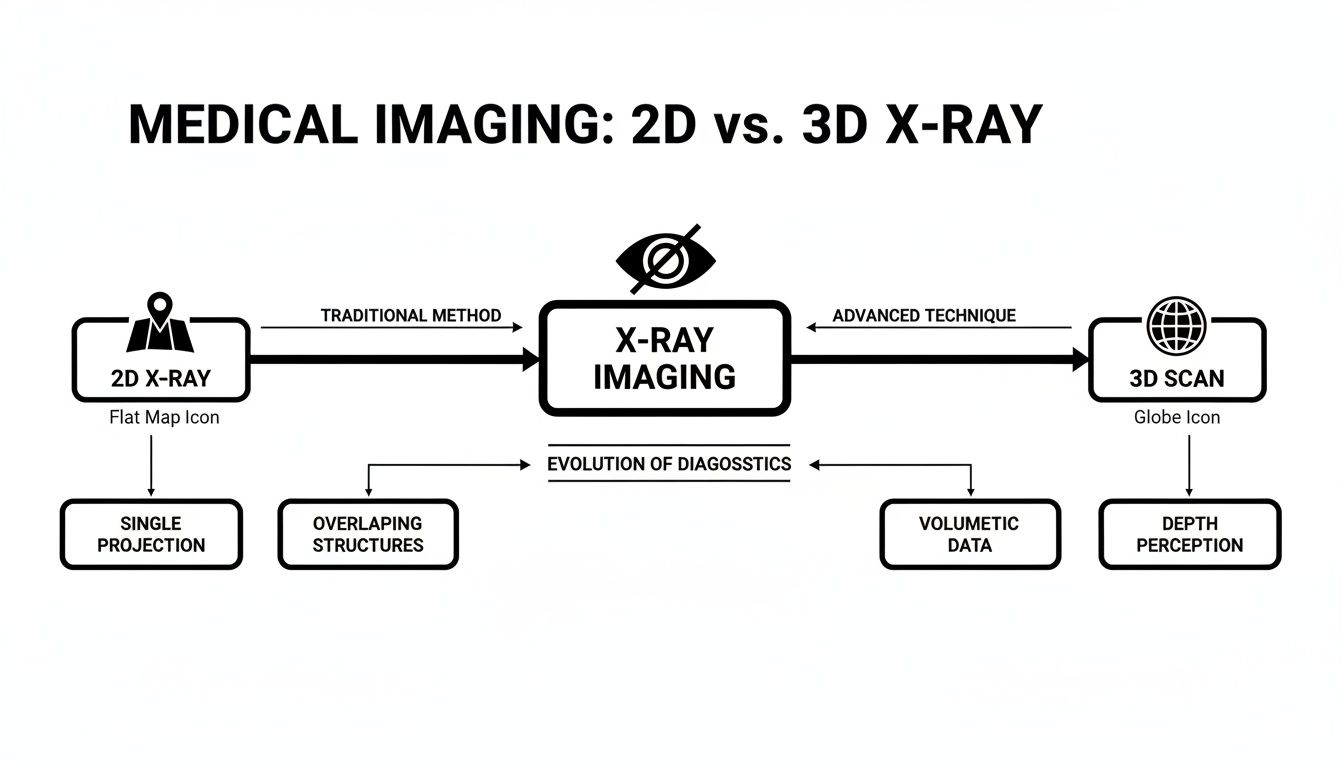
You can see how the 3D scan captures depth and the true relationship between different structures, whereas the 2D X-ray squashes everything together onto one flat plane.
From Better Diagnosis to Safer Treatment
This incredible clarity isn't just for show—it directly leads to more accurate diagnoses and much safer treatment plans. When we can see every last detail with precision, we can plan your procedure with a much higher level of confidence.
For example, when planning orthodontics, a 3D scan can show us the exact position of an impacted canine tooth that needs to be guided into place. It’s one of the many reasons our Invisalign treatment at Oasis Smiles Dental is so effective. Seeing the full picture helps us create a plan that not only works well but also minimises any potential risks along the way.
To really understand the difference, a side-by-side comparison makes it crystal clear.
2D X-Ray vs 3D Dental Scan at a Glance
This table breaks down the key differences between the two imaging technologies we use.
| Feature | Traditional 2D X-Ray | Modern 3D Dental Scan (CBCT) | | :--- | :--- | :--- | | Image View | A single, flat image where structures overlap. | A complete 3D model showing all angles without overlap. | | Level of Detail | Limited detail; can miss fine fractures or hidden canals. | Extremely high detail, revealing tiny structures with precision. | | Diagnostic Power | Good for detecting surface cavities and general bone levels. | Excellent for complex diagnostics like impacted teeth, nerve mapping, and jaw pathology. | | Treatment Planning | Provides a basic guide, often requiring some estimation. | Allows for precise, digital planning and surgical simulation. | | Patient Safety | Lower radiation dose for routine check-ups. | Low, focused dose that enables safer planning for complex procedures. |
Ultimately, our goal in using 3D dental radiography is to give you a higher standard of care. By having a complete and accurate understanding of your unique anatomy, we can prevent surprises during treatment, reduce procedure times, and ensure the final result is exactly what we planned for. This technology is a cornerstone of the modern, patient-first care we provide right here in Tamworth.
What to Expect During Your 3D Dental Scan
It's completely normal to feel a little curious about a new dental procedure. We want to walk you through exactly what happens during a 3D dental radiography scan, so you know just how quick, easy, and comfortable it is. Our team at Oasis Smiles Dental will be with you the entire time, making sure you feel right at home.
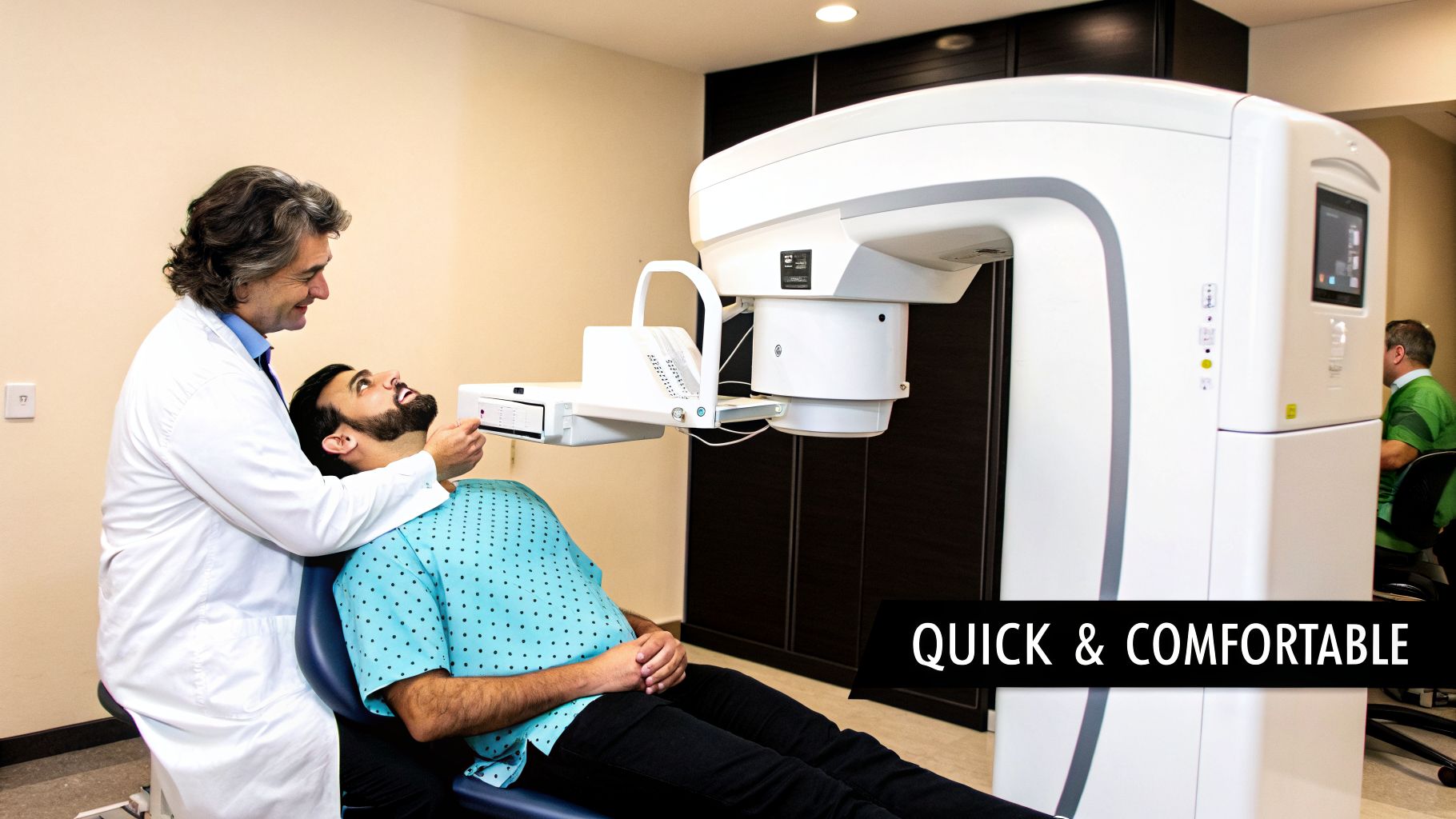
First things first, this isn't like a hospital CT scanner where you lie down in a tight tunnel. Our Cone Beam CT (CBCT) machine is open and modern, so you won't feel enclosed at all. The whole experience is designed to be over in just a few moments.
Preparing for Your Scan
Getting ready for your 3D scan couldn't be simpler. To make sure we get the clearest picture possible, we'll just ask you to do a couple of things right before we start.
Here’s all you need to do: * Remove any metal: We'll ask you to take off glasses, earrings, necklaces, hair clips, or any facial piercings. Metal objects can get in the way of the X-ray and create distortions in the final image. * Take out removable dental work: If you have dentures, a partial plate, or another removable appliance, you'll need to pop it out for the scan.
And that's it! No special diets or fasting required. If you'd like more general info about visiting our practice, feel free to check out our patient information guide.
The Scanning Process Step-by-Step
Once you’re ready, the scan itself is incredibly quick. A member of our team will guide you into the right spot, which usually just means sitting or standing comfortably for a few seconds.
- Getting into position: We'll help you get settled in the centre of the unit, often with a small chin rest to help you stay perfectly still.
- The scan begins: An arm on the machine will make one smooth, quiet rotation around your head. As it moves, it’s capturing hundreds of individual images from every possible angle.
- All done! The entire scan takes only 15 to 30 seconds. All you have to do is hold still for that short time.
> The experience is totally non-invasive and painless. You won’t feel a thing while the scanner is moving. Honestly, it’s over before you even know it, and you can get right back to your day.
As soon as the scan is finished, our software gets to work, stitching those hundreds of pictures together into a precise 3D model of your mouth. This is the detailed view that lets us see your teeth, bone structure, and nerves with amazing clarity, giving us everything we need to plan your treatment perfectly.
How 3D Imaging Transforms Dental Treatments
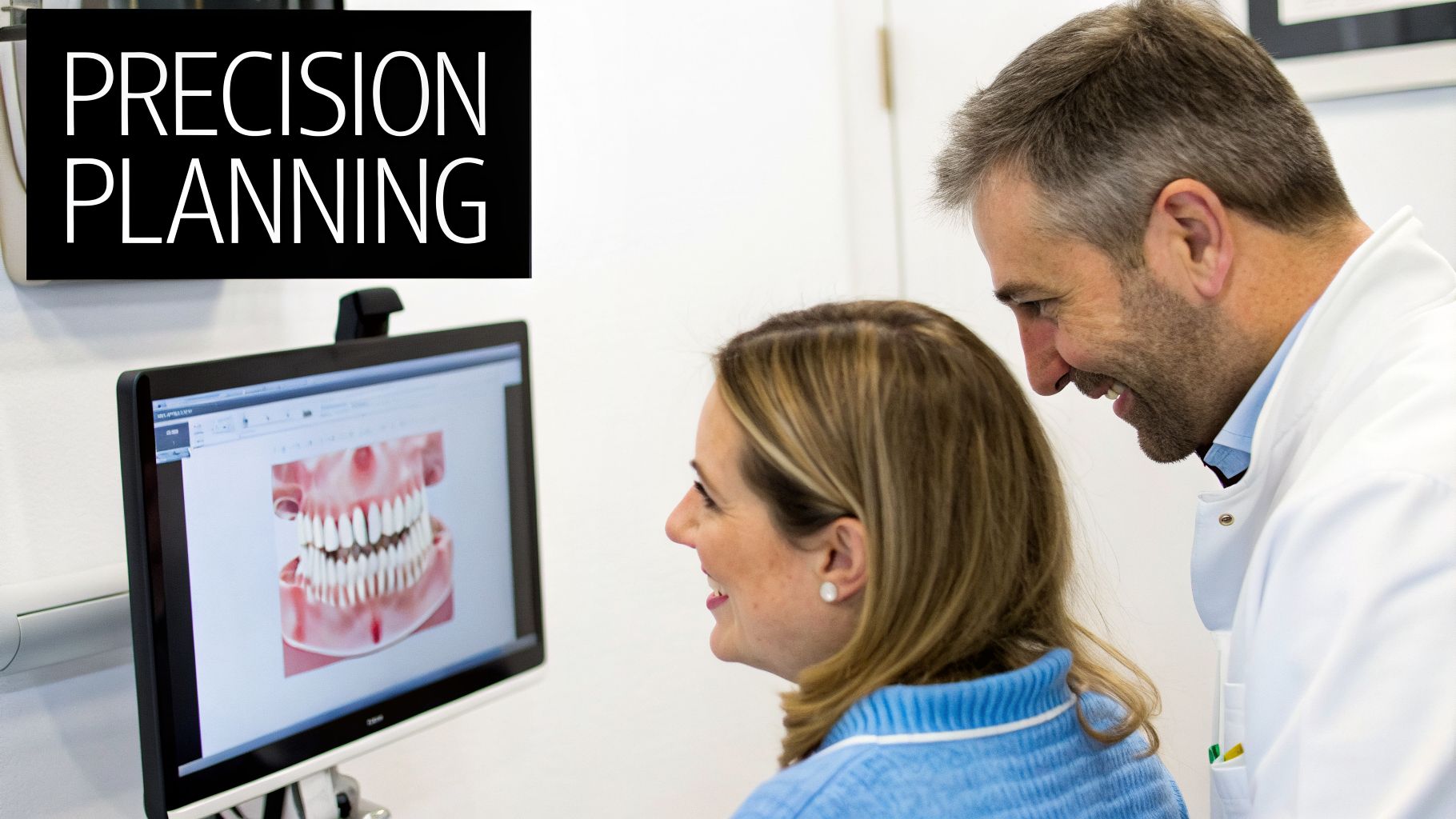
A 3D dental scan is so much more than just a detailed picture. It’s a tool that completely changes how we plan and carry out your dental care, making it safer, more precise, and far more predictable. It bridges the gap between diagnosing a problem and confidently treating it.
Think of it this way: a traditional 2D X-ray is like a flat road map, whereas a 3D scan is like having a fully interactive GPS model of the entire landscape. We can see everything from every angle before we even begin.
For our patients here at Oasis Smiles Dental, this means treatment plans built on certainty, not guesswork. It means better outcomes, more comfort, and the peace of mind that comes from knowing we have the most accurate information possible. Let’s look at how 3D dental radiography makes a real difference in some of our most common treatments.
Precision Planning for Dental Implants
Dental implants are a brilliant, long-lasting solution for missing teeth, but their success depends entirely on proper planning. An implant has to be placed in just the right spot, with enough healthy jawbone to support it, all while steering clear of important structures like nerves and sinuses.
A flat, 2D X-ray can give us a rough idea of bone height, but it can’t tell us how thick the bone is or show the exact 3D path of the nerve running through your lower jaw. This is where a 3D scan becomes absolutely vital.
With a 3D dental radiography scan, we can: * Measure Bone Density and Volume: We can see and digitally measure the exact height, width, and quality of your jawbone, ensuring it's robust enough to hold an implant for the long haul. * Map Vital Structures: The scan gives us a crystal-clear map of where your nerves and sinus cavities are. This allows us to plan the implant placement to avoid them completely, which is critical for safety. * Virtually Place the Implant: Long before your actual procedure, we use the 3D model of your jaw to digitally place the implant. We can test different sizes and angles on the screen to find the absolute perfect position for success and stability.
> Using 3D scans for implant planning isn't just an add-on; it's our standard of care. It takes all the guesswork out of the procedure, ensuring we have a predictable and safe surgical plan before you even sit in the chair.
This incredible level of detail is what leads to a smooth procedure and a result that lasts a lifetime. To find out more about our approach, you can learn more about our dental implant services here.
Navigating Complex Root Canal Therapy
The goal of root canal therapy is to save a tooth by cleaning out an infection from its inner canals. Success is all about finding, cleaning, and sealing *every single canal* within the tooth's root system. The catch is that every tooth is different, and root anatomy can be surprisingly complex.
A standard X-ray might show the main, obvious canals, but it can easily miss tiny extra canals or unusual curves hidden behind the main root. If a canal is missed, the infection can linger, leading to pain and potential failure down the road.
A 3D scan provides a complete, 360-degree view of the entire root structure. It lets us see things we simply couldn't before: * The exact number of root canals, including rare or hidden ones. * Any sharp curves, splits, or complex branching patterns. * The precise size and location of an infection at the root tip.
Having this information is like giving a cave explorer a detailed 3D map of every tunnel and chamber before they step inside. It helps us ensure a more thorough and successful treatment from the very first visit.
A Clearer Path for Orthodontics
Modern orthodontics, from traditional braces to clear aligners, is all about moving teeth safely into their correct positions. A 3D scan gives us a perfect understanding of the foundation—the jawbone, the full length of the tooth roots, and the position of any teeth that haven't come through yet.
This is especially crucial when dealing with impacted teeth, like canines that get stuck in the jaw. A 3D scan shows us the exact 3D position of the impacted tooth, how close it is to the roots of its neighbours, and the clearest, safest path to guide it into place. It turns what could be a very complex challenge into a predictable procedure.
Safer Wisdom Teeth Removal
Wisdom tooth removal is one of the most common dental surgeries, but it carries a risk of injuring the large nerve that gives feeling to your lower lip and chin. This nerve often lies very close to the roots of the lower wisdom teeth.
A 2D X-ray can show that the nerve is nearby, but it can’t tell us if it’s sitting on the cheek side, the tongue side, or even wrapped around the roots. A 3D scan eliminates this uncertainty. It shows us the exact relationship between the tooth and the nerve, allowing us to plan the safest extraction method and significantly reduce the risk of complications. The industry has recognised this benefit, and the Australian dental X-ray market, driven by 3D systems, was valued at USD 42.35 million in 2024 and is expected to grow. You can find out more about the booming 3D dental imaging market in Australia.
Let's Talk About Safety and Radiation
Hearing the word "radiation" can understandably raise some questions. We get it. At Oasis Smiles Dental, your health and peace of mind come first, so let's tackle this topic head-on. We only ever recommend a 3d dental radiography scan with great care and when it's absolutely essential for your treatment.
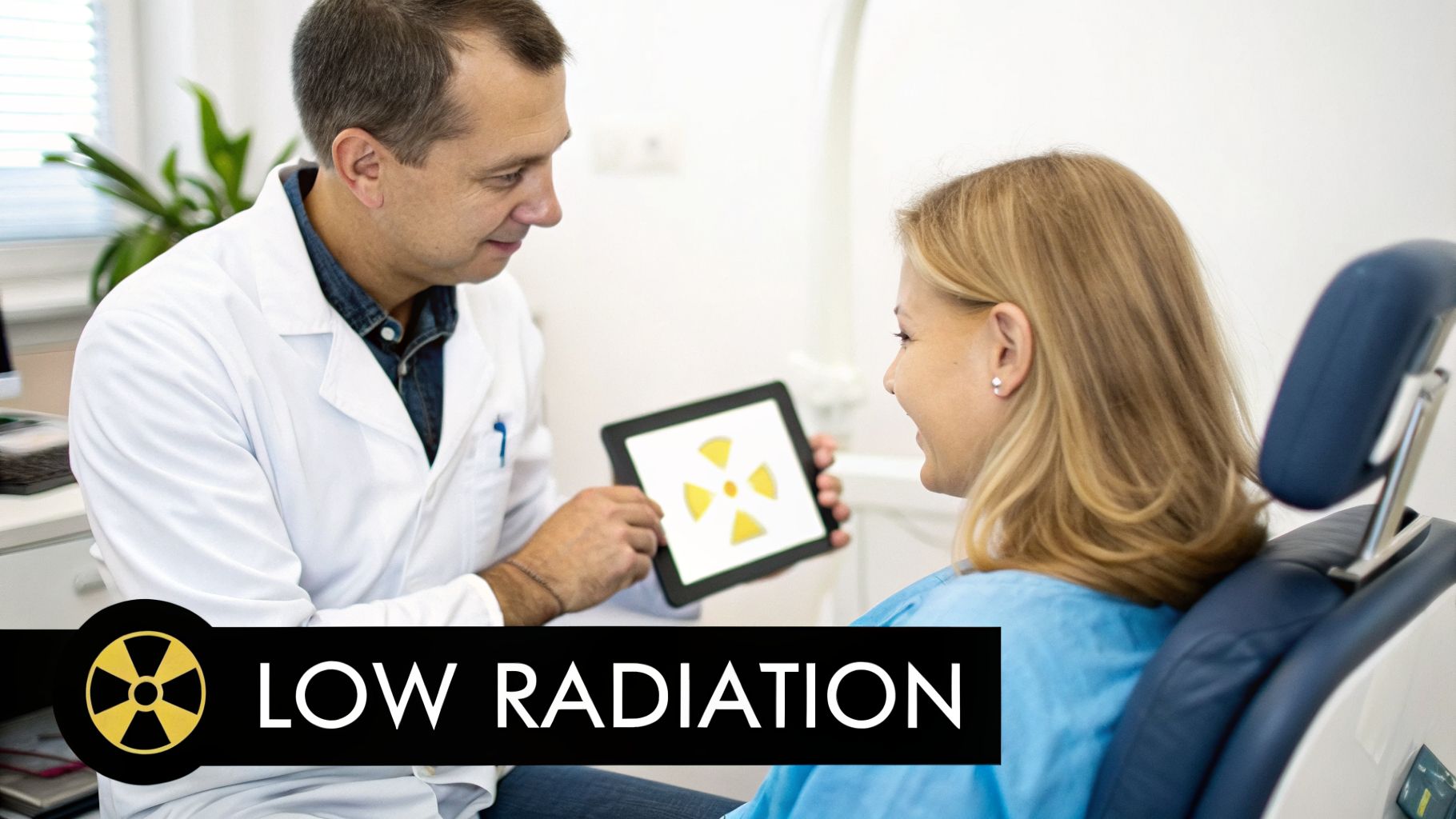
Our entire approach is built around a simple but powerful safety principle: ALARA, which stands for "As Low As Reasonably Achievable." This isn't just a guideline; it's our commitment to using the absolute minimum dose needed to get the crystal-clear images required for your care. A 3D scan is never a routine, check-the-box procedure. It’s a specialised tool we use only when that extra detail is critical for your safety and a successful outcome.
Putting Radiation into Perspective
The word "radiation" might sound a bit scary, but it's helpful to know we're all exposed to a small amount of natural background radiation every day. The dose from a modern dental CBCT scan is incredibly low and focused precisely where we need it.
Just to give you an idea of how low it is, a single dental 3D scan has a radiation dose:
- That is significantly lower than a medical CT scan you'd get at a hospital—often by as much as 95%.
- Roughly equivalent to the background radiation you'd absorb on a long-haul flight from Sydney to London.
- Similar to the amount of natural radiation you're exposed to over just a few days of living your normal life.
This really helps put things in perspective. The technology is designed to give us the maximum amount of diagnostic information for a very small, targeted dose.
> Your safety is our benchmark for care. We only recommend a 3D dental scan when the clear and detailed information it provides outweighs the very minimal risk, ensuring we can plan and perform your treatment with the highest degree of precision and safety.
The Benefit Always Comes First
Ultimately, the decision to use 3d dental radiography always comes down to a simple question: does the benefit outweigh the risk? For complex procedures like dental implant placement, navigating a tricky root canal, or planning the safe removal of a wisdom tooth near a major nerve, the answer is a clear yes.
That detailed 3D view allows us to see your unique anatomy, map out any potential hazards, and create a surgical plan that is incredibly precise. This level of planning dramatically reduces the risk of complications during your treatment, making the entire procedure much, much safer.
We promise to always be transparent with you. If we recommend a 3D scan, we will explain exactly why and how it will contribute to a better, safer result for you. Your trust is the foundation of our practice, and that begins with responsible and thoughtful care.
***
How We Use Technology for Better, Faster Dental Care
At Oasis Smiles Dental, our 3D dental radiography isn't just another piece of equipment. It's the starting block for a fully connected, digital approach to your care. We haven't just bought fancy tools; we’ve invested in a system where every piece of technology talks to the others. The real magic is in how it all works together to make your treatment quicker, more comfortable, and unbelievably accurate.
Because everything is connected, the detailed 3D scan we take of your teeth and jaw feeds directly into our other digital systems. This creates a smooth path from your very first appointment to your final result, which often means fewer visits for you.
From a 3D Scan to a Perfect Crown
Let’s say you need a new crown. The old way involved multiple appointments: one for those messy, gooey impressions, another to fit a temporary crown, and then a final visit once the permanent one came back from an external lab. Our digital process changes all that.
Here’s a look at how we do it right here in our Tamworth practice:
- The 3D Scan: We begin with a CBCT scan. This gives us a complete picture of your tooth, its roots, and the surrounding bone, just to make sure everything is healthy before we start.
- Digital Impressions: Forget the goop. We use our TRIOS digital scanner to take a fast, comfortable 3D scan of your teeth. It’s all done in minutes.
- Computer-Aided Design: We merge the CBCT data with the digital impression. Your new crown is then meticulously designed on a computer, allowing us to get the shape and fit just right, down to the micron.
- Same-Day Creation: That design is sent straight to our in-house CEREC milling machine. It then carves your permanent, high-quality ceramic crown right here in our clinic, often while you wait.
This combination of tools allows us to achieve outstanding results for everything from a single tooth to a complex full-mouth restoration, all without you having to go anywhere else.
The Oasis Smiles Digital Advantage
Having this complete digital setup in our practice offers huge benefits for our patients across Tamworth and the New England region. It simply means less time sitting in the dental chair, fewer trips back and forth, and a final result that’s been carefully planned and precisely made.
> By connecting all our digital tools, we can turn what used to be a series of separate appointments into one straightforward, efficient experience. Your 3D scan becomes the blueprint for a treatment plan that we don’t just see on a screen—we bring it to life with digital accuracy, right here.
This shift to a fully digital practice is becoming more common. A recent survey of Australian dental practices revealed that 86% are now using some form of 3D dental imaging. It shows how clinics like ours are bringing top-tier care to regional areas, so you don't have to travel to a major city.
Ultimately, our investment in technology is an investment in your health and your time. It helps us provide reliable, high-quality dentistry that’s convenient for you. When you visit us, you can feel confident knowing your care will be seamless from start to finish, all in one familiar, comfortable place. To explore the advanced technology at Oasis Smiles Dental, you can see all the tools we use to make your experience better.
Your Questions About 3D Dental Scans Answered
It's completely normal to have questions when you hear about new technology like 3D dental radiography. We get it. To help clear things up, here are some straightforward answers to the questions we hear most often from our patients here in Tamworth.
How Much Does a 3D Dental Scan Cost in Australia?
This is usually one of the first things people ask. In Australia, the cost for a private 3D dental radiography scan (or CBCT scan) generally falls between $150 and $350. The final price really just depends on what we need to look at—a single tooth, one jaw, or both jaws.
Medicare doesn't cover dental CBCT scans, but the good news is that many private health funds do. If your policy includes extras cover, you could be eligible for a rebate, which helps make this incredible diagnostic tool much more affordable. At Oasis Smiles Dental, we work with all major health funds and can give you an on-the-spot quote with your card. We also have flexible payment options available because we believe in total transparency. You’ll always get a clear cost breakdown before we move forward with anything.
Is a 3D Scan Necessary for Everyone?
Absolutely not. We're very selective about when we use this technology. For your regular check-ups and finding standard cavities, traditional 2D X-rays are still the gold standard. They do a fantastic job and keep radiation exposure to a minimum.
> Think of a CBCT scan as a specialist tool we bring out for the tricky jobs. It’s reserved for complex cases where a flat, two-dimensional picture just won’t give us the full story we need to plan your treatment safely and effectively.
We typically recommend a 3D scan only in specific situations, such as:
- Planning Dental Implants: To measure your bone in three dimensions and map out exactly where the nerves are.
- Complex Root Canals: To find tiny, hidden canals or see unusual root shapes that 2D X-rays might miss.
- Wisdom Tooth Removal: Especially when a tooth is sitting dangerously close to a major nerve.
- Orthodontic Planning: To pinpoint the exact location of impacted teeth and get a clear view of the entire jaw structure.
Can My Child Have a 3D Dental Scan?
Yes, and in some cases, it's incredibly useful. For children and teenagers needing orthodontic work, a CBCT scan gives us a precise road map of their developing mouth. We can see the adult teeth waiting to come through, check the exact position of impacted teeth, and analyse their jaw growth.
This level of detail is a game-changer for planning treatments like braces or Invisalign with pinpoint accuracy. Of course, when we recommend a scan for a younger patient, we are extremely careful. We always follow the ALARA (As Low As Reasonably Achievable) principle, which means using the lowest radiation setting possible to get the vital images we need. It's how we ensure the scan is both powerful and perfectly safe for your child.
--- Here at Oasis Smiles Dental, our whole approach is about using the right technology to make your dental care safer, more predictable, and more comfortable. If you have any other questions or are curious if a 3D scan could help you, we’d love to chat.