

Cone Beam CT Scan Cost: 2026 Guide to Australian Prices
In Australia, a dental CBCT scan typically costs $150 to $500 out of pocket, depending on the size of the scan and why it's being taken. If your dentist has just recommended one, that price range is the short answer, and the more useful answer is understanding what pushes your quote toward the lower or higher end.
For many people, this comes up at an awkward moment. You might be planning an implant, dealing with a painful wisdom tooth, or trying to get to the bottom of a root canal problem, and then you hear a new term plus a new fee. It's normal to wonder whether the scan is really necessary, whether private health will help, and whether there's a cheaper way to do it without missing something important.
A CBCT scan isn't ordered for every dental visit. It's usually recommended when your dentist needs a far more detailed view than a standard x-ray can provide. That extra detail can make treatment safer and more predictable, but it also affects cost.
Your Dentist Mentioned a CBCT Scan Now What
You're sitting in the chair, expecting to hear about a filling, a wisdom tooth, or the next step for an implant. Then your dentist says, “I'd like a CBCT scan first.” For many patients around Tamworth and the New England region, the first reaction is concern. Is something seriously wrong? Is this really needed? Will I have to travel, and who pays for it?
Those questions are reasonable.
A CBCT is usually recommended because your dentist wants a clearer view before doing something precise. In plain terms, a standard x-ray can show the general area, but it can leave overlap and blind spots. A CBCT gives a more detailed map of what is happening under the surface, so treatment can be planned with fewer surprises.
That matters most when the decision is close to an important structure such as a nerve, a sinus, a root, or a thin section of bone. It is a bit like checking the depth and shape of the ground before putting in fence posts. From the top, the spot may look fine. Underneath, the conditions can be very different.
Why your dentist may have suggested it
Common reasons include:
- Dental implants: your dentist may need to check the exact shape and amount of bone, not just whether bone is present.
- Wisdom teeth: the scan can show how close the tooth sits to nearby nerves or the roots of other teeth.
- Root canal concerns: some cracks, missed canals, or areas of infection are harder to judge on a flat image.
- Jaw joint, sinus, or airway questions: a wider scan may be requested when the problem is not limited to a single tooth.
The key point is clinical necessity. A CBCT is not usually suggested as an add-on for curiosity. It is used when the extra detail could change the treatment plan, reduce risk, or help avoid a problem that a 2D image might miss.
Regional patients often have a few extra practical concerns as well. Will the scan be done at the dental clinic or at an imaging centre? Does the fee include the dentist's review, or just the image itself? If you are comparing quotes in Tamworth or nearby towns, those details matter just as much as the headline price. Our patient information for appointments, fees, and treatment planning can help you know what to ask before you book.
Another common worry is whether the scan means treatment has suddenly become more serious. Usually, it means the opposite. Your dentist is trying to be more careful before proceeding. That is especially relevant for patients sorting through Medicare limits, DVA arrangements, or private health fund questions, where the rules can feel far less clear than they should be.
What Is a Cone Beam CT Scan Anyway
A cone beam CT scan is a dental 3D scan. The easiest way to think of it is this: a normal dental x-ray is like looking at a paper map, while a CBCT is more like seeing the terrain in 3D.
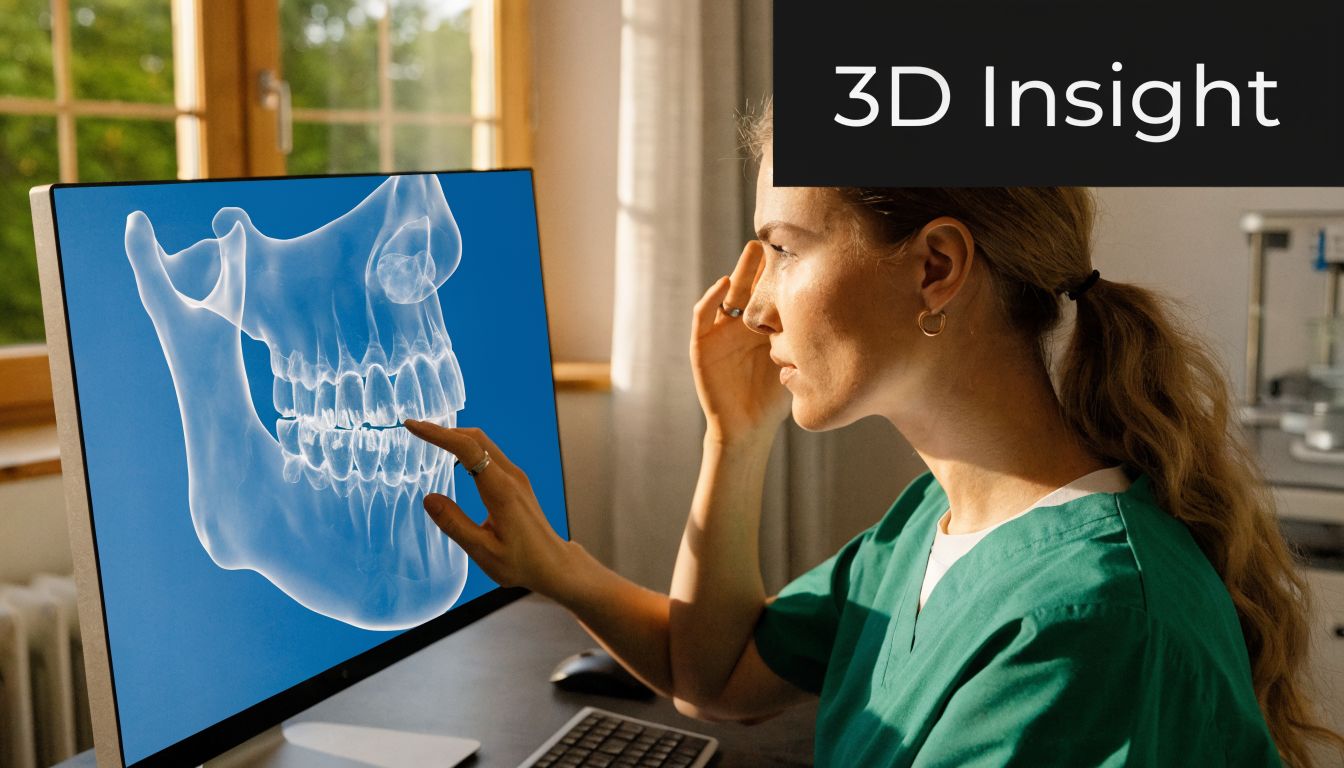
A standard x-ray is still very useful. Dentists use it every day. But sometimes a flat image overlaps structures and hides important detail. A CBCT scan gives slices and 3D views of the teeth, bone, roots, jaw joints, sinus areas, and other anatomy that can be hard to judge accurately on 2D images alone.
Why 3D matters in real treatment
The value of the scan isn't the technology by itself. It's what the technology helps your dentist avoid missing.
For example, with dental implants, a dentist needs to know not just that bone is present, but how much bone there is in the exact direction where the implant will sit. Width, height, angle, and the position of nearby anatomical structures all matter.
With wisdom teeth, the issue is often location. An impacted tooth can sit at an awkward angle or close to important structures. A 3D image can show that relationship more clearly than a panoramic x-ray.
With root canal problems, symptoms don't always match what shows on a flat film. A CBCT can help reveal hidden canals, unusual root shape, or areas of concern around the tooth.
Common reasons a dentist orders one
- Implant planning: To map bone and placement with more confidence.
- Impacted teeth: To understand position before removal or monitoring.
- Complex restorative work: To support detailed planning where precision matters.
- TMJ, sinus, or airway review: When the treatment question is larger than a single tooth.
> A CBCT scan is usually about clarity, not convenience. When treatment decisions depend on exact anatomy, a better image often leads to a better plan.
If you're curious about the equipment side of this, the dental technology overview shows the kind of digital systems modern practices use to improve diagnosis and planning.
The Typical Cost of a Cone Beam CT Scan in Australia
A common situation goes like this. You have been told you need a CBCT scan, then you start searching online and find prices that seem all over the place. For Australian patients, a realistic general range is often about A$150 to A$500, but that broad range only makes sense once you know what is being scanned.
The biggest price difference usually comes down to the field of view. That means how much anatomy is included in the image. A scan of one small area is like ordering a close-up photo. A scan of both jaws, the sinuses, or the airway is more like ordering a wide aerial map. More area usually means a higher fee because there is more image data to capture and more for the clinician to review.
In regional areas such as Tamworth and the wider New England region, quotes can also vary depending on whether the scan is done in your dental practice or through an outside imaging provider. That is one reason online price comparisons can feel confusing.
Estimated CBCT Scan Costs by Type
| Scan Type | Typical Price Guide (AUD) | Where It Usually Sits in the Range | |---|---:|---| | Small, targeted scan for one tooth or one local area | A$150 to A$250 | Lower end | | Larger jaw scan or full-arch planning scan | A$250 to A$400 | Middle to upper range | | TMJ, sinus, or airway scan with a larger field of view | A$300 to A$500 | Higher end |
These are guide prices, not fixed fees. The same scan label can still vary between clinics because one provider may include only the image capture, while another includes treatment planning, software review, or a formal report.
That matters a lot if the scan is being used for something precise, such as dental implant planning and placement. In that setting, the question is not only “How much is the scan?” but also “What information does my dentist need from it?”
Why one clinic quote may differ from another
Two clinics can quote different fees for reasons that are completely reasonable. A lower fee is not always better value, and a higher fee is not always overcharging.
A quote may differ because of:
- Scan size: A single-site scan is usually simpler than a full-jaw or airway scan.
- Clinical purpose: A scan for implant planning may be set up differently from one for wisdom teeth, TMJ, or sinus assessment.
- What is included: Some fees cover the scan only. Others include the dentist's review, planning, or transfer of files.
- Location and equipment setup: Metropolitan imaging centres, local dental clinics, and regional providers do not all structure their fees the same way.
A useful comparison comes from outside dentistry. In web services, two businesses may both say they build a website, but the price changes depending on scope, tools, and expertise. The same idea appears in these Australian ecommerce site development rates. A CBCT fee works in a similar way. The number by itself does not tell you exactly what is included.
A better question to ask
If you want a clearer answer than a broad online price range, ask your clinic three simple questions:
- What area is being scanned?
- What is the scan needed for?
- Does the fee include image review or treatment planning?
That short conversation usually gives patients a much more useful answer than a generic national estimate, especially when you are comparing quotes in regional Australia.
Key Factors That Influence the Final Scan Price
The fee for a CBCT scan can look puzzling until you break it into the parts that drive it. The biggest cost factor for the clinic is the technology itself. A 2020 Australian Dental Association purchasing guide notes that a small-to-midsize CBCT machine commonly costs about AUD 50,000 to 100,000, making it a major capital investment rather than a minor add-on, as outlined in this CBCT purchasing guide.
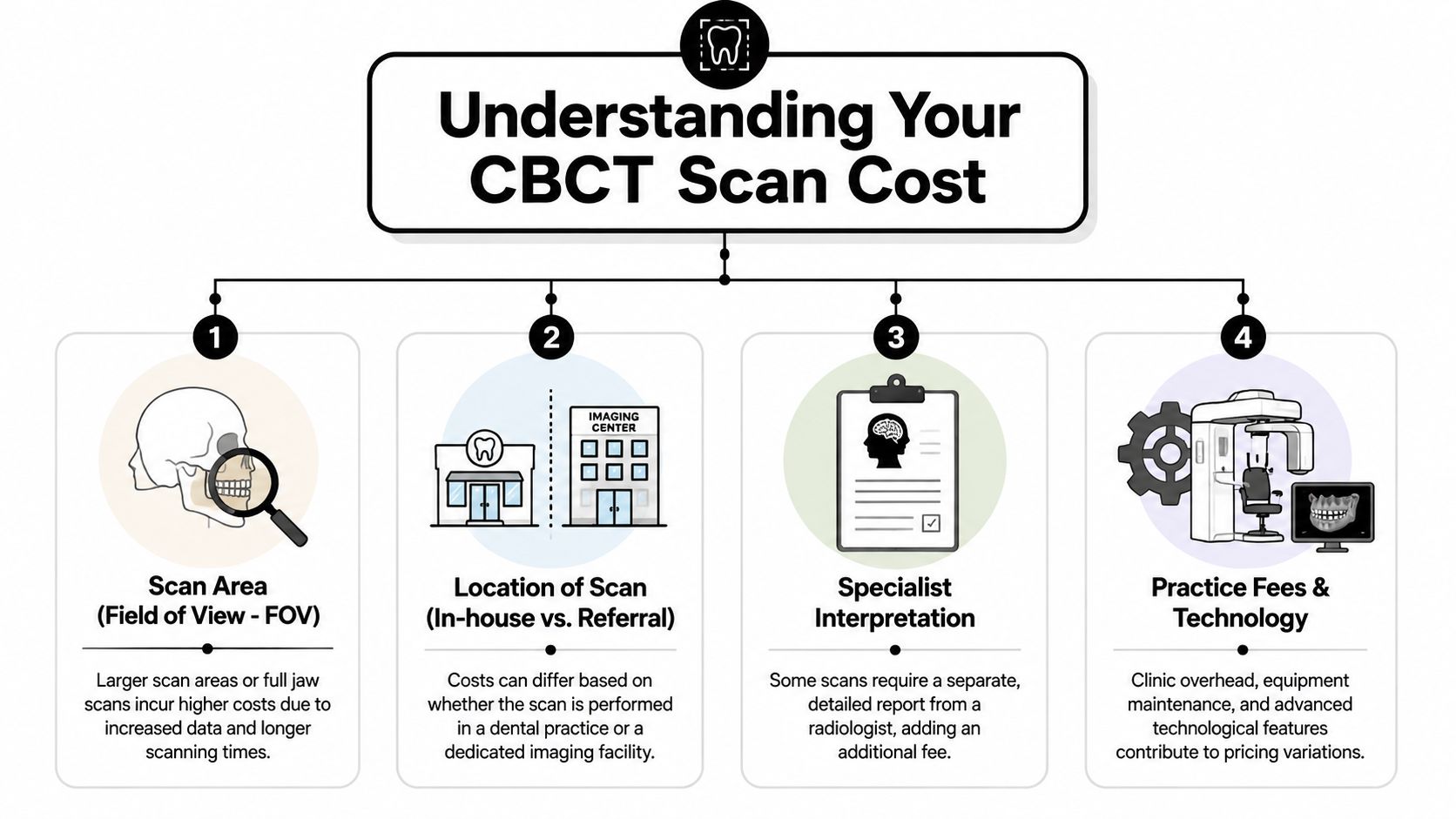
That upfront investment helps explain why the fee isn't based only on the few minutes it takes to capture the image. The practice also carries software, maintenance, training, and clinical interpretation costs.
Scan area matters most
The field of view is often the first thing that affects price. A scan of one small region creates less image data than a larger scan of the jaws or airway.
In simple terms, more anatomy means more to capture and more to review. That's why a targeted endodontic or single-site implant scan may be priced differently from a full-jaw planning scan.
Where the scan is done
Some patients have the scan taken in their dental clinic. Others are referred to a separate imaging centre.
That difference can affect:
- Convenience: In-house imaging may reduce extra appointments.
- Travel time: Referral imaging may mean another trip.
- Administrative steps: Separate providers can mean separate booking and payment processes.
For implant-related planning, many patients prefer fewer moving parts. If you're looking at implant treatment specifically, the dental implant information page shows why detailed imaging is often part of careful planning.
Interpretation and reporting
Not every CBCT scan is used in the same way. Some are reviewed directly by the treating dentist as part of a focused treatment question. Others may require a more formal report, especially when the scan covers a broader area or the clinical issue is more complex.
> The useful question isn't just “How much is the scan?” It's “Who is interpreting it, and is that included?”
Whether it stands alone or sits inside a treatment plan
Sometimes the scan is billed as a separate item. In other cases, it may sit within a larger course of treatment planning.
That can change how patients experience the fee. A standalone scan feels like a separate expense. Inside a broader treatment plan, it's easier to see it as part of the decision-making process that supports the final treatment.
Navigating Payments Health Funds and Rebates
Many Australians struggle with determining the final cost. They don't just want to know the listed price. They want to know what they'll personally have to pay after rebates, cover limits, and clinic policies are taken into account.
The general position is that Medicare generally does not cover routine dental imaging, so many patients face the private fee unless the scan is bundled into treatment or partly covered through extras cover, as explained in this Australian overview of CBCT out-of-pocket costs.

That doesn't mean there's never any assistance. It means you shouldn't assume there is.
Medicare, private health, and DVA
The most straightforward way to view this is:
- Medicare: Routine dental CBCT imaging is generally not covered.
- Private health extras: Some patients may receive partial cover, depending on their policy and annual limits.
- DVA: Eligibility and claim pathways can depend on your individual entitlement and treatment arrangement.
Private health is where most confusion sits. Two people can have cover with the same insurer and still receive different benefits because their extras level, annual limits, and item eligibility differ. That's why reception staff often encourage patients to check with their fund directly before the appointment.
Questions worth asking before you book
If you want to avoid surprises, ask these questions:
- Is the scan a separate fee or part of my treatment plan?
- What item number should I give my health fund?
- Is a specialist report included in the fee?
- Will I pay on the day, and can I claim on the spot?
> Helpful advice: Ask for the item number before you call your fund. Without it, you may get only a vague answer.
Payment options can make the fee easier to manage
Even when a rebate is limited or unavailable, a scan may still be the right clinical step. In those cases, practical payment options matter.
Many clinics offer ways to spread treatment costs or explain what can be staged first. If you want to see the kinds of arrangements patients often look for, the payment options page is a useful reference point.
The main thing is clarity. A good quote should tell you whether the scan is separate, included, partially claimable, or likely to be fully out of pocket.
Get a Clear and Accurate Quote at Oasis Smiles Dental
For patients in Tamworth and the New England region, the smartest approach isn't chasing the lowest advertised number. It's getting a quote that matches the exact scan you need.
That matters because CBCT pricing has always been tied to higher equipment and examination costs than standard 2D imaging. In peer-reviewed research, CBCT for third molar planning was reported at about €184.44 compared with €49.29 for panoramic imaging, and CBCT examinations were roughly 3 to 4 times more expensive in that context, with equipment purchase prices ranging from €148,000 to €227,000 in another multicentre study, as described in this peer-reviewed CBCT cost analysis.
For regional patients, there's another layer to value. When a clinic has in-house CBCT capability, you may avoid a separate trip to a metropolitan imaging centre and get diagnosis and planning done sooner. That doesn't automatically make every scan cheaper, but it can reduce the indirect burden of extra travel, more bookings, and treatment delays.
What a good quote should tell you
A useful quote should make these points clear:
- Why the scan is needed: Not just the name of the scan, but the treatment reason.
- What area is being scanned: Small focused scan or larger field of view.
- Whether reporting is included: This is one of the common areas of confusion.
- How it fits into treatment: Separate fee, or part of a larger treatment plan.
Why local transparency matters
When patients compare providers, they often rely heavily on online reviews and general reputation. That's sensible, as long as you also look for clear communication around costs and treatment planning. If you're interested in how clinics build trust online, this guide to optimizing dental practice reviews offers a useful outside perspective on what patients tend to value.
A clear quote won't just list a number. It should help you understand whether the scan is clinically necessary, what it includes, and what your likely out-of-pocket cost will be before treatment starts.
---
If you'd like a clear, local answer rather than a generic online estimate, Oasis Smiles Dental can assess your treatment needs and provide an itemised quote for CBCT imaging and any related care. For patients in Tamworth and the New England region, that means practical advice, modern in-house technology, and upfront information about fees before you commit.