

Full Mouth Rehabilitation: A Complete Patient Guide
Some people reading this are already tired.
Tired of chewing on one side. Tired of worrying that a tooth might crack at dinner. Tired of smiling with lips closed in family photos, or putting off treatment because the whole thing feels too big, too expensive, or too overwhelming to even ask about.
If that sounds familiar, you're not being vain, and you're not overreacting. When several teeth are worn, broken, missing, or uncomfortable, it affects far more than appearance. It changes how you eat, how you speak, how your jaw feels by day's end, and often how confident you feel when you meet people.
Many patients don't come in saying, “I need full mouth rehabilitation.” They say, “I can't chew properly anymore.” Or, “My teeth keep breaking.” Or, “I've been patching things up for years and I think I need a proper plan.”
That's exactly where this guide begins.
Your Journey to a Confident Smile Starts Here
A common story goes like this. Someone has one broken tooth repaired, then another starts hurting. A few older fillings fail. Grinding has worn the front teeth shorter. There may be a bridge that no longer feels right, or gaps that make eating awkward. Over time, the mouth starts to feel less like a healthy system and more like a collection of separate problems.
That's when frustration sets in.
You might avoid crunchy foods. You may hold your hand near your mouth when you laugh. You may feel embarrassed that you “left things too long”, even though life, family, work, distance, and cost all play a part. In regional communities, people often put everyone else first and keep going until discomfort becomes impossible to ignore.
Full mouth rehabilitation is for situations like these. It isn't one single treatment. It's a carefully organised plan to rebuild comfort, function, and appearance in a way that makes sense for your whole mouth, not just the next sore tooth.
> Full mouth rehabilitation isn't about creating a perfect smile for a brochure. It's about helping you eat, speak, smile, and live without constantly thinking about your teeth.
If you're nervous, that's normal. If you're hopeful, that's good too. Both feelings can exist at the same time.
What Is Full Mouth Rehabilitation and Is It Right for You
Think of full mouth rehabilitation like renovating a home with deep structural issues. If one window is cracked, you replace the window. But if the roof leaks, the floors have shifted, and the wiring is unreliable, you need a full plan. The same applies to your mouth.
When a dentist recommends full mouth rehabilitation, they're not saying every tooth must be replaced. They're saying your mouth needs a coordinated approach. The aim is to restore how the teeth, gums, jaw joints, and bite work together.
More than a single procedure
A single crown fixes one damaged tooth. A filling repairs a cavity. An implant replaces one missing tooth. Full mouth rehabilitation brings these kinds of treatments together under one plan so the final result feels balanced.
That matters because the mouth works as a system. If one area has collapsed from wear or missing teeth, other teeth often carry too much force. Jaw muscles compensate. Chewing becomes uneven. Small problems can stack up.
The need for this kind of extensive care is significant. In the United States, an estimated 178 million adults are missing at least one tooth, and around 40 million are completely edentulous, according to full mouth restoration statistics. Those numbers reflect broad oral health needs that are also familiar in regional communities, where people often present after years of gradual wear and repeated repairs.
For patients trying to make sense of complex treatment plans, even tools outside the clinic can help. Systems such as intelligent dental documentation search show how much modern dentistry now relies on clear records, organised planning, and careful communication rather than guesswork.
Signs you may be a candidate
You might be suited to full mouth rehabilitation if several of these sound familiar:
- Multiple missing teeth: Gaps affect chewing, speech, and how the bite distributes pressure.
- Teeth that are worn flat or shorter than they used to be: This often happens with grinding or long-term erosion.
- Repeated breakages: Crowns, fillings, or teeth keep chipping because the bite forces aren't being managed well.
- Jaw discomfort or tired facial muscles: Bite imbalance can contribute to strain.
- Old dental work that is failing in several places: Patching one tooth at a time may no longer be the most sensible path.
- Advanced gum problems or unstable teeth: The foundation needs attention before the final restorations can last.
- You feel your smile no longer matches how you want to live: You avoid food, social situations, or photos because of your teeth.
Who benefits most
The people who do best are usually not the ones with the “worst teeth”. They're the ones ready for a proper plan.
That means understanding that treatment may happen in stages, that some problems need groundwork before the visible smile changes, and that a lasting result depends on maintenance as much as the dentistry itself.
The Building Blocks of Your New Smile
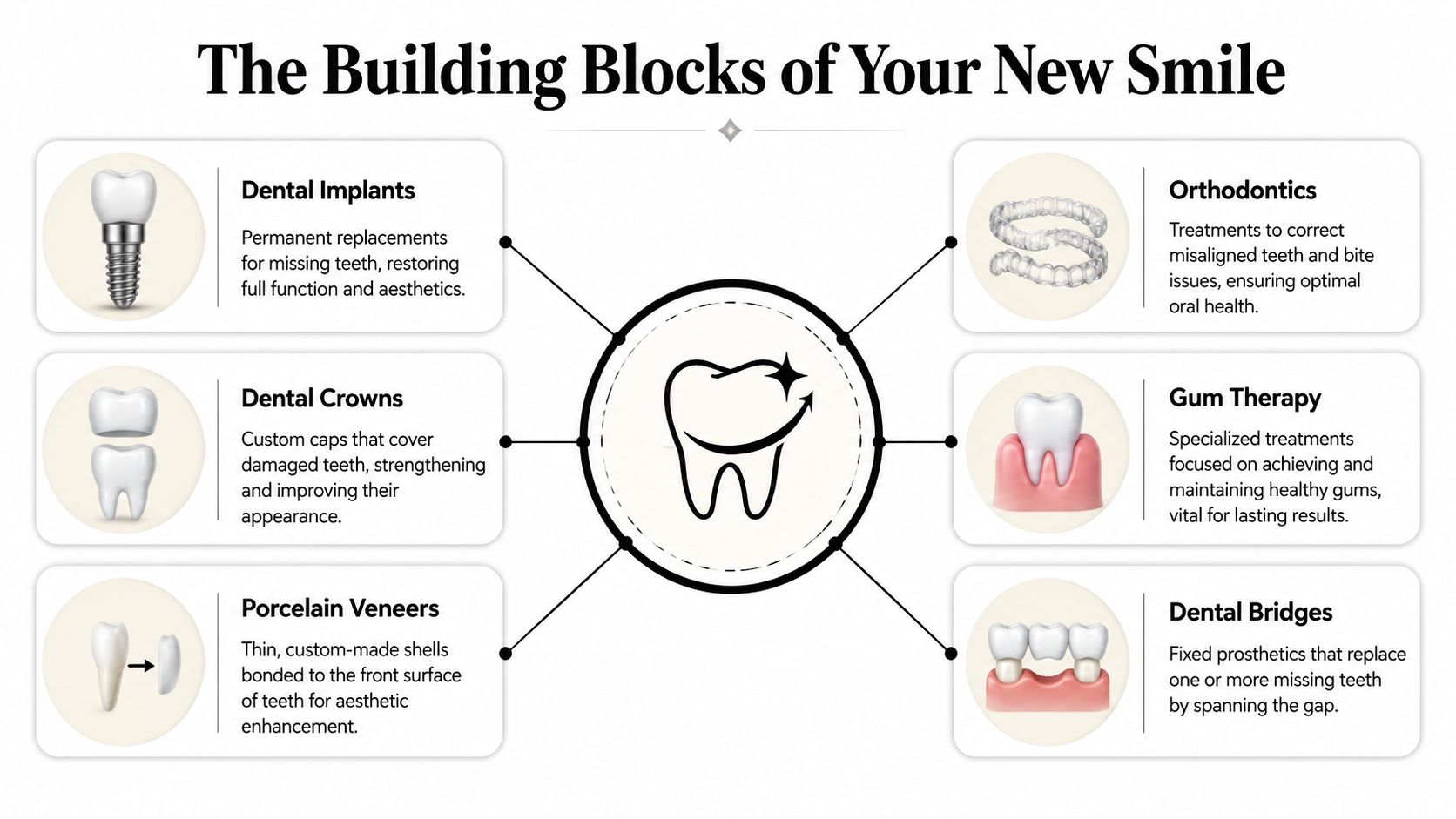
Every full mouth rehabilitation plan is customised, but most plans are built from the same core pieces. Each one has a specific job. Some create support. Some restore shape. Some improve appearance. Others protect what's already there.
Dental implants and the foundation of the bite
If you've lost teeth, dental implants often act like the anchor points of the whole design. An implant sits in the jaw and supports a crown, bridge, or larger prosthesis. In plain terms, it replaces the root as well as the visible tooth.
For some patients who need a full arch replaced, All-on-4® can be an option. According to this overview of full mouth rehabilitation procedures, the technique has a 95-98% 5-year survival rate and often avoids the need for bone grafting by using four angled implants. That can make treatment more straightforward for the right patient.
If you want to understand how implant treatment fits within broader restorative care, this page on dental implants and restorative dentistry is a useful starting point.
Crowns and bridges restore structure
A crown is a custom-made cap that covers and protects a damaged tooth. In rehabilitation, crowns often do more than repair. They help rebuild lost height, reshape worn teeth, and create a stable bite.
A bridge spans a gap where one or more teeth are missing. It can be supported by natural teeth or implants. Bridges are often chosen when the goal is to restore chewing function across an area without leaving spaces that overload neighbouring teeth.
Here's a simple way to view it:
| Treatment | Main job in rehabilitation | Best suited to | |---|---|---| | Crowns | Protect and reshape damaged teeth | Teeth that can still be saved | | Bridges | Replace missing teeth across a gap | Patients needing fixed replacement in a localised area | | Implant crowns | Replace individual missing teeth without relying on adjacent teeth | Single-tooth gaps or strategic support points |
Veneers refine the visible smile
Not every rehabilitation includes veneers, and they're rarely the first priority when major disease or bite issues are present. But in selected cases, veneers help improve the front teeth by adjusting shape, length, colour, or minor irregularities.
They're best understood as a finishing tool, not a structural rescue tool.
If a patient's front teeth are healthy enough and the bite has already been stabilised, veneers can help the final result look more natural and balanced. If the teeth are weak, heavily worn, or under strong grinding forces, crowns may be the safer choice.
Orthodontics creates room and alignment
Sometimes the best way to restore teeth is to move them first.
Orthodontics, including clear aligners or braces, can reposition teeth before crowns or veneers are placed. That can reduce the amount of drilling needed and improve how the upper and lower teeth meet. In a complex case, moving teeth even slightly can make the final rehabilitation more conservative and more stable.
> Practical rule: The best restorative work often starts with the least destructive path. If gentle tooth movement can create space and improve alignment, it may protect healthy tooth structure later.
Gum therapy prepares the ground
No rehabilitation lasts well on unhealthy gums.
If there is gum inflammation, infection, or bone loss around the teeth, that has to be treated first. Otherwise, even the most beautiful crowns or implants are sitting on an unstable foundation. Gum therapy may include deep cleaning, more frequent maintenance visits, and careful home care coaching.
This part of treatment doesn't usually get the attention that smile makeovers do, but it often determines whether the final result stays comfortable and functional over time.
Sometimes the best plan is a combination
A realistic rehabilitation plan often mixes several approaches rather than relying on one.
For example:
- Implants might replace teeth that can't be saved.
- Crowns may strengthen worn back teeth.
- A bridge could close a gap in one section.
- Orthodontics might improve a bite before the final restorations.
- Gum treatment may run alongside everything else.
That's why two patients with similar-looking problems can receive very different recommendations. The final design depends on what can be saved, what needs replacing, how the bite works, and what matters most to the patient.
Your Rehabilitation Journey A Step-by-Step Timeline
Individuals don't fear the final result. They fear the unknown middle.
They wonder how many visits there will be, whether they'll be left with gaps, how they'll manage work and family, and what they'll look like during treatment. Those are sensible concerns. Full mouth rehabilitation is a process, and it helps when you can see the path ahead.

Phase one begins with listening
The first appointment usually feels more like a strategy meeting than a treatment visit. You talk through what's bothering you, what you want to change, and what's made you delay treatment until now. Some patients care most about chewing. Others care most about confidence. Many want both.
The clinical team then gathers the information needed to build a proper plan. That may include photos, digital scans, bite records, and imaging. If you're preparing for your own consultation, this guide to a first dental visit and what to expect gives a helpful overview of how a planning appointment usually unfolds.
At this stage, many patients feel relief for the first time in a long while. Problems that seemed chaotic start to look organised.
Phase two creates a healthy starting point
Before the visible reconstruction begins, the mouth often needs groundwork.
That might involve treating gum disease, removing teeth that can't be saved, managing decay, or adjusting old restorations that are interfering with the bite. This phase can feel unglamorous because it isn't the “new smile” part yet, but it's often where comfort starts improving.
Some people are surprised to learn that temporary restorations may be part of the process. These are not the final version. They act more like a trial run, helping you function and helping the dentist test shape, bite, and appearance before the permanent work is made.
Phase three is where patience matters
If implants are part of the plan, healing periods are often built in. If bite changes are significant, the team may want to test your comfort in temporaries before committing to the final design. If the front teeth need to be rebuilt, speech and lip support may be reviewed along the way.
This is also the point where emotions can swing. You're making progress, but you may not feel “finished” yet.
The psychological side matters just as much as the clinical one. As this discussion of the full mouth rehabilitation journey notes, managing expectations and anxiety during a multi-month process is a key part of patient-centred care. Temporary changes in appearance, waiting periods, and uncertainty about the end point can all affect confidence if they aren't talked through properly.
> Some days during treatment feel exciting. Others feel slow. That doesn't mean something is wrong. It usually means your mouth is moving through a careful, staged plan.
Phase four brings the plan together
When the mouth is healthy and stable enough, the final restorations are fitted. This may include crowns, bridges, implant-supported teeth, or a full-arch prosthesis. The aim isn't just to make teeth look good in photos. The aim is to make them feel right when you chew, talk, and rest your jaw.
A final fit appointment can be emotional. Patients often notice the visual change first, then the functional changes over the following days and weeks. Food feels different. Speech may feel slightly unfamiliar at first, then settles. Smiling becomes less deliberate.
What the timeline feels like from the patient chair
The sequence varies, but the experience usually follows this pattern:
- Uncertainty at the beginning: “I know something's wrong, but I don't know how fixable it is.”
- Relief after planning: “At least now I understand what's happening.”
- Adjustment during staged care: “This is taking time, but I can see why.”
- Confidence as things come together: “I'm starting to feel like myself again.”
Questions worth asking before you start
A good treatment plan should leave room for practical life planning too. Ask things like:
- What will be temporary and what will be final
- Whether I'll have visible gaps at any point
- How eating may change during each stage
- What kind of discomfort is normal after each appointment
- How often I'll need review visits
- What happens if we need to phase treatment for budget reasons
Patients cope better when they know what the next step looks like. Certainty doesn't remove every worry, but it makes the process feel manageable.
How Advanced Dental Technology Creates Superior Results
The best dental technology doesn't just look impressive. It solves real patient problems.
It can reduce uncertainty, make appointments more comfortable, improve fit, and help the final result last. In full mouth rehabilitation, that matters because small inaccuracies don't stay small. They affect bite, comfort, speech, appearance, and wear over time.
Better imaging means better planning
Traditional dental images show useful information, but complex rehabilitation often needs a three-dimensional view. CBCT 3D imaging helps the clinician assess bone, roots, sinuses, jaw relationships, and implant sites with much greater clarity than a flat image alone.
That's especially important when rebuilding a bite. According to this clinical reference on full mouth reconstruction protocols, digital CBCT overlays combined with TRIOS scans allow vertical dimension of occlusion, or VDO, simulation with less than 0.5 mm of error. In plain language, that means the team can test and refine how tall your bite should be with very high precision.
If you're unfamiliar with the term, VDO is the space relationship between your upper and lower jaws when the teeth come together. Get that wrong and a smile can look good but feel tiring, strained, or unstable.
Digital scans are easier on patients
Many people still remember old-style impressions as one of the worst parts of dental treatment. They were messy, uncomfortable, and difficult if you had a strong gag reflex.
TRIOS digital scanners change that experience. Instead of filling trays with impression material, the clinician scans the teeth and bite digitally. For patients, that usually means less discomfort. For the team, it means more detailed records and easier communication when designing restorations.
A digital scan also helps patients understand their case. When you can see your own bite on a screen, the treatment conversation becomes clearer and less abstract.
Chairside design and faster restorations
CEREC same-day crowns can shorten parts of the restorative process. In the right situation, a crown can be designed, milled, and fitted without the long gap between preparation and lab delivery that patients often expect.
That doesn't mean every full mouth rehabilitation is completed in a day. Far from it. But same-day technology can simplify selected appointments, reduce temporary crown time, and keep momentum in a staged treatment plan.
The same applies to in-house 3D printing and digital planning tools. Surgical guides, trial smiles, and mock-ups can be made more precisely and tested before final work is delivered.
> Advanced dental technology is at its best when you barely notice it. You just notice that the process feels more organised, more comfortable, and more predictable.
If you'd like to see the types of digital tools used in modern restorative care, this overview of dental technology in clinical practice gives a practical snapshot.
Understanding Outcomes Potential Risks and Recovery
Full mouth rehabilitation can change daily life in very practical ways. Patients often describe being able to chew more evenly, smile without hesitation, and stop thinking about their teeth all day. Speech can improve. Jaw strain can settle when the bite is stabilised. Food choices often become easier again.
That said, trustworthy advice has to include the other side of the conversation too.
What the evidence tells us
A 5-year retrospective analysis of 150 cases found a 92% overall survival rate for fixed dental prostheses, according to this study on full-mouth rehabilitation outcomes. In the same analysis, 15% of patients experienced technical complications such as chipping or debonding, and 12% experienced biological complications including secondary caries or periodontal issues.
That's a strong result, but it isn't a promise of perfection. It tells us that full mouth rehabilitation is reliable and durable when properly planned, while also reminding us that maintenance matters.
The results patients usually notice first
Most positive changes fall into a few broad areas:
- Function: Eating becomes less awkward and more comfortable.
- Appearance: Teeth look more even, supported, and natural.
- Comfort: A balanced bite can reduce the feeling that one side does all the work.
- Confidence: Patients often stop hiding their smile or worrying about what might break next.
Material choice can influence longevity too. The study above noted that zirconia-based prostheses showed better survival than traditional metal-ceramic alternatives.
Possible complications and what they mean
Complications don't always mean treatment has failed. Sometimes they mean something needs repair, adjustment, or closer monitoring.
Examples include:
| Type of issue | What it might involve | What patients should know | |---|---|---| | Technical | Chipping, loosening, debonding | Often repairable, but it needs review promptly | | Biological | Gum inflammation, decay around restorations, periodontal problems | Usually linked to hygiene, maintenance, or pre-existing risk factors | | Functional | Bite discomfort, muscle fatigue, speech adjustment | May improve with minor adjustments and adaptation |
> A full mouth rehabilitation is not a “set and forget” treatment. It works best when the patient and dental team stay involved after the final fit.
Recovery is usually a series of smaller recoveries
There isn't one single recovery period. Instead, each stage has its own short healing and adjustment phase.
After some appointments, you may feel tender or tired. After others, the main task is adapting to a new shape or bite. Temporary restorations may feel different from natural teeth at first, and permanent restorations can take a little time to feel completely familiar.
Long-term success depends heavily on routine care. Daily cleaning, review appointments, and early attention to anything that feels off can prevent small issues becoming larger ones.
Planning Your Investment Costs and Financing Explained
For many patients, the hardest part of full mouth rehabilitation isn't deciding whether they need it. It's figuring out how to pay for it without feeling overwhelmed.
That concern is reasonable. This type of treatment is extensive by design, and the cost depends on many moving parts rather than one fixed fee.
What drives the total cost
The main factors usually include:
- How many teeth need treatment: A case involving several crowns is different from one involving extractions, implants, and full-arch replacement.
- The types of procedures involved: Gum treatment, implant surgery, orthodontics, crowns, bridges, and temporary restorations all add different layers of complexity.
- Material choices: Different restorative materials have different strengths, aesthetics, and laboratory requirements.
- How staged the treatment needs to be: Complex cases often need sequencing over time rather than one block of treatment.
- How much preparatory work is required: The healthier the starting point, the simpler the pathway tends to be.
A careful plan should separate what is urgent, what is foundational, and what is optional. That helps patients make decisions without feeling pressured to do everything at once.
Why phased treatment often helps
A staged approach can make treatment easier financially and emotionally.
One patient may start by stabilising pain, infection, and failing teeth. Another may restore the chewing side first, then move to the front teeth later. Someone else may choose an interim solution now and a more definitive implant-based plan once timing and budget line up.
That doesn't mean “doing half the job”. It means sequencing treatment intelligently.
Practical questions to ask at your planning visit
Bring a notebook, or ask for a written summary. You'll want clarity on:
- Which parts are essential right now
- Which parts can safely wait
- What maintenance costs may arise later
- Whether your private health fund may contribute to parts of care
- What payment arrangements are available
Clear financial conversations are part of good clinical care. If you're comparing options, this page on financial information and payment options is worth reviewing before your consultation.
Don't judge the plan by the first number alone
The cheapest path at the beginning isn't always the lowest-cost path over time. Repeating emergency repairs, replacing short-term solutions, or postponing foundation work can become expensive in other ways, including stress, time away from work, and reduced quality of life.
A better question is often, “What plan gives me the best chance of comfort, durability, and manageable stages?”
Your New Beginning Starts at Oasis Smiles Dental
Choosing where to have full mouth rehabilitation is about more than equipment or treatment menus. You need a team that can handle complexity, explain things clearly, and treat anxious patients with patience rather than hurry.
For families in Tamworth and the New England region, that local relationship matters. It's easier to commit to a multi-stage plan when your care is close to home, your review appointments are practical, and the people treating you understand the pace and pressures of regional life.

Oasis Smiles Dental has served the local community for over 20 years, with a patient-centred approach that combines family care, advanced restorative treatment, digital planning, and support for anxious patients, including sleep dentistry options. That matters in full mouth rehabilitation because complex treatment works best when the clinical standard is high and the human experience feels calm.
Patients often want three things from a rehabilitation provider:
- A clear plan: They want to know what's happening, in what order, and why.
- Comfort throughout treatment: They don't want to be shamed for delaying care, and they don't want rushed decisions.
- Long-term support: They want a practice that can guide maintenance after the final restorations are fitted.
That final point is often overlooked. A reconstructed smile still needs check-ups, hygiene care, bite reviews, and occasional adjustments. Long-term success comes from continuity.
The practice's investment in CBCT 3D imaging, TRIOS digital scanning, CEREC same-day crowns, and in-house 3D printing supports that continuity by making planning and treatment more precise. Just as important, the team treats people of different ages and comfort levels, from routine family care through to extensive restorative work.
Good patient education also matters outside the clinic. If you're curious how trustworthy health providers improve access to clear information online, Outrank's guide to healthcare SEO offers a useful look at how healthcare practices present complex topics in ways patients can understand.
If you've been living with worn, missing, broken, or uncomfortable teeth, you don't need to decide everything today. You only need to start the conversation.
---
If you're ready to talk through your options for full mouth rehabilitation, book a consultation with Oasis Smiles Dental. The team can assess your teeth, bite, gums, and goals, then help you understand what's possible, what needs to happen first, and how to move forward at a pace that feels manageable.