

Same Day Dental Crowns at Oasis Smiles Dental Tamworth
A cracked tooth rarely happens at a convenient time. It shows up before a long weekend, just before a family event, or halfway through a busy work week when you can't easily fit in multiple dental visits.
Patients often don't just worry about the tooth itself. They worry about chewing, talking, smiling, the chance of it breaking further, and whether they're about to spend weeks dealing with appointments, a temporary fix, and more discomfort than they expected.
The Problem With a Broken Tooth Is Never Just the Tooth
You might bite into something ordinary and feel that sharp jolt. Suddenly the tooth that was “mostly fine” yesterday is now sensitive to cold water, sore when you chew, or visibly chipped when you look in the mirror.
That's why a damaged tooth can throw off much more than your mouth. It can affect meals, sleep, confidence, and your plans for the next few days.

The older crown process often added to that stress. Traditionally, a dentist would prepare the tooth, take a physical mould, place a temporary crown, send the case to an external lab, and ask you to come back later for the final fitting. That meant more than one appointment, more waiting, and a period where the tooth was protected by something designed to be temporary, not ideal.
Why the waiting can feel harder than expected
Temporary crowns can do the job for a short time, but patients often find them awkward. They can feel different in the bite, they may need extra care while eating, and they create that uneasy feeling of “I hope this lasts until my next visit”.
For people in Tamworth and the wider New England region, the inconvenience can be even bigger. One extra appointment isn't always just a quick stop. It may mean more time off work, more school pick-ups to juggle, or another drive back into town.
> A broken tooth becomes a life problem very quickly. The dental issue is only one part of it.
If your tooth has broken suddenly or become painful, timely care matters. In urgent situations, it's worth looking at an emergency dental appointment option so the tooth can be assessed before the damage worsens.
The modern alternative patients often ask about
Same day dental crowns were developed to solve exactly these practical frustrations. Instead of sending your crown away to be made elsewhere, the dentist can design and create it during the same appointment using digital technology in the clinic.
That changes the whole experience. Fewer interruptions. Fewer unknowns. And for many patients, a much easier path from “this tooth is a problem” to “it's fixed”.
What Exactly Is a Same Day Dental Crown
A dental crown is a protective cap that covers a damaged or weakened tooth. Dentists use crowns when a tooth has cracked, has a very large filling, has broken down after decay, or needs extra support after root canal treatment.
Think of a crown as a custom helmet for your tooth. It's shaped to fit your bite, protect what's underneath, and let you chew comfortably again.
What makes it “same day”
With traditional crowns, the final crown is usually made in a dental laboratory after your appointment. With same day dental crowns, the design and manufacturing happen in the clinic during one visit using CAD/CAM technology. That stands for computer-aided design and computer-aided manufacturing.
A simple way to picture it is this. Instead of taking a physical mould and mailing it away, your dentist creates a digital model of your tooth, designs the crown on a computer, and then uses an in-house machine to mill it from a ceramic block.
It's a bit like having a highly specialised workshop for teeth inside the practice.
The name you may hear
Many patients hear the word CEREC when they ask about same day crowns. CEREC is one of the best-known systems for this kind of treatment. It has been around globally since 1985, and in Australia the Australian Dental Association endorsed CAD/CAM systems for in-office crown fabrication in 2005, helping move this technology into everyday dental care. The same verified data also notes TGA regulatory approval in 2006 for Australian use.
Those milestones matter because they show this isn't a new gimmick. It's an established method that dentists have refined over time.
Why patients like the idea so quickly
The biggest difference is easy to understand:
- One main visit instead of several
- No messy conventional impression material
- No waiting weeks for the final crown
- No temporary crown in many cases
In an Australian Dental Industry Association report, same-day crowns reduced average treatment time from 2 to 3 weeks for traditional lab-made crowns to a single 1 to 2 hour visit, with 92% patient satisfaction reported in regional clinics. The same verified data also notes that this approach typically cuts 2 to 3 visits down to one.
That's why the technology makes sense to patients straight away. It takes a treatment that used to feel stretched out and turns it into a process people can understand and manage in one sitting.
Your Single-Visit Appointment What to Expect
The best way to make a dental appointment feel less intimidating is to know what will happen before you sit in the chair. Same day dental crowns are very structured, and that predictability is reassuring.
Most appointments follow four main stages.
Preparation and digital scan
First, the dentist checks the tooth, removes any damaged areas, and gently shapes it so the new crown can fit securely. After that, instead of using a tray full of impression material, the tooth is scanned with an intraoral scanner.
That digital scan creates a detailed 3D image of your tooth and bite. According to the verified data on Trios scanning accuracy, these scanners capture images at 20 to 50 μm, compared with about 100 to 200 μm for traditional impressions. The same data notes that this precision can reduce the gap between crown and tooth to less than 50 μm, which can cut the risk of microleakage and secondary decay by up to 60% compared with lab crowns.
That sounds technical, but the patient benefit is simple. Better detail helps the crown fit more accurately from the start.
For a closer look at the digital tools involved, you can browse the clinic's dental technology information.
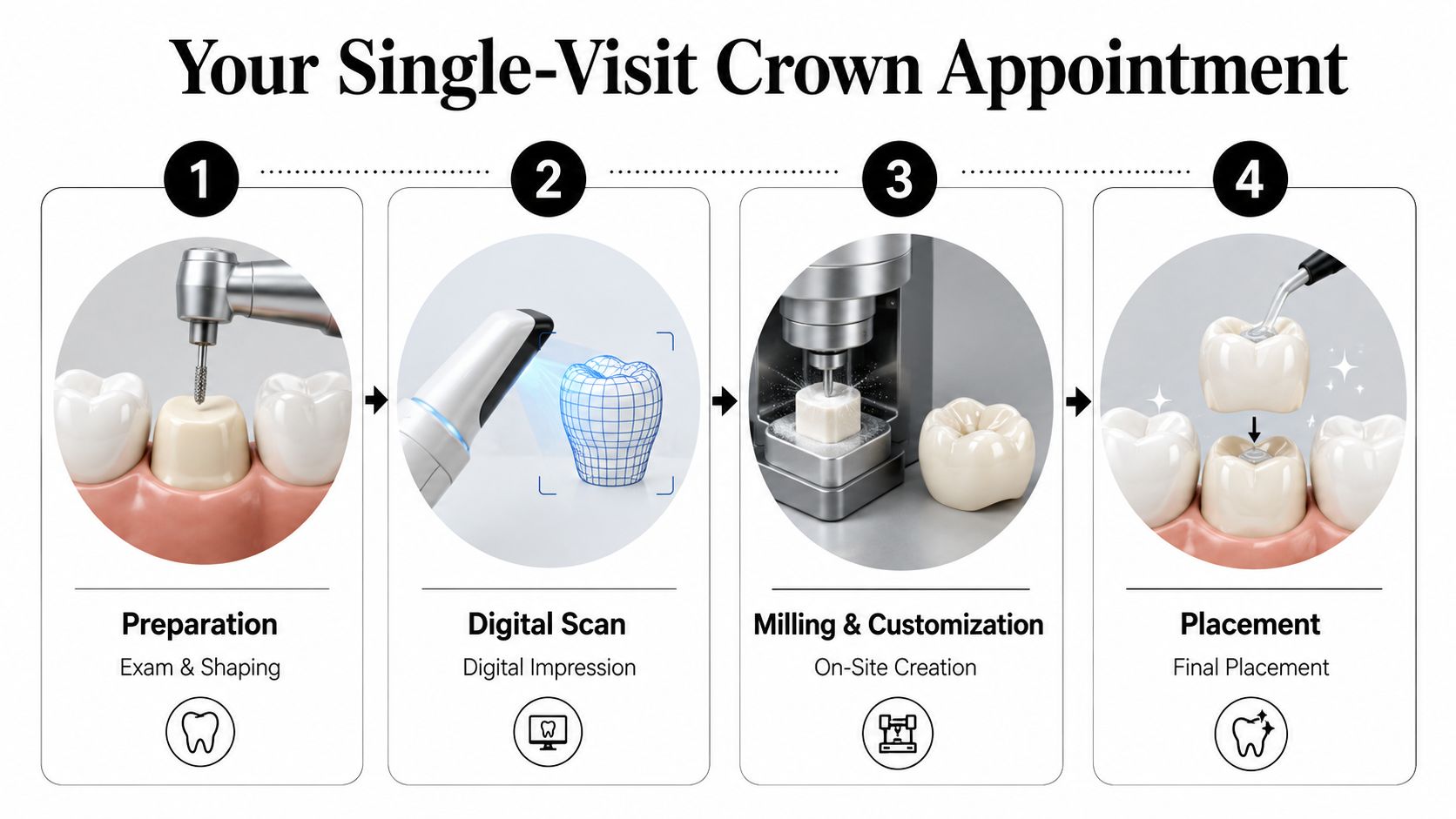
Designing the crown on screen
Once the scan is complete, the dentist uses software to design the crown. This is the stage many patients find surprisingly interesting, because you can often see the model of your tooth on the screen.
The software helps shape the crown so it sits well against neighbouring teeth and lines up with your bite. Rather than relying on a physical mould alone, the dentist works with a digital model that can be adjusted with precision before the crown is ever made.
> Practical rule: If you've had trouble with gagging during old-style impressions, digital scanning is often a far more comfortable experience.
Milling your crown in the clinic
After the design is approved, the data goes to the in-house milling machine. The machine carves the crown from a solid ceramic block chosen to suit the tooth.
In the verified Australian data, single-visit treatment is described as taking about 1 to 2 hours, with stages such as scanning in 5 minutes, design in 10 minutes, milling in 15 to 20 minutes, and cementation after finishing. Some materials may also need sintering before placement.
This part often changes how people think about dentistry. The crown isn't a generic piece pulled off a shelf. It's made for your tooth, on the day, in response to the scan taken from your mouth.
Final fitting and bonding
Once the crown is ready, the dentist checks the fit, the contact points, the bite, and the appearance. Small refinements can be made if needed, then the crown is bonded into place.
At that point, the tooth is protected and functional again. You leave with the permanent restoration already fitted, rather than a temporary stand-in.
Here's the flow in a quick snapshot:
- Tooth preparation so the damaged area is cleaned and reshaped
- Digital scanning instead of a traditional mould
- Computer design of your custom crown
- In-house milling and final bonding in the same visit
For many people, that's the main appeal of same day dental crowns. The process is modern, but it feels straightforward once you see each step.
Same Day Crowns vs Traditional Crowns A Clear Comparison
Patients usually ask the same question in different ways. Is the faster option also a good option? That's the right question to ask.
The answer depends on the tooth, the bite, and the treatment plan, but there are some practical differences that are easy to compare.
Same Day vs Traditional Crowns at a Glance
| Feature | Same-Day Crown (CEREC) | Traditional Lab Crown | |---|---|---| | Appointments | Usually completed in one visit | Usually requires more than one visit | | Total treatment time | Can be completed in a single appointment | Often involves a waiting period between visits | | Impression method | Digital scan | Conventional impression is commonly used | | Temporary crown | Often not needed | Commonly needed while waiting for the final crown | | Manufacturing | Made in the clinic | Made in an external dental lab | | Materials | Commonly milled from monolithic ceramic materials such as zirconia or e.max | Can include a range of lab-made crown materials | | Colour matching | Digital workflow can support strong shade matching | Shade communication may involve lab interpretation | | Fit workflow | Designed and adjusted from a digital model | Relies on impression quality and lab fabrication |
Where same day crowns stand out
The biggest advantage is convenience, but it's not the only one. Same-day crowns milled from monolithic materials like zirconia, with a flexural strength of 900 to 1200 MPa, showed a 95% survival rate over 7 years in high-load areas in the verified Australian data, compared with 88% for porcelain-fused-to-metal crowns. The same dataset also reports 99% colour match through the digital process.
That's useful because people often assume “fast” must mean “less durable”. In many situations, modern monolithic ceramic is both strong and attractive.
Why avoiding a temporary crown matters
Temporary crowns are one of the least-loved parts of the older process. They're there for a reason, but they can feel like a compromise because they are a compromise. You're waiting for the final restoration while trying not to disturb something that isn't meant to be permanent.
For patients, that means extra care at meals, uncertainty if it feels loose, and another appointment to get the permanent crown fitted. Same day treatment removes that awkward in-between stage in many cases.
> The most comfortable crown experience is often the one that doesn't leave you managing a temporary for days or weeks.
Where traditional crowns may still be used
Traditional crowns still have a place in dentistry. Some cases need different materials, more layered aesthetic work, or a treatment sequence that benefits from laboratory involvement.
So this isn't a story of old versus new where one option wins every time. It's more accurate to say same day crowns have become a strong choice for many single-tooth restorations because they combine speed, digital precision, and durable ceramic materials in one workflow.
Is a Same Day Crown Right for You
Same day dental crowns suit many people, but not every tooth should be treated the same way. The best dentists don't force every case into one system. They look at your tooth, your bite, your goals, and what will hold up well over time.
People who are often good candidates
A same day crown is often a good option if you have:
- A cracked tooth that still has enough healthy structure to restore
- A large old filling where the remaining tooth needs more protection
- A broken tooth that needs full coverage rather than a small repair
- A tooth after root canal treatment that needs extra strength
- A busy schedule and want to avoid multiple visits if the case is suitable
Why anxious patients often prefer it
For many people, the attraction isn't just speed. It's the chance to get the whole job done without returning to repeat the hardest part.
The verified Australian data notes that 25% of regional Australians experience dental anxiety, and that same-day procedures can reduce patient-reported discomfort by 70% because treatment and anaesthesia are limited to a single session. That can make a big difference for someone who already finds dental care stressful.
If you'd like to understand where crowns fit within broader tooth repair options, this overview of crowns and restorative dental treatments can help.
Cases where another option may be better
There are also times when a dentist may recommend something else. That can include:
- Very complex bite problems
- Some full mouth rehabilitation plans
- Cases needing specialist input
- Teeth with structural issues that change the restoration plan
- Situations where another material or approach is better for the final result
That kind of honesty matters. A crown should be chosen because it's right for your tooth, not because it happens to be available on the day.
> Good crown planning starts with suitability, not speed.
Understanding the Cost and Longevity in Australia
Cost is one of the first things patients ask about, and that makes sense. A crown is an investment in keeping a tooth functional, comfortable, and stable.
What patients usually pay for
The verified Australian data states that the per-crown cost for same-day treatment is similar to traditional treatment at AU$1,200 to AU$1,800. It also notes that same-day crowns can save patients AU$200 to AU$400 in follow-up appointment fees, while avoiding the extra hassle and potential remake costs linked to temporary crowns, which fail in 15 to 20% of traditional cases.
So the conversation isn't only about the sticker price of the crown itself. It's also about the hidden costs of extra visits, more time away from work or family, and managing a temporary crown in the meantime.
If you want a general overview of payment pathways, health funds, and accepted support options, the practice's financial information page is a practical place to start.
How long do same day crowns last
Longevity depends on several things. The condition of the tooth underneath matters. Your bite matters. Whether you clench or grind matters. Home care matters too.
The verified Australian data includes strong durability outcomes for same-day crowns. One source reports a 97% 5-year survival rate for same-day crowns versus 94% for lab crowns, and another reports 95% survival over 7 years for CEREC zirconia in high-load areas.
That doesn't mean every crown lasts the same number of years in every mouth. It does mean same-day crowns can be a sound long-term restoration when the case is selected well and the crown is cared for properly.
Simple habits that protect your crown
A crown still needs looking after. The goal is to protect both the crown and the tooth underneath it.
- Brush thoroughly around the gumline, not just the visible crown
- Clean between teeth daily so plaque doesn't build up at the edges
- Don't use teeth as tools for opening packaging or biting hard objects
- Ask about a night guard if you clench or grind
- Keep regular dental reviews so bite and margins can be checked early
That kind of maintenance is what helps a well-made crown stay a good investment.
Get Your Same Day Crown in Tamworth (FAQs Included)
For local families, convenience matters, but trust matters more. You want to know the practice is established, the technology is modern, and the team can explain your options in a way that makes sense.
Oasis Smiles Dental has served Tamworth and the New England region for over 20 years, with advanced tools including CEREC same-day crown technology, Trios digital scanners, CBCT 3D imaging, and in-house 3D printing. The clinic is located at Shop 15/1 Piper Street, near Northgate Shopping Centre, and welcomes patients of all ages, including those who feel nervous about dental treatment.

The patient experience doesn't stop at the treatment itself. Many people appreciate simple communication before and after appointments, especially when they're arranging family schedules or feeling anxious. If you're interested in how healthcare clinics can make that side easier, these digital patient engagement techniques offer some practical ideas.
Quick FAQs
#### Are same day crowns painful
The tooth is numbed before treatment, so the procedure itself should be manageable. Many patients find the process easier than expected because it happens in one appointment and usually avoids the messy impression stage.
#### Do same day crowns look natural
Yes, they're designed to blend with your smile. In the verified Australian data, the digital process achieved 99% colour match, which is why many patients like the cosmetic result as much as the convenience.
#### Are they strong enough for back teeth
They can be, depending on the case and material chosen. The verified data reports strong results for monolithic zirconia in high-load areas, which is one reason same day crowns are often used on posterior teeth when appropriate.
#### How long will my appointment take
Many same day crown appointments are completed in a single visit. Verified Australian data places that visit at around 1 to 2 hours for suitable cases.
#### What if I'm a nervous patient
That's common, and it should be discussed openly. A single-visit approach often suits anxious patients because there's less waiting, fewer repeated procedures, and less disruption overall. Sleep dentistry options may also help some patients feel more comfortable.
---
If you need advice about a broken, worn, or heavily filled tooth, Oasis Smiles Dental can help you understand whether a same day dental crown is the right option. The team supports Tamworth and the New England region with modern restorative care, flexible payment options, and a calm, patient-centred approach.