

How Long Do Dental Crowns Last? An Expert Guide
So, you’re wondering, how long do dental crowns last? It’s the first question most people ask, and it’s a great one. The short answer is anywhere from 5 to over 25 years, but the real story is a bit more involved. Think of it like the tyres on your ute; their lifespan depends on the quality of the rubber, how you drive, and how well you look after them. A crown is no different.
A Practical Guide to Your Crown's Lifespan
Getting a dental crown is a big decision for your smile and your health, so you deserve to know what to expect from your investment. We’ve put this guide together for our patients here in Tamworth and across the New England region to give you a clear, honest look at how long your crown should last.
We'll cover how different materials stack up and how modern technology, like the CEREC same-day crowns we use in our practice, is changing the game in terms of both durability and convenience.
What Can You Realistically Expect?
There isn't one simple answer for a crown's lifespan because it's not a set-and-forget solution. It’s a range that’s influenced by a handful of important factors. Thankfully, we have plenty of great clinical data, much of it from local Australian dental practices, that gives us a solid idea of what to expect.
For instance, one large-scale review from 2020 that looked at 1,500 restorations found that all-ceramic crowns—the kind we love for beautiful, natural-looking front teeth—had a 94% success rate at 5 years, 85% at 10 years, and even 72% after 20 years. For the tough back teeth that do all the heavy lifting, super-strong materials like Zirconia have shown a 91% survival rate after 15 years in a separate Australian review of 900 cases. You can read up on more of these crown longevity findings if you like to dig into the details.
To make things simple, the table below gives you a quick snapshot of what you can expect from different crown types.
> Key Takeaway: While the *average* crown lasts about 10-15 years, many can serve you perfectly for much longer with the right care. The material we choose and where it’s placed in your mouth are the two biggest factors right from the start.
Dental Crown Lifespan at a Glance
This table provides a quick summary of the average lifespan for different types of dental crowns based on typical Australian clinical data.
| Crown Material | Average Lifespan (Years) | Best For | | :--- | :--- | :--- | | All-Ceramic (e.g., E-max) | 10–20+ Years | Front teeth, excellent aesthetics | | Zirconia | 15–25+ Years | Back molars, full mouth rehab, strength | | Porcelain-Fused-to-Metal| 10–15+ Years | Good balance of strength and looks | | Gold Alloy | 20–30+ Years | Back molars, biocompatibility, durability |
As you can see, the material makes a huge difference. Gold has been the gold standard for decades for a reason—it’s incredibly durable. But modern ceramics like Zirconia are giving it a serious run for its money, offering incredible strength without compromising on looks.
Choosing the Right Crown Material for Durability
Deciding on a dental crown is a bit like choosing building materials for a house. You wouldn't use plasterboard for your front steps, and you wouldn't use heavy-duty concrete for an interior feature wall. It’s all about matching the material to the job it needs to do.
The same principle applies to dental crowns. The material your crown is made from is one of the single biggest factors in determining how long it will last. Let's walk through the options so you can feel confident in the conversation with your dentist.
Gold Alloy Crowns: The Durability Champion
For decades, gold alloy crowns have been the gold standard—pun intended! While you don’t see them at the front of the mouth much anymore, they are still a fantastic choice for back molars that do all the heavy lifting when you chew.
Their biggest advantage is simply their incredible toughness and resistance to wear. Gold is also very kind to the teeth it bites against, so it won’t wear down your natural tooth enamel over time. The data backs this up. A major 2019 Australian study found that metal crowns had a massive 96% survival rate at 15 years and 82% at 25 years. In our experience here in NSW, it’s not uncommon for gold crowns to last an average of 27 years.
Porcelain-Fused-to-Metal (PFM) Crowns
For a long time, PFM crowns were the perfect compromise between strength and appearance. They’re built with a strong metal base for durability, which is then covered by a layer of tooth-coloured porcelain.
They do have a couple of trade-offs, however. The porcelain layer can sometimes chip or wear down, revealing the dark metal underneath. You might also notice a dark line appearing at the gum line over the years as your gums naturally recede, which can be a cosmetic issue for front teeth.
> A Note on Looks vs. Strength: Historically, you had to choose: a crown that looked good or a crown that was strong. PFM was the best attempt to bridge that gap, but modern materials have really changed the game.
The chart below gives you a general idea of what to expect from different materials, showing how some are designed for shorter-term function while others are engineered for the long haul.
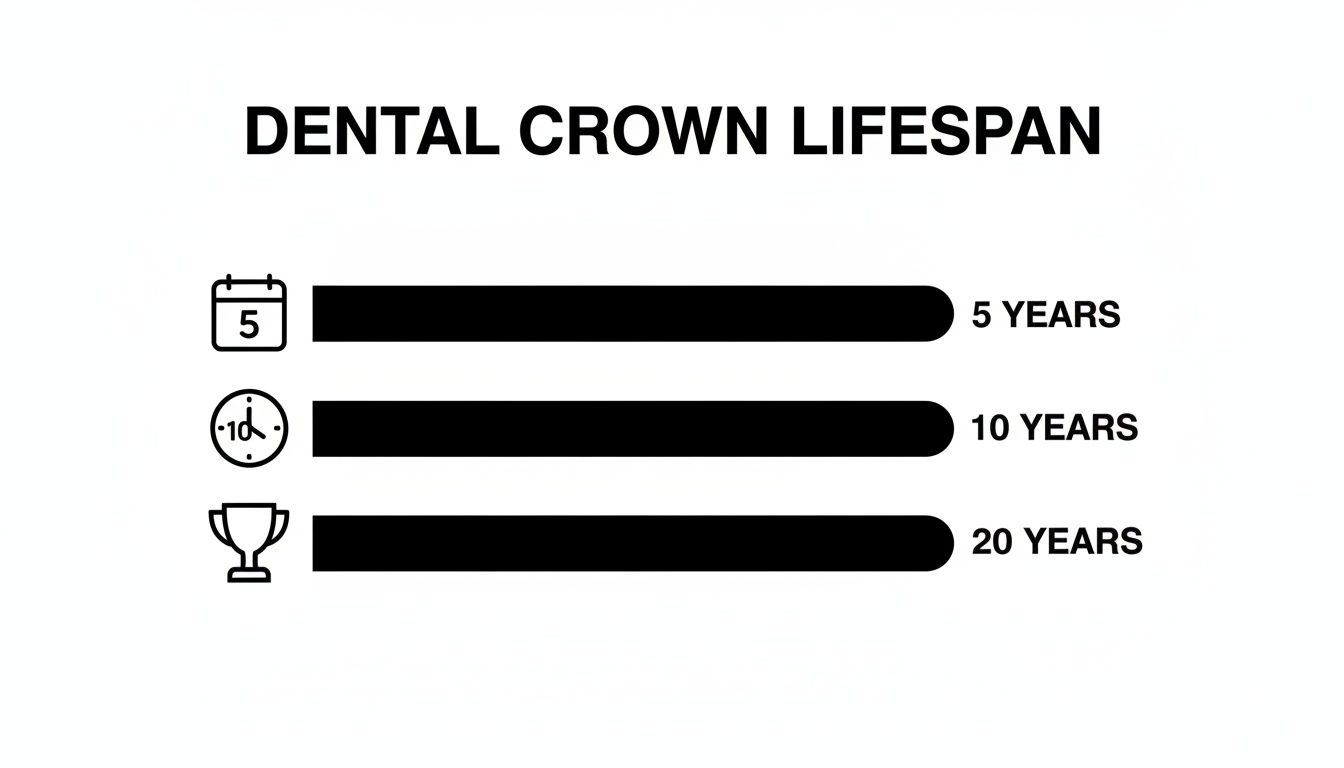
As you can see, while most crowns should last at least 5 years, the right material and care can push that lifespan well beyond 20 years.
All-Ceramic and Zirconia Crowns
This is where things get really exciting in modern dentistry. Materials like E-max and Zirconia have completely changed what’s possible with dental restorations.
- All-Ceramic (E-max): These crowns are famous for their stunning, natural appearance. They have a translucency that perfectly mimics real tooth enamel, making them the top choice for front teeth where every detail matters.
- Zirconia: Often called ‘ceramic steel’, Zirconia gives you the best of both worlds. It’s exceptionally strong and fracture-resistant—tough enough for the hardest-working molars—but it also looks beautiful and natural. It's the material we trust for creating our durable, tooth-coloured same-day CEREC crowns right here in our Tamworth clinic.
With these advanced options, the old compromise between a crown that lasts and a crown that looks great is a thing of the past. You really can have it all.
Factors That Impact Your Crown's Lifespan
While the type of material we choose is a massive part of the puzzle, the question "how long do dental crowns last?" isn't just about the crown itself. Think of it like a brand-new, top-of-the-line tyre. Its performance and lifespan still depend on the car it's fitted to, the roads it travels on, and how you drive.
Your dental crown is no different. Its longevity is truly a partnership between you, your habits, and your dentist.
Many real-world factors determine whether a crown will see you through five years or last for twenty-five. Some are entirely in your hands, while others come down to the precision and technology we use in the clinic. Let’s break down what really makes a difference.
Your Daily Habits and Oral Hygiene
Your at-home care is the single most important factor you control. A crown is made of porcelain or zirconia, so it can't decay. The natural tooth underneath it, however, absolutely can.
The most vulnerable spot is the margin – that tiny line where the edge of the crown meets your tooth and gum.
If plaque builds up here, decay can creep in underneath, weakening the tooth's foundation and ultimately causing the crown to fail. This is why great oral hygiene isn’t just a nice-to-have; it's essential for protecting your investment.
A rock-solid routine includes: * Thorough Brushing: Brush twice a day, paying close attention to gently cleaning the gum line around the crown. * Daily Flossing: This is non-negotiable. Flossing gets into the tight spaces between your teeth that a toothbrush simply can't reach, clearing out plaque from the crown’s edge. * Regular Check-ups: Visiting us every six months for a professional clean and exam lets us spot and sort out tiny issues before they become big, expensive problems.
Letting these habits slide can cause trouble for the supporting tooth and gums. Good hygiene is also vital for preventing issues like gum disease, which can make your gums recede and expose the sensitive margin of the crown. You can learn more about how we help patients manage gum health to support their dental work.
Bite Forces and Unconscious Habits
The amount of force your crown handles every day plays a huge role in its lifespan. This is especially true for crowns on your back molars, which bear the brunt of your chewing power.
But it’s not just about eating. Certain habits can put extreme, damaging pressure on your crown:
- Bruxism (Teeth Grinding): Many people grind or clench their teeth, often without even realising it while they sleep. This can create immense force, leading to wear, chipping, or even fracturing the crown over time.
- Using Teeth as Tools: Tearing open packets with your teeth, chewing on pens, or biting your nails can create sudden, sharp impacts that easily chip or crack a crown.
- Eating Hard or Sticky Foods: Regularly chewing on ice, hard lollies, or tough, sticky foods can either fracture the crown or, in some cases, create enough force to pull it loose.
> Think of it this way: Your crown is like a fine ceramic plate. It’s strong enough for daily meals, but you wouldn't use it to crack open nuts. Being mindful of these habits is key to its longevity.
The Dentist's Skill and Technology
The final piece of the puzzle is the quality of the crown's fit. This all comes down to your dentist's skill and the tools at their disposal. A crown with a perfect, seamless fit is your best defence against failure.
Even the tiniest microscopic gap between the crown and your tooth is an open invitation for bacteria to hide and start causing decay.
This is where modern technology completely changes the game. At Oasis Smiles Dental, we use a suite of digital tools to guarantee an incredibly precise fit: * Trios Digital Scanners: These replace those goopy, uncomfortable impression moulds with a quick and highly accurate 3D scan of your mouth. * CBCT 3D Imaging: This gives us a detailed, three-dimensional picture of your tooth and bone, allowing for meticulous planning. * CEREC Technology: Our in-house CEREC machine takes these digital scans and mills a perfectly fitted crown from a solid block of high-grade ceramic or zirconia while you wait.
This all-digital approach takes the guesswork out of it and ensures the tightest possible seal against bacteria. The proof is in the numbers. Research tracking over 1,000 crowns in Australian clinics found that while older PFM crowns had a 92% survival rate at 10 years, advanced CEREC zirconia crowns showed a 95% success rate at 12 years, with a precision fit being a key reason. For more details on these findings, you can read the research summary.
Ultimately, when your diligent home care meets our precision technology, you get the best possible outcome for a long-lasting, successful crown.
Simple Ways to Care for Your Dental Crown
Think of your new dental crown as a significant investment in your smile's health and appearance. Like any important investment, it needs a little looking after to give you the best return—in this case, years, or even decades, of reliable function. The good news is, the care involved is simple and straightforward.
A common mistake is thinking the crown itself is indestructible. While the material—whether it's porcelain, zirconia, or metal—can't get a cavity, the tooth underneath and the gums around it are still very much at risk. Ultimately, the secret to a long-lasting crown is all about keeping that foundation healthy.
This guide is your simple manual for looking after your crown. By following these tips, you'll help prevent decay, keep your gums in great shape, and make sure your restored tooth stays strong and stable for as long as possible.
Your Daily Crown Care Checklist
Excellent oral hygiene is, without a doubt, the best tool you have to make your crown last. The most important spot to keep clean is the margin—that little seam where the edge of the crown meets your natural tooth, right at the gum line. Plaque has a real knack for building up here, so being diligent with your cleaning is key.
Here’s a simple but highly effective routine to follow every single day:
- Brush Thoroughly Twice a Day: Always use a soft-bristled toothbrush with fluoride toothpaste. When you get to your crown, angle the bristles right where the tooth meets the gum. Use gentle, circular motions to sweep away any plaque that's trying to set up camp along the margin.
- Floss Daily Without Fail: This part is non-negotiable. Flossing is the only way to clean the tight spots on either side of your crown. Gently slide the floss down and wrap it in a C-shape against the crown’s surface, then move it up and down to clean the side of the tooth and just beneath the gum line.
- Consider an Antiseptic Mouthwash: Adding an antibacterial mouthwash to your routine can help reduce bacteria throughout your mouth. It gives the gums around your crown an extra layer of defence against irritation and disease.
> Remember, the goal is to treat your crowned tooth just like a natural tooth, but with a little extra focus on that gum line. This simple habit is your best defence against decay starting underneath the crown, which is one of the main reasons a crown might fail.
Professional Maintenance and Lifestyle Habits
Beyond what you do at home each day, a few other things are crucial for keeping your crown in prime condition. These habits help protect your crown from everything from slow, gradual wear to sudden, unexpected damage.
It's amazing how much your diet and even unconscious habits can affect your dental work. Chewing on very hard things—think ice cubes, pen lids, or hard lollies—can create enough force to chip or crack even the strongest crown. Sticky, chewy foods can also be a problem, as they have the potential to pull on and loosen a crown over time.
Then there's the issue of clenching or grinding your teeth (a habit called bruxism), which many people do in their sleep without even realising it. This puts an incredible amount of pressure on your teeth and can dramatically shorten a crown's lifespan. If you wake up with a sore jaw or think you might be a grinder, it's definitely something to bring up with us. A custom-fitted night guard can protect your teeth and dental work from this excessive force.
Finally, your regular six-monthly check-ups are your best insurance policy. During these visits, our team can: * Give your teeth a professional clean, hitting spots you might miss. * Carefully inspect the crown’s margins for any signs of leakage. * Check on the health of the tooth underneath and the surrounding gums. * Give the crown a good polish to keep it looking great.
Warning Signs Your Crown Needs Attention
Even the best-made dental crowns won't last forever. Think of them like the tyres on your car—they do a brilliant job for a long time, but eventually, they show signs of wear. Knowing how to spot these early signs is the key to preventing a small issue from turning into a major headache.
It really comes down to paying attention to how your mouth feels. A tiny change is often the first clue that your crown needs a professional look. If you ignore it, you risk damaging the underlying tooth, which is the very thing the crown is there to protect.
Key Symptoms to Watch For
If you notice any of these things happening, it’s time to give your dentist a call. They're all signs that either the crown itself or the tooth underneath might be in trouble.
- Pain or New Sensitivity: A crowned tooth should feel normal. If you suddenly feel a jolt from hot coffee or cold ice cream, that’s a red flag. Pain when you bite down is an even more serious signal that decay could be starting under the crown.
- The Crown Feels Loose: Your crown should feel rock-solid, just like a natural tooth. If you feel any wiggle or movement at all, the dental cement has likely failed. This leaves a gap for bacteria to get in.
- Visible Damage: Take a good look at your crown in the mirror from time to time. Do you see any chips or cracks? Even a tiny fracture is a weak point that can let decay creep underneath.
- A Dark Line at the Gum: While a faint line can be normal with some older crowns, a new or darkening line right where the crown meets the gum is often a sign of trouble brewing at the margin.
> Don't wait for a small problem to become a real pain. Taking quick action is the best way to save the tooth and avoid more complex and costly treatments later.
Why You Shouldn't Ignore These Signs
None of these symptoms will just go away on their own. In fact, they’re pointing to an underlying problem that will only get worse.
A loose crown, for instance, creates a perfect little trap for food and bacteria, which can cause rapid decay on the vulnerable tooth structure it’s supposed to be protecting. A chip might seem like just a cosmetic issue, but it compromises the crown's integrity, making a complete fracture much more likely. And any pain is your body’s alarm system telling you something is wrong—ignoring it can lead to a serious infection or abscess.
If you’re in or around Tamworth and notice any of these signs, please don't put it off. If the pain is severe, you might need urgent help; our guide to emergency dentistry services explains what to do next. Get in touch with us at Oasis Smiles Dental for an assessment so we can get to the bottom of it and protect your smile.
Finding a Dental Crown Solution You Can Trust in Tamworth
When you're investing in a dental crown, you want to know it’s going to last. It’s not just about fixing a tooth; it’s about making a smart, long-term choice for your smile and your health. Here in Tamworth, we’ve spent decades helping our local New England community do just that.
For over 20 years, Oasis Smiles Dental has been looking after local families. We’ve seen kids grow up and bring their own children to us. That experience, combined with some of the best technology available today, allows us to offer crowns that are both beautifully made and incredibly durable.
Same-Day Crowns are a Reality in Tamworth
We know that life in our region is busy. Juggling work, family, and appointments is a constant balancing act. That’s why we invested in our own on-site CEREC system, which lets us create and place your permanent crown in a single visit.
Forget about goopy impressions, temporary crowns that might fall off, and booking a second appointment weeks down the track. But convenience is only half the story. The real advantage of this technology is how it helps us build a crown that’s truly made to last.
- A Perfect, Protective Seal: The digital 3D scan of your tooth is far more accurate than a traditional mould. This lets us mill a crown that fits with microscopic precision, creating a tight seal that locks out bacteria and prevents future decay.
- Incredibly Strong Materials: Your crown is milled from a single, solid block of high-grade ceramic or zirconia. There are no layers or weak points like in older crowns, making it exceptionally resistant to chipping and cracking under pressure.
- Immediate, Lasting Results: You leave our clinic with your final, permanent tooth firmly in place, ready to use straight away.
> This means a crown from our Tamworth clinic isn’t just faster—it’s engineered from the ground up for a longer life. The precision fit and superior material strength are key to a restoration that stands the test of time.
More Than Just Placing a Crown
A crown's lifespan also depends heavily on the health of your entire mouth. Think of it like putting a new roof on a house with a shaky foundation. If your bite is misaligned or you have other underlying issues, your new crown will be put under unnecessary stress.
That’s why we always look at the bigger picture. Our team takes a comprehensive approach, offering everything from cosmetic dentistry to orthodontics. By making sure your bite is balanced and your surrounding teeth are healthy, we create the perfect environment for your crown to last for many years.
We firmly believe that everyone in our community deserves access to fantastic dental care without the financial stress. We accept all major health funds, Medicare (CBDS), and DVA, and we also offer flexible payment plans to fit your budget.
For a local dental solution built on trust and designed to last, get in touch with us at Oasis Smiles Dental today.
Your Dental Crown Questions Answered
It’s completely normal to have a few more questions pop up, even after you’ve learned the basics. Getting a crown is a big step for your oral health, and we want you to feel totally confident in your decision.
Here are some of the most common things our patients in Tamworth ask us about.
Does My Health Fund Cover Crown Replacement?
For the most part, yes. Most Australian health funds that include major dental cover will offer a rebate for crown replacements, as long as they are clinically necessary. How much you get back really depends on your level of cover and any annual limits you might have. The best thing to do is always give your fund a quick call before you commit to treatment.
Here at Oasis Smiles Dental, we work with all major health funds. We can give you the exact dental item codes for your treatment plan, which makes it simple for you to check your rebate. We're also proud to support patients through DVA schemes and the Medicare Child Dental Benefits Schedule where they apply.
Can a Chipped Crown Be Repaired, or Does It Need Replacing?
That really comes down to how big the chip is and where it’s located. A tiny, purely cosmetic chip on a porcelain crown—one that doesn’t throw off your bite—can often be fixed. We can usually smooth it down or even patch it with a bit of tooth-coloured composite resin. It’s a straightforward solution for small aesthetic issues.
However, a bigger crack or a fracture that weakens the crown's overall structure is a different story. If the damage affects the seal, it almost always needs a full replacement. A poor fit is like leaving a door open for bacteria, which can lead to decay in the natural tooth underneath. Our dentists will always look at the damage and recommend the most durable, long-term solution to protect your health.
> A small repair might work for a tiny chip, but replacing a badly damaged crown is vital. It’s the only way to protect the tooth underneath from infection and ensure the crown can still do its job properly.
Are CEREC Same-Day Crowns as Strong as Traditional Crowns?
Absolutely. In fact, the latest CEREC crowns are often even stronger. The crowns we make right here in our Tamworth clinic are milled from a single, solid block of high-tech ceramic, like zirconia. This single-piece design gets rid of the weaker layers you’d find in old-school porcelain-fused-to-metal crowns.
Study after study shows that CEREC crowns last just as long—and often longer—than crowns made in a traditional lab. Their incredible strength is boosted by the precise seal we get from digital scanning, which helps them last longer by keeping bacteria out. Of course, getting it all done in a single appointment is a fantastic bonus.
Is Getting a Crown a Painful Procedure?
The procedure itself shouldn't be painful at all. Before we even start, we’ll make sure the entire area is completely numb with a local anaesthetic, so you won’t feel a thing while we work. It’s normal to feel some slight sensitivity in the tooth or tenderness around the gums for a few days afterwards, but that’s easily managed with standard over-the-counter pain relief.
For anyone who feels a bit anxious about dental work, we’re also happy to offer sleep dentistry options. We want to make sure your experience at Oasis Smiles Dental is comfortable, relaxed, and completely stress-free from beginning to end.
--- Ready to talk about a long-lasting crown solution that’s perfect for you? The team at Oasis Smiles Dental is here to help. Contact us today to book a consultation at our Tamworth clinic and take the next step toward a healthy, confident smile. Learn more at https://www.oasissmilesdental.com.au.