

24 7 Dental Care: A Guide to Urgent Treatment in Tamworth
It's 9.30 pm, your tooth is throbbing, your cheek feels hot, and every chemist shelf remedy has stopped helping. Or your child has taken an elbow to the mouth at sport, and you're trying to work out whether this can wait until morning. In that moment, you don't want a lecture. You want a clear answer, a calm plan, and to know who to call.
That's where the idea of 24 7 dental care often gets confusing in regional Australia. In a major city, you might picture a clinic open all night. In Tamworth and the wider New England region, urgent dental care usually works differently. What matters is not a neon sign at midnight. What matters is fast triage, sensible first aid, and access to same-day emergency treatment when it's needed.
When Dental Pain Can't Wait
A dental emergency rarely arrives at a convenient time. It starts with a crack while eating dinner, a swelling that gets worse after work, or a toothache that suddenly shifts from annoying to overwhelming. People often wait a little too long because they're not sure whether it's serious enough to act on.

That hesitation is understandable. It's also one reason urgent dental access matters so much in NSW. Dental-related emergency department visits in New South Wales reached 45,600 in 2022–23, which shows how often people end up seeking help in hospital for problems that are usually better managed by a dentist, as reported in the AIHW overview of dental oral health data.
What people usually need in the moment
Most patients in pain are trying to answer three questions:
- Is this dangerous: Is the problem uncomfortable, urgent, or serious?
- What can I do now: Should you use ice, rinse, take pain relief, or leave it alone?
- Where do I go: Do you need a dentist, an emergency department, or the next available appointment?
> Practical rule: If pain is escalating, swelling is spreading, or trauma has moved or broken a tooth, treat it as urgent until a dentist says otherwise.
The good news is that there is a practical path forward, even when true around-the-clock clinics are rare. In regional towns, urgent care usually depends on rapid assessment and reserved emergency appointments rather than a literal overnight surgery. Knowing how that system works can save time, reduce damage, and make a stressful night much more manageable.
Identifying a True Dental Emergency
Not every dental problem needs immediate treatment. Some can safely wait a day or two. Others need same-day care. A small number need hospital-level help straight away, especially if breathing, swallowing, or heavy bleeding is involved.
The hardest part is that pain doesn't always match severity. A tiny crack can hurt badly, while an infection can be advancing with only a dull ache. That's why a simple triage approach works better than guessing.
Dental Emergency Triage Guide
| Situation | What It Looks/Feels Like | What to Do | |---|---|---| | Life-threatening swelling or bleeding | Facial swelling affecting breathing or swallowing, or bleeding that won't stop | Go to the hospital emergency department immediately | | Knocked-out adult tooth | Whole tooth out of the mouth after trauma | Contact a dentist urgently. Time matters, because the chance of saving the tooth drops significantly after the first 30 to 60 minutes, according to Australian Dental Association emergency guidance | | Severe toothache with swelling | Constant pain, pressure, heat, bad taste, or visible gum swelling | Seek same-day dental care | | Broken tooth with pain | Sharp edge, exposed inner tooth, pain when biting or with cold air | Contact a dentist promptly for assessment | | Lost crown or filling with no pain | Restoration has come out, but discomfort is mild or absent | Arrange an early dental appointment and protect the area | | Small chip with no pain | Minor edge fracture, no sensitivity, no bleeding | Book a routine dental visit soon |
The situations that need fast action
A knocked-out tooth is one of the clearest examples of a true dental emergency. If it's an adult tooth, you do not want to wait and see. Every minute outside the mouth reduces the chance of a good result. A child's baby tooth is different and should not be pushed back in at home, but it still needs prompt advice.
Severe swelling is another red flag. If swelling is limited to the gum or cheek, a dentist is usually the right first contact. If it affects breathing, swallowing, or the floor of the mouth, that becomes a medical emergency.
For readers who want a more detailed breakdown of warning signs, this guide to common symptoms of a dental emergency is useful.
> If you're deciding between “I'll sleep on it” and “I should call”, the safer choice is usually to call.
Problems that feel urgent but may not be
A lost filling on its own isn't always an emergency. Neither is a small chip that hasn't exposed the tooth and isn't causing pain. Those issues still deserve care, because they can worsen quickly, but they're different from trauma, infection, or uncontrolled bleeding.
When patients know that difference, they make calmer decisions. They also get to the right place faster.
Your First Aid Plan for Dental Emergencies
Once you've worked out that the problem is urgent, the next step is to protect the tooth, reduce pain, and avoid making things worse before you're seen. First aid won't fix the cause, but it can make treatment easier and improve the outcome.
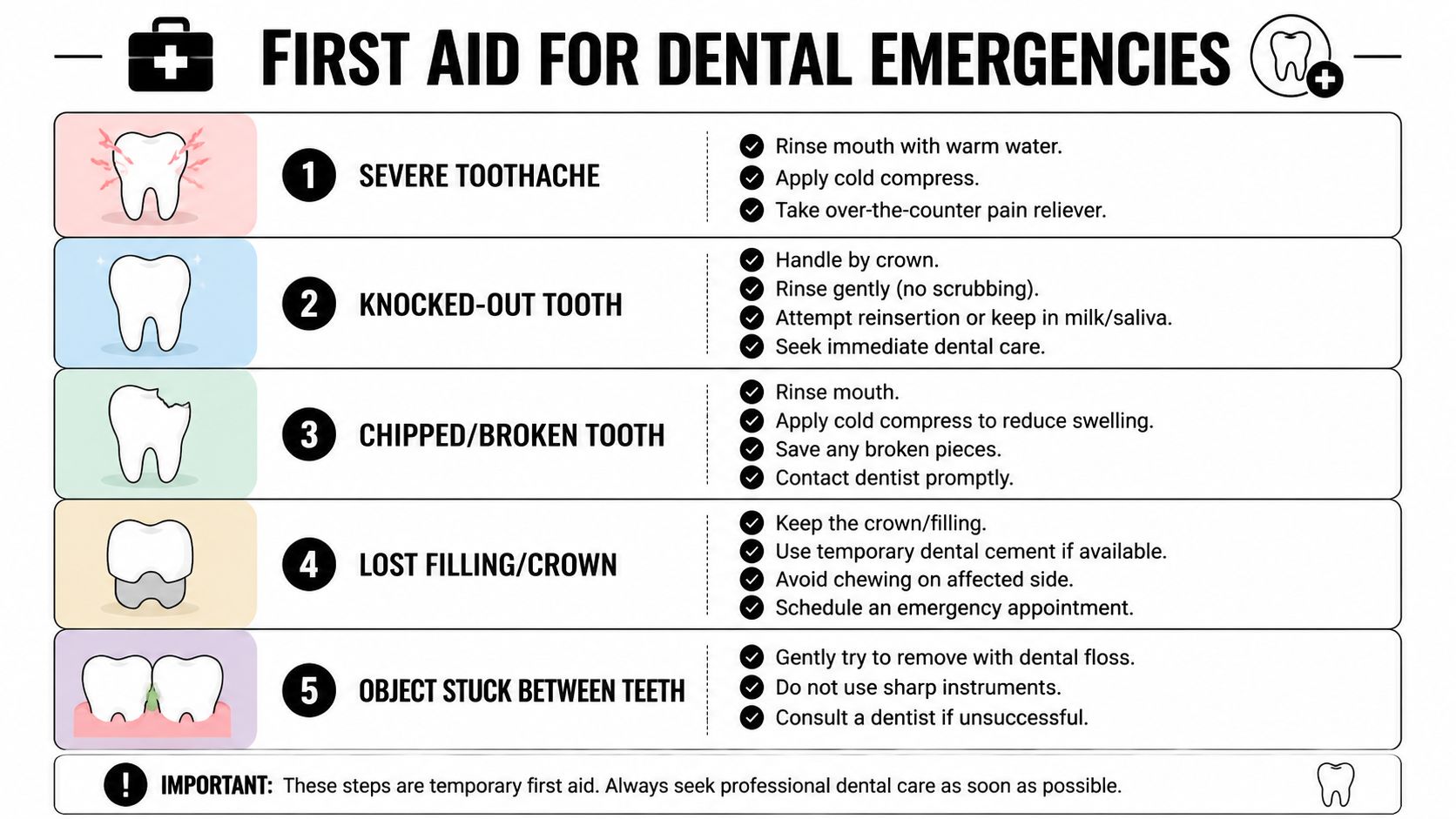
What to do right away
- For a severe toothache, rinse with warm water and check gently for trapped food. A cold compress on the outside of the face can help with swelling. Avoid placing aspirin directly on the gum, because it can irritate the tissue.
- For a knocked-out adult tooth, pick it up by the crown, not the root. If it's dirty, rinse it gently without scrubbing. If you can reinsert it easily, do so. If not, place it in milk or saliva and get urgent dental help.
- For a chipped or broken tooth, rinse the mouth, save any broken pieces, and use a cold compress if the area is swelling. Avoid chewing on that side.
- For a lost crown or filling, keep the crown if you have it and avoid sticky or hard foods. Temporary dental cement from a pharmacy can sometimes protect the area short term. This practical guide for Tamworth patients dealing with a lost filling or crown explains what to do before you're seen.
- For something stuck between teeth, try floss first. Don't use pins, knives, or sharp metal objects. Those often turn a simple problem into a gum injury.
What usually helps and what doesn't
Some home measures are sensible. Others create more problems than they solve.
- Cold compresses help: They can reduce swelling and dull pain from the outside.
- Gentle rinsing helps: Warm salt water can soothe irritated tissue and clean the area.
- Heat usually doesn't help: It can worsen swelling in infected areas.
- DIY glues don't help: Household adhesives should never go in the mouth.
> A useful short-term goal is simple. Keep the area clean, keep swelling down, and keep the tooth or restoration safe until treatment.
Pain relief at the clinic can happen quickly
Many people worry that they'll have to “put up with it” until full treatment starts. In practice, once you're in a proper clinical setting, pain can often be brought under control quickly. Australian guidance notes that inhaled analgesics such as Penthrox (methoxyflurane) may be used in some clinical situations and can provide pain relief in 5 minutes, as outlined in the Australian Prescriber article on managing acute pain.
That doesn't mean every emergency is solved instantly. It does mean there are effective ways to stabilise things once you get to the chair.
Finding After-Hours Dental Care in Tamworth
When people search for 24 7 dental care, they usually mean one of two things. They either need help now, or they need to know there is a reliable pathway if something happens outside usual hours. In regional areas, those are not always the same thing.
What 24 7 dental care usually means in a regional town
In Tamworth, true overnight dental clinics are uncommon. The practical version of after-hours care is usually:
- Phone triage: working out whether the issue is dangerous, urgent, or can wait
- First-aid advice: clear steps to protect the tooth and control symptoms
- Same-day emergency access: reserved appointments during clinic hours for urgent cases
- Hospital referral when needed: for serious facial swelling, major trauma, or airway concerns
That model works better than many people realise. A study from the University of Sydney's Dental Public Health unit found that tele-dentistry triage in rural NSW reduced unnecessary emergency department presentations by 28%, which highlights the value of remote assessment when a physical all-night clinic isn't available, as described by the University of Sydney report on virtual dental care in rural areas.
Dentist or hospital emergency department
A hospital emergency department is the right place if you have trouble breathing, trouble swallowing, major facial trauma, or bleeding that won't stop. But most dental pain, broken teeth, lost crowns, and localised abscesses are better handled in a dental setting, where the team has the right instruments and materials to treat the actual tooth.
Patients also benefit from structured communication systems. For anyone interested in how healthcare teams organise urgent calls and triage, this IntakeAI guide to clinical call centers gives a useful overview of why prompt, clear call handling matters.
If you need local information on appointment pathways, after-hours expectations, and urgent treatment options, the most relevant starting point is this page on emergency dentistry in Tamworth.
> In regional practice, good urgent care isn't about pretending a clinic is open all night. It's about making sure the patient gets the right advice and the right slot quickly.
Your Local Solution for Urgent Dental Care
Regional patients don't need vague promises about round-the-clock dentistry. They need a system that is realistic, responsive, and built for what happens in country towns. That usually means a team that leaves room for urgent cases, can diagnose quickly, and can complete more treatment in one visit.

One of the clearest service gaps in rural Australia is delay caused by clinic hours. The Rural Health Alliance notes that 25% of households delay emergency care due to clinic hours, which is exactly why structured same-day access matters in places like Tamworth, according to the Rural Health Alliance reports.
What a workable emergency system looks like
A strong urgent-care setup in private practice usually includes:
- A cut-off for same-day triage: If a clinic asks emergency patients to call before a certain time, that isn't arbitrary. It helps staff assess the problem properly, reserve clinical time, and avoid unsafe rushing late in the day.
- Chairside diagnosis tools: CBCT imaging can clarify what's happening beneath the surface far more effectively than guesswork when pain, trauma, or infection is involved.
- Single-visit restorative options: CEREC same-day crowns can be valuable in emergencies because they reduce the need for temporary fixes when a heavily damaged tooth needs immediate protection.
- Calmer treatment for anxious patients: Sleep dentistry and other anxiety-management options matter when the pain is urgent and the patient is already distressed.
Why same-day capability matters
The difference between emergency treatment that stabilises the problem and emergency treatment that solves it often comes down to equipment. If a practice can scan, image, design, and restore in-house, the patient may avoid multiple visits while in pain.
That's especially useful when a tooth is cracked, a large filling has failed, or a crown cannot be glued back on. A same-day ceramic restoration is often a stronger answer than a temporary patch.
> Chairside reality: The best emergency appointment doesn't just stop pain. It gives the dentist enough information and enough tools to make the tooth safe again.
Financial stress matters too. Patients are more likely to seek care promptly when the clinic accepts major health funds and supports Medicare or DVA where applicable. That doesn't remove every cost concern, but it lowers one of the barriers that often causes people to wait.
For anyone trying to organise an urgent appointment, the most helpful next step is direct contact through the Tamworth dental contact page. Clear communication early in the day gives the best chance of being seen promptly for a genuine emergency.
Taking Control of Your Dental Health
The immediate priority in a dental emergency is simple. Work out how serious it is, use sensible first aid, and get to the right place quickly. In Tamworth, that usually means understanding that 24 7 dental care is less about a clinic being open all night and more about reliable triage and same-day emergency access.
The longer-term lesson is just as important. Most emergencies don't begin as emergencies. They begin as a crack that wasn't checked, a filling that started leaking, or gum inflammation that stayed quiet until it turned painful. Regular examinations give your dentist a chance to catch those problems before they become a late-night crisis.
That's one reason well-run practices focus on both emergency access and prevention. If you're curious about the broader business side of why good dental practices prioritise responsiveness, follow-up, and patient communication, this expert guide for dentists gives useful context from the practice-management side.
A practical habit helps. Save your dental clinic's number in your phone before you need it. Then book routine care when things are calm, not just when they hurt.
---
If you need urgent dental help in Tamworth, Oasis Smiles Dental offers a practical local pathway for emergencies, including same-day appointments for urgent cases when you call before 1pm. The clinic serves families across Tamworth and the New England region, with modern diagnostics, same-day crown technology, sleep dentistry options for anxious patients, and support for major health funds, Medicare and DVA. Save their details now so you're not searching in a panic later, and if it's been a while since your last check-up, book a visit before a small problem turns into an emergency.