

How to Stop Snoring: Your Guide to Quieter Nights
You finally get into bed, drift off, and then comes the nudge. Or maybe you're the one doing the nudging, lying awake while the person beside you rattles the room. For some people, snoring is just an occasional rough night after a long week. For others, it's become part of bedtime, and that's usually when the questions start.
Why is this happening? Is it just annoying, or is it a sign of something else? And most significantly, how to stop snoring without turning bedtime into a complicated project?
The good news is that snoring often makes more sense once you know what's going on in the airway. Better still, there isn't just one option. Some people improve with a small change in sleep position. Some need medical assessment. And many are surprised to learn that a dentist may be able to help, especially when jaw position, bite, and airway shape are part of the problem.
Why That Nightly Noise Really Matters
A common story goes like this. One partner falls asleep quickly. The other lies there listening to a harsh, uneven sound that gets louder when the snorer rolls onto their back. Then comes the gentle push, the half-awake turn onto the side, a few quiet minutes, and then the snoring starts again.
That pattern is so common because snoring is common. Between 25% to 50% of adults snore regularly, and it's more common in middle-aged or older men and postmenopausal women, according to the American Medical Association's overview of snoring. In plain terms, if snoring is affecting your household, you're far from alone.
What snoring actually is
Snoring happens when air moves through a partly narrowed airway during sleep. As the air pushes through, the soft tissues in the throat vibrate. That vibration creates the sound.
It doesn't always mean something serious is wrong. But it also shouldn't always be brushed off as “just noise”.
> A simple rule: if snoring is frequent, loud, or linked with poor sleep, it deserves a closer look.
Some people notice it most when they're tired, congested, or sleeping flat on their back. Others have a jaw position, bite pattern, or airway shape that makes the throat more likely to narrow during sleep. That's one reason snoring can sit right at the overlap between general health and dental care.
Why paying attention helps
The first reason is practical. Broken sleep affects mood, energy, patience, and the quality of family life. The second reason is health. Snoring can sometimes be an early clue that the airway isn't staying open the way it should overnight.
If you've been wondering whether your symptoms are worth discussing, it can help to read about signs that may point to a sleep management assessment in Tamworth. Many people wait longer than they need to because they assume snoring is too minor to mention.
It isn't minor when it keeps happening.
Quick Fixes You Can Try Tonight
Some snoring solutions are long-term projects. Others are simple enough to try tonight. These quick changes won't fix every cause of snoring, but they can reduce airway narrowing and give you a clearer sense of what makes your snoring better or worse.
Change your sleep position
For many people, the worst snoring happens on the back. In that position, the tongue and soft tissues are more likely to fall backward and narrow the airway.
Try sleeping on your side instead. If you tend to roll back during the night, use a body pillow or place a firm pillow behind your back so side-sleeping feels more stable.
If you want a plain-English guide to how to sleep to stop snoring, that resource gives a useful overview of side sleeping and bed setup ideas.
Raise your upper body, not just your head
This point often confuses people. Sleeping with an extra pillow under your head isn't always enough, because it can bend the neck rather than opening the airway well. A better option is to incline the upper body using a wedge pillow or an adjustable bed base.
Clinical research found that sleeping in an inclined position led to a 7% relative reduction in snoring duration, 4% fewer awakenings, and a 5% increase in deep sleep compared with sleeping flat, based on objective snoring and sleep measurements published in the study.
That matters because the change is mechanical. A gentle incline can reduce the collapse of soft tissues in the airway.
Help your nose do its job
Not all snoring starts in the throat. If your nose feels blocked, you may end up breathing through your mouth, which can make snoring worse.
You can try:
- Nasal strips that lift the sides of the nose slightly
- Nasal dilators that help keep the nasal passages more open
- Steam or a warm shower before bed if dryness and congestion are part of the problem
- A clean bedroom if dust or seasonal irritation seems to trigger a blocked nose
If your nose is constantly blocked, that's worth discussing with a GP or other health professional. Temporary tools can help, but ongoing congestion usually needs a proper look.
Reduce dryness before bed
A dry throat can make tissues feel more irritated. Some people snore more when the room is dry, especially in winter or when the heater is on.
A few low-effort changes can help:
- Keep water nearby so you're not going to bed already dry
- Use a humidifier if the bedroom air feels harsh
- Breathe through the nose where possible, because mouth breathing dries the throat more quickly
> Small bedtime changes can be useful because they test the cause. If one simple adjustment noticeably reduces snoring, that tells you something important about what the airway is responding to.
Build a simple one-night test
Instead of trying everything at once, pick a short combination:
| Tonight's change | Why it may help | |---|---| | Side sleeping | Stops the tongue and throat tissues falling backward as easily | | Wedge pillow or bed incline | Reduces airway narrowing while you sleep | | Nasal strip | Improves airflow if the nose feels blocked | | Water and humidified air | Reduces throat dryness and irritation |
That kind of quick experiment is useful. If your snoring improves with position changes, that's a clue that airway collapse during sleep is playing a large role. If nothing changes at all, that's useful information too, because it may point to a more persistent cause.
Lifestyle Habits for Long-Term Snoring Reduction
Quick fixes are helpful, but lasting improvement usually comes from what happens every day, not just what happens in the bedroom. Snoring tends to respond best when the airway is under less strain overall.
That's why long-term habits matter. They don't just aim for a quieter night. They aim for easier breathing and better sleep quality over time.
Weight and airway pressure
Carrying extra weight can increase pressure around the airway, which makes it easier for soft tissues to narrow during sleep. Not everyone who snores is above their ideal weight, and not everyone with extra weight snores. But when weight is part of the picture, even steady, realistic progress can help.
This is one of those areas where people often get discouraged because they think the goal has to be dramatic. It doesn't. What matters is moving in the right direction with a plan you can maintain.
A useful way to think about it is this: if the airway has less external pressure around it, it may stay open more easily overnight.
Alcohol and sedatives near bedtime
Alcohol can make snoring worse because it relaxes the muscles in the upper airway. Some sedating medicines can have a similar effect.
That doesn't mean everyone who snores has to avoid alcohol completely. It does mean bedtime is the wrong time to test your luck if snoring is already a problem. If you've noticed your snoring is worse after drinks in the evening, trust that pattern.
A practical approach is to watch for your own triggers:
- A late drink can leave the throat more relaxed during sleep
- Several drinks may make snoring louder or more uneven
- Sedating medication may play a role, so it's worth asking your GP if you're unsure
Smoking and airway irritation
Smoking can irritate and inflame the airway. When tissues are irritated, airflow becomes less smooth and breathing at night may become noisier.
This is one reason some people notice their snoring is worse during periods of heavier smoking, after illness, or when the nose and throat feel chronically irritated. Stopping smoking helps many parts of health, and your night breathing may benefit too.
> The aim isn't perfection. It's fewer factors working against your airway every night.
Daytime habits that shape night breathing
Snoring doesn't always start at bedtime. Sometimes the setup has been building all day.
If you spend the day breathing through your mouth because your nose is blocked, if you go to bed overtired, or if your throat feels dry every evening, those patterns can carry into sleep. Paying attention to those smaller clues can help you choose the right next step.
Here are a few habits worth noticing:
- Late, heavy evenings can leave you sleeping more heavily and breathing less comfortably
- Untreated nasal issues may push you into mouth breathing
- Poor sleep routine can make everything worse because fatigue often deepens noisy breathing
A simple way to track patterns
You don't need a complex diary. For a week or two, notice a few details:
| What to notice | What it can tell you | |---|---| | Back sleeping or side sleeping | Whether body position affects the noise | | Evening alcohol | Whether relaxed throat muscles are a trigger | | Nasal blockage | Whether your snoring seems linked to congestion | | Morning feeling | Whether you wake refreshed or feel unwell-rested |
This kind of self-observation helps because snoring often has more than one cause. A person might have mild congestion, occasional back sleeping, and a jaw shape that narrows the airway. No single tip fixes all of that, but a pattern often starts to emerge.
Don't ignore the dental side
This is the part many general snoring guides miss. Your bite, jaw position, dental crowding, palate shape, and tongue posture may all influence how much room your airway has when you sleep.
For example, a lower jaw that sits further back can allow the tongue to sit further back as well. A narrow upper arch or high palate may also leave less space for easy airflow. These aren't things you can solve with a nasal strip.
That's why it's helpful to stop thinking about snoring as only a lifestyle issue. For some people, it's partly a structural issue too. When that's the case, better habits still help, but they may need to be paired with a proper airway and dental assessment.
When Snoring Signals Something More Serious
Some snoring is straightforward. It's noisy, frustrating, and disruptive, but not dangerous. Other times, snoring is the sound of an airway struggling repeatedly through the night. That's the point where it may be linked with obstructive sleep apnoea, often shortened to OSA.
Many people don't realise where the line is. They assume that if they're still functioning during the day, they're probably fine. But the body can get used to poor sleep in ways that make the problem easy to underestimate.

Red flags worth taking seriously
It's time to seek medical advice if snoring comes with signs that breathing may be interrupted during sleep.
Watch for things like:
- Witnessed pauses in breathing
- Gasping, choking, or spluttering during sleep
- Waking unrefreshed even after a full night in bed
- Strong daytime tiredness
- Morning headaches
- Difficulty concentrating or increased irritability
If a partner says, “You go quiet, then suddenly snort or gasp,” that's important information. It can point to an airway that's closing and reopening through the night.
> Loud snoring on its own is one thing. Loud snoring with pauses in breathing is a different conversation.
What usually happens next
The first stop is often your GP. They'll ask about your symptoms, your sleep pattern, how you feel during the day, and what someone else has noticed overnight. If sleep apnoea seems possible, they may refer you for a sleep study.
A sleep study sounds more intimidating than it is. The point is to measure what your breathing is doing while you sleep, rather than guessing based on symptoms alone. Once that information is clear, treatment choices become much more sensible.
If weight is one part of the overall picture, some people also find it helpful to read practical information about managing sleep apnea through weight loss alongside advice from their own doctor.
Where CPAP fits
For moderate-to-severe OSA, CPAP is considered the gold standard. It works by delivering pressurised air through a mask to help keep the upper airway open during sleep. According to Sleep Foundation's overview of snoring treatment, approximately one-third of users discontinue CPAP therapy because of issues such as mask discomfort, claustrophobia, nasal dryness, and noise.
That doesn't mean CPAP isn't effective. It means real life matters. A treatment can be excellent on paper and still be hard for some people to use comfortably every night.
Why alternatives matter
Many patients feel stuck in this situation. They hear that snoring may be linked to sleep apnoea, they learn about CPAP, and they assume the next step is either a machine or nothing.
That isn't always the case.
There are situations where a medical diagnosis is needed first, and then a dental solution may become part of treatment. If you'd like a plain-language explanation of that overlap, this article on how sleep dentistry may help manage sleep apnoea symptoms in Tamworth is a helpful next read.
The key point is simple. If your snoring is paired with warning signs, don't just keep experimenting at home forever. Get the cause clarified.
Advanced Dental Solutions for Snoring
Many people are surprised to hear that a dentist can play a real role in snoring treatment. That's because most generic snoring advice focuses on side sleeping, nasal strips, or weight changes, then jumps straight to CPAP. It often skips the middle ground entirely.
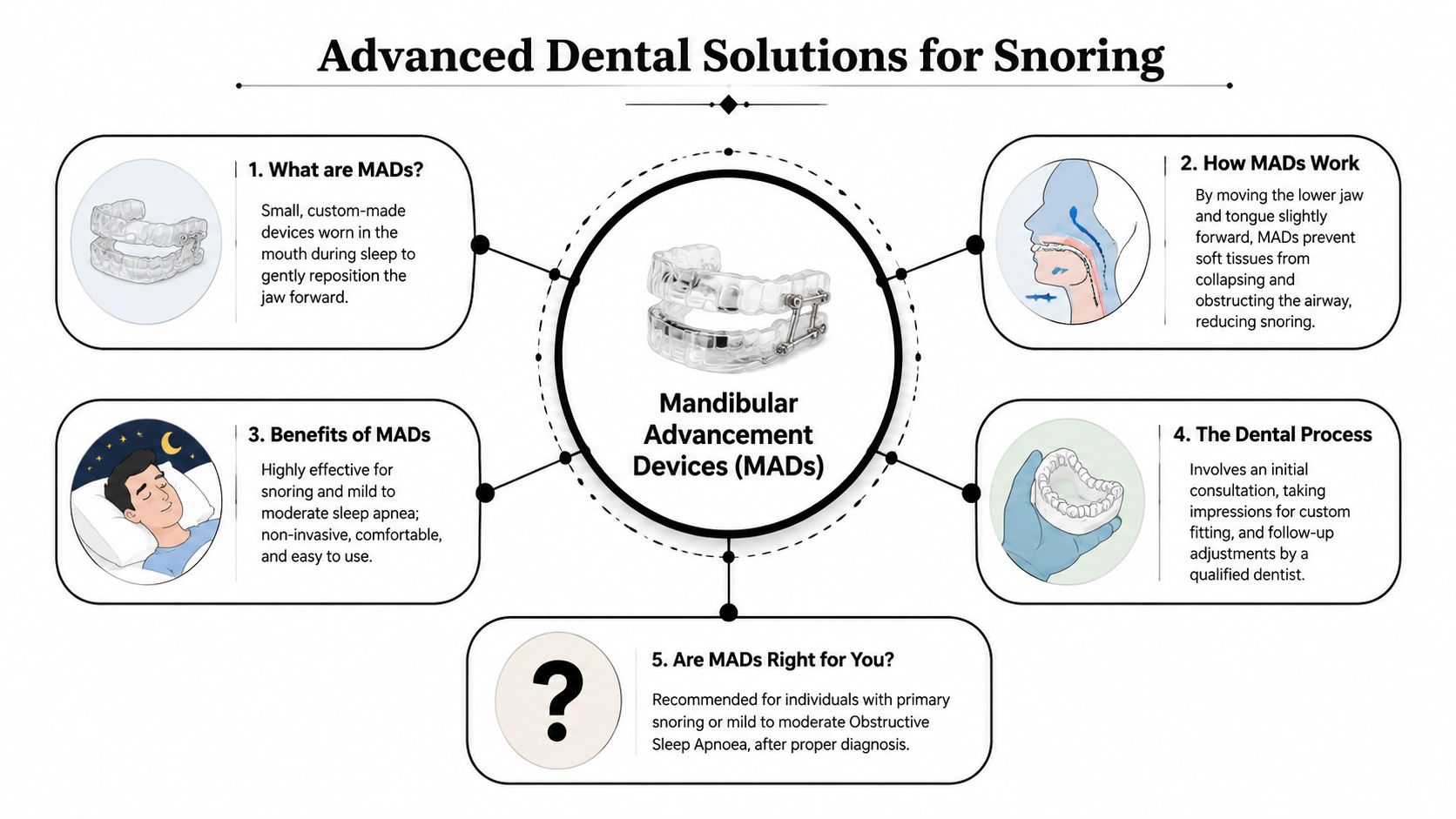
That middle ground is important. In the right patient, a custom-fitted mandibular advancement device, often shortened to MAD, can be a practical and evidence-based option.
What a MAD actually is
A MAD is not just a generic “mouthguard”. It's a custom oral appliance worn during sleep that gently holds the lower jaw further forward than its usual resting position.
That small change can make a meaningful difference because the lower jaw, tongue, and soft tissues are connected in the airway space. When the jaw sits a little further forward, the airway is less likely to collapse.
What the evidence says
Randomised controlled trials show that custom-fitted mandibular advancement devices are highly effective for reducing snoring, with the evidence graded at level 1b and recommendation grade A in the clinical review available through this published source on oral appliance therapy.
The same review explains that these devices typically advance the jaw by 6 to 10 mm, which can increase airway space by approximately 40% to 60%.
Those numbers matter because they explain why these appliances are different from over-the-counter boil-and-bite products. The aim isn't just to put something in the mouth. The aim is to position the jaw precisely enough to improve airflow while keeping the device wearable and tolerable.
Why bite and jaw position matter
This is the dental angle many people haven't heard before. If your lower jaw sits back, if your bite relationship reduces tongue space, or if your oral anatomy leaves less room in the airway, snoring may be partly structural.
That's why two people with similar lifestyle habits can have very different sleep breathing. One person improves with side sleeping alone. Another doesn't, because their jaw position keeps contributing to airway narrowing night after night.
A dentist trained in this area looks at more than teeth. They consider how the teeth meet, where the lower jaw sits, whether the appliance can be worn safely, and how to balance airway improvement with comfort in the jaw joints and muscles.
What the process usually involves
A proper MAD isn't chosen in one quick guess. It's usually part of a careful sequence.
- Assessment and diagnosis
- Records and fitting
- Gradual adjustment
- Follow-up
> The best oral appliance is not the one that pushes the jaw furthest. It's the one that improves the airway and is comfortable enough to wear consistently.
Why custom matters
A boil-and-bite product may seem simpler, but it can be bulky, unstable, or poorly positioned. A custom appliance is made for your mouth, your bite, and your treatment goal.
That's especially important if you already have dental work, jaw tension, bite wear, or missing teeth. An oral appliance has to fit into the situation of your mouth, not just the theory of snoring treatment.
For people in the New England region who want to understand what a professionally made device involves, the oral appliance treatment page explains how a dental sleep appliance is used to support the airway during sleep. At Oasis Smiles Dental, these appliances can be planned as part of a broader dental and airway assessment using digital records where appropriate.
Who may benefit most
A dentist-fitted MAD may be suitable for people who:
- Snore regularly and haven't improved enough with simple changes
- Have been diagnosed with mild-to-moderate sleep apnoea and need a non-invasive option
- Struggle with CPAP comfort or nightly use
- Suspect their jaw position or bite may be contributing
Not everyone is an ideal candidate. Some people need medical treatment first. Others may need a combined approach. But when the anatomy of the mouth and jaw is part of the problem, a dental appliance can directly address the mechanics of the airway in a way that generic snoring advice cannot.
Your Tamworth Action Plan for a Quiet Night's Sleep
If you live in Tamworth or the wider New England region, the best approach is usually the simplest one. Don't jump straight to the most complicated treatment. Start by narrowing down what kind of snoring you're dealing with.
That means a calm, practical plan.

Step one starts at home
Begin with the changes that are easy to test over the next week or two.
Try: - Side sleeping instead of back sleeping - A wedge pillow or gentle upper-body incline - Reducing evening alcohol if it seems to make snoring worse - Addressing nasal blockage and throat dryness - Watching for patterns linked to fatigue, congestion, or mouth breathing
If the snoring settles, that's useful. Keep going with what works.
Step two is knowing when home care isn't enough
Book in with your GP if your snoring is persistent, worsening, or linked with daytime exhaustion, choking sounds, or pauses in breathing. That's the point where guessing can waste time.
A medical review helps sort out whether you're dealing with straightforward snoring, sleep apnoea, or a mix of problems. Once you know that, choosing treatment becomes much easier.
Step three is considering a dental airway assessment
A major gap in mainstream snoring advice is that it often gives very little detail about dentist-fitted oral appliances, even though they're recognised by the Australian Dental Association as a primary, non-invasive treatment for snoring and mild-to-moderate sleep apnoea, as noted in this discussion of snoring solutions and oral appliances.
That matters locally because many people in Tamworth don't realise a dentist may be able to assess the part their bite, jaw position, and oral anatomy are playing in night-time breathing.
A local checklist you can follow
| If this sounds like you | Next step | |---|---| | You snore mainly when sleeping flat | Trial side sleeping or a wedge setup | | You snore and feel blocked through the nose | Address congestion and monitor changes | | You snore often and feel tired in the day | See your GP for assessment | | You've been told your jaw or bite may be part of it | Ask about a dental airway review |
If you're getting ready for an appointment, the first visit information for new patients can help you know what to expect before coming in.
For local families, the practical next move is simple. Start with the low-risk changes tonight. If the snoring keeps going, get it assessed. If jaw position, bite, or airway structure may be involved, ask whether a dentist-led oral appliance could be appropriate. A quieter night often starts with understanding the cause, not just trying random products.
---
If snoring is affecting your sleep, your partner's sleep, or raising concerns about sleep apnoea, you can arrange a consultation with Oasis Smiles Dental. The clinic is located at Shop 15/1 Piper Street, near Northgate Shopping Centre in Tamworth. A consultation can help clarify whether simple changes, GP review, or a custom oral appliance is the right next step for you.