

Dental Partial Repair: Your Guide to Fast Local Fixes
When a partial denture breaks, the first thought is usually: What do I do now? It might happen at breakfast, while cleaning it over the sink, or halfway through a normal workday in Tamworth. One small crack can suddenly make eating awkward, speech unclear, and smiling feel uncomfortable.
If that's where you are right now, take a breath. A broken partial is upsetting, but it's also a problem dentists deal with often. In regional areas like Tamworth and across the New England region, getting the right repair quickly matters even more because nobody wants to spend days or weeks waiting on a city lab if it can be avoided.
A partial denture does more than fill a gap. It helps support chewing, keeps nearby teeth from drifting, and restores day-to-day confidence. When it breaks, the issue isn't only cosmetic. The fit can change, pressure can shift to the wrong places, and a small defect can turn into a larger one if it's ignored.
That Dreaded Snap When Your Partial Denture Breaks
The sound is usually what patients remember. A sharp little snap while biting into toast. A crack after dropping the partial in the bathroom. A clasp that suddenly gives way when taking it out at night. It feels dramatic because it interrupts something personal and essential.
The good news is that partial denture damage is common. Data summarised by Impressions Dental's denture statistics overview notes that about 20% of new denture wearers require adjustments within the first three years, and partial dentures can reach a 41% failure rate after 10 years of use, mainly because of fractures from material erosion. That won't make the moment less annoying, but it should reassure you that this isn't unusual or a sign you've done something wrong.
Why it feels like such a big problem
A partial denture sits right at the intersection of comfort, function, and appearance. When it breaks, even slightly, people often notice:
- Eating becomes cautious. You start chewing on one side or avoiding certain foods altogether.
- Speech can change. A small shift in fit can affect the way air moves around the appliance.
- The mouth can get sore. Sharp edges and movement can irritate the gums or press against natural teeth.
- Confidence drops quickly. Many patients worry other people will notice before anyone does.
> A broken partial usually feels urgent because it affects several parts of life at once, not just one.
For patients in Tamworth and nearby towns
Regional patients often have an extra layer of stress. They're not just asking whether the partial can be repaired. They're asking how fast it can happen, whether they'll need to travel, and whether they'll be left without it while a lab handles the work elsewhere.
That's why the first step matters. Don't try to force the appliance back into place. Don't keep wearing it if it's unstable. And don't assume a home fix will hold long enough to get by.
Most breaks are manageable. The key is getting the denture assessed properly, early, and with a plan that matches the actual damage.
Understanding Common Partial Denture Damage
Partial dentures rarely break in a random way. The pattern of damage usually points to what has been happening in the mouth for some time, and that affects whether a repair will hold or whether a replacement part is the better option.
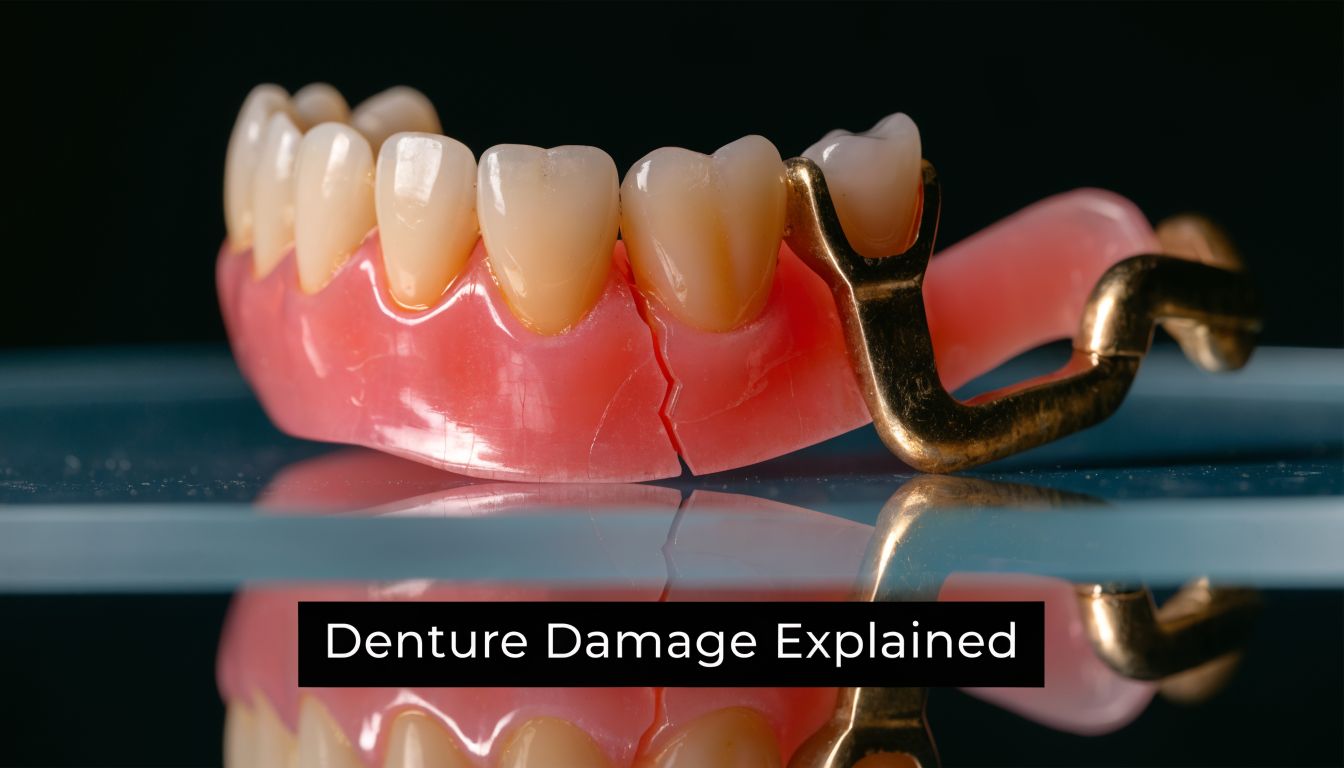
If you are unsure whether you have a metal partial, an acrylic partial, or a full denture, our guide to partial and full dentures explains the difference and helps make sense of the repair options.
The most common break points
A partial denture has several components, and each tends to fail in its own way.
- Acrylic base cracks. The pink base can split after being dropped, but I also see cracks caused by repeated flexing during chewing when the fit has changed.
- Metal clasps loosen or snap. Clasps are designed to flex within limits. Once they are bent in and out repeatedly, the metal can weaken and stop gripping properly.
- A denture tooth comes away. Sometimes the tooth itself is intact and only the bond has failed. In other cases, the acrylic underneath has worn or fractured as well.
- The framework distorts. A metal frame does not have to snap to cause trouble. Even a slight bend can change how the partial seats against teeth and gums.
Why this damage happens
Some failures are sudden. A drop onto bathroom tiles can do it in a second. Others are gradual and more common in day-to-day practice in Tamworth.
A partial that no longer fits the gums closely can rock during meals. A clasp that has loosened can shift extra force onto another part of the frame. Changes in natural teeth, grinding, or an uneven bite can all create small stress points that build up unnoticed until something gives way.
Clinical repair literature notes that fractures in removable partial dentures are often associated with metal fatigue or casting problems in high-stress areas, particularly around saddles and pontics, as described in this PubMed-indexed review of removable partial denture design and failure considerations. That lines up with what we see in practice. The visible break is often the final stage of a problem that started earlier.
What patients often do not see
The obvious damage is not always the full story.
A missing clasp may seem like the whole issue, but the underlying problem may be that the denture has been sitting unevenly for months. A tooth that has come off may be repairable, yet the base holding it may already be thin or cracked. If that underlying strain is missed, a quick repair can fail again.
This matters even more in a regional centre. If a partial is sent away to a metro lab without a careful assessment first, patients can lose days and still end up with a repair that does not address the underlying cause. With modern in-house options such as digital scans, 3D printing, and CEREC support where appropriate, the assessment can be faster and the repair plan more precise.
The goal is not just to reattach what broke. The goal is to make the partial stable, comfortable, and safe to wear again.
Professional Repair vs Temporary DIY Kits
When a partial breaks, most patients choose between two paths. One is a proper clinical repair. The other is a temporary home fix bought in a chemist or online. They are not equal options.
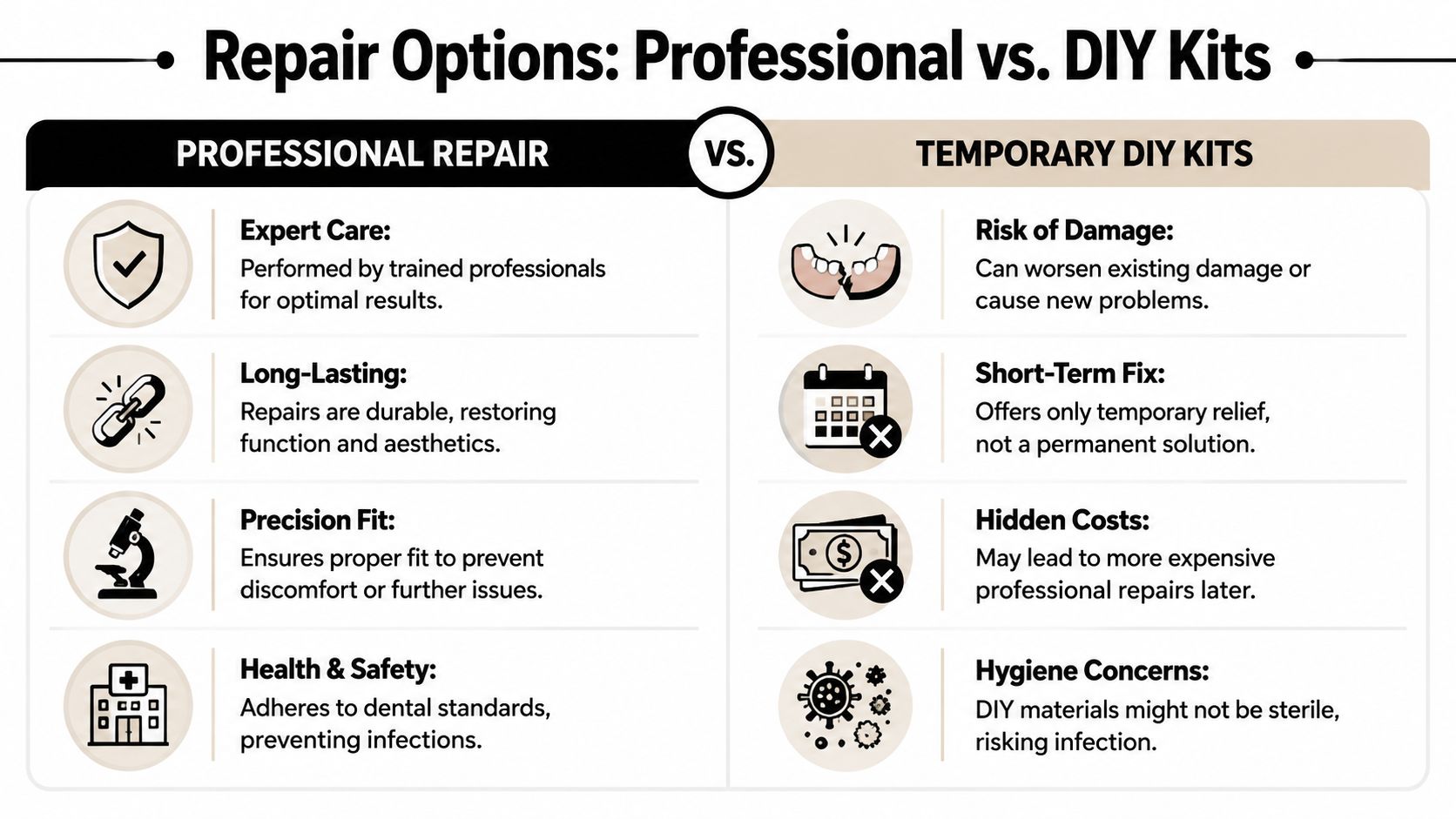
What a professional repair actually does
A clinical repair doesn't just stick pieces back together. The denture is examined for fit, fracture pattern, stress points, and whether repair is sensible at all. In some cases, the best treatment is reinforcement or remake rather than patching the obvious break.
Professional repairs can involve very specific methods that cannot be reproduced at home. Historical evidence on fixed partial dentures also gives a useful warning about simplistic fixes. A study discussed in PubMed's record on rebonding and renewal outcomes found that 39% of rebonded partials dislodged, showing the limitations of simple rebonding and the value of a more thorough repair approach.
That doesn't mean every broken partial needs replacing. It means the method matters.
Why DIY kits are tempting and why they usually disappoint
The attraction is obvious. A kit is quick, private, and seems cheaper at first. If you've got a family event, work the next day, or a long drive into town, a home patch can sound reasonable.
The problem is that DIY kits usually solve the wrong problem. They focus on sticking, not fit. They don't correct bite pressure. They don't assess whether a clasp has deformed. They don't account for tiny shifts that can rub the gums or overload a natural tooth.
Common problems with DIY fixes include:
- Misalignment. Once parts are glued in the wrong position, professional repair becomes harder.
- Extra damage. Adhesives can contaminate the fracture line and weaken the final repair.
- Mouth irritation. Rough edges or a warped fit can create sore spots quickly.
- False confidence. Patients keep wearing a damaged appliance longer than they should.
> Practical rule: If you wouldn't trust a hardware-store glue to repair your glasses properly, don't trust a home kit to repair a device that sits against your gums and teeth all day.
Side-by-side comparison
| Feature | Professional Repair (Oasis Smiles Dental) | DIY Temporary Kit | |---|---|---| | Assessment | Dentist checks the break, fit, bite, and whether repair is appropriate | No clinical assessment | | Materials | Dental materials and lab methods chosen for oral use | Consumer-grade temporary materials | | Precision | Repair is aligned to the denture and the mouth | Easy to set pieces in the wrong position | | Safety | Done within documented clinical standards | Unregulated home repair | | Durability | Designed to restore function for real day-to-day use | Short-term patch at best | | Future treatment | Keeps options open for adjustment, reline, or remake | Can complicate later repair |
The real trade-off
A professional repair asks for more effort up front. You need an appointment, an assessment, and sometimes a short wait while the work is completed. But it gives you a much better chance of getting back a partial that fits, functions, and doesn't create a second problem.
A DIY kit asks less at the start and often costs more in the end. Not always in dollars immediately, but in avoidable damage, discomfort, and repeat treatment.
Your Repair Journey at Oasis Smiles Dental
The part that unsettles patients most is often the gap between the break and the answer. A partial snaps at breakfast, before work, or just before a family event in Tamworth, and the first question is simple. Can this be repaired today, or will I be stuck waiting?

From the first phone call
A good repair process starts with a calm, practical conversation. The team needs to know what has broken, whether the partial is in pieces, whether any wire or metal is bent, and whether it is causing pain or rubbing. That helps us judge how urgently you need to be seen and whether to keep the appliance out until we assess it.
For patients in a regional centre, speed matters in a very real way. If a repair can be assessed and managed locally, that often means less time off work, fewer disrupted meals, and less of that self-conscious feeling that comes with suddenly being without teeth. Patients who are new to the practice often feel more settled after reading what a first dental visit looks like, especially if they are worried an urgent appointment will feel rushed.
Once you arrive, the job is to make sound decisions early. We check the break itself, how the partial sits, whether the bite has shifted, and whether the supporting teeth and gums are still healthy enough for a repair to make sense. A fast answer is helpful. A correct answer is better.
Why local in-house technology matters in Tamworth
Years ago, many regional patients had one frustrating path. The denture was checked locally, packaged up, then sent to a metro lab. That added freight time, lab queue time, and the risk that the repaired partial still needed adjustment when it came back.
In-house technology can shorten that process considerably for suitable cases. Digital scanning, CBCT where needed, CEREC workflows, and in-house 3D printing help us record the shape accurately and move quickly when a repair, copy, or replacement step can be done on site. That does not mean every broken partial is a same-day job. It means the decision and the next step can often happen faster, without sending you into a long waiting loop.
The clinical side matters, but so does the front desk and scheduling side. Practices that invest in streamlining dental practice operations can usually respond to urgent repair calls more efficiently, which patients notice straight away.
What the appointment usually involves
The repair visit is usually straightforward. First, we examine the partial outside the mouth. Then we check the fit in the mouth if it is safe to do so, look for pressure spots, and confirm whether the break is isolated or a sign that the appliance has been under strain for some time.
From there, there are usually three possible paths. A suitable minor break may be repaired promptly. A more complex case may need extra steps to restore fit and function properly. Some partials are so worn, distorted, or poorly fitting that a repair would only postpone another failure, and in those cases I would rather say that clearly than patch it and send you home disappointed.
Patients often ask whether modern same-day repair is real. In the right case, yes. With local equipment and the right materials, some repairs can be completed much faster than the old send-away model. That is one of the practical advantages of being treated in a clinic that has invested in current in-house systems rather than relying on a distant lab for every step.
What matters most is that you leave with a clear plan. You should know whether the partial is being repaired, adjusted, remade, or left out temporarily for your own safety, and you should know why.
Understanding Costs Timelines and Payment Options
Cost is one of the first questions patients ask, and fairly so. The answer depends on what's broken, whether the fit needs to be corrected, whether the framework is involved, and whether the appliance is still a good candidate for repair.
What affects the price
A simple crack in acrylic is different from a broken metal clasp or a distorted framework. Chairside repair may be possible in some situations. Other cases need more involved work, extra documentation, or outside lab steps.
For broad context, Balmoral Dental Center's denture repair guide notes that government schedules might reimburse around $250 to $400 for a repair, while actual regional out-of-pocket costs can be higher. That's exactly why it's important to check your health fund limits, DVA or Medicare eligibility where relevant, and what payment support the clinic offers before treatment starts.
How long repairs usually take
Timelines depend on complexity more than anything else.
- Minor repairs may be done the same day if the break is straightforward and the clinic has in-house capability.
- Moderate repairs can take longer if the fit needs reassessment or reinforcement.
- Complex framework issues may need additional lab work, especially if the metal structure has failed.
For regional patients, local technology, such as digital scanning and in-house fabrication, can make a real difference by shortening delays that used to be accepted as normal.
Payment support matters
The practical side of care is easier when there's a clear payment conversation early. Patients should ask about:
- Private health fund claiming through on-the-spot systems where available
- DVA and Medicare eligibility if applicable
- Flexible payment arrangements for more involved treatment
- Whether repair or replacement gives better value in the long run
If you want to understand what support may be available before booking, the clinic's payment options information is a useful starting point.
> The cheapest quote isn't always the lowest-cost outcome. A weak repair that fails again can be more expensive than a proper fix done once.
Immediate Steps and Preventing Future Breaks
If your partial has broken today, keep things simple. Don't test it. Don't trim it. Don't glue it.
What to do right now
- Collect every piece. Even small fragments can help with an accurate repair.
- Rinse your mouth gently if the break happened while you were wearing it.
- Store the denture safely in a clean container so nothing else is lost or bent.
- Stop wearing it if it feels loose, sharp, or unstable.
- Arrange urgent assessment through an emergency dental appointment if you're in pain or can't use the appliance safely.
What not to do
Superglue is the classic mistake. So is forcing the partial back into place and hoping it will hold until the weekend. Both can worsen the break and make proper alignment harder later.
There's also an important quality issue here. In Australia, denture repair is a standardised, documented clinical procedure with ADA coding and guidelines for billing and claims through private health funds, Medicare, and DVA, as explained in this overview of dental code D5621 and repair documentation. That professional framework is one of the clearest differences between regulated dental partial repair and an unregulated DIY fix.
Reducing the chance of another break
A few habits help:
- Clean it over a folded towel or sink of water so drops are less likely to cause fractures.
- Avoid bending clasps yourself when the fit changes.
- Be careful with very hard or sticky foods if the denture already feels worn.
- Keep regular check-ups so small fit changes are picked up before they become a break.
A broken partial feels disruptive, but it's usually manageable with the right help and the right timing.
---
If your partial denture has cracked, bent, or become uncomfortable, Oasis Smiles Dental can help you get clear answers quickly. Their Tamworth team offers modern assessment, same-day emergency appointments for calls before 1 pm, and practical repair options designed to get local patients back to eating, speaking, and smiling with confidence.