

Valplast Single Tooth Denture: Your Tamworth Guide
Losing one tooth can feel bigger than it sounds. You might catch yourself smiling with your lips closed, turning your head in photos, or chewing on one side because the gap feels strange.
For many people in Tamworth, the first question isn’t “What’s the fanciest treatment?” It’s “What can replace this tooth comfortably, naturally, and without making life harder?” A valplast single tooth denture is one of the options that often comes up in that conversation.
It’s a removable replacement for one missing tooth, designed to be light, flexible, and far less noticeable than the older-style partial dentures many people remember. If you’ve been told you may need a bridge, an implant, or a denture, this guide will help you understand where Valplast fits, where it shines, and where it may not be the best choice.
Your Complete Guide to the Valplast Single Tooth Denture
When someone loses one tooth, they often feel caught in the middle. The gap may be too obvious to ignore, but a full treatment plan like an implant can take time, healing, and a bigger budget. That’s where a valplast single tooth denture can make sense.
Think of it as a small, custom-made removable tooth replacement that fills the space without involving surgery. It’s usually used when a person wants something discreet and comfortable while they decide on a longer-term plan, or when they prefer a removable option from the start.
A lot of confusion comes from the word “denture”. Many people picture a bulky plate that moves around. A single-tooth Valplast denture is very different from that image. It’s much smaller, made from a flexible nylon material, and designed to blend with the colour of your gums rather than showing metal.
If you’re comparing choices, it helps to start with the basics. A valplast single tooth denture is often considered when you want:
- A natural look that avoids visible metal clasps
- A removable option that doesn’t require surgery
- An interim solution while planning something like an implant
- A gentle approach for a mouth that has just had an extraction
For local patients looking into denture treatment options, this kind of appliance often sits in the “practical and cosmetic” category. It can restore your smile quickly, help with day-to-day confidence, and give you breathing room to make a longer-term decision.
> A missing tooth changes more than appearance. It changes how your mouth feels when you speak, bite, and smile.
Understanding This Flexible and Invisible Tooth Replacement
A valplast single tooth denture is made from a flexible nylon-based material rather than the hard acrylic many people associate with older-style dentures. That difference shapes how it feels, how it looks, and how discreetly it sits alongside your natural teeth.
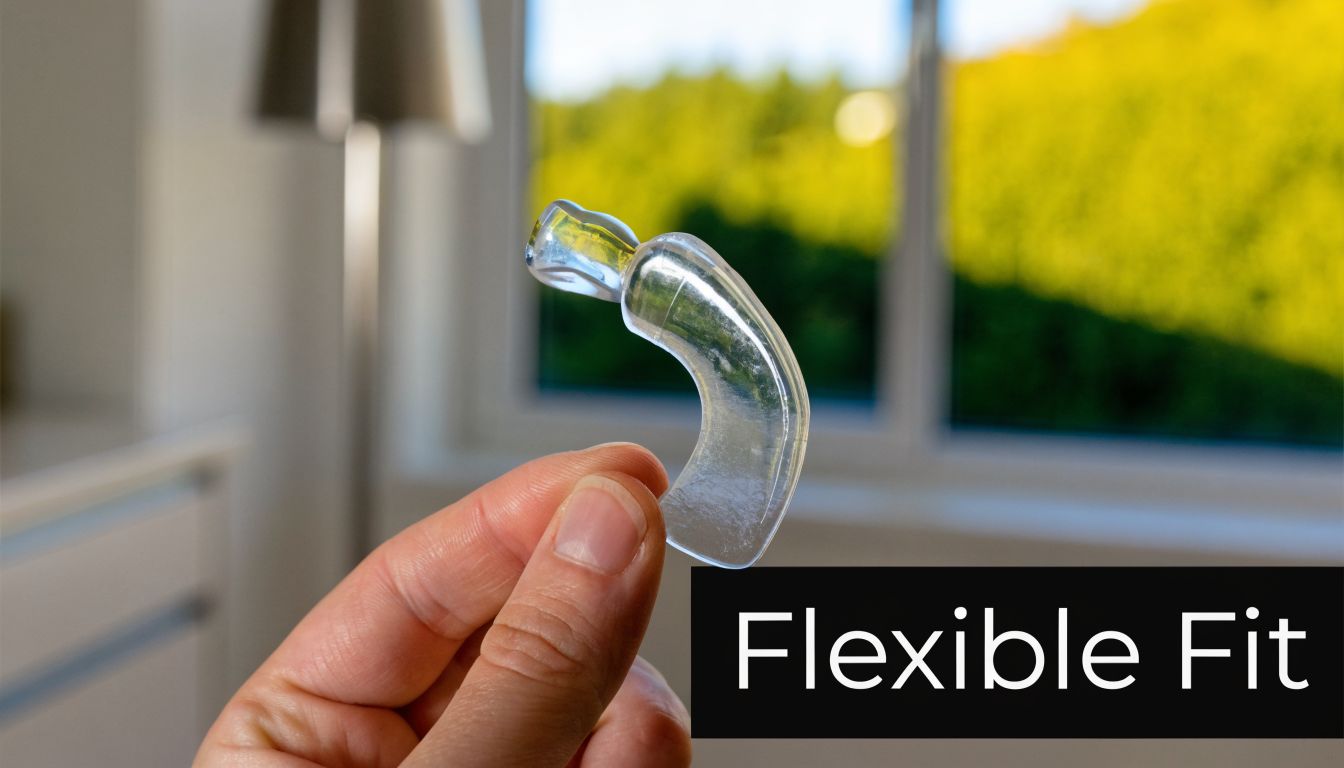
At Oasis Smiles Dental, we often explain it as a small removable replacement designed to blend into the mouth rather than announce itself. For many Tamworth patients, that matters just as much as replacing the gap. If you can smile, speak, and laugh without feeling like everyone is staring at a metal clasp, the treatment tends to feel more acceptable in everyday life.
What makes Valplast different
The main difference is flexibility.
A traditional temporary denture is usually rigid. Valplast has some controlled bend to it, so it can adapt more closely to the shape of the gums and nearby teeth. In simple terms, a stiff appliance sits on the mouth. A flexible one can follow the mouth more gently.
That does not mean it goes loose or floppy. It means the material has enough give to improve comfort and reduce the bulky feel some patients dislike in more conventional removable options.
It also means the denture can often stay in place without obvious metal clasps. Instead, the gum-coloured material lightly engages the neighbouring teeth in a less noticeable way.
Why patients like the look
Appearance is a big reason people ask about Valplast, especially when the missing tooth shows in the smile line.
The base is designed to blend with the gums, and the flexible clasps are tissue-coloured rather than shiny silver. That softer appearance can make a single-tooth denture look less medical and more natural at a normal speaking distance.
“Invisible” doesn’t mean unseen. It means the denture usually draws much less attention than older removable designs.
That distinction helps. Patients sometimes hear the word invisible and expect something impossible. A better expectation is this: people are far less likely to notice the appliance unless they are looking closely.
Why the material matters
Valplast is made from a biocompatible thermoplastic nylon resin. In everyday language, that means it is designed to be worn comfortably in the mouth and to flex a little during normal use.
For some patients, the monomer-free material is also reassuring because they have concerns about the ingredients used in certain acrylic appliances. The material choice is only one part of the decision, but it does help explain why Valplast feels different from a basic flipper.
Here is what that can mean day to day:
- Lighter feel for many patients, especially compared with bulkier rigid plates
- Closer adaptation to the natural gum shape
- No visible metal clasps in many single-tooth designs
- Simple removal for cleaning at home and taking out overnight
A good fit still matters more than the material alone. That is one reason our team uses digital dental technology, including modern scanners and 3D planning tools to make the process more precise and easier to understand.
A valplast single tooth denture does not replace a tooth root, and it will not feel identical to a natural tooth. But it can be a very practical middle option. For the right patient, it restores the appearance of the smile, keeps the treatment removable, and feels far more refined than the word “denture” often suggests.
The Valplast Fitting Journey at Oasis Smiles Dental
Patients often feel better once they know what happens. The process is usually calmer and more straightforward than they expect.
Step one starts with the conversation
The first appointment is about the gap, but it’s also about you.
Some patients want something temporary while they heal after an extraction. Others want to avoid surgery. Some are mainly worried about how the missing tooth looks when they smile. Those details shape whether a valplast single tooth denture is sensible, or whether another treatment would suit better.
This is also where we check the nearby teeth and gums, because even a small removable appliance depends on a healthy environment around it.
The scan replaces the old goopy impression for many patients
One of the nicest changes in modern dentistry is that many cases can now be planned digitally. Instead of a bulky tray of impression material, a Trios digital scanner can capture the mouth in a more comfortable way.
That gives a detailed 3D model and helps with accuracy. Patients often like being able to see their own teeth on screen, because it turns a confusing treatment into something concrete.
Our clinic technology includes digital scanning, CBCT imaging, and in-house planning tools, which you can see on the Oasis Smiles Dental technology page.
The design phase is where fit and comfort are decided
This stage matters more than people realise.
A Valplast appliance is made from a biocompatible, 100% monomer-free nylon thermoplastic resin. According to Bremadent’s Valplast denture overview, its flexible clasps and uniform base thickness of 1.5mm help it adapt to the mouth’s contours and reduce pressure on adjacent teeth. The same source notes this makes it useful for immediate replacement after an extraction, so the site can heal undisturbed.
In practical terms, the dentist and lab are thinking about questions like:
- Where should the support come from
- How can the denture stay discreet when you smile
- How can chewing force be spread gently
- How can insertion and removal stay simple
The fitting appointment is usually fine-tuning, not guesswork
When the denture is ready, the first job is to seat it gently and check the basics. We look at how it sits, how it feels, and whether the bite closes evenly.
You’ll usually be shown how to insert and remove it without twisting it the wrong way. That sounds minor, but it makes a big difference to comfort and long-term wear.
Common early feedback includes:
- “It feels strange at first”. That’s normal. Your tongue notices any new shape quickly.
- “It looks better than I expected”. This is common with tissue-toned flexible clasps.
- “Do I wear it all day?”. Your dentist will guide you based on your case.
> The best fitting appointment isn’t one where you feel nothing straight away. It’s one where the denture sits properly, your bite is checked carefully, and you know what to expect over the next few days.
Adjustments are part of the journey
Even a well-made denture may need small tweaks after you’ve worn it at home.
That doesn’t mean something has gone wrong. Mouths are dynamic. Your speech, bite, and cheek muscles all test the appliance in ways that a chairside fitting can’t fully mimic.
Is a Valplast Denture the Right Choice For You
A valplast single tooth denture can be a very good option. It can also be the wrong one. The key is matching the denture to the tooth position, your bite, your gum health, and your long-term goals.
Good fit if you want these things
You may be a strong candidate if several of these sound like you:
- You want a removable replacement rather than surgery.
- You need an interim tooth while planning an implant or another definitive treatment.
- You’ve had a recent extraction and want the area to heal without a fixed restoration immediately going in.
- You dislike the look of metal clasps and want something more discreet.
- You’ve had trouble with rigid acrylic appliances and want a more flexible feel.
This option can be particularly appealing to first-time denture wearers because it often feels less bulky and less confronting than the word “denture” suggests.
Situations where another option may be better
A balanced discussion matters here.
A Valplast denture isn’t automatically ideal just because it looks natural. Certain front-tooth situations need extra caution, especially if long-term gum appearance is a major concern.
A 2011 clinical study found that when Valplast was used as a temporary restoration for a single missing front tooth, it caused labial gingival recession in adjacent teeth, which makes it potentially unsuitable in some anterior cases where gum health is the priority, according to the PubMed record for that study.
Consider alternatives if these apply
- Your missing tooth is at the front and gum appearance is critical
- Your surrounding gums are already fragile or receding
- You want the most fixed, tooth-like option possible
- You don’t want to remove the appliance for cleaning
- You have bite conditions that may make retention difficult
> Comfort and cosmetics are important, but gum health matters just as much. For some single front-tooth gaps, the more honest answer is that another treatment may protect the tissues better.
The real decision often comes down to purpose
Ask yourself one practical question. Is this meant to be a bridge to the next step, or is it the solution you want to live with for years?
If it’s a bridge to a future implant, a valplast single tooth denture can be very useful in selected cases. If you want the closest thing to a fixed natural tooth and you’re suitable for it, an implant may fit your goals better.
If cost, healing time, or avoiding surgery matters most, Valplast often stays firmly in the conversation. If tissue stability around a visible front tooth is your top concern, a dentist may steer you elsewhere.
Comparing Your Single Tooth Replacement Options
When patients compare treatments, they usually care about the same five issues. How it looks. How it feels. How long it takes. What it does to the teeth next to it. And what it may cost over time.
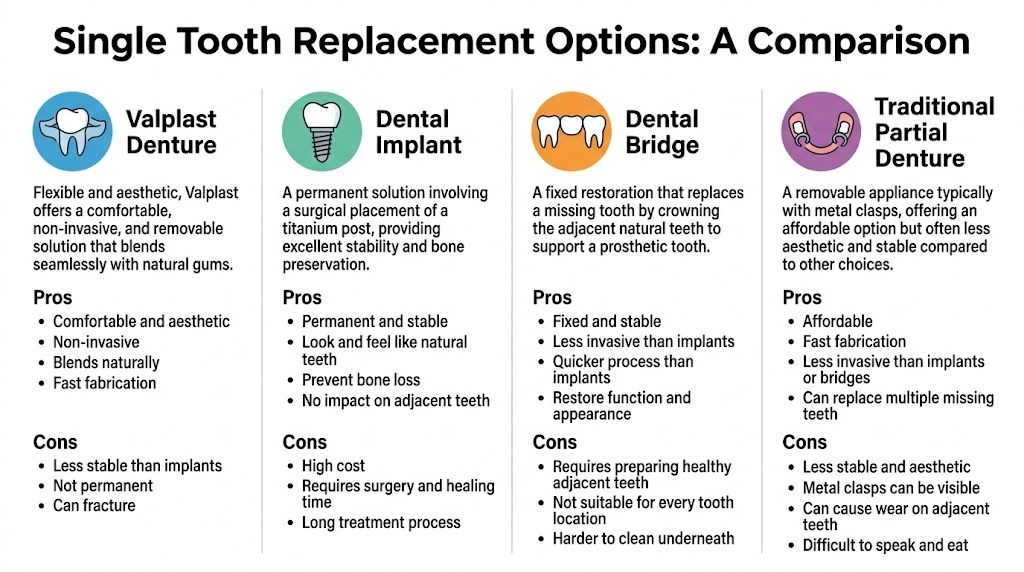
Single-Tooth Replacement At a Glance
| Factor | Valplast Single-Tooth Denture | Dental Implant | Fixed Bridge | Acrylic 'Flipper' Denture | |---|---|---|---|---| | Appearance | Gum-coloured, flexible, usually discreet | Very natural-looking once restored | Natural-looking when well made | Can look acceptable but often bulkier | | Feel | Flexible and lightweight | Closest to a fixed tooth | Fixed in place | More rigid and often less refined | | Treatment style | Removable, non-surgical | Surgical then restorative | Fixed restoration | Removable, non-surgical | | Effect on nearby teeth | Usually avoids cutting adjacent teeth | Usually avoids cutting adjacent teeth | Requires preparation of neighbouring teeth in many cases | Usually avoids cutting adjacent teeth | | Use case | Interim or removable cosmetic option | Long-term fixed replacement | Fixed option when adjacent teeth are suitable | Temporary or budget-focused option | | Cleaning | Removed for cleaning | Cleaned like a tooth with extra care | Cleaned in place with special attention under bridgework | Removed for cleaning | | Cost position | Mid-range among removable options | Usually highest upfront | Often between denture and implant, depending on case | Often lower-cost entry option |
Valplast compared with an implant
A dental implant is the option many patients think of as the gold standard. It replaces the missing tooth with a fixed crown supported by an implant placed in the jaw.
That fixed feel is its biggest strength. It doesn’t come in and out, and many people like that it can function more like a natural tooth in daily life. If you’d like to understand that route in more detail, this overview of dental implant treatment options explains how it works.
Valplast sits at the opposite end of the process. It’s removable, doesn’t involve surgery, and is often faster and simpler. For someone who wants a practical cosmetic replacement without committing to implant treatment yet, that difference matters.
Valplast compared with a fixed bridge
A bridge is also a fixed option, so it doesn’t need to be removed each day. Many people like that.
The trade-off is that the neighbouring teeth often have to be prepared to support the replacement tooth. If those adjacent teeth already need crowns, that may be reasonable. If they’re healthy and untouched, some patients prefer not to alter them.
That’s where a valplast single tooth denture can be appealing. It usually fills the gap without drilling the teeth next door.
Valplast compared with an acrylic flipper
This is the comparison people often need most.
An acrylic flipper is another removable single-tooth denture. It’s the more traditional version. It can work well as a temporary appliance, but it’s usually stiffer and often feels bulkier.
Valplast tends to win on comfort and cosmetics. The flexible gum-coloured material generally looks softer and more natural than a rigid acrylic base with more obvious components.
The flip side is that acrylic appliances can sometimes be more straightforward in certain repair or modification situations. So this isn’t a simple “new is always better” story. It depends on what your mouth needs and how long you plan to use the appliance.
How most patients decide
People rarely choose based on one factor alone. They’re balancing priorities.
A patient who says, “I don’t want surgery yet, I want it to look good, and I need something removable,” often leans toward Valplast.
A patient who says, “I want the most fixed and natural-feeling long-term answer,” often leans toward an implant.
A patient who says, “I need a straightforward temporary replacement while I sort out the next step,” may be suitable for either Valplast or an acrylic flipper depending on the case.
> The best treatment isn’t the one with the fanciest label. It’s the one that matches your mouth, your goals, and the role the replacement tooth needs to play.
Long-Term Care and Lifespan of Your Valplast Denture
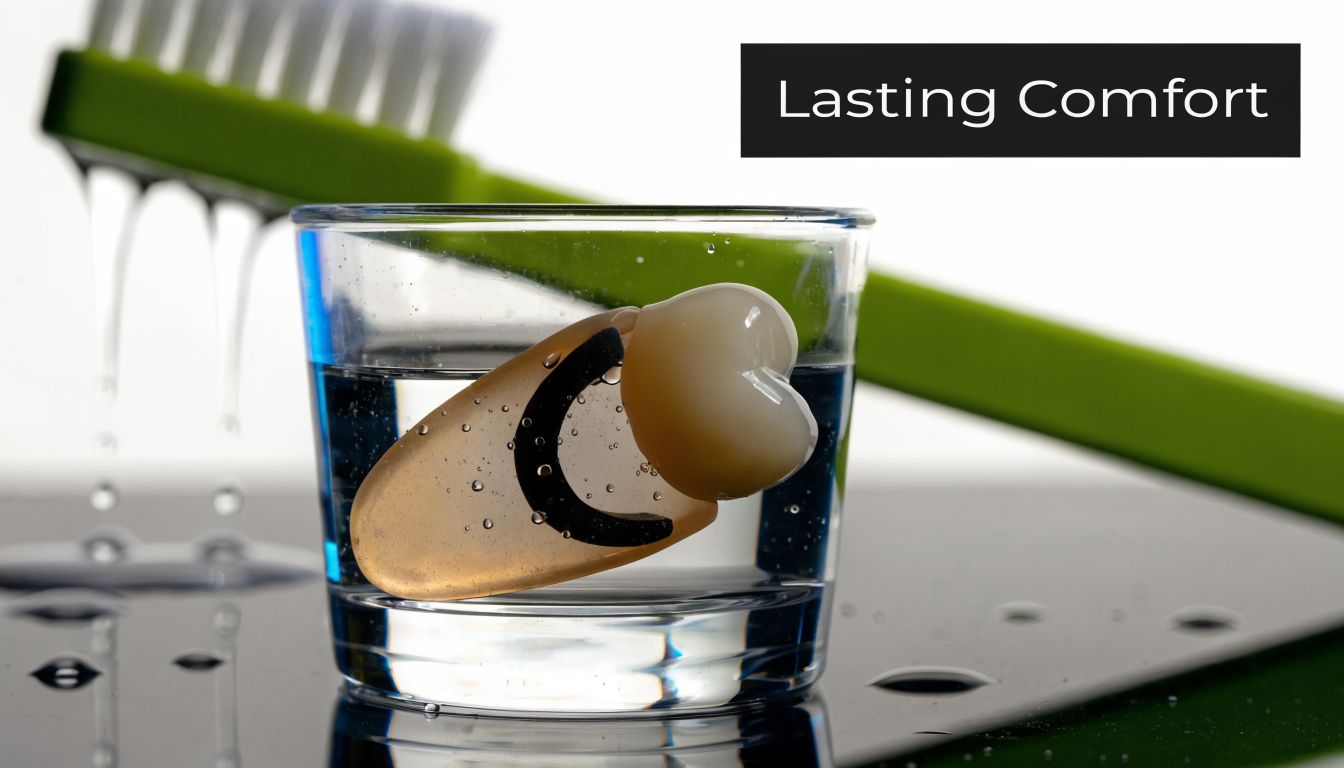
A valplast single tooth denture can stay comfortable and attractive for a long time if you treat it properly. Most of the daily care is simple, but the details matter.
Daily habits that help
The aim is to keep both the denture and the supporting teeth clean.
Food and plaque can collect around the clasps and the gumline, so you need to clean the appliance gently and brush your natural teeth carefully as well. If the supporting teeth get inflamed or decayed, the denture becomes harder to wear successfully.
Try to build these habits:
- Remove it carefully using the technique your dentist showed you
- Rinse it after meals when possible
- Clean it with products suited to flexible dentures
- Brush your natural teeth and gums thoroughly
- Store it safely when it’s out of the mouth
Do and don’t list
| Do | Don’t | |---|---| | Use a cleaner recommended for flexible dentures | Use regular toothpaste if it’s too abrasive | | Handle it over a folded towel or basin of water | Snap or force it into place | | Attend review appointments if the fit changes | Ignore sore spots or looseness | | Keep the surrounding teeth very clean | Assume discomfort will always “settle on its own” |
Fit matters over time
A common misunderstanding is that if a denture fits on day one, it will always fit the same way.
Your mouth changes. Teeth move slightly, gums remodel, and bite forces shift. That’s one reason reviews matter. A denture that once felt neat can become irritating if the fit changes and no one checks it.
There’s also an important design point behind long-term stability. For Valplast to be stable, the design requires at least 5mm of posterior interocclusal clearance, because the prosthetic tooth is held by mechanical grip rather than a chemical bond. The PMC clinical report on flexible denture design notes that insufficient clearance is a primary cause of prosthetic teeth dislodging over time.
That’s why good planning at the start matters so much. If the available space is wrong, the denture may be fighting physics from the beginning.
When to ask for a review
Contact your dentist if you notice:
- A click or rock when you bite
- A clasp area that starts rubbing
- A change in speech that wasn’t there before
- Food trapping that suddenly worsens
- The false tooth feeling less secure
> Small problems are easier to fix than worn patterns of damage. If a denture starts behaving differently, get it checked early.
Costs Health Funds and Payment Options in Tamworth
You have replaced the missing tooth in your mind already. Then the practical question lands. What will it cost, and how does payment work?
That is a normal place to pause.
At Oasis Smiles Dental, we talk about fees early because treatment decisions are easier when the clinical plan and the financial plan make sense together. A Valplast single tooth denture is often chosen by patients who want a discreet removable option without committing straight away to the higher cost and longer treatment path of a fixed replacement.
The final fee depends on the work involved in your specific case. A front tooth often needs more attention to shape, colour, and how it blends when you smile. A back tooth may look simpler, but the bite forces can make the design more demanding. In the same way two houses can both need a door replaced, but one frame is much trickier to fit, two single-tooth dentures can involve very different planning.
At our Tamworth clinic, that planning may include digital scans rather than traditional impressions, bite records, design communication with the lab, and review visits to refine the fit. If a tooth has only just been removed, the timing of healing can also affect how the denture is staged and adjusted.
What can affect the fee
A quote usually reflects several moving parts, including:
- The position of the missing tooth
- How your upper and lower teeth meet
- Whether the area is still healing after an extraction
- How much cosmetic detail is needed
- How many adjustment or review appointments are expected
Technology can influence value too. Digital scanners and 3D printed models help us plan more precisely and record the shape of your mouth clearly, which is useful when fine details matter. It does not mean every case is identical. It means the process is more controlled from the start.
Health funds and rebates
If you have extras cover, check whether your policy includes removable dentures or partial dentures. Each fund is different, and the rebate can vary depending on your level of cover, annual limits, and waiting periods.
Our team can help you understand the practical side before treatment begins. You can also read our patient information for appointments, cover, and payment support if you want a clearer picture before booking.
Other support that may apply
Some Tamworth patients also ask us about:
- DVA support, if you are eligible
- Medicare Child Dental Benefits Schedule, in limited situations where it applies
- Flexible payment options, if spreading the cost would help
The goal is simple. Your treatment plan should suit your mouth and your budget. For some patients, a Valplast single tooth denture is the long-term answer. For others, it works like a practical stepping stone while they plan for a bridge or implant later.
Common Questions and Your Next Steps with Us
Patients often ask the practical questions last. That makes sense. Once you understand the treatment, you start wondering what day-to-day life with it is like.
Will I be able to eat normally with it
Usually, yes, but there’s an adjustment period.
Start with softer foods and chew slowly at first. Cut food into smaller pieces and try to spread chewing across both sides when possible. Very sticky or very hard foods can be more challenging, especially in the early days.
Will it affect my speech
It can, briefly.
Anything new in the mouth changes the way the tongue moves. Individuals adapt by reading aloud, repeating tricky words, and wearing the denture as instructed. Your speech usually improves as your mouth learns the new shape.
Can people see the clasps when I smile
Often far less than with a metal partial denture.
That’s one of the main reasons people choose Valplast. The clasping parts are designed to blend with the gum area rather than flash silver when you talk or laugh. The exact result depends on where the missing tooth is and how your lip line sits when you smile.
Is it meant to be permanent
Sometimes it’s used as an interim solution, and sometimes people wear it longer term.
That depends on your goals, the health of the surrounding teeth and gums, and whether you may later move to something fixed like a bridge or implant. The most honest answer is that the role of the denture should be planned from the beginning, not guessed later.
What should you do next
If you’re missing one tooth, don’t try to choose in the dark.
A proper assessment can tell you whether a valplast single tooth denture is likely to sit well, whether the bite space is suitable, whether the gum tissues are a concern, and whether another option may serve you better. That’s especially important for front-tooth gaps, healing extraction sites, and mouths where comfort has been a problem before.
If you’d like a personalised opinion, call for an appointment, ask about same-day emergency availability if you’ve recently lost a tooth, or visit the clinic near Northgate Shopping Centre at Shop 15/1 Piper Street, Tamworth.
---
If you’re ready to find out whether a valplast single tooth denture is the right fit for your smile, book a consultation with Oasis Smiles Dental. Our team can assess the gap, explain your options clearly, and help you choose a solution that suits your comfort, appearance goals, and budget.