
Sleep Apnoea Treatment Without CPAP: Non-Mask Options for 2026
If you’re fed up with your CPAP machine, you’re in good company. The good news is that finding an effective sleep apnoea treatment without CPAP isn't just a dream—it's a genuine reality for many Australians. There are proven alternatives that are quiet, comfortable, and won't get in the way of your life.
Your Guide to Effective CPAP Alternatives
After a sleep apnoea diagnosis, you were probably told that Continuous Positive Airway Pressure (CPAP) therapy is the “gold standard.” And while it works well in theory, the reality on the ground can be very different. In fact, studies show that up to 60% of people simply can’t use their machine consistently.
Between the bulky mask, the noise, a feeling of claustrophobia, and the sheer inconvenience of it all, getting a good night's sleep can feel further away than ever.
This is precisely why we need to talk about other options. Treating sleep apnoea isn’t a one-size-fits-all problem. It’s less about forcing a single solution and more about finding the right tool for *your* specific anatomy, lifestyle, and health needs.
Quick Overview of Sleep Apnoea Treatments Without CPAP
Before we dive into the details, here’s a quick snapshot of the main alternatives to CPAP therapy. Think of this as a starting point to help you see what else is out there.
| Treatment Option | Best For | How It Works | | :--- | :--- | :--- | | Oral Appliance Therapy | Mild to moderate OSA; CPAP intolerance | A custom-fitted mouthguard gently moves the lower jaw forward to keep the airway open. | | Lifestyle Changes | All severities (often as a complementary approach) | Weight management, exercise, and avoiding alcohol before bed can reduce airway collapse. | | Positional Therapy | People who primarily have apnoeas when sleeping on their back | A device or technique encourages you to sleep on your side, preventing the tongue from blocking the throat. | | Surgical Options | Specific anatomical blockages; when other treatments fail | Procedures to remove excess tissue or restructure the jaw to permanently widen the airway. |
Each path offers a different way to achieve the same goal: an open airway and a restful, healthy night's sleep.
Finding a Solution Beyond the Mask
For so many people, the path to better sleep means leaving the CPAP machine behind. The most important thing is finding a treatment you can actually stick with every single night, because consistent use is what truly delivers health benefits.
Thankfully, there are several well-established treatments for sleep apnoea that don't involve a mask and hose.
These alternatives work by tackling the root cause of the airway obstruction from different angles:
- Oral Appliance Therapy: These are not your average mouthguards. They are custom-made devices, managed by a specially trained dentist, that gently hold your jaw in a position that keeps your airway clear while you sleep.
- Lifestyle and Positional Changes: Sometimes, simple adjustments to your daily routine and how you sleep can make a massive difference.
- Advanced Therapies and Surgery: For some, targeted procedures can address specific anatomical issues that other methods can't solve.
> Finding a comfortable and effective solution is about more than just stopping the snore. It's about protecting your long-term heart health, getting your energy back, and truly improving your quality of life. The best treatment is always the one you will actually use.
Working out which option is right for you can feel like a maze, which is why getting professional guidance is non-negotiable. A sleep physician is the expert who can diagnose your specific type of sleep apnoea. From there, a dentist with advanced training in sleep medicine can assess if a dental device is a good match for you. You can learn more about how specialised sleep dentistry provides a clear path to better sleep.
This guide will walk you through each of these non-CPAP solutions. We get the real-world struggles people face with CPAP, and our goal is to give you a sense of hope and control. Your journey to quiet nights and energised days starts now.
Why CPAP Isn't the Only Answer for Sleep Apnoea
If you've been told you have sleep apnoea, you've probably also been told about CPAP. But what if that's not the right fit for you? Let's talk about what’s really going on when you sleep and why you have more options than you think.
At its core, Obstructive Sleep Apnoea (OSA) is a mechanical problem. Think of your airway as a flexible garden hose. While you're awake, your throat muscles are engaged and hold that "hose" open, letting air flow through without any issues.
But as you drift off to sleep, those muscles relax. For people with OSA, they relax a little *too* much. The airway becomes soft and floppy, and can either narrow significantly or collapse entirely. This is what stops you from breathing. Your brain, sensing the emergency, jolts you just enough to gasp for air. This can happen over and over—sometimes hundreds of times a night—all without you ever fully waking up.
It's More Than Just Snoring
Loud, consistent snoring is the classic sign of OSA, but it’s often the tip of the iceberg. Your body is working overtime all night just to breathe, and the strain shows up in your daily life.
Do any of these sound familiar?
- Dragging yourself through the day, even after a full eight hours in bed.
- Waking up with a dull, persistent headache that only fades as the morning goes on.
- Feeling irritable, moody, or emotionally flat for no obvious reason.
- Struggling with "brain fog," finding it hard to concentrate or remember things.
If you’re nodding along, you’re not just tired. You’re exhausted on a cellular level.
> A lot of people dismiss sleep apnoea as just bad snoring. But it's a serious medical condition where you literally stop breathing. This starves your body of oxygen and puts immense strain on your heart and brain, making treatment essential for your long-term health.
The Common Struggle with CPAP
For years, the go-to treatment for sleep apnoea has been Continuous Positive Airway Pressure, or CPAP. It’s a machine that uses a mask to push a stream of air down your throat, propping the airway open. And for some, it works wonders.
For many others, though, it just doesn't. If you’ve tried CPAP and given up, you are not alone. The reasons people find it so difficult are incredibly common and completely valid.
- The Mask: It can be hard to find a mask that seals properly without digging into your skin or leaking air into your eyes.
- The Feeling: Many people feel claustrophobic or anxious wearing a mask to bed, making it impossible to relax.
- The Noise: The hum of the machine can be just as disruptive for your partner as your snoring was.
- The Hassle: Lugging a bulky machine with you on holidays or work trips is a real pain, breaking the consistency needed for it to work.
This is why finding a sleep apnoea treatment *without* CPAP is so important. After all, the best treatment is the one you’ll actually use every single night.
The numbers back this up. Research from Australian institutions like NeuRA shows that about 50% of patients can’t stick with their CPAP machine long-term. This has created a huge demand for better, more comfortable options. In fact, the market for alternatives like custom-made oral appliances is expected to hit USD 260.58 million in Australia alone by 2030. You can discover more about the market trends for sleep apnoea devices to see how the industry is adapting.
Understanding why the "gold standard" isn't a one-size-fits-all solution is the first step toward finding what *will* work for you. To get a better handle on the condition itself, you can also read also about the fundamentals of sleep apnoea and the different ways it can be managed.
Oral Appliance Therapy: The Dentist-Led Alternative
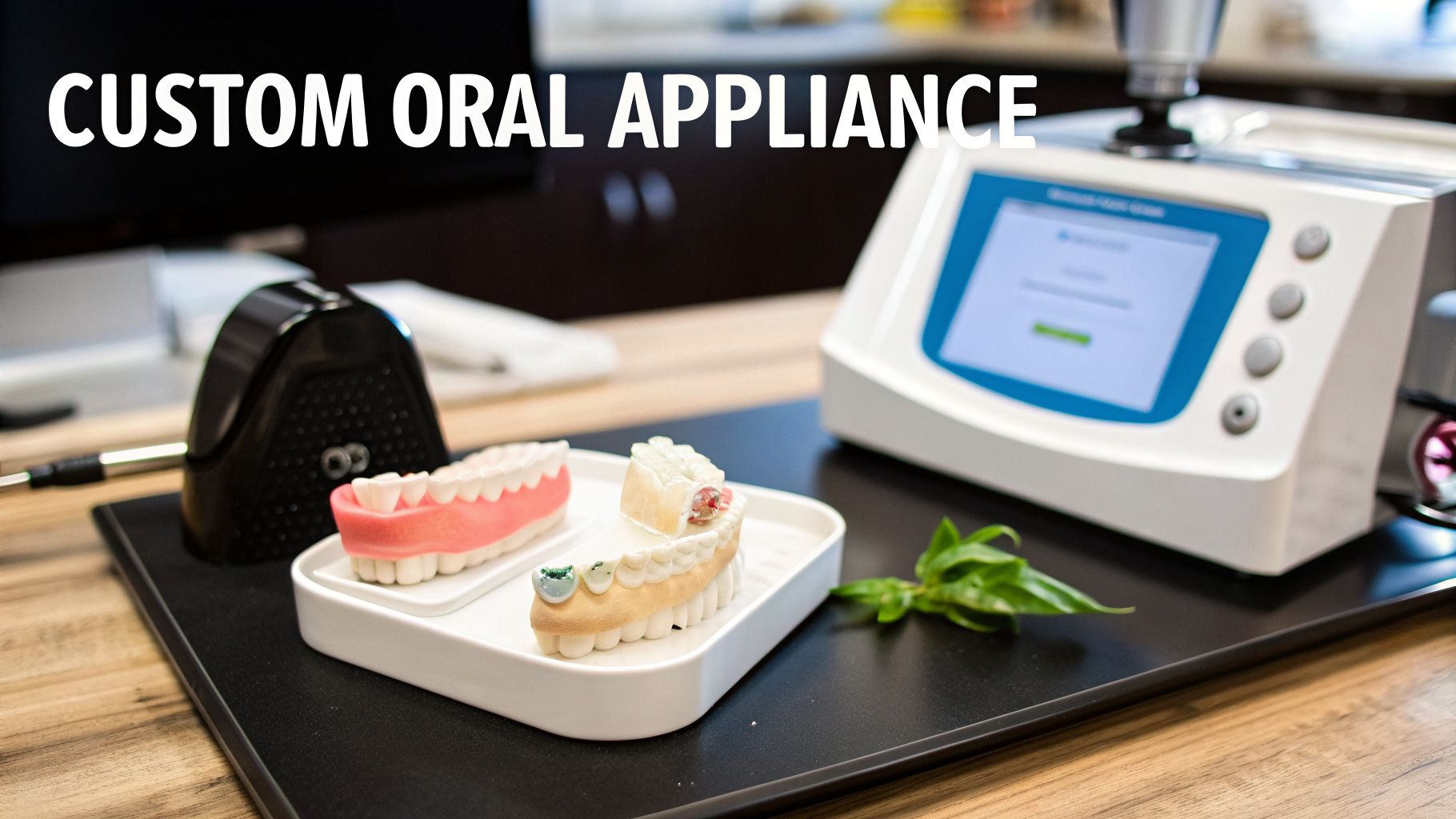
When it comes to proven alternatives to CPAP, Oral Appliance Therapy is often at the top of the list. It’s a fantastic sleep apnoea treatment without CPAP that we, as dentists, can provide—one that’s comfortable, silent, and easy to manage. For many people who just can’t get on with a CPAP machine, it’s a breath of fresh air.
The treatment centres around a device called a Mandibular Advancement Splint (MAS). The best way to think of it is like a custom-made mouthguard, but one that’s been expertly engineered just for you to wear while you sleep.
It works in a surprisingly simple way. The MAS gently holds your lower jaw (your mandible) in a slightly forward position. This tiny shift is all it takes to keep the airway at the back of your throat open, preventing it from collapsing and allowing you to breathe freely and quietly all night long.
How Do I Get a Custom Oral Appliance?
Getting a custom-fitted MAS isn't complicated, but it does follow a careful, medically-guided process. It's a team effort between your doctor and a dentist with specific training in sleep medicine to make sure the device is a perfect match for both your mouth and your diagnosis.
Here’s a look at what the journey typically involves.
Step 1: Your Initial Dental Assessment
It all starts with a chat and a thorough check-up with a sleep-trained dentist. We’ll take a close look at your teeth, gums, and jaw joints to make sure you’re a suitable candidate for an oral appliance. We need to see that your teeth are healthy enough to support the device and that your jaw is in good shape.
Step 2: A Formal Sleep Study
A proper diagnosis is absolutely essential. Your dentist will work with your GP to refer you to a sleep physician for a formal sleep study. This test is what officially diagnoses the type and severity of your sleep apnoea by measuring your breathing, oxygen levels, and other vital signs while you sleep.
Step 3: Precise Digital Scans of Your Mouth
Once you have that diagnosis, we can get started on the fitting. Gone are the days of messy, goopy impression trays. We now use advanced digital scanners, like the TRIOS system, to create a perfect 3D model of your teeth and bite. It’s quick, comfortable, and incredibly accurate.
Step 4: Crafting and Fitting Your Device
Your unique digital scans are sent off to a specialised dental lab where your MAS is meticulously crafted. When it arrives back with us, you’ll come in for a fitting appointment. We’ll make sure it fits perfectly, show you how to use it, and make any tiny adjustments needed to get the position just right for maximum comfort and effectiveness.
Comparing CPAP vs Oral Appliance Therapy
To help you weigh your options, here’s a straightforward comparison between CPAP therapy and a custom-made Mandibular Advancement Splint.
| Feature | CPAP Therapy | Oral Appliance Therapy (MAS) | | ----------------------- | ------------------------------------------------------------------------- | ------------------------------------------------------------------------------ | | How It Works | A machine delivers pressurised air through a mask to keep the airway open. | A custom-fitted device holds the lower jaw forward to keep the airway open. | | Best For | All levels of sleep apnoea, especially severe OSA. | Mild to moderate OSA and those who can't tolerate CPAP. | | Comfort & Convenience | Can be noisy and bulky. The mask may cause skin irritation or claustrophobia. | Small, quiet, and discreet. Easy to wear and travel with. | | Maintenance | Requires daily cleaning of the mask, tubing, and humidifier chamber. | Simple daily cleaning with a toothbrush and approved cleansers. | | Side Effects | Dry mouth, nasal congestion, mask leaks, and discomfort. | Potential for initial jaw soreness or minor bite changes, usually temporary. | | Professional Oversight | Managed by a sleep physician. | A collaboration between your sleep physician and a specially trained dentist. |
Ultimately, the choice depends on your specific diagnosis and what you can realistically stick with long-term. Consistency is the key to any successful sleep apnoea treatment.
Who Is a Good Candidate for an Oral Appliance?
While oral appliances are an excellent tool, they aren't a one-size-fits-all solution. Your sleep physician and a sleep-trained dentist will help you decide if it’s the best choice for you.
Generally, you’re a strong candidate if you:
- Have a diagnosis of mild to moderate Obstructive Sleep Apnoea.
- Are CPAP intolerant, meaning you’ve tried CPAP but just can't use it consistently.
- Travel often and need a treatment that’s easy to pack and use anywhere.
- Simply prefer a solution that is less invasive, quiet, and more comfortable.
For those with severe sleep apnoea, CPAP is usually still the first-line treatment because it’s the most effective at managing serious health risks. However, an oral appliance might still be an option if CPAP has failed, sometimes used together with other therapies to get the best outcome.
Lifestyle and Positional Changes That Make a Difference
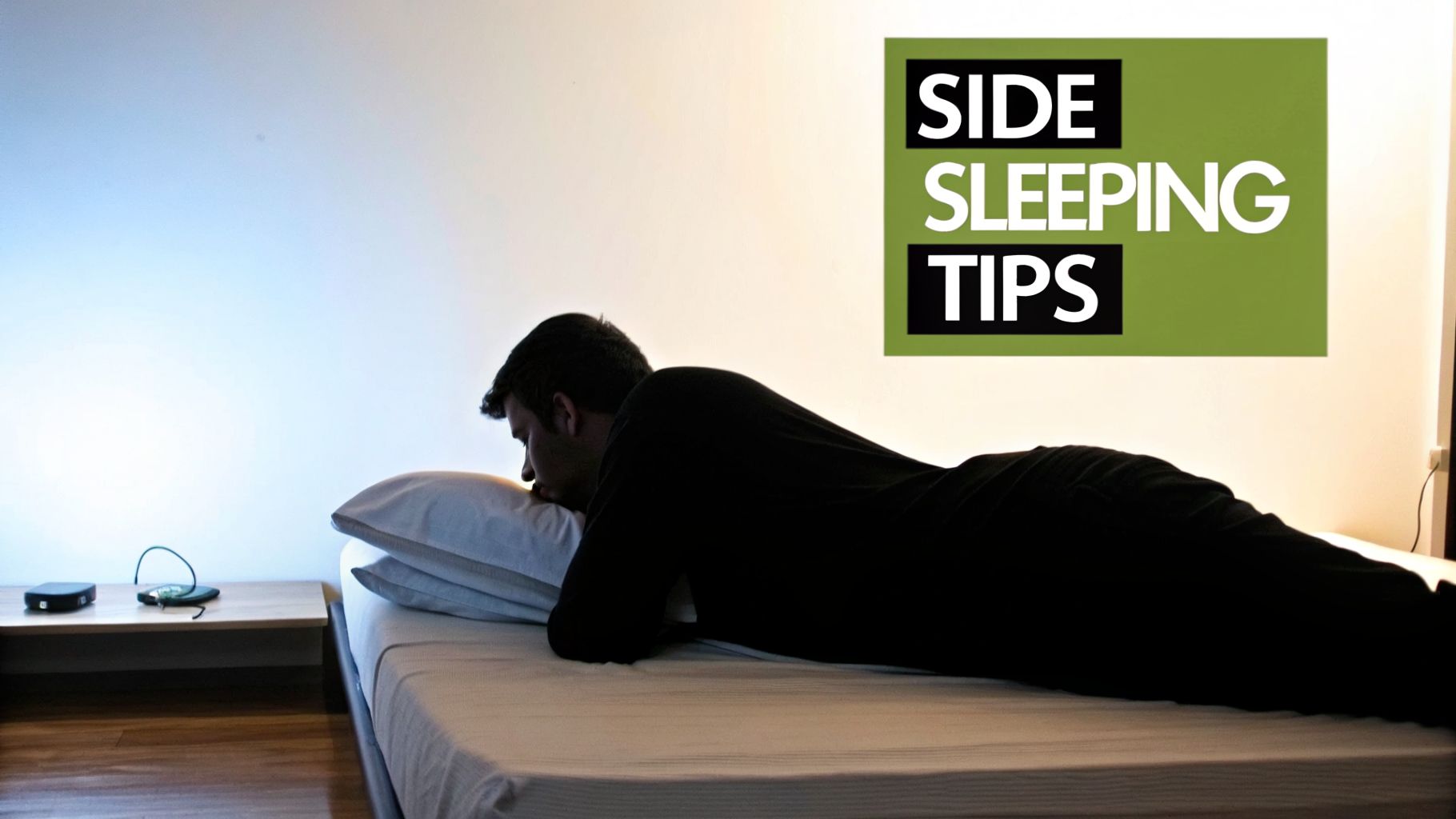
While medical devices get a lot of attention, some of the most powerful ways to manage sleep apnoea start with simple changes to your daily life. For many people, these lifestyle and positional adjustments can dramatically reduce symptoms, and in some cases, they're enough to be a successful sleep apnoea treatment without CPAP.
These aren't just minor tweaks. They get right to the heart of what causes your airway to collapse at night. Think of them as the foundation of good sleep health, putting you back in control of your own treatment.
Key Lifestyle Habits to Adopt
It’s amazing how much of an impact a few consistent changes can have on your breathing overnight. The whole idea is to create conditions inside your body where your airway is less likely to get blocked.
- Weight Management: This is a big one. Excess fat, especially around the neck, physically narrows your airway. The good news is that losing even 10% of your body weight can lead to a huge improvement in your Apnoea-Hypopnoea Index (AHI).
- Reduce Alcohol Before Bed: Alcohol acts as a muscle relaxant. If you have a drink close to bedtime, your throat muscles become extra floppy, making an airway collapse much more likely.
- Quit Smoking: Smoking inflames and irritates your throat tissues. That inflammation leads to swelling, which shrinks your airway and makes apnoea episodes more frequent and severe.
The Power of Positional Therapy
Do you find your apnoea is much worse when you sleep on your back? You're not alone. When you lie flat, gravity has a direct line of pull, causing your tongue and soft palate to fall backward and obstruct your throat. This is incredibly common and known as positional OSA.
The solution can be surprisingly simple: train yourself to sleep on your side. This technique, called positional therapy, is a proven way to help keep your airway open naturally all night long.
> Think of it this way: if your airway only gets blocked in one position, avoiding that position is one of the easiest and most effective treatments available. It’s a simple change that can bring about remarkable results.
Of course, changing a lifelong sleeping habit isn’t always easy. Your body has a mind of its own when you're asleep and often wants to roll back to what’s familiar. Luckily, there are a few simple tricks and tools to help you stay on your side.
Some easy-to-implement tips include:
- Specialised Pillows: Contoured pillows or full-body pillows can make side sleeping far more comfortable and help lock you into position.
- The Tennis Ball Trick: It's an old-school method, but it works. Simply sew a tennis ball onto the back of an old t-shirt. If you start to roll onto your back, the discomfort will make you shift back to your side without fully waking up.
- Wearable Devices: For a more modern approach, you can get small, wearable sensors that you place on your chest or neck. They gently vibrate whenever you roll onto your back, subtly training your body to prefer sleeping on your side.
Whether used on their own for mild cases or combined with other treatments like a dental oral appliance, these strategies are a crucial part of a complete plan for managing sleep apnoea.
Exploring Advanced Medical and Surgical Therapies
Sometimes, lifestyle changes and even custom-fitted oral appliances just aren't enough, especially for those dealing with moderate to severe obstructive sleep apnoea. When you’ve tried other non-invasive treatments without success, it's time to look at the next step. This is where advanced medical and surgical therapies can offer real hope for a sleep apnoea treatment without CPAP.
These options work by physically changing the structure of your airway, aiming for a more permanent fix to the blockages that ruin your sleep. They are usually reserved for people with specific anatomical problems and are only considered after a deep dive into your case by a team of specialists, including a sleep physician and a surgeon.
Surgical Approaches to Open the Airway
Surgery for sleep apnoea involves removing or repositioning the very tissue that’s physically blocking your throat. One of the most established procedures is the Uvulopalatopharyngoplasty (UPPP). During this surgery, a surgeon trims away excess tissue from your soft palate and uvula to create a wider airway.
While UPPP can work well, it’s a major operation with a significant recovery time. It’s typically an option when other treatments have failed and the blockage is clearly coming from the soft palate area.
> The whole point of an advanced therapy is to create a stable, open airway that doesn’t need an external device every single night. For the right person, these procedures can be genuinely life-changing, providing a long-term solution where other methods fell short.
Hypoglossal Nerve Stimulation: A Pacemaker for Your Tongue
One of the most exciting advanced therapies available today is Hypoglossal Nerve Stimulation (HNS). The best way to think of it is as a 'pacemaker for your tongue'. It’s a small device, implanted in the body, that stops your tongue from relaxing and falling back into your airway while you sleep.
The HNS system cleverly monitors your breathing. The moment it senses you're about to have an apnoea, it sends a tiny, gentle pulse to the hypoglossal nerve. This stimulation tightens your tongue muscle just enough to shift it forward, keeping your airway clear.
The results from this targeted approach have been fantastic. For instance, pioneering Aussie researchers at Flinders University achieved an incredible 93% success rate in one of their experimental procedures. Unlike CPAP, which so many find difficult to stick with, HNS provides a much more integrated solution for certain OSA patients by directly preventing the tongue from collapsing. You can read more about these exciting findings on ScienceAlert.com.
Is an Advanced Therapy Right for You?
Choosing surgery or an implanted device is a big decision that needs careful thought. These aren't first-line treatments. They represent a specialised path for those with complex or severe sleep apnoea who haven't had luck with CPAP or oral appliances.
The journey starts with a comprehensive assessment, which might include: * A detailed review of your sleep study results. * An anatomical exam by an Ear, Nose, and Throat (ENT) surgeon. * Sometimes, a procedure called Drug-Induced Sleep Endoscopy (DISE), where a specialist can watch exactly how and where your airway collapses while you’re sedated.
This in-depth workup makes sure any treatment is aimed precisely at your unique anatomy. The use of advanced imaging in modern clinics is a key part of this, and you can learn more about the technology that aids in diagnosis and planning. By exploring every option, even the most complex cases have a clear path towards a genuine solution and, finally, a restful night's sleep.
Could a Pill Be the Future of Sleep Apnoea Treatment?
What if managing your sleep apnoea was as simple as taking a pill before you went to bed? It might seem a long way off, but this is exactly where sleep medicine is heading, and Australian researchers are leading the charge. The entire focus is shifting from purely mechanical fixes to developing medications that address the root cause of why the airway collapses in the first place.
For many people with sleep apnoea, the problem isn’t just about having a narrow throat. It's that the muscles responsible for holding the airway open go a bit limp during sleep. Scientists are now looking at how certain medications, even ones already used for other conditions, can be used to "wake up" and stabilise these muscles while you rest.
Turning Research into Reality
The thinking behind it is actually quite clever. Instead of trying to invent a new miracle drug from the ground up, the approach is to combine existing TGA-registered medications that are already proven to be safe. By combining them, they can create a new effect that specifically targets the nerve pathways controlling your airway.
And it's already showing remarkable promise. In a world-first trial, researchers from Australian institutions like NeuRA and Flinders University did just that. They used a combination of repurposed drugs and saw a dramatic drop in sleep apnoea severity among participants. The study, led by Professor Danny Eckert, found that almost everyone in the trial had fewer breathing interruptions and better oxygen levels. You can read more about these groundbreaking findings and see how this work is setting the stage for a new era of treatment.
> The trial showed this non-invasive approach could reduce sleep apnoea severity by over 30%. For the 50% of patients who can't get on with CPAP, this points to a future where you might not need a mask or machine at all.
What This Means for You Today
While you can't get a "sleep apnoea pill" from your local chemist just yet, this rapid progress is incredibly important. It’s a powerful sign that the field is moving well beyond the old-school solutions of masks and machines.
Here’s what you should take away from all this: * More options are on the horizon. The future for treating sleep apnoea without CPAP is looking brighter than ever. * Treatment is getting more personal. A pill could one day be prescribed to target the specific neurological reason for *your* sleep apnoea. * Expert guidance is key. With the medical landscape changing so fast, it's never been more important to work with a health team that keeps up with these advances. This ensures you always have access to the best care for your own unique situation.
Your Next Steps to Better Sleep Without CPAP
Knowing there are effective alternatives to CPAP is one thing. Actually taking the steps to find one is what will bring back your energy and improve your health. So, let's walk through a practical roadmap to find the right sleep apnoea treatment without cpap for you. It's more straightforward than you might think.
The whole journey starts when you connect the dots in your daily life. Are you constantly exhausted? Waking up with a pounding headache? Maybe your partner has mentioned you snore like a freight train or, more worryingly, that you stop breathing altogether. These aren't just little quirks; they're your body's way of telling you it's struggling for air while you sleep.
Starting the Conversation With Your GP
Your General Practitioner (GP) should always be your first stop. They can listen to your concerns, go over your medical history, and give you a referral for a professional sleep study. This is a critical diagnostic step, and it's often bulk-billed through Medicare, making it accessible for most people.
A sleep study is the only way to get a clear, definitive diagnosis. It measures your breathing, blood oxygen levels, and sleep stages to figure out the type and severity of your sleep apnoea. Without this data, you're just guessing.
Finding the Right Dental Sleep Professional
Once you have a diagnosis, it’s time to find a dental professional who has specific, dedicated training in sleep medicine. This is key—not every dentist is equipped to manage sleep apnoea. You need someone who truly understands the condition and, just as importantly, works hand-in-glove with your GP and sleep physician.
When you're looking for a provider, keep an eye out for these things: * A patient-first focus: They should really listen and take the time to understand your lifestyle, what worries you, and what you hope to achieve. * Modern diagnostic tools: Clinics that use technology like CBCT 3D imaging and digital scanners can design oral appliances that are far more precise and comfortable. * A collaborative spirit: The right professional will actively communicate with your entire healthcare team to make sure your care is seamless and comprehensive.
This chart shows you what that decision-making path usually looks like, from first noticing symptoms to exploring your treatment options.
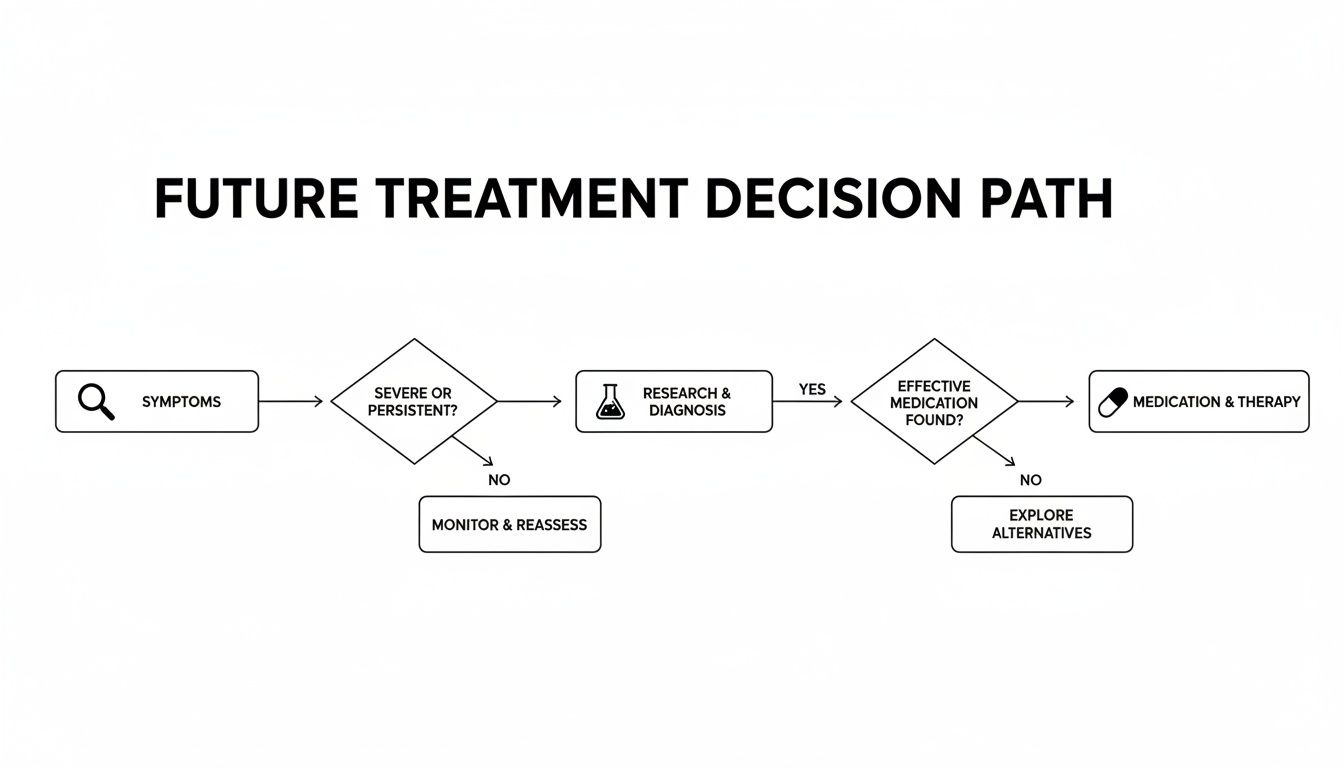
As you can see, it's a structured process of evaluation and consultation designed to pinpoint the therapy that’s best for you.
> Taking that first step can feel like the hardest part, but it's the most important one you'll make. A proper diagnosis and a well-fitting treatment plan can completely transform your quality of life, giving you back your energy and protecting your health for years to come.
Think of it as a partnership between you and your healthcare providers. By understanding your options and taking an active role, you can find a solution that's both comfortable and effective—one that finally lets you get a proper night's rest. Don't let uncertainty stop you from waking up feeling refreshed and ready for the day.
--- At Oasis Smiles Dental, our team is passionate about helping patients across Tamworth and the New England region find sleep apnoea solutions that work for them. If you’re ready to explore life beyond CPAP, we invite you to schedule a consultation with our experienced team.