

Your Guide to Finding a Gum Disease Specialist in Tamworth
If you’ve ever been told you have a problem with your gums, your first thought is probably your regular dentist. But what happens when the issue is more serious? That’s where a gum disease specialist, or a *periodontist*, comes in.
A periodontist is a dentist who has gone back to university for several more years to focus entirely on the health of your gums and the bone that holds your teeth in place. They’re the experts you need when gum problems become complex or persistent.
The Role of a Gum Disease Specialist

It helps to think of your general dentist as your family GP for your mouth. They are your first port of call for everything from check-ups and cleans to fillings and crowns, and they’re brilliant at spotting the early warning signs of trouble.
A gum disease specialist, on the other hand, is like a cardiologist for your oral health. If your GP found a complex heart condition, they would refer you to a heart specialist. In the same way, when your dentist spots advanced or stubborn gum disease, they’ll refer you to a periodontist for highly specialised care.
These experts dedicate their entire practice to protecting the very foundations of your smile: your gums, the ligaments that anchor your teeth, and the underlying jawbone.
When Is a Specialist Needed?
So, why would your dentist suggest you see a periodontist? A referral is common if you have: * Moderate to severe gum disease (periodontitis). * Gum problems that aren't getting better with standard treatment. * Other health issues, like diabetes, that can complicate gum disease. * A need for dental implants, as periodontists are masters of the bone and gum work needed for a successful outcome.
This kind of specialised care is especially crucial in regional communities. Here in the New England region, and across rural Australia, preventable dental conditions have led to consistently higher hospitalisation rates than in major cities. Getting expert care early is key.
> At its heart, a periodontist’s job is to save your natural teeth and restore health to the gums and bone supporting them. They handle everything from intensive deep cleaning to advanced surgical procedures that can help regenerate lost tissue.
General Dentist vs Gum Disease Specialist (Periodontist)
To help you understand why a referral might be the best step for your health, it’s useful to see how the roles of a general dentist and a periodontist differ. Our team at Oasis Smiles Dental is here to guide you, and you can learn more about our patient-first approach.
This table shows a side-by-side comparison.
#### General Dentist vs Gum Disease Specialist (Periodontist)
| Area of Focus | General Dentist | Gum Disease Specialist (Periodontist) | | :--- | :--- | :--- | | Primary Role | Manages overall oral health for all ages. | Diagnoses and treats diseases of the gums and bone. | | Common Treatments | Check-ups, fillings, crowns, routine cleanings. | Scaling and root planing (deep cleaning), gum surgery, dental implants. | | Gum Disease Focus | Identifies and treats early-stage gum disease (gingivitis). | Manages moderate to advanced periodontitis and complex cases. | | Training | General dental degree (4-5 years). | Dental degree plus 3 additional years of specialised training. |
Ultimately, your general dentist and a periodontist are a team working for you. Your dentist is your frontline defence, while a gum disease specialist provides the advanced skills needed to tackle serious threats to your smile, ensuring you always get the right care at the right time.
Recognising the Warning Signs of Gum Disease

Gum disease can be incredibly subtle. It often creeps up without any real pain, which is why so many people don’t notice a problem until it’s already become quite serious. But your body does give you clues, and learning to spot them is your best defence for a healthy smile.
Think of it like your gums are trying to get your attention. A little bit of bleeding now and then is like a quiet whisper. If you ignore it, that whisper can turn into a much louder cry for help. The trick is to listen closely from the very beginning.
There are really two main stages to this journey. It’s crucial to know the difference, because one is simple to fix while the other needs a lot more work, often from a gum disease specialist.
The First Whisper: Gingivitis
The first stop, and the mildest form of gum disease, is gingivitis. At its core, this is just inflammation caused by plaque—that sticky, fuzzy film of bacteria that builds up on your teeth every day. If brushing and flossing don’t clear it away, the plaque irritates your gums and the first signs of trouble appear.
The great news? Gingivitis is 100% reversible. A professional clean from your dentist and a solid routine at home can get your gums back to perfect health. You just have to catch it early.
Watch out for these common signs of gingivitis: * Red, Puffy Gums: Healthy gums should be a nice, firm, pale pink. If yours look swollen, feel tender, or have a dark reddish colour, that's a classic sign of inflammation. * Bleeding When You Brush or Floss: This is the big one. It is never normal for your gums to bleed, no matter how well you think you’re cleaning. * Bad Breath That Won't Go Away: If you’re dealing with persistent bad breath (halitosis) that mouthwash and brushing can't seem to fix, it could be the bacteria hanging around your gumline.
Letting these symptoms slide allows the bacteria to dig in deeper, paving the way for a much bigger headache.
The Louder Warning: Periodontitis
When gingivitis isn't dealt with, it can progress into periodontitis. This is where things get serious. The infection is no longer just a surface-level issue; it starts to destroy the gum tissue and, critically, the bone that holds your teeth firmly in your jaw.
This is the point where you’ll likely need a gum disease specialist. Their entire focus is on stopping periodontitis in its tracks and doing everything possible to save your teeth.
> Periodontitis is a destructive cycle. The infection causes your gums to pull away from your teeth, forming little gaps or "pockets." These pockets are the perfect hiding spot for more plaque and bacteria, which deepens the infection and eats away at the bone supporting your teeth.
As the infection moves below the gumline in periodontitis, it causes bone loss that you can't see but that can have devastating effects. If you spot any of the following signs, it's a clear signal to get professional help right away. To get a better idea of what’s involved, you can learn more about our approach to treating gum disease.
The signs of periodontitis include all the symptoms of gingivitis, plus: * Receding Gums: Your teeth might start to look longer than they used to. That’s because your gums are literally pulling back. * Loose or Shifting Teeth: As the bone disappears, your teeth lose their solid foundation and can become wobbly. You might even notice new gaps forming between them. * Pain When You Chew: This can mean the infection is affecting the very ligaments that anchor your teeth. * Pus Between Your Teeth and Gums: A sure-fire sign of a significant infection that needs immediate attention.
It's a common belief that losing teeth is just a part of getting older, but that’s simply not true. Periodontitis is one of the main reasons adults lose their teeth. By spotting the signs and getting help quickly, you can keep your smile intact for life.
How We Diagnose Gum Issues at Oasis Smiles
Figuring out what’s going on with your gums shouldn't feel like a secret medical procedure. Here at Oasis Smiles Dental, we pull back the curtain. We believe in showing you exactly what’s happening inside your mouth and, most importantly, *why* it's happening. Our entire diagnostic process is built to give you a clear picture, so you feel confident and in control of your dental health.
Think of us as detectives for your smile. We use a combination of a careful, hands-on examination and some truly impressive technology to gather all the clues. This lets us build a complete map of your gum and bone health before we even start talking about treatments.
This isn’t about just spotting problems. It’s about charting the safest, most effective path forward for you. We want every patient from Tamworth and the New England region to feel empowered by their diagnosis, not confused by it.
Starting with a Gentle Measurement
One of the very first things we’ll do is take some gentle measurements around your teeth. This is called periodontal probing, and it’s one of the most reliable ways to check for gum disease. It sounds technical, but it’s actually a very straightforward process. We use a tiny, specialised ruler to measure the small space (or ‘sulcus’) between your gum and your tooth.
In a healthy mouth, this space is quite shallow, usually between 1 and 3 millimetres. When we start seeing deeper measurements, which we call “pockets,” it’s a direct sign that gum disease is causing the gums to pull away from the tooth.
- 1-3 mm Pockets: This is the range we love to see! It generally points to healthy, happy gums.
- 4-5 mm Pockets: This often signals the early to moderate stages of gum disease (periodontitis).
- 6 mm+ Pockets: Deeper pockets like this suggest more advanced gum disease that will likely need specialist care to resolve.
This simple check gives us an incredibly detailed map of your gum health, tooth by tooth. It tells us precisely where the inflammation is and how far things have progressed, which is crucial for planning our next steps.
Seeing Beyond the Surface with Advanced Imaging
While probing tells us a lot about your gums, it can’t show us what’s happening with the jawbone hidden beneath. This is where our advanced imaging technology comes in, because bone loss is the single biggest threat in periodontitis.
To get that crystal-clear view, we use a sophisticated 3D X-ray called Cone Beam Computed Tomography (CBCT).
> Think of a standard dental X-ray as a flat photo—it’s useful, but limited. A CBCT scan, on the other hand, is like having a detailed 3D model of your jaw. It lets us look at your teeth, roots, and bone from every conceivable angle with incredible accuracy.
This level of detail is a complete game-changer for diagnosing gum disease properly. A CBCT scan allows us to:
- Accurately Measure Bone Loss: We can see exactly how much supporting bone has been lost around each tooth, something that’s impossible to gauge with just a visual exam.
- Identify Hidden Problems: It helps us find underlying infections or other issues lurking near the tooth roots that would otherwise go unnoticed.
- Plan Treatment with Confidence: With a detailed 3D map, we can plan any procedure with pinpoint precision, which makes the treatment safer and far more predictable.
By combining careful probing with these highly detailed 3D scans, we leave nothing to chance. You can learn more about the state-of-the-art tools we use to provide top-tier care right here in Tamworth on our advanced dental technology page. This thorough approach ensures every recommendation we make is based on a complete and accurate understanding of your health.
How We Treat Gum Disease Here in Tamworth
Hearing you have gum disease can be worrying, but it’s important to know that modern treatments are incredibly effective and much more comfortable than you might imagine. A diagnosis isn't the end of the road; it’s the starting point for getting your oral health back on track.
Here in Tamworth, we have a full suite of treatments designed to stop gum disease in its tracks and restore your smile. The path we take depends entirely on how far the disease has progressed. For many, a non-surgical approach is all it takes. For more advanced cases, we have specialist procedures to rebuild and secure what’s been lost, giving your teeth a stable foundation for the future.
Your First Line of Defence: Non-Surgical Treatments
The cornerstone of treating early to moderate gum disease is a procedure called scaling and root planing. You may have heard it called a "deep clean," which is a fair description, but it’s a far more targeted treatment than your regular hygiene appointment.
Think of it like this: your standard clean is like clearing away surface debris from a garden bed. A deep clean, however, is like carefully weeding and tilling the soil right down to the roots to create a healthy environment for plants to thrive again. We’re getting below the gumline to where the real problem lies.
The process involves two main steps:
- Scaling: We meticulously remove the built-up plaque and hardened tartar (calculus) from your teeth, focusing on the deep pockets that have formed under the gums.
- Root Planing: Once the tartar is gone, we gently smooth the tooth roots. This smooth surface makes it much harder for bacteria to gain a foothold, allowing your gums to heal and reattach properly.
For many patients, this is the only treatment needed to halt the progression of periodontitis and avoid the need for more involved procedures.
When We Need to Go a Step Further: Surgical Options
If gum disease has been active for a while, the damage can be more severe. The pockets around the teeth might be too deep to clean effectively with non-surgical methods, and you may have lost some of the underlying bone.
In these situations, our gum disease specialist may talk to you about surgical options. The goal of surgery isn’t just to clean out the infection, but to repair the damage and create a healthier oral environment that’s easier for you to maintain long-term.
> The main reason for periodontal surgery is to get access to those hard-to-reach areas, thoroughly remove the bacteria causing the damage, and reshape the tissues to create a healthy, stable, and cleanable foundation for your teeth.
Common surgical treatments we perform right here in our Tamworth clinic include:
- Pocket Reduction (Flap) Surgery: We gently lift the gums to access and remove deep-seated tartar and diseased tissue. The gums are then repositioned to fit more snugly around the teeth, reducing the depth of the pockets.
- Bone Grafts: When periodontitis has destroyed the bone that supports your teeth, we can place a special grafting material in the area. This acts as a scaffold, encouraging your body to regenerate its own bone and provide better support for your teeth.
- Gum Grafts: Gum recession often exposes the sensitive roots of your teeth. To fix this, we can perform a gum graft, where a small piece of tissue (often from the roof of your mouth) is used to cover the exposed root, protecting it and improving the gum line’s appearance.
To help you understand how different stages of gum disease are managed, we've put together a simple table outlining the typical symptoms and treatments.
Gum Disease Treatment Options by Stage
| Stage of Gum Disease | Common Symptoms | Typical Treatment Approach | | --- | --- | --- | | Gingivitis (Early Stage) | Red, swollen gums that may bleed when brushing. No bone loss. | Professional dental clean and improved at-home oral hygiene (brushing and flossing). | | Early Periodontitis | Increased bleeding, gum pockets of 4-5mm, early signs of bone loss. | Scaling and Root Planing (deep clean) to remove plaque and tartar below the gumline. | | Moderate Periodontitis | Deeper pockets (6-7mm), noticeable bone loss, gums pulling away, teeth may feel slightly loose. | Scaling and Root Planing. Surgical options like Pocket Reduction Surgery may be considered. | | Advanced Periodontitis | Deep pockets (>7mm), significant bone loss, shifting or very loose teeth, persistent bad breath, pain when chewing. | Surgical interventions are often necessary, such as Pocket Reduction, Bone Grafts, or Gum Grafts to save teeth. |
This table provides a general guide, but every patient's situation is unique. We'll always discuss the best approach for you after a thorough diagnosis.
This diagram shows the straightforward steps we follow to get a clear picture of your gum health.
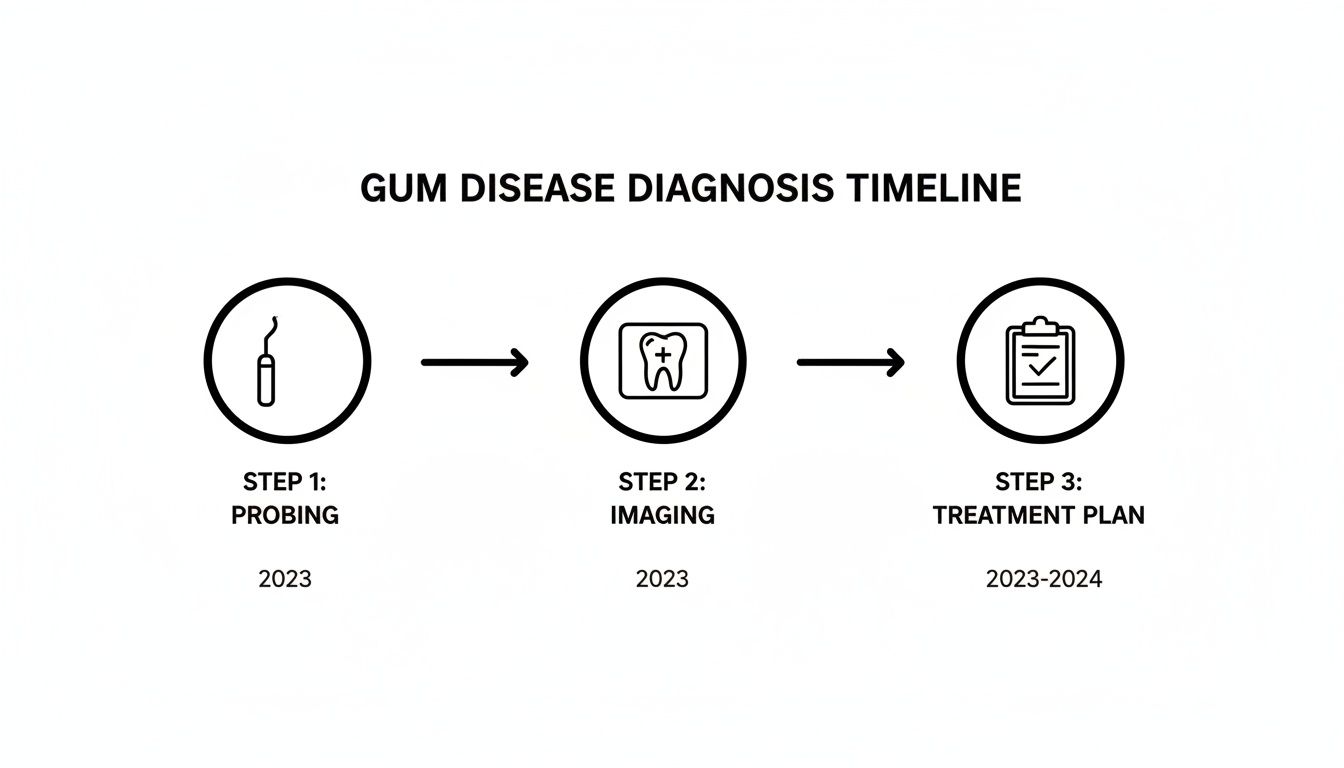
As you can see, our diagnostic process is clear and logical, moving from the initial check-up to a personalised treatment plan designed just for you.
No matter what treatment you require, our goal is always the same: to stop the disease, save your natural teeth, and give you a healthy, stable smile for life.
Life After Treatment and Preventing Future Problems
Getting your gum disease under control is a massive win, and something to be proud of. But what happens next is just as important for keeping that healthy smile for the long haul.
Think of it a bit like managing any other chronic health issue, like diabetes. It’s not a 'one-and-done' fix. Long-term success comes from staying on top of it. From here on out, it’s all about teamwork. You, at home, and our team here in Tamworth work together to keep your gums healthy for good. This partnership is your best line of defence.
Your New Home Care Game Plan
What you do at home every single day is your first line of defence against gum disease making a comeback. You're already familiar with brushing and flossing, but after treatment, we often need to step things up a notch to protect those areas that were once vulnerable.
Your periodontist or hygienist will walk you through a routine tailored just for you, but it usually involves a few extra tools to disrupt the plaque that started all the trouble.
- Interdental Brushes: These little brushes are fantastic for getting into the spaces between your teeth, which can sometimes be a bit wider after treatment. They’re often much better than floss for cleaning the tricky, curved surfaces of the tooth roots.
- Water Flossers: A water flosser can be a brilliant sidekick in your routine. It uses a targeted stream of water to flush out bacteria and bits of food from between your teeth and along the gumline.
- Antiseptic Mouth Rinses: We might suggest using a specific therapeutic mouthwash for a short time. This helps keep bacterial levels down while your gums are healing and getting stronger.
The real goal is to be meticulous. We’re not just cleaning teeth anymore; we're carefully cleaning the exact spot where your gums meet your teeth. That’s where the daily battle is won.
> Think of your post-treatment care as protecting a valuable investment. You’ve put in the time and effort to get your gums healthy; your daily routine is the insurance policy that keeps it that way.
The Importance of Professional Maintenance
No matter how good you get with your home care, there will always be stubborn plaque and tartar in hard-to-reach spots. It’s just a fact. That’s why regular professional check-ins are absolutely non-negotiable after you’ve had gum disease treatment.
These aren't your typical scale and clean appointments. We call them periodontal maintenance, and they're specifically designed to protect your progress. We’ll usually need to see you every three to four months.
During these appointments, we:
- Check Your Pockets: We’ll re-measure the small spaces between your teeth and gums to make sure they’re staying shallow and stable.
- Inspect Your Gums: We have a good look for any new signs of bleeding or inflammation.
- Give a Deep Clean: We’ll thoroughly remove any plaque and tartar that has built up, both above and below the gumline.
This regular catch-up allows your gum specialist to spot any tiny warning signs long before they have a chance to turn into a bigger problem again. To see how this fits into a lifetime of good oral health, feel free to read our guide on preventive care in Tamworth.
Lifestyle Choices That Make a Real Difference
Finally, don't underestimate how much your overall lifestyle affects your gums. Some habits can give your gums the support they need to stay healthy, while others can unfortunately make a relapse much more likely.
If you smoke, quitting is the single best thing you can do for your gums. Smoking seriously weakens your body's ability to heal and fight off infection, leaving you much more vulnerable to gum disease returning.
Beyond that, a balanced diet that’s low in sugar and acidic foods helps to starve the plaque bacteria that cause all the problems in the first place. Every positive choice you make creates a healthier environment inside your body, and your mouth will thank you for it.
Your Gum Health Journey with Oasis Smiles Dental
We’ve always believed that fantastic dental care should be two things: thorough and right here on your doorstep. When you work with Oasis Smiles Dental for your gum health, you’re not just another appointment in a calendar. You’re our neighbour, and we’re here to support you, whether it’s for a simple check-up or more specialised care from a gum disease specialist.
For over 20 years, our team has been looking after families across Tamworth and the wider New England region. We know that the thought of any dental work, especially for gum problems, can be stressful. That’s why we’ve gone to great lengths to create a practice that feels welcoming from the moment you walk in.
Your Comfort Is Our Priority
Feeling anxious about a dental visit is incredibly common, but it should never be a barrier to getting the care you need for a healthy smile. Our team is genuinely here to support you. We take the time to chat through every step, answer your questions (no matter how small!), and make sure you feel completely in the driver's seat.
If you’re particularly nervous or need more complex work done, we offer options like sleep dentistry. It allows you to feel deeply relaxed and at ease throughout your treatment, free from any stress or discomfort. Think of it as hitting the snooze button on your dental worries.
> Your peace of mind is everything. By offering calming solutions like sleep dentistry, we ensure that anxiety doesn’t get in the way of the vital care you need from a gum disease specialist.
Making Your Care Accessible
When it comes to your health, waiting is rarely the best option. If you’ve spotted any signs of gum trouble—like bleeding when you brush, tenderness, or your gums pulling back—the best thing you can do is book an assessment. A small issue today is much easier to manage than a major problem down the track.
We're also committed to making first-rate dental care affordable for our Tamworth community. We want you to focus on your health, not financial stress.
- All Major Health Funds: We work with all major funds to help you get the most out of your private health insurance.
- Government Schemes: We’re proud to support patients covered by the Medicare Child Dental Benefits Schedule (CDBS) and Department of Veterans' Affairs (DVA) programs.
- Flexible Payment Plans: To help you get started right away, we offer simple, interest-free payment plans that let you spread the cost of your treatment over time.
Book Your Consultation Today
Taking that first step is easy. Your gum health is the very foundation of your overall wellbeing, and our team at Oasis Smiles Dental is here to provide the expert care you deserve. Whether you’ve been referred by another dentist or you’re just worried about your gums, we’re ready to help.
Don’t let gum problems linger. Contact Oasis Smiles Dental today to book your consultation and let us help you get back to a healthy, confident smile for life.
Your Gum Disease Questions, Answered
Over the years in our Tamworth clinic, we've found that patients often have the same worries and questions about gum disease. Let's clear up a few of the most common ones.
Is Gum Disease Reversible?
That's a great question, and the answer really depends on how far things have progressed. In its earliest stage, called gingivitis, the condition is absolutely reversible. A good professional clean and diligent care at home is usually all it takes to get your gums back to full health.
Once it advances to periodontitis, however, the bone that supports your teeth starts to be lost. That bone damage, unfortunately, is permanent. The goal of treatment then shifts. A gum disease specialist can stop the disease in its tracks and manage it effectively, but the focus becomes about holding the line and preventing any more damage.
Does Gum Disease Treatment Hurt?
We know this is a huge concern for many people, and your comfort is always our first thought. For deep cleaning procedures (known as scaling and root planing), we always use a local anaesthetic to make sure the area is completely numb. You really shouldn't feel pain during the treatment.
If you’re feeling particularly anxious, we can also discuss options like sleep dentistry to help you have a completely calm and stress-free experience.
Why Can't My Regular Dentist Just Handle It?
Think of it this way: your GP is brilliant for managing your overall health, but if you had a tricky heart condition, they would refer you to a cardiologist for specialised care. It's the same principle here.
A gum disease specialist, or periodontist, has completed an extra three years of intensive university training focused *only* on the gums and the underlying bone. They have the advanced skills and experience to handle severe cases, perform delicate gum surgery, and manage complex situations that go beyond general dentistry.
> The single most important thing to understand is that gum disease never gets better on its own. The longer you wait, the more damage the infection can do. Catching it early is the absolute key to saving your teeth.
How Often Will I Need Check-Ups After My Treatment?
Once the active phase of your treatment is complete, you’ll enter a "maintenance" phase. This isn't optional—it's essential for keeping the disease at bay and preventing it from coming back. For most patients, this means visiting your dentist or specialist for a professional clean and check-up every three to four months.
---
Don't let unanswered questions hold you back from getting the care your gums need. The friendly team at Oasis Smiles Dental is here to give you clear answers and expert treatment.