

A Patient's Guide to OPG Dental Radiography in 2026
Have you ever wondered how your dentist gets a complete picture of everything happening inside your mouth? Often, the answer is a special type of X-ray called an OPG.
An OPG, which stands for Orthopantomogram, is a panoramic scan that captures a single, wide view of your entire mouth. Think of it as a panoramic photograph of your teeth, jaws, and surrounding facial structures, all in one detailed image.
Getting the Full Story of Your Oral Health
Trying to understand your overall dental health by looking at small, individual X-rays can be like trying to piece together a jigsaw puzzle with only a few of the pieces. It’s hard to see how everything fits together.
An OPG dental X-ray, on the other hand, gives us the whole puzzle at once. It’s the roadmap to your mouth, showing us not just individual teeth but the entire system and how it functions as a whole.
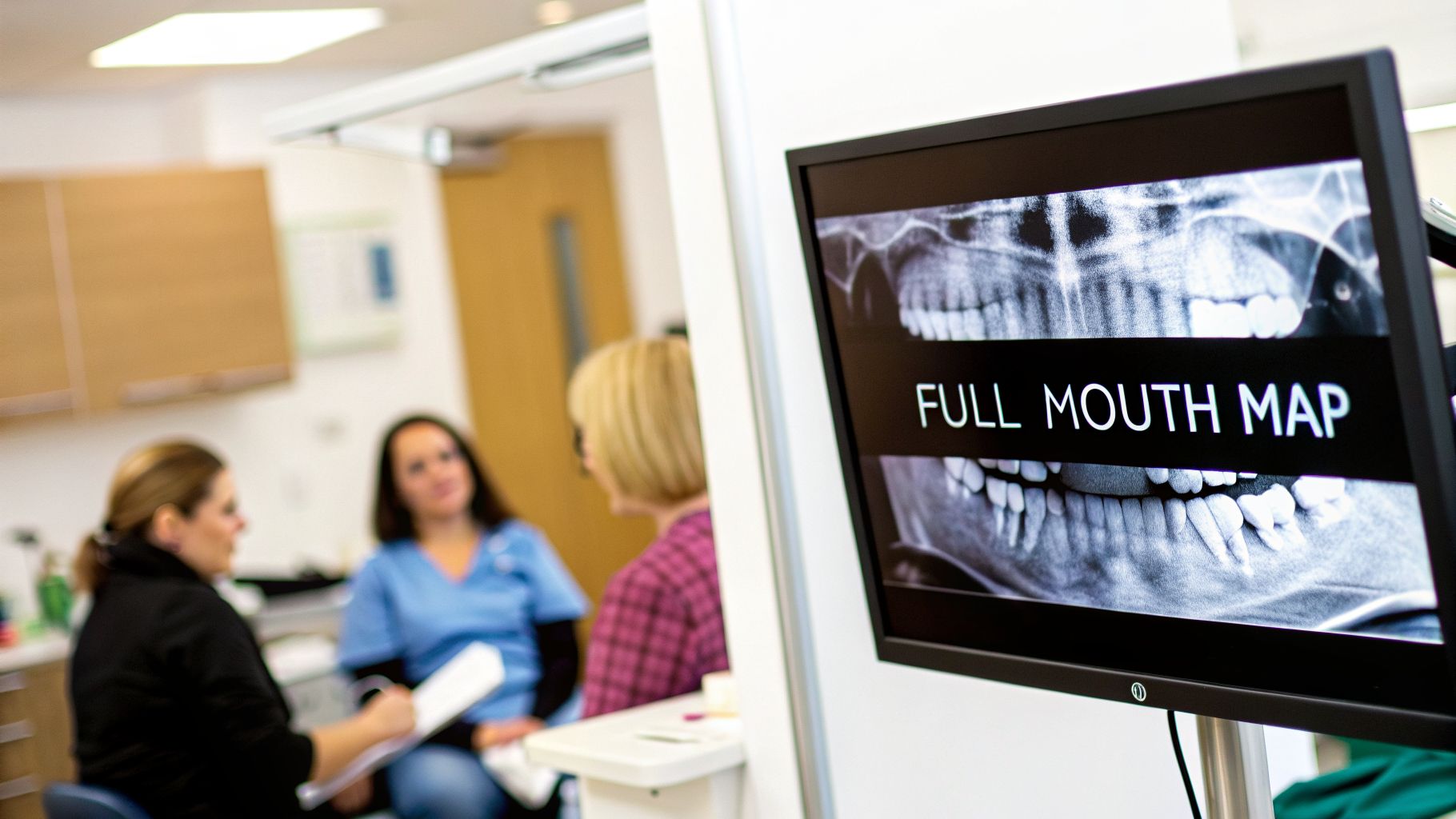
This broad overview is essential for more than just finding cavities. It allows us to understand the complex relationships between your teeth, your upper and lower jaws, and even your jaw joints.
What Can an OPG Show Us?
This 'big picture' view is crucial for spotting issues that are simply impossible to see with the naked eye during a regular check-up. The sheer amount of information an OPG provides is astounding.
Here are just a few things a single scan can help us identify:
- Impacted Wisdom Teeth: We get a crystal-clear view of wisdom teeth that are stuck beneath the gums, coming in sideways, or causing problems for neighbouring teeth.
- Jaw and Tooth Development: For children and teens, an OPG is perfect for tracking how their jaws are growing and ensuring adult teeth are coming through correctly.
- Jawbone Health: It helps us assess the density and health of your jawbone. This is absolutely critical when planning for treatments like dental implants or assessing the fit of dentures.
- Jaw Joint (TMJ) Problems: The scan captures a clear image of your temporomandibular joints (TMJ), helping us pinpoint the source of clicking, pain, or other jaw issues.
- Hidden Cysts or Tumours: Sometimes, more serious issues like cysts or tumours can develop silently within the jawbone. An OPG is one of our best tools for detecting them early.
In Australia, where nearly one-third of adults have untreated tooth decay, having a diagnostic tool that provides such a comprehensive view is more important than ever. It allows us to diagnose problems accurately and plan effective, long-term treatments.
> An OPG isn’t just an image of your teeth—it’s the story of your oral health. It reveals the hidden connections between teeth, bone, and joints, allowing us to take a much more complete and proactive approach to your care.
Here at Oasis Smiles Dental, the OPG is a cornerstone of our diagnostic process. We use it alongside our other advanced dental technologies to ensure we have the most accurate and complete picture of your health. By bringing all this information together, we can create a treatment plan that is truly right for you.
The OPG Procedure: What to Expect During Your Scan
The thought of any medical scan can be a little intimidating, but an OPG is a surprisingly quick, simple, and totally painless process. We’ve found that knowing exactly what’s going to happen helps put our patients at ease, so let’s walk through it step-by-step. Our goal is to make sure you feel comfortable from the moment you walk in.
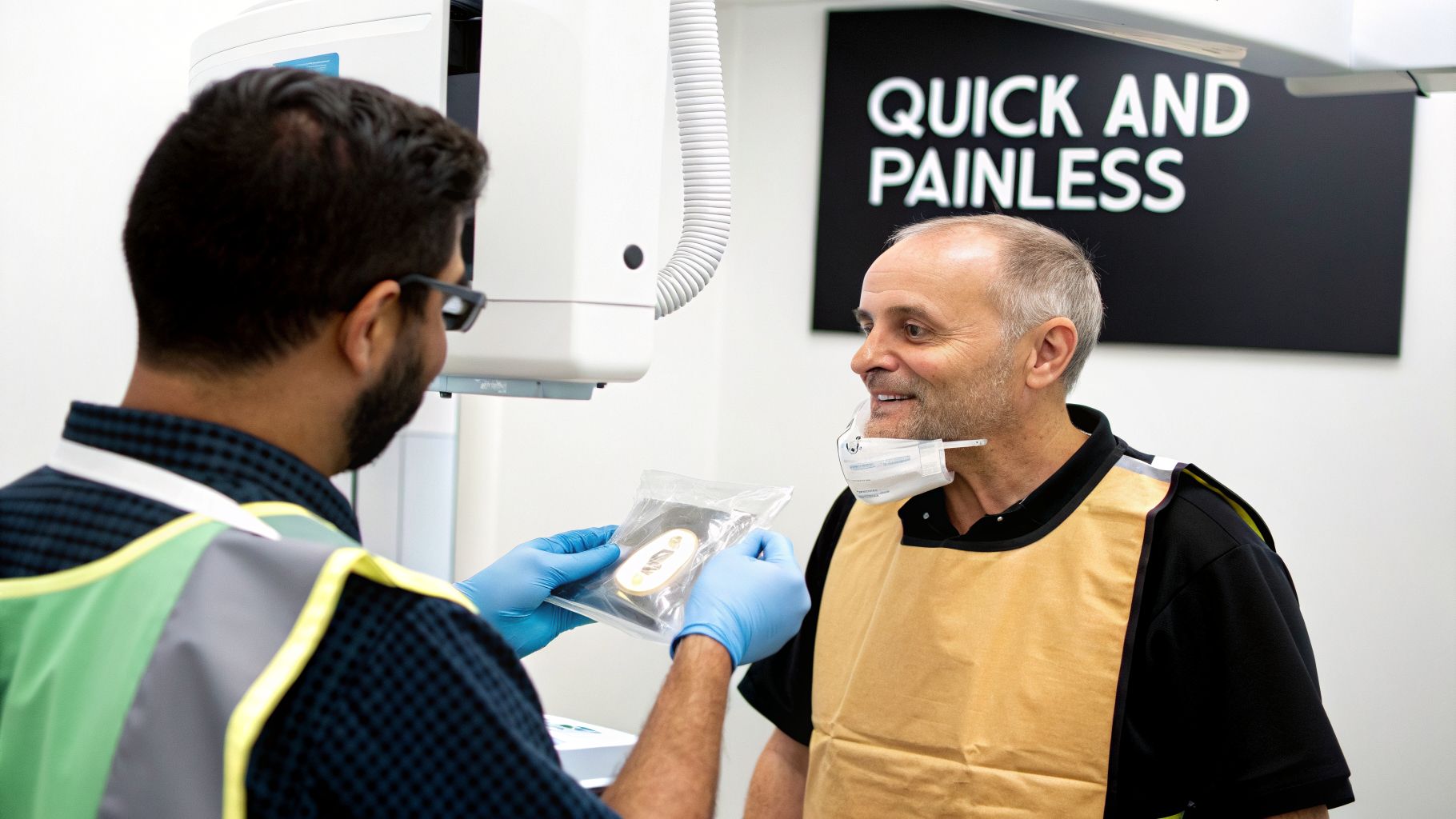
Before we start the scan, one of our friendly team members will run you through a few simple preparation steps. This is all about making sure we get a crystal-clear image of your teeth and jaws, with nothing getting in the way.
Getting You Ready for the Scan
First things first, we'll ask you to remove any metal objects from your head and neck. This is really important because metal can show up on the X-ray as "ghost images" or blurry spots, which might hide something your dentist needs to see.
This usually means taking off: * Jewellery like earrings, necklaces, and any facial piercings * Eyeglasses or removable hair clips * Any dentures, plates, or other removable dental work
Next, we’ll place a heavy but flexible lead apron over you. Think of it as a protective blanket. It's a standard safety measure that shields your body from the very small amount of radiation needed for the scan, keeping your exposure as low as possible. Your safety is our top priority, and this is a non-negotiable part of our process.
During the Scan Itself
Once you’re all set, we’ll guide you to the OPG machine. You'll either stand or sit, and we'll help position your head correctly. You’ll be asked to gently bite down on a small, sterile plastic guide.
This little bite-piece is key—it helps keep your head perfectly still and lines up your teeth for the best possible image. The most important thing you can do during the scan is to stay completely motionless.
> The machine has an arm that will slowly and smoothly rotate in a half-circle around your head. The scan itself is incredibly fast, taking only about 15 to 20 seconds. You won’t feel a thing.
And that’s it! The whole thing is over before you know it. Because the image is digital, it’s available instantly for your dentist to look at. For more general information about visiting our practice, feel free to check out our patient information page. We’re here to make your OPG scan a completely seamless and comfortable experience.
***
Is an OPG X-ray Safe? Let's Talk About Radiation
It's completely understandable to have questions about radiation and X-rays. We get asked about it all the time, and it’s a great question to ask. The short answer is yes, OPGs are very safe.
Modern OPG dental radiography is designed to capture a huge amount of detail using an incredibly small, focused amount of radiation. Your safety is always our number one priority.
To give you a bit of perspective, the radiation exposure from a single digital OPG scan is minimal. Think of it like this: it's roughly the same amount of natural background radiation you'd absorb on a short commercial flight, say from Sydney to Melbourne. It’s a tiny fraction of the radiation we all encounter from natural sources every day of our lives.
Our Commitment to Your Safety
Here at Oasis Smiles Dental, we live by a simple but powerful safety principle for all X-rays: ALARA. This stands for "As Low As Reasonably Achievable," and it’s a promise we make to every single patient who walks through our door.
What does ALARA mean in practice?
- We only take X-rays when absolutely necessary. We'll only recommend an OPG if the information we gain is essential for your diagnosis and treatment planning.
- We use the lowest dose possible. Our modern equipment is calibrated to capture a crystal-clear image with the minimum amount of radiation required.
- We never take an X-ray "just in case." Every scan must have a clear clinical purpose.
> Your health and safety guide every decision we make. We ensure every X-ray is justified, optimised, and performed with the highest standards of care.
To add another layer of protection, we always follow standard safety protocols. This includes giving you a lead apron to wear during the scan, which effectively shields the rest of your body and keeps your exposure to an absolute minimum.
Do I Need a Thyroid Collar for an OPG?
This is another common question, especially if you've had other types of X-rays before. For a panoramic OPG, however, a thyroid collar can actually do more harm than good.
Because the OPG machine rotates all the way around your head, a collar can get in the way of the X-ray beam. This often creates a shadow right over the jaw, blocking our view of the very areas we need to see.
Since the radiation dose is already so low and the beam is very narrow and targeted, leading dental radiology associations now agree that a thyroid collar isn't needed for a properly performed OPG. You can rest easy knowing the risk to your thyroid is negligible and our state-of-the-art equipment is set up to keep you safe.
How OPGs Compare to Other Dental X-rays
Think of dental X-rays like a photographer's camera bag. You wouldn't use a wide-angle lens to capture a tiny insect, and you wouldn't use a macro lens for a sweeping landscape. In the same way, different dental issues call for different types of images. While an OPG dental radiography scan gives us a fantastic panoramic overview, sometimes we need to zoom in or see things in 3D.
Understanding why we choose one X-ray over another can help you feel more informed and confident about your care. Let’s look at how the OPG stacks up against the other common imaging tools we use.
OPG vs. Bitewing X-rays
Bitewings are the small, detailed X-rays we typically take during your routine check-ups. They are our go-to for getting a really close look at just a few teeth at a time.
Their main job is to spot problems in the hard-to-see areas, particularly the surfaces *between* your teeth. This makes them brilliant for catching early signs of decay, checking on the health of your bone between teeth, and making sure existing fillings and crowns are still fitting perfectly.
The limitation? Bitewings only show a small part of the story. They can’t see your wisdom teeth, your jaw joints (TMJ), or give us a complete picture of your entire jawbone. For that, we need the wide-angle view of an OPG.
> An OPG shows us the whole forest—the overall jaw structure, all the teeth, and the sinuses. A bitewing shows us the individual trees in high-definition detail. We often need both to get the full picture.
We always carefully consider which scan is truly necessary. Our decision-making process is straightforward and always puts your safety first, as this simple chart shows.
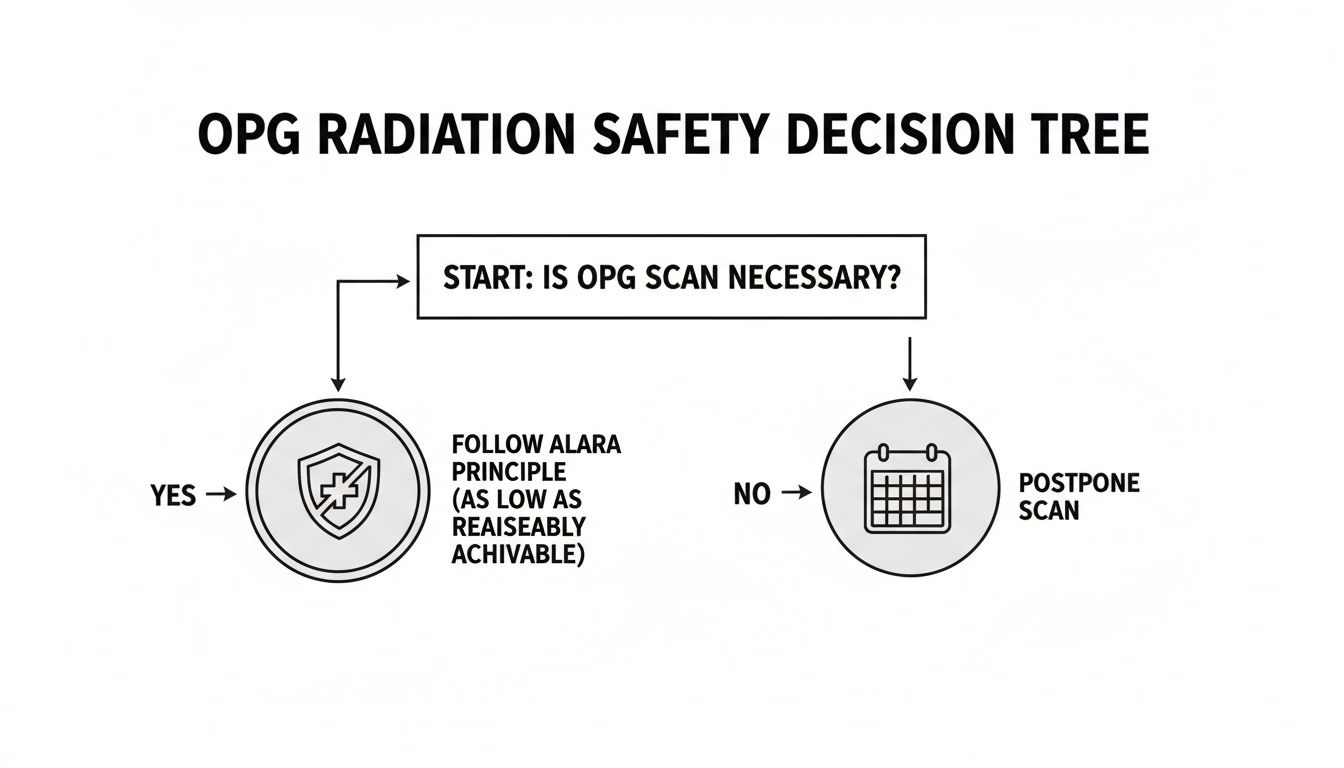
As you can see, the first question is always: "Is this scan absolutely necessary for an accurate diagnosis and safe treatment?" This ensures we never take an X-ray without a clear and justified reason.
OPG vs. Cone Beam CT (CBCT) Scans
A Cone Beam CT, or CBCT scan, is the powerhouse of dental imaging. While an OPG gives us a flat, 2D panoramic picture, a CBCT creates a complete 3D model of your teeth, jaw, soft tissues, and nerve pathways.
This incredible level of detail is reserved for more complex situations where a two-dimensional image just isn’t enough. Think of it as the difference between a map and a globe. The 3D view is essential for:
- Dental Implant Surgery: To precisely map out the best spot for an implant, avoiding sensitive areas like nerves and sinuses.
- Complex Extractions: Especially for deeply impacted wisdom teeth, a CBCT shows us exactly where the tooth is in relation to nearby structures.
- Advanced Orthodontics: To get a true understanding of jaw alignment and tooth positions. You can learn more about how detailed imaging helps us plan treatments like Invisalign in our orthodontic services guide.
Because a CBCT gathers so much information, it naturally involves a higher radiation dose than an OPG. That's why we use it very selectively. An OPG is often our first step. If it reveals something that requires a more detailed, three-dimensional look, only then would we recommend a CBCT scan.
To make it even clearer, here’s a quick breakdown of when we’d use each type of imaging technology.
Comparing Dental Imaging Technologies
This table helps show the different purposes of OPGs, bitewing X-rays, and 3D CBCT scans, so you can see why your dentist might recommend one over another.
| Imaging Type | Primary Purpose | What It Shows | Best For | | :--- | :--- | :--- | :--- | | OPG | Wide panoramic overview | All teeth, upper/lower jaws, sinuses, jaw joints (TMJ) | Wisdom teeth assessment, general orthodontic planning, fracture detection | | Bitewing X-ray | High-detail close-up | In-between surfaces of a few teeth, bone level | Detecting cavities between teeth, checking crowns/fillings | | 3D CBCT Scan | In-depth 3D model | Teeth, jawbone, soft tissue, nerve pathways in 3D | Dental implant planning, complex extractions, advanced diagnostics |
Each tool has a specific job, and choosing the right one ensures we get the exact information we need to keep your smile healthy, without any unnecessary scans.
An OPG isn't just a one-off scan we take when there's a problem. It's an invaluable tool we use to map out your oral health throughout your entire life, from your very first teeth right through to planning for restorative work in later years.
Think of it as creating a historical record of your smile. Each OPG dental radiography scan captures a specific moment, letting us track how your teeth and jaws are changing over time. This gives us the full picture, helping us anticipate challenges and plan treatments with your unique dental story in mind.
An Image for Every Age
For young kids, an OPG is fantastic for watching how their jaw is growing and how their adult teeth are developing under the gums. It helps us confirm everything is coming in as it should and lets us spot potential issues—like crowding or even missing adult teeth—long before they become a real problem.
As we move into the teenage years, the OPG becomes a cornerstone of orthodontic planning. It reveals the precise position of every tooth, even those that haven't broken through the gumline yet. This detailed view is critical for designing an effective plan for braces or Invisalign to create a healthy, functional, and straight smile.
From Wisdom Teeth to Complex Restorations
In young adulthood, the conversation often turns to wisdom teeth. An OPG is the go-to method for checking on them. We can clearly see if they’re impacted (stuck), growing in at a funny angle, or likely to cause pain and infection down the track. This allows us to plan for a safe and timely removal if needed.
Later in life, our dental needs can become a bit more complex. An OPG is absolutely essential for: * Checking Jawbone Health: It helps us assess the density and quality of your jawbone, which is crucial information we need before planning for dental implants, bridges, or dentures. * Planning for Dental Implants: If you're looking at replacing missing teeth, an OPG gives us the foundational view we need to start the planning process. You can learn more about how we use imaging to plan for successful dental implants in our detailed guide. * Monitoring Your Overall Oral Health: The scan can also help us spot less obvious issues, like bone loss from advanced gum disease or other silent problems that might otherwise go unnoticed.
> As Australia's population gets older, this kind of forward-thinking dental care is more important than ever. With the number of Australians over 65 projected to reach 4.2 million by 2030, the need for comprehensive imaging like OPGs is definitely on the rise.
This group often has more intricate dental histories, and an OPG is an efficient way to assess everything from bone levels to potential locations for implants. For those interested in industry trends, you can read more about Australian dental imaging on Mordor Intelligence. At the end of the day, this single X-ray supports thoughtful, proactive dental care for every member of the family.
Got Questions About OPGs? We've Got Answers
It’s perfectly normal to have a few questions, even after you've learned a bit about OPGs. To help you feel completely at ease, we’ve put together some straightforward answers to the things our patients ask us most often.
We want to clear up any lingering concerns so you can feel confident and well-informed about your dental care.
How Often Will I Need an OPG X-Ray?
That's a great question, and the simple answer is: it depends. There’s no fixed "every so often" rule for OPGs. We only recommend one when it's clinically necessary for what’s happening in your mouth right now, not based on a calendar schedule.
For many people, this might mean an OPG scan only every 3-5 years, or sometimes even less. We typically suggest one in a few key situations: * When you're a new patient: An OPG gives us a fantastic, comprehensive starting point to understand your overall oral health. * To look into a specific problem: This could be anything from mysterious jaw pain and tracking wisdom teeth to seeing if you're a good candidate for braces. * To plan major treatment: It's a must-have for planning procedures like dental implants or tricky extractions.
Your dentist will only ever suggest an OPG when it's genuinely needed to get an accurate diagnosis and create a safe, effective treatment plan for you.
> Your dental health is as unique as you are. We don’t believe in a one-size-fits-all approach to X-rays. An OPG is a diagnostic tool we use thoughtfully, and only when it adds real value to your care.
Can I Have an OPG if I’m Pregnant?
Your safety, and your baby’s, is our number one priority. As a standard precaution, we avoid all non-emergency X-rays during pregnancy.
Even though the radiation from a modern digital OPG is extremely low and the beam is nowhere near your abdomen, we believe in being extra cautious. It is absolutely crucial that you let our team know if you are pregnant or even think you might be.
We will gladly postpone any routine scans until after your baby is born. In the very rare event of a true dental emergency where an X-ray is unavoidable, we would always consult with your doctor before going ahead with any imaging.
Is an OPG Covered by Private Health Insurance?
Here in Australia, an OPG scan (which falls under item number 037) is often partially covered if your private health insurance includes extras or ancillary benefits.
The exact rebate you'll get depends entirely on your health fund and your specific level of cover. We are more than happy to give you the item number ahead of time so you can check with your provider. That way, there are no surprises.
Our clinic also supports relevant government schemes, such as the Child Dental Benefits Schedule (CDBS) and services for Department of Veterans' Affairs (DVA) cardholders.
Do I Need a Referral from a Doctor for an OPG?
Nope, you don't need to see a GP for a referral. If your dentist here at our practice decides an OPG is the next best step during your check-up, they can provide the referral for the scan right then and there.
One of the best things about a modern dental clinic is having this technology in-house. At Oasis Smiles Dental, we have our own OPG machine, meaning you can get your scan done conveniently with us, often in the very same appointment. It saves you the hassle of a separate trip to an imaging centre.
--- At Oasis Smiles Dental, we believe an informed patient is an empowered patient. If you have any other questions at all about OPGs or your dental health, our friendly team is always here to chat. Contact us today to schedule a consultation and see our commitment to patient-focused care for yourself. Book your appointment online or give our Tamworth clinic a call.