

Finding a Cone Beam CT Near Me in Tamworth
If you've ever found yourself searching for a "cone beam CT near me," you're probably looking for a better, more detailed answer to a dental issue. A Cone Beam CT (CBCT) scan gives your dentist an incredibly detailed, 3D model of your mouth, jaw, and face. It's the difference between a flat photograph and a complete digital sculpture, offering a level of clarity that regular 2D X-rays simply can't match. Here at Oasis Smiles Dental in Tamworth, we rely on this technology to ensure we have the full picture before starting any complex treatment.
What Is a Cone Beam CT Scan and When Do You Need One?
The name 'Cone Beam CT' might sound a bit technical, but the idea behind it is actually quite simple. Imagine a standard dental X-ray is like a flat road map. It’s great for showing you the general layout, but it gives you no information about the height of hills or the depth of valleys. It’s useful, but it’s missing a whole dimension.
A CBCT scan, however, is more like a detailed 3D digital model of your entire jaw and facial structure. Instead of one flat image, a cone-shaped beam of X-rays makes a single, quick pass around your head, capturing hundreds of individual images. A powerful computer then pieces all of this information together, building a complete 3D view we can explore from any angle.
Why a 3D View Matters
This three-dimensional perspective is a game-changer. It allows our dentists at Oasis Smiles Dental to see everything—your teeth, roots, jawbone, sinuses, and even nerve pathways—in their true relationship to one another. There's no more guesswork.
This level of detail is crucial for a number of common dental treatments:
- Dental Implant Planning: We can measure the exact height and width of your jawbone to ensure there’s enough support for an implant. It also lets us map a precise path to avoid sensitive nerves and sinuses.
- Complex Root Canals: Sometimes, a tooth has tiny, hidden canals or fractures that don't show up on a normal X-ray. A CBCT scan reveals these, helping us understand the full scope of an infection.
- Orthodontic Assessment: For treatments like braces or clear aligners, seeing the exact position of every tooth root within the jawbone helps create a more predictable and effective treatment plan.
- Impacted Teeth: When removing teeth, especially wisdom teeth, it’s vital to know exactly where they are in relation to major nerves. A CBCT scan provides a clear map for a safe extraction.
> A CBCT scan moves dental diagnostics from estimation to absolute precision. It eliminates surprises during procedures, leading to safer, more predictable outcomes for you.
The demand for this technology is growing fast. In fact, Australia's market for cone beam computed tomography systems was valued at USD 25.4 million in 2022 and is expected to hit USD 79.6 million by 2030. This boom shows just how much modern dental practices are embracing advanced diagnostics to provide better patient care.
Ultimately, finding a practice with CBCT scanning is about choosing a higher standard of dental care. You can find out how we use this and other modern tools by exploring our advanced dental technology.
How 3D Imaging Leaves Traditional X-Rays Behind
You’ve probably had standard dental X-rays before. They give us a flat, two-dimensional picture of your teeth and jaw. Think of it like a regular photograph – it’s useful, but it squashes everything into a single layer. While these are fine for routine check-ups, they don't always tell the whole story.
The main problem with a flat 2D image is that important details can overlap and hide from view. A tooth root might look like it's a safe distance from a nerve, when in reality, they're practically touching. Things like tiny fractures or hidden infections in a complex root system can be missed entirely. This means your dentist is often working with incomplete information, forced to make educated guesses.
From Guesswork to a 360-Degree View
This is where a Cone Beam CT (CBCT) scan changes everything. Instead of a flat picture, it creates a complete 3D model of your mouth, jaw, and even your face. It's the difference between looking at a flat paper map and exploring a detailed digital globe.
The machine takes hundreds of pictures in one quick, single rotation around your head. A powerful computer then stitches all these individual images together, creating a comprehensive model we can digitally rotate, slice, and examine from any angle imaginable.
This full-picture perspective gives your dentist a crystal-clear, 360-degree view of crucial structures, including:
- Nerve Pathways: We can trace the exact location of sensitive nerves to ensure we avoid them during procedures like placing a dental implant or extracting a wisdom tooth.
- Bone Quality: Your dentist can measure the precise density and volume of your jawbone, confirming if it’s strong enough to support an implant. No more guesswork.
- Soft Tissues: The scan provides detailed images of your sinuses and other soft tissues, which helps us diagnose issues or plan surgery with much greater accuracy.
- Exact Tooth Positions: We see the true orientation of every single tooth and its roots within the jaw, which is absolutely vital for effective orthodontic planning.
> The biggest advantage of a CBCT scan is the shift from estimation to precision. It gives your dentist the ability to plan your treatment with total confidence, leading to safer procedures and far more predictable results.
Here's a quick comparison to make the difference clear.
Cone Beam CT vs Traditional Dental X-Ray
| Feature | Traditional 2D X-Ray | Cone Beam CT (3D Imaging) | | :--- | :--- | :--- | | Image Type | Flat, 2-dimensional image. | Complete 3-dimensional model. | | View | Overlapping structures can hide details. | 360-degree view with no hidden areas. | | Detail Level | Shows basic tooth and bone structure. | Reveals nerves, soft tissue, and bone density. | | Planning Accuracy | Requires some estimation and guesswork. | Allows for precise, measurement-based planning. | | Best For | Routine check-ups, detecting surface cavities. | Complex procedures like implants, root canals, and orthodontics. |
Ultimately, a CBCT scan provides a level of detail that a traditional X-ray simply can't match, which is critical for complex treatments.
This infographic shows how these superior diagnostics directly lead to better patient care across key treatment areas.
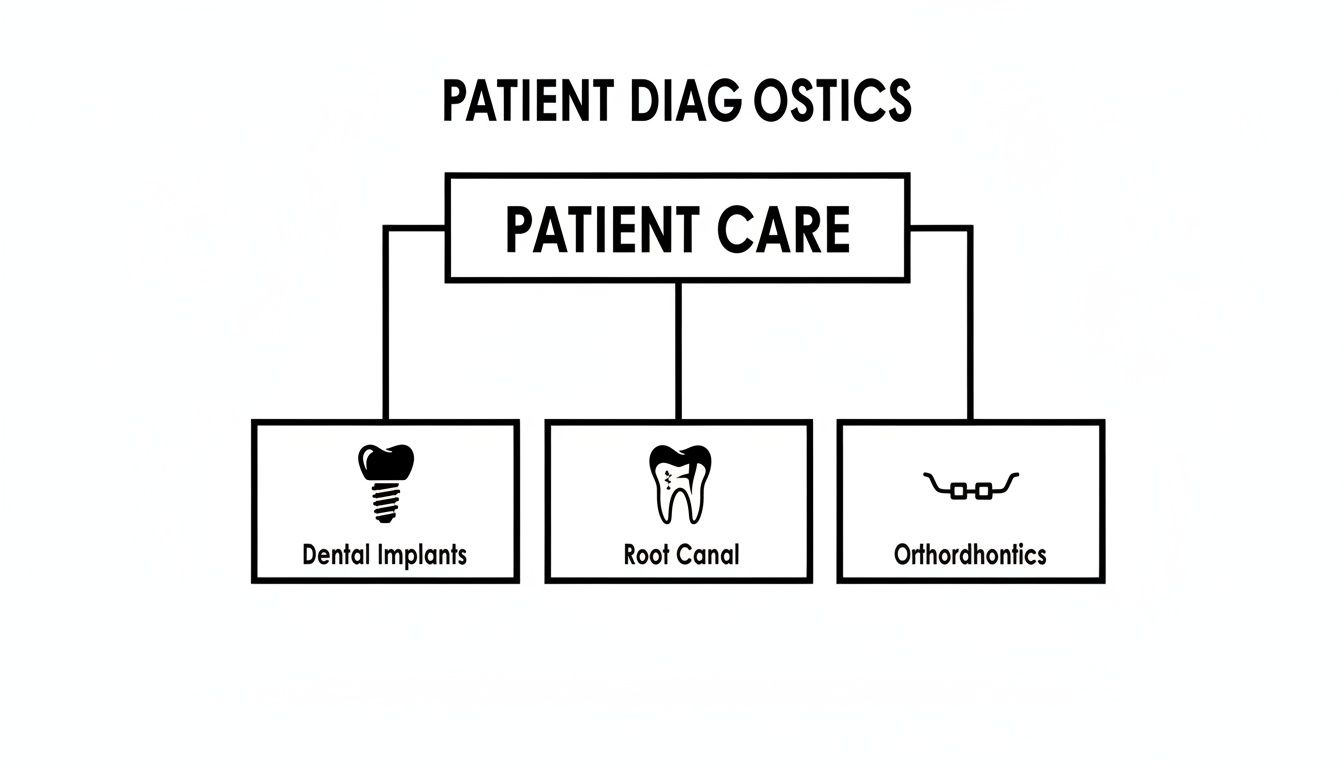
As you can see, better diagnostics are the foundation for successful outcomes in dental implants, root canals, and orthodontics.
What This Means for You in the Dental Chair
This isn't just about getting a fancy picture; it’s about what that clarity means for your actual dental experience. When you search for a "cone beam CT near me," you're really looking for a higher standard of care that delivers tangible benefits.
For you, this translates to safer, less invasive procedures and fewer surprises. With a detailed 3D blueprint, your dentist can perform treatments with pinpoint accuracy. This helps preserve healthy tissue, often reduces your recovery time, and ensures that the treatment plan we create for you is based on facts, not assumptions.
Real-World Uses for CBCT Scans in Modern Dentistry
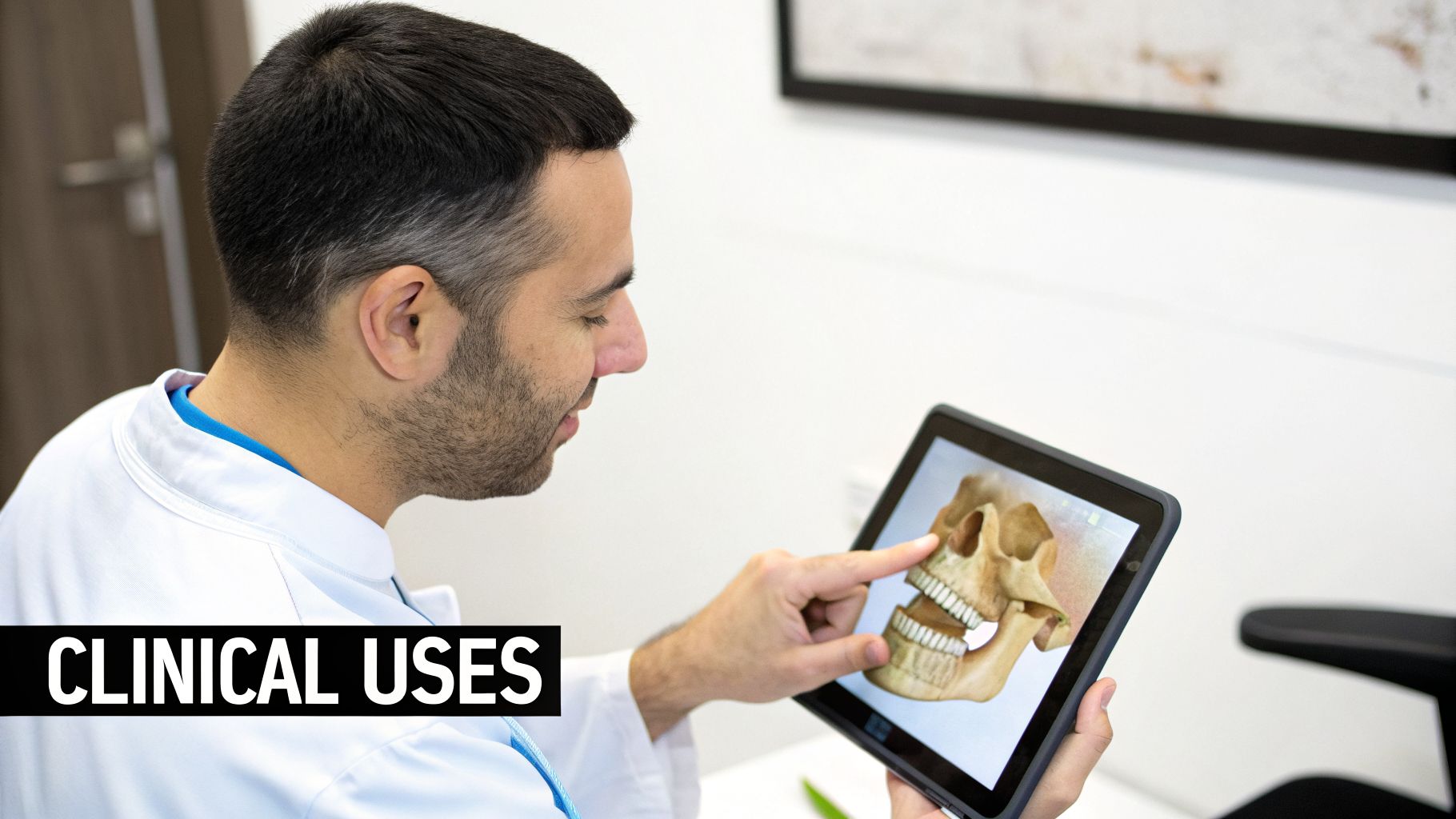
While the technology itself is impressive, what really matters is how it helps us give you better, safer, and more predictable results. At Oasis Smiles Dental, we see the CBCT scanner as our secret weapon—a tool that lets us create a detailed 3D map for some of the most intricate procedures in dentistry.
This is where the theory behind 3D imaging becomes a practical reality. If you're searching for a "cone beam CT near me," understanding these real-world applications will show you exactly why this technology is no longer a luxury, but a true standard of care.
Precision Planning for Dental Implants
When it comes to dental implants, there’s no room for guesswork. For an implant to be successful, it needs a solid foundation of healthy jawbone. A CBCT scan gives us the power to measure your bone density and volume with incredible accuracy, right down to the millimetre. It answers the most critical question: can your jaw securely support an implant for a lifetime?
Beyond that, the scan creates a precise 3D model of your entire jaw. We can clearly see where sensitive nerves and sinuses are located, allowing us to plan the placement of the implant well away from these vital structures. This level of foresight and safety is something a traditional flat 2D X-ray simply can't provide. You can learn more about how this fits into our process by reading about our approach to dental implants in our comprehensive guide.
Uncovering Hidden Issues in Root Canals
A throbbing toothache often signals the need for a root canal, but pinpointing the exact problem can be tricky. Teeth can have complex root systems with tiny, extra canals or hairline fractures that are completely invisible on a standard X-ray. If these hidden issues are missed, the treatment can fail, and the pain will return.
> A CBCT scan lights up the entire root structure, turning what was once a guessing game into a clear diagnosis. We can spot hidden canals and infections with confidence, ensuring we treat the root of the problem completely—the first time.
In fact, studies have shown that CBCT technology can increase the detection rate of missed canals by up to 40% compared to old-school X-rays. That’s a massive improvement in our ability to save a natural tooth and help you avoid future procedures.
Advanced Orthodontic and Surgical Insights
Orthodontic treatment, whether it’s braces or Invisalign, is about more than just straightening the crowns of your teeth. It’s about moving the entire tooth, root and all. A CBCT scan gives us a complete picture of how each tooth root is positioned within the jawbone, which is invaluable for planning more effective and predictable orthodontic treatment, especially for complex cases.
The scan is also essential for other procedures, such as:
- Impacted Wisdom Teeth: It provides a crystal-clear map of the tooth’s position relative to major nerves, making removal significantly safer.
- Pathology Detection: The detailed 3D view can help us spot the early signs of cysts, tumours, or other abnormalities that might be missed on a 2D scan.
By delivering this incredible level of detail, the CBCT scan has helped shift modern dentistry from an art of estimation to a science of precision.
Your CBCT Scan Appointment: What to Expect
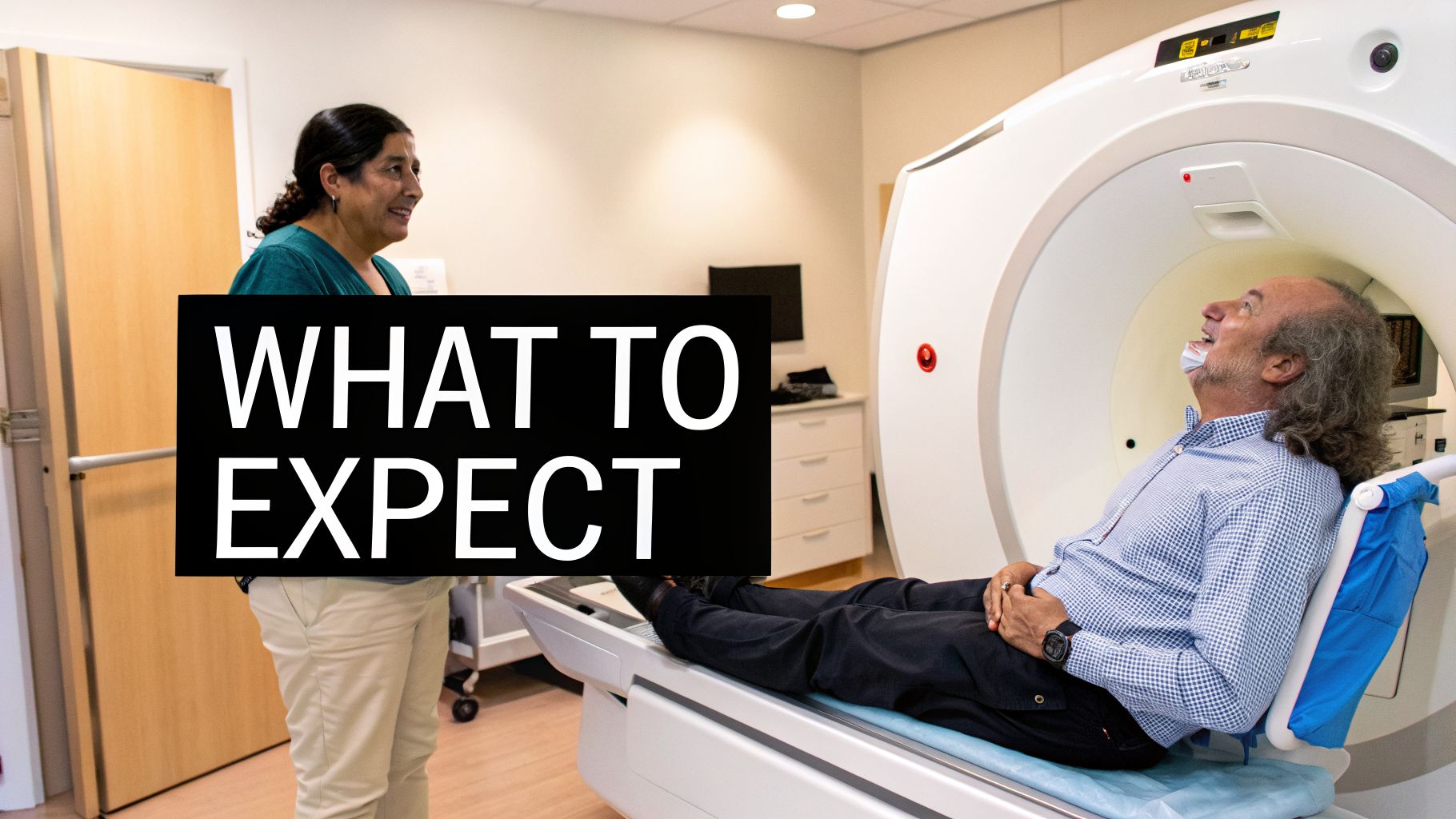
We find that the idea of any new dental scan can make some people feel a bit nervous. We want to put your mind at ease straight away—the CBCT process is incredibly simple, quick, and completely comfortable. At our Tamworth practice, we’ve designed the whole experience to be as stress-free as possible.
When you come in for your scan, our friendly team will be right there to walk you through the very short preparation. There’s not much for you to do, but we will ask you to take off a few things to make sure we get a perfectly clear image.
Before the Scan Begins
Your main job is just to remove any metal objects from around your head and neck area that could get in the way of the scan. This usually includes items like:
- Glasses or sunglasses
- Jewellery, such as earrings and necklaces
- Hearing aids
- Hairpins or clips
- Any removable dental work like dentures or plates
Once those items are safely put aside, we’ll help you get settled in the scanner. A lot of people picture a big, enclosed medical CT machine, but our CBCT scanner is completely open, so you won't feel claustrophobic at all.
You’ll either be sitting or standing comfortably, and we’ll guide you to place your chin on a small stabiliser. This simply helps you keep your head nice and still during the scan, which is the secret to getting a sharp, high-quality 3D image for your diagnosis.
During the Scan Itself
This is the quickest part of the whole appointment. Once you’re settled and still, the scanner’s arm will make one quiet, smooth rotation around your head.
> The actual scan itself takes less than 30 seconds. You genuinely won't feel a thing. There's no pain, no loud noises, and no discomfort. Most of our patients are surprised at just how fast and easy it is.
And just like that, you’re all done. You can immediately put your glasses, jewellery, or dental appliances back in. The entire appointment, from the moment you walk in to when you leave, often takes only a few minutes.
Of course, if you have any questions before, during, or after, our team is right there with you to help. For more general details, you can also look at our patient information and resources.
After you leave, our dental team gets to work analysing the detailed 3D images. At your next consultation, your dentist will go over the findings with you, using the scan to explain their diagnosis and map out a precise treatment plan made just for you.
Your Safety and Peace of Mind Come First
Let's talk about radiation. It's a question that naturally comes up with any kind of scan, and we want to tackle it head-on because your health and comfort are what matter most to us. While a Cone Beam CT (CBCT) does involve radiation, the amount is important to put into perspective.
A dental CBCT scan exposes you to significantly less radiation than a traditional medical CT scan. In fact, the exposure level is often compared to the natural background radiation you'd absorb on a long-haul flight, say from Sydney to London. It’s a very small, highly focused dose used for a very specific purpose.
How We Keep You Safe
Here at Oasis Smiles Dental, our guiding principle for any imaging is ALARA—‘As Low As Reasonably Achievable’. This isn't just our policy; it's a worldwide safety standard for all medical and dental professionals.
What this means for you is simple: we will only ever suggest a CBCT scan when the diagnostic information is absolutely crucial for your treatment. If a standard 2D X-ray can give us what we need, that’s what we’ll use. Every single time.
> We don’t think of a CBCT scan as a routine screening. It’s a specialised tool we pull out to solve complex diagnostic problems, making sure the insight we gain is far more valuable than the tiny amount of radiation involved.
This thoughtful approach guarantees you get the most accurate diagnosis possible, but without any unnecessary exposure. Your safety truly is at the heart of every recommendation we make.
Why the Benefits Are Worth It
The decision to use a CBCT scan is always made with great care. We recommend it only when that detailed 3D picture is the key to a safe, predictable, and successful outcome for you.
Think about these real-world situations: * Planning Dental Implants: A scan lets us map out the exact location of your nerves, so we can place the implant without risking any damage. * Treating Complex Root Canals: It helps us spot tiny, hidden canals or infections that a standard X-ray would miss, preventing future pain and treatment failure. * Removing Impacted Teeth: We get a crystal-clear 3D view of the tooth’s position relative to other structures, allowing for a much safer and less invasive extraction.
In every one of these examples, the risk of moving forward without that complete picture is far greater than the minimal risk from the scan itself. So, when you're searching for a "cone beam CT near me," it’s vital to choose a practice that operates with this level of transparency and care. It’s the best way to ensure the technology is used to protect you, giving both you and your dentist clarity and confidence.
Costs and Accessing CBCT Scans in Tamworth
It's completely normal to think about the practical side of things, and cost is a big part of that. When we recommend a CBCT scan, we don't see it as just another expense. Think of it as a crucial investment in getting your diagnosis spot-on, which often prevents bigger, more expensive issues down the road. It gives us the clarity we need to get your treatment right the first time.
Here at Oasis Smiles Dental, we’re committed to making this advanced level of care available to everyone in Tamworth. That’s why we proudly accept all major Australian health funds, so you can make the most of your private health insurance.
Your Health Fund and Payment Options
How much your private health insurance covers will really depend on your specific policy and your level of cover for diagnostic imaging. Our team is more than happy to give you the item numbers you'll need, so you can check with your fund and know exactly where you stand.
> We firmly believe that financial worries shouldn't stand in the way of getting the best dental care. To make things easier, we offer a range of flexible payment solutions to suit different budgets.
We also support patients who are covered by relevant Medicare or Department of Veterans' Affairs (DVA) schemes. Our commitment is to give you complete clarity on the financial side of your care, with no surprises.
Making Your Decision Stress-Free
We want you to feel completely confident and informed about every part of your care, and that absolutely includes the costs. Our friendly front-office team can walk you through everything – from the scan fee to your insurance options and payment plans – in a clear and supportive way.
Your dental health is our top priority, and that includes making the whole process as simple and stress-free as we can.
If you’d like to chat about your specific needs or learn more about our payment options, please get in touch with our Tamworth team. You can find all our details by visiting our contact us page.
Your CBCT Scan Questions, Answered
It’s completely normal to have questions before any dental procedure. We hear a lot of the same queries from patients looking for a "cone beam CT near me," so we’ve put together some straightforward answers to help you feel more comfortable.
How Long Does the Scan Actually Take?
The scan itself is surprisingly quick. In just 20 to 40 seconds, the machine completes one full rotation, and we’re done. The whole appointment, from getting you settled in the chair to making sure you’re ready to go, rarely takes more than a few minutes.
Most people are genuinely surprised by how fast and simple the entire process is.
Is a CBCT Scan Painful or Uncomfortable?
Not in the slightest. The scan is completely painless. You just need to sit or stand still for a few seconds while the machine quietly and smoothly moves around your head.
> You won't feel a thing. It's an open-design machine, so there are no tight spaces or loud, clunky noises. It’s a very calm and easy experience, even for patients who feel a bit anxious.
Our team is right there with you, explaining every step to make sure you feel relaxed and at ease.
Will I Get My Scan Results Immediately?
The 3D images are created on the computer almost instantly, but that’s just the first step. The real work comes next, as your dentist needs to carefully analyse the enormous amount of detail in those images. They'll digitally explore your jaw, teeth, and nerves from every possible angle to make a precise diagnosis.
Your dentist will usually go over the results with you during a separate follow-up appointment. That’s when they can show you what they’ve found and talk you through the best treatment plan for your specific situation.
Why Not Just Use a Regular X-Ray?
Traditional 2D X-rays are fantastic for general check-ups, but they have limitations. Because they produce a flat, single image, different structures—like tooth roots, nerves, and bone—can get layered on top of each other, hiding important details. Think of it like looking at a flat map; it’s useful, but it doesn't show you the hills and valleys.
When we're planning something more complex, like a dental implant or dealing with an impacted wisdom tooth, a 3D CBCT scan is non-negotiable. It gives us the depth and detailed view we need to ensure your treatment is not only successful but also safe and predictable. A 2D image just can’t provide that level of certainty.
--- Ready to see what advanced 3D imaging can do for your peace of mind? The team at Oasis Smiles Dental is here to offer the highest standard of diagnostic care right here in Tamworth. Book your consultation today and let's get you a clear, precise plan for your dental health. Find out more at https://www.oasissmilesdental.com.au.