

A Patient's Guide to Panoramic X Ray Dental Scans in Tamworth
A panoramic x-ray dental scan is one of our most valuable tools, giving us a complete, single-image overview of your entire mouth. It captures everything in one go—*all your teeth, both jaws, and the surrounding structures*—all laid out in one flat, easy-to-read image.
Seeing the Full Picture of Your Dental Health
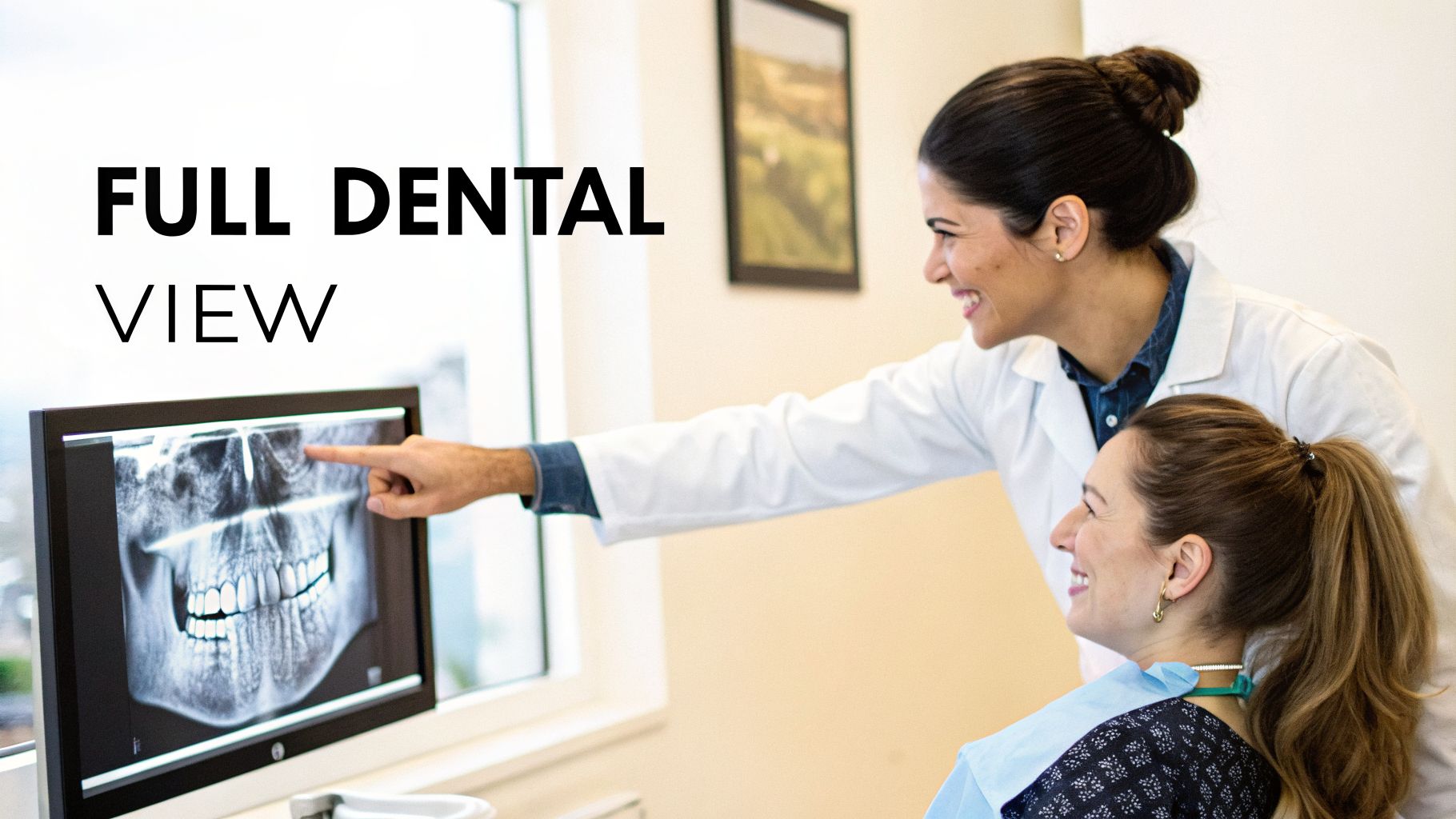
Ever wondered how we get that all-in-one view of what’s happening inside your mouth? While those small, standard X-rays are great for a close-up on one or two teeth, a panoramic X-ray gives us the bigger picture.
Think of it like comparing a detailed portrait of a single person to a sweeping landscape photo of an entire valley. Both are useful, but they tell very different stories.
This wide perspective is invaluable. It lets our dentists at Oasis Smiles Dental see how your teeth, jawbones, and even your sinuses all connect and work together. Having this complete picture helps us plan treatments with far more accuracy and foresight.
Why the Broad View Matters
A panoramic X-ray isn’t just about seeing all your teeth at once; it’s about understanding the complex system they're part of. With this technology, we can spot and assess conditions that smaller, more focused X-rays would simply miss.
It gives us a clear map for many common dental procedures, including:
- Assessing Wisdom Teeth: We can see their exact position, check if they are impacted (stuck), and see how close they are to important nerves and sinuses.
- Planning Orthodontics: It helps us track how adult teeth are coming in for children and map out the best strategy for braces or aligners.
- Evaluating for Dental Implants: The scan clearly shows if there's enough healthy bone in the jaw, which is absolutely critical for an implant to be successful.
- Detecting Hidden Issues: It helps us find things like jawbone problems, cysts, tumours, infections, and tiny fractures that are impossible to see during a standard check-up.
> A panoramic image lets your dentist see the full context of your oral health. It reveals the intricate relationships between bone, teeth, and soft tissues, which is essential for diagnosing issues and planning effective, long-term treatments.
This powerful diagnostic tool is just one of the ways we embrace modern technology. To learn more about our commitment to advanced care, you can explore the other technologies we use at our Tamworth clinic.
Here at Oasis Smiles, having this big-picture view from a panoramic x-ray dental scan means we can catch potential problems early, making sure we provide the most thorough and effective care for you and your family.
Ever wondered what actually happens during one of those big, rotating dental X-ray scans? It’s far simpler and quicker than you might think. The whole experience is designed to be easy and comfortable.
The machine itself does all the work, making a slow, gentle sweep around your head. As it moves, it captures a single, continuous image of your entire mouth, from your upper and lower jaws to all your teeth.
You’ll just need to stand or sit still for a moment—usually less than a minute. It's fast and completely painless, but it gives us an incredible amount of information in one go.
The Science Behind the Scan
So, how does the machine capture that full, wide smile? It uses a clever process called tomography.
Think of it this way: your jaw is curved, but to see everything clearly, we need a flat picture. Tomography allows the machine to focus on just one slice—your jaw and teeth—while intentionally blurring everything in front of and behind it.
An X-ray tube rotates on one side of your head while a sensor moves in perfect sync on the opposite side. This synchronised dance effectively "unrolls" the curve of your jaw into a flat image. It’s a bit like peeling an orange and laying the peel flat to see the entire surface at once.
This is what creates that iconic panoramic view of your mouth. It’s this broad perspective that makes a panoramic X-ray dental scan so valuable for planning treatments and spotting bigger issues.
How It Differs from Other Dental X-Rays
But what about those small, individual X-rays you get during a check-up? Many patients ask why we need different types, and it’s a great question. Those smaller X-rays, called “bitewings,” are essential, but they serve a very different purpose.
Bitewings are our close-up specialists. They give us a highly detailed look at a few teeth at a time, making them perfect for finding tiny cavities between your teeth or checking the bone level in one specific spot.
A panoramic X-ray, on the other hand, gives us the wide-angle, big-picture view. It’s not designed to spot the smallest cavities, but rather to see how everything works together.
> A panoramic X-ray shows us the whole "forest"—the position of every tooth, the health of the jawbone, and even your sinuses. Bitewings give us a close look at the individual "trees," helping us spot decay and other small-scale problems.
To make it clearer, here’s a quick comparison of the different X-rays we use at Oasis Smiles Dental.
Panoramic vs. Other Dental X-rays at a Glance
This table helps explain why your dentist might recommend one type of imaging over another. Each gives us a unique and valuable piece of information.
| X-Ray Type | What It Shows | Best For Detecting | Common Use Case | | :--- | :--- | :--- | :--- | | Panoramic | The entire mouth, including all teeth, both jaws, and TMJ. | Impacted wisdom teeth, jaw fractures, cysts, and orthodontic issues. | Initial assessment for braces, implants, or wisdom tooth removal. | | Bitewing | Crowns of the back teeth in one specific area (left or right). | Cavities between teeth and early signs of gum disease. | Routine check-ups to monitor for interdental decay. | | Periapical | The entire tooth, from the crown down to the tip of the root. | Root infections, abscesses, and problems with a single tooth. | Diagnosing a painful tooth or planning a root canal. |
Using this multi-tool approach ensures we don't miss a thing. By combining the broad overview from a panoramic scan with the detailed insights from bitewings, your dentist gets a complete and accurate picture. This allows for precise diagnoses and helps create the most effective treatment plan for you.
Key Benefits of a Full-Mouth X-Ray
A panoramic X-ray gives us a perspective that a standard check-up just can't provide. Instead of looking at individual teeth, it gives us one big, clear picture of your entire mouth, jaw, and surrounding structures. This complete overview is a game-changer for planning effective, long-term dental care.
This wide-angle view is especially helpful for more complex treatments. When we’re planning orthodontics like braces or Invisalign, for example, a panoramic image is essential. It lets us see everything at once: adult teeth still waiting to come down, the precise angle of every root, and how your upper and lower jaws align. This allows us to map out the safest and most effective path to a straighter, healthier smile.
This flowchart shows just how simple the panoramic X-ray process is, from the moment you stand in the machine to the final image appearing on our screen.
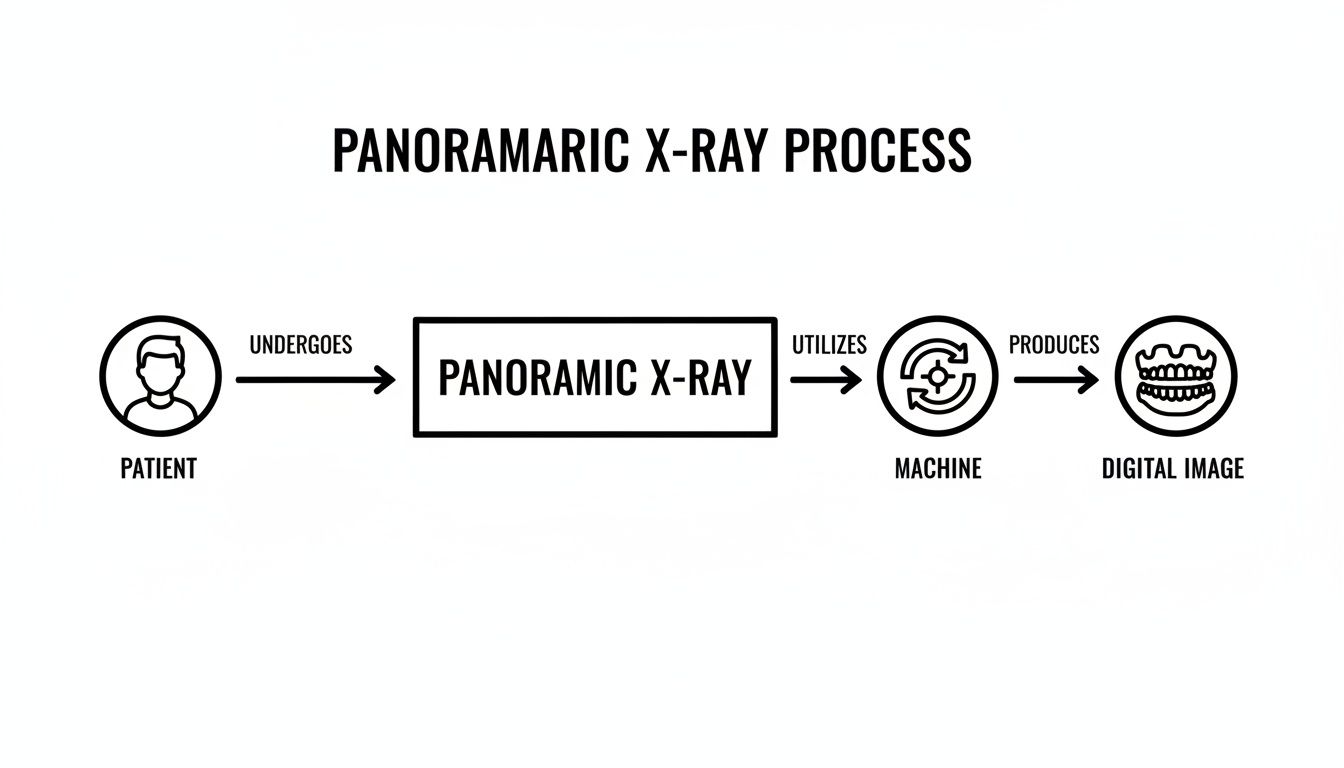
The best part is how quick and efficient it is. With just one slow rotation, we get a complete digital map of your oral health, ready for immediate review.
Revealing More Than Meets the Eye
While smaller, targeted X-rays are perfect for spotting cavities between teeth, a panoramic X-ray is our go-to for identifying the bigger picture. It’s designed to uncover underlying problems that might not show any symptoms until they become serious.
Think of it as a broad security scan for your mouth. It helps us find potential issues early, such as: * Impacted Wisdom Teeth: We can clearly see if your wisdom teeth are stuck, growing sideways, or pushing dangerously against other teeth or nerves. * Jawbone Fractures: After an injury, it’s the best way to spot subtle hairline fractures that are impossible to see from the outside. * Cysts and Tumours: The scan can reveal abnormal growths inside the jawbone that often don't cause pain in their early stages. * Sinus Problems: Because the image includes the sinuses above your top teeth, it can help us figure out if a nagging toothache might actually be related to sinus pressure.
> Getting the full story of your oral health in a single image means we can be proactive. It allows us to catch and address structural issues before they lead to pain or require more complex treatment down the road.
This isn’t just about convenience; it’s a vital part of modern preventive care. Here at Oasis Smiles Dental, it’s one of the most important tools we have for giving our patients in Tamworth and the New England region a truly thorough examination.
Planning for Dental Implants
If you're thinking about dental implants, a panoramic scan is one of the very first steps. Implants need a solid, healthy jawbone to anchor into, and this X-ray gives us a precise look at the bone’s density and height. It helps us confirm if you have enough bone for an implant right away or if we might need to consider a bone graft first. This careful planning is key to ensuring your implant is successful and lasts a lifetime.
The value of this technology is recognised across Australia. The number of panoramic X-ray machines in dental practices grew from 1,681 in 2014 to 3,059 by 2020. That's a 1.6-fold increase when adjusted for population and the number of dentists. In practical terms, that means the number of machines jumped from 108 per 1,000 dentists in 2014 to 174 per 1,000 by 2020.
For families in regional areas like ours, this trend is fantastic news. It means greater access to comprehensive imaging at local clinics like Oasis Smiles Dental, so you can get the answers you need without travelling to a major city.
Are Dental X-Rays Safe? Let's Talk About It
It’s one of the first questions we get asked, and it’s a great one: "Are X-rays safe?". We completely understand why you’d ask. At Oasis Smiles Dental, we want you to feel confident and informed about every part of your care, so let's clear the air about radiation.
The short answer is yes, modern panoramic dental X-rays are incredibly safe. The dose of radiation is extremely low.
Believe it or not, we’re all exposed to a small amount of radiation every single day. It’s called natural background radiation, and it’s just part of living on Earth—it comes from the sun above and the very ground we walk on. A panoramic X-ray actually exposes you to less radiation than what you absorb from your natural surroundings in a single day.
How Much Radiation Are We Really Talking About?
To put it in perspective, let's look at the numbers. Comparing the radiation from a dental X-ray to other sources is like comparing a single drop of water to a swimming pool—the difference is huge.
We measure radiation in a unit called a microsievert (μSv). This allows us to make clear, scientific comparisons and stick to the core principle of ALARA—keeping doses As Low As Reasonably Achievable.
Here’s how a panoramic X-ray stacks up against everyday exposures:
- One Panoramic X-ray: Roughly 5-10 μSv.
- One day of normal background radiation: About 10 μSv.
- A flight from Sydney to Melbourne: Around 5 μSv.
- A cross-country flight (like Darwin to Perth): Approximately 16 μSv.
So, a return flight between Sydney and Melbourne gives you about the same dose as one of our scans. These numbers show just how tiny the exposure really is, making it a perfectly safe way for us to get the full picture of your dental health.
Our Commitment to Aussie Safety Standards
Here at Oasis Smiles Dental, we don’t just meet the safety standards—we live by them. We strictly follow the guidelines set out by the Australian Radiation Protection and Nuclear Safety Agency (ARPANSA). These national standards are in place to ensure every X-ray is taken with the lowest possible radiation dose needed to get a crystal-clear image.
A single panoramic X-ray (often called an OPG) uses 10 microsieverts or less. For comparison, a standard medical chest X-ray is about 20 microsieverts, and that Darwin-to-Perth flight is around 16 microsieverts. This fantastic safety record is why panoramic imaging is trusted for everything from routine check-ups to orthodontic planning for families all across Australia.
> The extremely low radiation dose makes panoramic X-rays a safe and reliable choice, even for children needing orthodontic assessments or for patients who require regular monitoring. Your safety is always our first consideration.
This focus on minimal exposure gives us—and you—the confidence to use this valuable diagnostic tool without a second thought. It allows us to plan treatments for braces or check on wisdom teeth with complete peace of mind. We know this is especially reassuring for anxious patients or for the Tamworth families who trust us with their care.
Our team is always ready to have a chat and answer any other questions you might have. You can also find more details in our patient information section.
Preparing for Your Scan at Oasis Smiles Dental
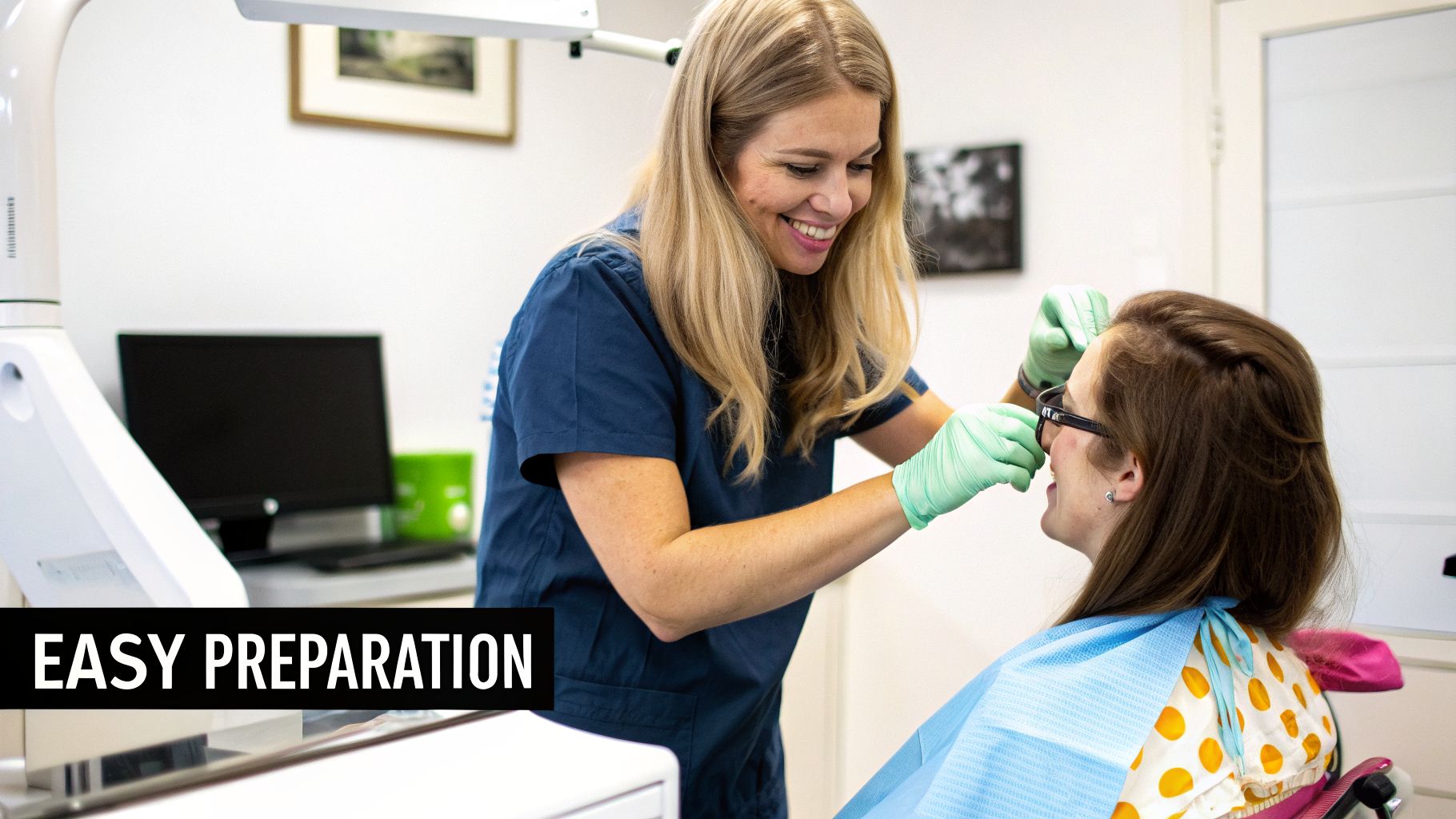
We find that knowing what to expect helps make any dental visit feel a bit more comfortable. When it comes to a panoramic X-ray, the good news is that the whole process is incredibly simple. There's almost nothing you need to do to prepare before your appointment at our Tamworth clinic.
Once you arrive, our friendly team will walk you through the quick setup. Our main goal is to capture a perfectly clear image of your jaw, and the only thing we need to do is make sure nothing gets in the way of the scan.
To do this, we'll ask you to remove anything from around your head and neck. This is a really important step, as it prevents any shadows or bright spots from appearing on the X-ray that could hide what we need to see.
What You'll Need to Remove
Just before the scan, we’ll help you set aside a few common items:
- Jewellery: This includes earrings, necklaces, chains, and any facial piercings.
- Eyeglasses: The metal and other materials in your glasses can block the X-ray beam.
- Hair Accessories: We'll need you to take out any metal clips, pins, or hairbands.
- Removable Dental Appliances: If you wear dentures or a partial plate, we’ll ask you to remove them for the scan.
Our team will guide you through it all and will have a safe place for your belongings. This simple preparation is the key to getting the accurate diagnostic information your dentist needs.
During and After the Scan
With all the metal out of the way, the scan itself is over in a flash. One of our team members will help you get into the right position, asking you to bite down gently on a small, sterile guide to help keep your head perfectly still. The machine then makes one slow, quiet pass around your head, a process that usually takes less than one minute.
The moment the scan is done, the digital image pops up on our screen. Your dentist can then review the panoramic X-ray with you right away, pointing out the key structures of your jaw and explaining their findings in plain, easy-to-understand language.
This is where you see the real value of the scan. It helps us connect what we can see in your mouth during a physical exam with all the important structures hidden beneath the surface. You can learn more about the first part of this process in our guide on what to expect during a routine dental check-up and clean.
It’s great to see this technology becoming more common across the country. Between 2014 and 2020, the number of panoramic radiography machines in Australia grew 1.6 times to over 3,000 units, which means better access for people in regional centres like Tamworth. This trend helps dentists spot issues like decay, which affects about 33% of Australian adults, right from the very first appointment.
> The panoramic scan provides a comprehensive roadmap for your care. It's the moment when your dentist can clearly discuss the next steps, whether that's planning for wisdom tooth removal, orthodontic treatment, or simply monitoring your oral health.
In some cases, the panoramic image might show us that we need an even closer look. For complex treatments like placing dental implants, we may suggest a 3D scan (known as a CBCT) to get a complete, multi-dimensional view of your jawbone. Having both technologies right here in our Tamworth clinic means we can give you a seamless diagnostic experience without having to send you elsewhere.
Your Panoramic X-ray Questions, Answered
It’s completely normal to have a few questions before any dental procedure, and panoramic X-rays are no exception. Getting the facts straight can make you feel much more comfortable and prepared for your visit.
We've put together answers to the questions we hear most often from our patients here at Oasis Smiles Dental. Think of this as a quick chat to clear up any uncertainties about your scan, from how often you'll need one to whether it's comfortable.
Our goal is simple: to make sure you feel confident and relaxed when you walk through our doors.
How Often Will I Need a Panoramic X-ray?
This is probably the number one question we get. Unlike your regular check-up X-rays, a panoramic scan isn't something you'll need every year. We only recommend one when there's a specific clinical reason to get that big-picture view of your mouth.
It’s a special tool we pull out when we need to see everything at once.
Some common reasons we might suggest one include: * Planning orthodontic treatment like braces, so we can see exactly how every tooth is positioned. * Keeping an eye on wisdom teeth, checking if they're impacted or growing too close to nerves. * Looking into jaw joint (TMJ) issues, or investigating things like cysts, tumours, or fractures. * Checking your jawbone density before planning for dental implants to make sure there's enough solid bone for support.
Ultimately, we’ll always talk it through with you. Your dentist will weigh the benefits against your personal health history and only recommend a scan when it’s truly necessary for your care.
Does a Panoramic X-ray Hurt?
Not at all. We get asked this a lot, especially by patients who feel a little nervous about dental appointments. We can happily reassure you that a panoramic X-ray is completely painless.
There are no needles and nothing goes inside your mouth, apart from a small plastic guide you’ll gently bite on. This just helps you keep your head perfectly still for the clearest possible image. The machine simply moves around the outside of your head.
The whole thing is over in less than a minute. Most of our patients are surprised by just how quick, quiet, and easy the entire process is.
> The scan is designed with your comfort in mind. Because it’s so quick and non-invasive, it’s a stress-free experience for everyone, including children and anxious patients.
Can a Panoramic X-ray Find Cavities?
While a panoramic X-ray gives us a fantastic overview of your entire mouth, it isn't our go-to tool for finding small cavities. The scan is designed to show the "big picture"—your jawbones, sinuses, and the general position of all your teeth.
For spotting decay, especially the tiny spots that hide between your teeth, we use a different kind of X-ray called a bitewing. These smaller, more detailed images are the gold standard for catching early-stage cavities long before they're visible to the naked eye.
Here’s a good way to think about it: A panoramic X-ray is like a satellite map of the whole country, showing the major highways and cities. A bitewing is the detailed street map of a single neighbourhood, showing every house and laneway.
Both are vital and give us different information. The panoramic spots large-scale issues, while bitewings provide the fine detail needed to keep your teeth healthy.
What Is the Cost and Is It Covered by My Health Fund?
We know that fitting dental care into the family budget is a real consideration. Here at Oasis Smiles Dental, we’re committed to making our services accessible to the entire Tamworth community.
We accept all major health funds, but it's important to know that coverage for specific scans like a panoramic X-ray can differ quite a bit between funds and policies. We always recommend giving your health fund a quick call beforehand so you know exactly what your entitlements are.
To make things easier, we also offer several other payment pathways: * We accept Medicare for eligible children under the Child Dental Benefits Schedule (CDBS). * We welcome Department of Veterans' Affairs (DVA) cardholders. * We can arrange flexible payment options to help spread out any out-of-pocket costs.
Our friendly team at the front desk is always ready to have a chat through these options with you and help you make sense of your treatment plan finances.
Time for Your Dental Check-Up in Tamworth?
We've covered a lot of ground on the panoramic x ray dental scan, and it's easy to see why it’s such a powerful tool. Getting that single, complete picture of your mouth, jaw, and teeth is a game-changer. It helps us see what’s really going on so we can create a treatment plan that makes sense for you.
Whether it’s for a routine family check-up or the first step in a bigger cosmetic or restorative journey, that bird's-eye view means we don't miss a thing. It’s all about taking the guesswork out of your dental health.
Your Local Tamworth Dentist, Here for the Long Haul
Here at Oasis Smiles Dental, we’re proud to bring this level of advanced, patient-focused care to our community in Tamworth and the wider New England region. For over 20 years, we’ve been the trusted choice for local families, and investing in the best diagnostic tools is a huge part of our promise to you.
We genuinely believe that top-tier dental care should be accessible, comfortable, and, above all, effective. That’s why our modern clinic, just a stone's throw from Northgate Shopping Centre, is set up to give you exactly that.
> The most important decision you can make for your oral health is simply getting started. A proper check-up, with the right diagnostic imaging, gives us the roadmap we need to help you achieve a lifetime of healthy smiles.
Ready to see how a modern, thorough, and friendly approach to dentistry can benefit you and your family? It all starts with a simple conversation. We’d love for you to come in and experience how we blend a warm, personal touch with exceptional clinical skill.
Our friendly team is ready to book an appointment for you or your whole family. If you're in pain, we also set aside time for same-day emergency appointments—just give us a call before 1 pm.
---
Take the next step. Get in touch with Oasis Smiles Dental to book your appointment today. Schedule your visit now.