

Cheap Dental Braces Tamworth: Affordable Options 2026
A lot of Tamworth parents start in the same place. You notice your child’s front teeth are getting crowded, or their bite looks a bit off, and within seconds your mind jumps from “Do they need braces?” to “How on earth are we going to pay for them?”
That’s why so many people search for cheap dental braces.
It’s a fair question, but the better question is this. Which braces give you the best value for your family? Cheap shouldn’t mean rushed treatment, hidden costs, or a result that needs fixing later. It should mean a safe, reliable option that works well and fits the household budget.
For families across Tamworth and the New England region, the challenge isn’t just finding a low number on a website. It’s working out what that quote includes, whether health fund rebates will help, and how to compare braces with newer options like clear aligners without getting lost in marketing language.
Parents often tell me they feel stuck between two worries. One is spending too much. The other is choosing the wrong treatment because it looked cheaper at the start.
Both worries are reasonable.
A straight smile is about appearance, but it’s also about function. Teeth that line up better are often easier to clean, and bite problems can be easier to manage when they’re treated properly. So the aim isn’t to cut corners. The aim is to make a good decision with clear information.
The Search for Affordable Braces in Tamworth
If you live in Tamworth, Gunnedah, Quirindi, Moonbi, Manilla, or elsewhere in New England, you probably already know that healthcare choices feel more personal in a regional area. You’re not just choosing a treatment. You’re choosing convenience, travel time, appointment flexibility, and whether the cost will be manageable over months, not just today.
A local parent might notice their teenager hiding their smile in photos. Another might hear a general dentist mention crowding or a bite issue during a check-up. Then comes the online search. “Cheap dental braces Tamworth.” “Affordable braces near me.” “Braces cost NSW.” The problem is that many pages either throw out broad prices with no context or focus on selling the most modern-looking option.
That’s where people get confused.
Cheap isn’t always the same as affordable
A low starting price can sound reassuring, but it doesn’t always tell you the full story. Some treatments suit simple cases better than others. Some need more discipline at home. Some may look discreet but end up costing more if they aren’t the best fit.
For most families, affordable means three things:
- The treatment works well: It should suit the child or adult wearing it.
- The costs are explained clearly: You should know what’s included and what might come later.
- The payment path is realistic: Health funds, Medicare eligibility, and staged payments can all matter.
> Practical rule: Don’t judge braces by the headline price alone. Judge them by suitability, durability, and how clearly the clinic explains the total cost.
Why local context matters
National averages can be useful, but they don’t answer the practical questions New England families ask every day.
Questions like:
- Will my health fund reduce the upfront hit?
- Can we spread the cost out month by month?
- If something breaks, do we need to travel far for help?
- Will my child need the strongest option because the case is more complex?
These are concerns behind the phrase cheap dental braces. Families aren’t looking for a bargain bin smile. They’re looking for a sensible path forward.
That’s what makes a local cost guide more useful than a generic one. It helps you compare options with your own family budget, your own child’s needs, and the realities of living in regional NSW.
Understanding the Real Cost of Braces in 2026
Cost guides often create more confusion than clarity. One page says braces cost one amount, another says something higher, and a third mixes braces and clear aligners together as if they’re interchangeable. They’re not.
For a realistic starting point, families need a baseline.
In Australia, metal braces typically cost between $5,000 and $8,000 AUD for a complete treatment in 2026, while ceramic braces usually range from $6,000 to $9,500 AUD. The same source notes a 5 to 7 per cent annual increase and says that access to major health funds in regional areas like Tamworth can reduce out-of-pocket costs by 30 to 50 per cent for eligible families, according to this 2026 braces pricing guide for Australia.
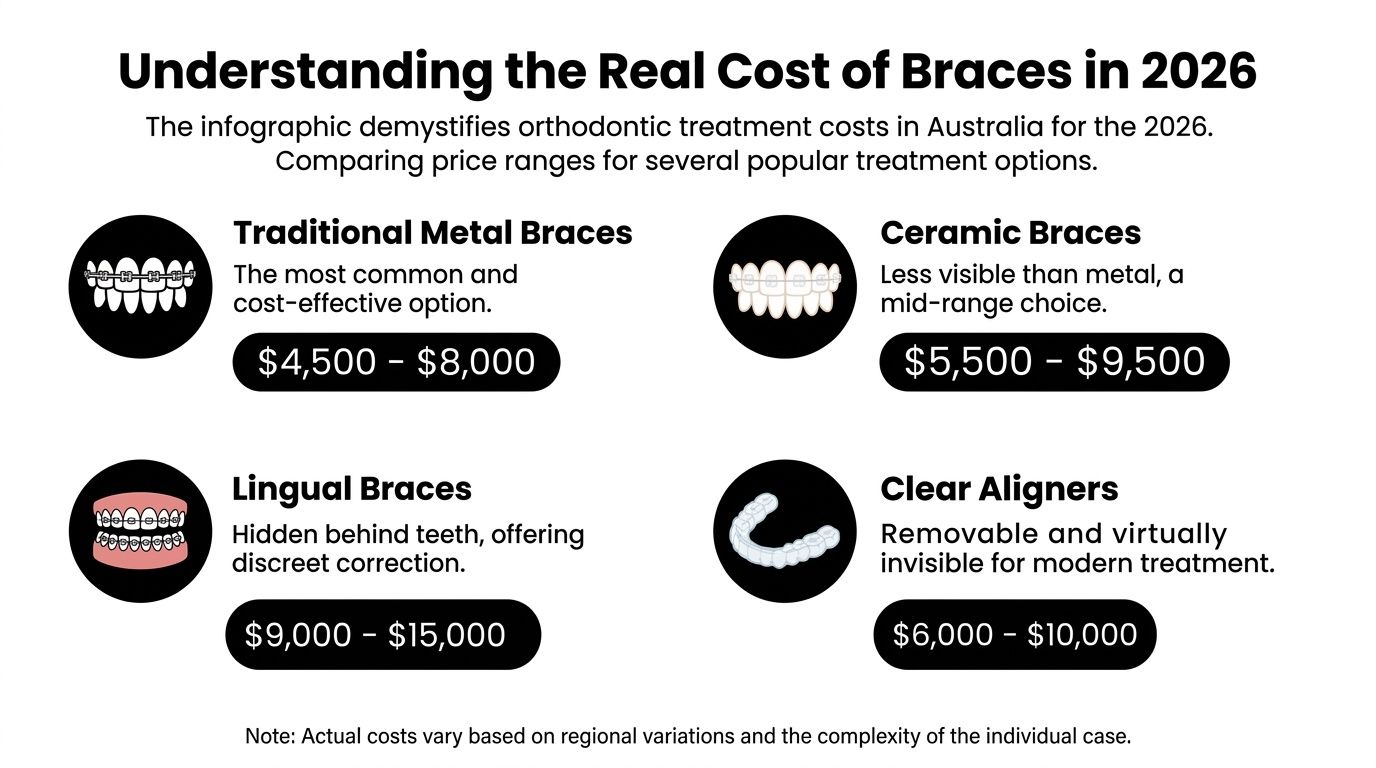
A simple cost comparison
The table below gives a practical overview. Where exact verified figures weren’t available for a category, I’ve kept the wording qualitative rather than guessing.
| Brace Type | Average Cost Range (AUD) | Typical Treatment Time | Best For | |---|---:|---|---| | Traditional metal braces | $5,000 to $8,000 | Varies by case | Families wanting the lowest-cost comprehensive braces option | | Ceramic braces | $6,000 to $9,500 | Varies by case | People who want braces that are less visible | | Lingual braces | More expensive than metal and ceramic | Varies by case | Patients prioritising discretion | | Clear aligners | Varies by provider and case | Varies by case | Suitable cases where removability and appearance matter |
Why the ranges vary
A braces quote is rarely just “the braces”. It may include records, planning, fitting appointments, review visits, and sometimes the first retainer set. But this is exactly where many parents get tripped up. Different providers package treatment differently.
One clinic may give a broader all-inclusive figure. Another may quote the treatment itself, then discuss add-ons later. That doesn’t automatically mean one is better or worse, but it does mean you need to ask direct questions.
Ask things like:
- Are routine adjustment visits included?
- What happens if a bracket breaks?
- Are retainers included at the end?
- Will I need extra payments if treatment takes longer?
Why metal braces still sit at the budget end
Metal braces remain the benchmark for families comparing value. They’re widely used, well understood, and usually come in lower than ceramic options. For many parents, that’s the category they mean when they search for cheap dental braces.
That doesn’t mean they’re “basic” in a poor-quality sense. It means they offer a dependable treatment method at the more affordable end of the orthodontic range.
If you’re also comparing aligners, it helps to read a provider’s explanation of clear aligner treatment options such as Invisalign alongside braces, because the right choice depends on the bite problem, not just the marketing.
> A useful quote is one that explains both the number and the treatment behind it.
What local families should take from these numbers
For Tamworth and New England families, the most important takeaway is simple. Metal braces usually set the affordability baseline. If you’re comparing several treatment options, start there.
Then look at what changes the number in your specific case:
- How complex the tooth movement is
- How long treatment is likely to run
- What’s included after the braces come off
- Whether your health fund reduces your out-of-pocket cost
Those details matter more than flashy labels. A treatment that looks cheaper online can still cost more overall if it isn’t the right fit or if the quote leaves out important follow-up care.
What Factors Change the Final Price of Braces
Two children can both need braces and receive very different quotes. That doesn’t always mean one clinic is expensive and another is cheap. Often, it means the treatment needs are different.
The case itself changes the cost
A mild crowding problem is different from a bite correction that needs stronger, more controlled tooth movement. Some patients need straightforward alignment. Others need the teeth and bite guided together over a longer period.
That affects the amount of planning, the number of appointments, and how long the braces stay on.
A parent might ask, “Why can’t we just do the top teeth because that’s what shows?” Sometimes there are reasons that isn’t the best idea. Teeth need to meet properly, not just look straighter from the front. If the bite is ignored to save money, the result may not be stable or comfortable.
The type of appliance matters
Different systems behave differently.
Metal braces tend to be the workhorse option. Clearer or more discreet choices may suit appearance goals, but they can carry a higher fee or be less suitable for difficult movements. The right appliance depends on the case, the age of the patient, and how consistently instructions can be followed at home.
Technology can shape value too. Digital scanning and treatment planning can improve fit, accuracy, and communication. In practical terms, that may help families understand the plan more clearly and reduce the guesswork that used to come with old-style impressions.
Hidden costs are where many families get caught
This is the part many cost pages skip.
Many orthodontic providers don’t clearly explain what happens if retainers break or if ongoing adjustments are needed after treatment. The total cost of ownership, including retainer care and possible out-of-pocket expenses 2 to 5 years later, is a major concern for budget-conscious regional families, as noted in this discussion of affordable orthodontic costs and retention questions.
That matters because braces don’t end the day they come off. Retention matters. Teeth can shift. Retainers can be lost, cracked, or forgotten in a school lunch wrap and thrown out.
> What to ask before you commit: “What costs might come up after active treatment ends?”
A better way to read a quote
When you compare quotes, don’t just compare totals. Compare categories.
Look for these points:
- Records and planning: Are scans, photos, and treatment design included?
- Adjustment visits: Are regular review appointments built into the price?
- Emergency care: If something breaks, is that already covered or charged separately?
- Retention phase: Are retainers included, and what happens if they need replacing?
A more expensive quote can sometimes be better value if it’s more complete. A lower quote can still be a good choice, but only if you understand what it does and doesn’t include.
The long view usually saves money
Families often focus on the start because that’s the biggest immediate decision. That’s understandable. But the wiser question is, “What will this cost us over the full life of the treatment?”
That’s especially important in regional areas, where extra visits and unexpected follow-up can be harder to manage around school, work, and travel.
Cheap dental braces make sense when they’re part of a well-explained plan. They stop being affordable when surprise costs pile up later.
Comparing Your Main Options Metal Braces vs Clear Aligners
The choice frequently comes down to two paths. Traditional metal braces or clear aligners.
That sounds simple, but the choice becomes murky once advertising gets involved. Some aligner marketing suggests the removable option is cheaper. In real life, it depends on the case.
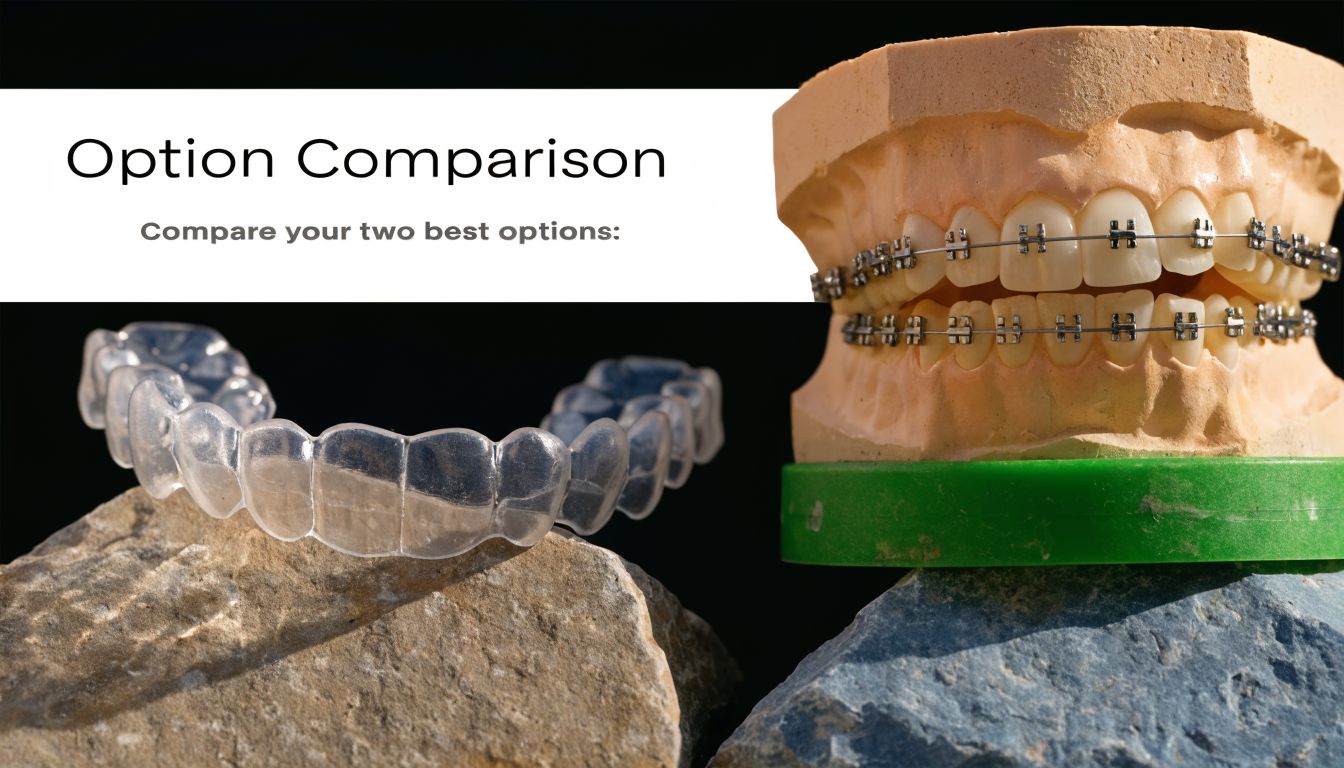
How metal braces work
Metal braces use brackets fixed to the teeth and wires that apply steady force. That constant pressure is one reason they’re so dependable across a wide range of cases.
Verified guidance for regional Australia states that traditional metal braces remain the most cost-effective option for many patients, with costs from AUD 3,000 to AUD 7,000, and notes their predictable tooth movement of 0.5 to 1 mm per month. The same source says their durability makes them especially suitable for complex cases, and that they’re often ideal for difficult teen orthodontic problems, as outlined in this guide to the most affordable type of braces.
In plain language, metal braces are strong, consistent, and forgiving. They don’t depend on a child remembering to wear them because they stay on the teeth full time.
How clear aligners work
Clear aligners use a sequence of removable trays. Each tray is designed to guide the teeth gradually. They’re popular because they’re less noticeable and can be removed for meals and brushing.
That removability is also the catch.
For the right patient, aligners can be neat and convenient. For the wrong patient, they can become frustrating. If trays aren’t worn as instructed, treatment can stall or drift off plan. For disciplined teens and adults with suitable cases, they can be a very good option. For more complicated movement, they may not offer the same straightforward value as metal braces.
Side-by-side thinking
Here’s the practical comparison many parents need:
| Question | Metal braces | Clear aligners | |---|---|---| | Lower-cost starting point | Often yes | Depends on case and provider | | Best for complex movement | Often yes | Sometimes, but case-dependent | | Removable | No | Yes | | Visible on teeth | More visible | Less visible | | Relies on patient compliance at home | Less | More |
Which option is more affordable for your family
The answer depends on what “affordable” means in your house.
If affordable means the lowest likely fee for full treatment, metal braces usually lead. If affordable means flexibility, fewer appearance concerns, and your child or teen is highly reliable with removable trays, aligners may still be worth considering.
A lot of confusion comes from comparing unlike cases. A mild alignment issue in a responsible adult is not the same as a teenage bite problem with crowding and rotation.
> Some treatments look cheaper in an ad because the ad assumes the easiest case.
A simple decision shortcut
Metal braces usually make more sense when:
- The case is more complex
- Durability matters
- You want the strongest value option
- You don’t want treatment depending heavily on daily self-discipline
Clear aligners usually make more sense when:
- Appearance is a major priority
- The case is suitable
- The patient will wear the trays properly
- Removability is important for work, sport, or comfort
If you want to see how a local provider presents braces as a treatment option, it helps to compare that information against your own priorities rather than starting with trends or social media claims.
For many New England families, cheap dental braces usually means metal braces for good reason. They’re often the option that best balances cost, strength, and predictable progress.
Smart Strategies to Make Braces Affordable
Once families understand the likely treatment options, the next question is practical. How do you make this fit the weekly and monthly budget without feeling overwhelmed?
The good news is that the sticker price isn’t always the amount you carry alone.

Start with your health fund
If your family has extras cover, check the orthodontic component before treatment starts. Don’t assume all dental extras are the same. Orthodontics often sits under its own rules, and families can be caught out by waiting periods or annual limits.
Ask your insurer direct questions:
- Do we have orthodontic cover, or only general dental extras?
- Is there a waiting period still running?
- How are orthodontic claims paid?
- What documents will the clinic need from us?
This is one of the biggest reasons local advice matters. A realistic payment conversation should happen before the treatment begins, not halfway through.
Check Medicare eligibility for children
For some families, the Child Dental Benefits Schedule can make treatment more manageable. Verified data notes that since 2014, the CDBS has provided up to $1,000 per child over two consecutive years for eligible low-income families, covering part of treatment costs in qualifying situations.
That doesn’t mean every child’s braces are fully covered. It means eligible families may have support available that changes the out-of-pocket picture in a meaningful way.
Ask about staged payments, not just total price
A large total can sound impossible until it’s broken into regular payments.
For adults, verified data states that costs are similar to teens, but clinics such as Oasis Smiles Dental may offer interest-free payment plans over 12 to 24 months, and that can make treatment easier to manage for households balancing rent, school expenses, petrol, and groceries. The key point for families is simple. A treatment that feels too expensive upfront can become realistic when spread out.
Use a checklist before you say yes
A useful affordability conversation should cover four items.
- Your rebate path
- Your payment schedule
- Your included items
- Your likely aftercare costs
> A family that understands the payment structure often feels calmer, even before treatment begins.
Don’t let embarrassment delay the conversation
Some parents feel awkward asking detailed money questions. Please don’t. Dental teams hear these questions every day, and they should be able to answer them clearly.
The most confident families aren’t the ones with the biggest budgets. They’re the ones who ask the right questions early.
If you’re organising appointments, forms, or cover details, a practical first stop is the clinic’s patient information page, where you can check the basics before booking.
Affordable braces rarely happen by accident. They happen when you combine the right treatment with rebates, sensible scheduling, and a payment plan that your household can live with.
The Dangers of Ultra-Cheap Braces and DIY Kits
Not every low-cost offer is a smart one.
When families search for cheap dental braces, they sometimes come across options that promise quick results with little or no in-person supervision. That might be a mail-order aligner kit, a social media offer from outside the local area, or treatment bundled into a dental holiday overseas.
The risk is the same in each case. Teeth don’t move safely just because a tray or brace is placed on them. Safe movement needs proper diagnosis, monitoring, and adjustment over time.
Why supervision matters
A crooked smile might look like a simple alignment issue, but what’s happening underneath can be more complicated. Bite position, gum health, jaw function, and the way teeth meet all matter.
If treatment focuses only on making the front teeth look straighter, several problems can follow:
- The bite may feel wrong: Teeth can end up meeting awkwardly.
- The gums may suffer: Movement without proper checks can irritate or damage supporting tissues.
- Results may relapse: Teeth can shift back if the plan wasn’t stable.
- Fixing mistakes can cost more: A cheap shortcut can become a more expensive repair job.
The false economy of “too cheap”
The trouble with ultra-cheap care is that the number looks attractive before anything goes wrong.
If a patient develops discomfort, poor tooth movement, or a bite issue, they still need local professional help. At that point, the family may be paying twice. Once for the shortcut, and again for corrective care.
That’s why the safest “cheap” option is usually not the lowest advertised price. It’s the most appropriate professionally supervised treatment at a manageable cost.
Why local care usually protects value
A local clinic can monitor progress, answer questions quickly, and deal with small problems before they become large ones. That’s especially important for children and teens, where compliance, growth, and bite changes all affect the result.
There’s also peace of mind in knowing where to go if something breaks, rubs, or doesn’t feel right. Regional families already juggle enough without adding the uncertainty of remote-only treatment.
A straighter smile should improve health and confidence. It shouldn’t create a second round of treatment because the first option was built around price alone.
Your Next Step to a Straighter Smile in Tamworth
By this point, the picture is usually clearer.
Cheap dental braces aren’t really about chasing the absolute lowest number. They’re about finding the treatment that suits the case, understanding the full cost, and making the payments workable for your family.
For many Tamworth and New England households, that means starting with metal braces as the value benchmark, then comparing that with clearer or more discreet options only if they suit the person wearing them. It also means asking the questions that matter most. What’s included? What happens after treatment? How do health fund rebates and payment plans change the actual out-of-pocket amount?
What a first consultation should feel like
A good braces consultation shouldn’t feel rushed or mysterious.
You should expect a careful look at the teeth and bite, a discussion about what’s bothering you or your child, and a clear explanation of the treatment choices. If the clinic uses digital tools such as a Trios scanner, that can make the assessment cleaner and more comfortable than traditional impressions.
You don’t need to arrive already knowing which option you want. That’s the clinician’s job to help sort out.
Questions worth bringing with you
Write these down before the appointment if it helps:
- Which treatment suits this case best, and why?
- Is the lower-cost option also the right clinical option?
- What’s included in the quote?
- What extra costs might come later?
- How would payments work month to month?
A clear answer to those five questions can remove a lot of stress.
If you’re ready to ask for a personalised assessment, the simplest next move is to contact the clinic and book a consultation. Once you have a customized plan in front of you, the decision becomes much easier because you’re working from your family’s real needs, not generic estimates online.
Frequently Asked Questions About Braces Costs
Are retainers usually included in the braces price
Sometimes yes, sometimes no. This is one of the most important things to check before treatment starts. Ask whether the first set of retainers is included and what happens if they need replacing later.
Can braces on just the top or bottom teeth save money
Sometimes they can, but not every patient is a good candidate. Teeth need to work together as a bite, so treating only one arch isn’t always the safest or most stable option. A lower fee doesn’t help if the result creates a bite problem.
Do adults pay more than teenagers for braces
Not usually by much. For Australian adults, orthodontic costs are similar to those for teens, and interest-free payment plans can spread the expense over 12 to 24 months. The same verified data also notes a 15 per cent rise in adult orthodontics since 2020, as reported in the source used earlier for national pricing data.
How much will my health fund rebate
It depends on your policy. Some families have strong orthodontic cover. Others have general extras without much support for braces. The only reliable answer comes from checking your own insurer’s orthodontic benefits and waiting periods.
Are metal braces still the cheapest option
In many cases, yes. They’re often the most cost-effective choice for families who want reliable treatment and good value, especially when the case is more complex.
---
If you’d like clear advice specific to your family, Oasis Smiles Dental can help you compare braces and aligner options, explain likely costs, and talk through payment pathways in plain English. For Tamworth and New England families, that kind of local guidance can make the whole process feel far more manageable.