

Complete Dental Implants: Your Tamworth Guide
If you're reading this in Tamworth, there’s a good chance you already know the small frustrations that tooth loss creates. You stop ordering the foods you used to enjoy. You chew on one side. You smile with your lips closed in family photos. If you wear dentures, you may also know the daily routine of adhesives, movement, and that low-level worry that they’ll slip at the wrong time.
For many people, the hardest part isn’t only the missing teeth. It’s the way missing teeth slowly change ordinary life. Dinner feels different. Talking in public feels different. Even laughing can feel different.
Complete dental implants are one of the clearest long-term options for people who’ve lost most or all of their teeth. They’re designed to replace a full arch of teeth with a fixed solution that feels far more stable than a removable plate. In regional areas, they also matter for another reason. Access to advanced planning, clear pricing, and ongoing maintenance can shape whether treatment feels possible at all.
Reclaiming Your Smile and Your Life
A lot of people arrive at this point gradually.
It might start with a few back teeth removed years ago. Then more teeth weaken, crack, or become uncomfortable. A denture helps for a while, but eating gets fiddly. Apples are out. Steak becomes work. Social events feel tiring because you're always managing your mouth instead of enjoying yourself.
That’s often when patients begin asking about a more fixed option.

Complete dental implants are meant for people who want more than a cosmetic change. They’re about getting back the practical parts of life. Biting into food without hesitation. Speaking clearly. Smiling without thinking about gaps, movement, or loose plates.
What this can mean day to day
When people describe what they want, they usually don’t start with dental terms. They say things like:
- Eat normally again: enjoy meals that need proper chewing, not just softer choices
- Feel secure in public: no clicking, shifting, or fear that teeth will move
- Look like themselves: a smile that suits their face and doesn’t look artificial
- Stop planning around dentures: fewer workarounds during travel, meals, and family events
Some patients first explore broader appearance-based options through a smile makeover overview, then realise they need a stronger functional foundation before cosmetic details even matter.
> Missing teeth affect confidence, but they also affect comfort, nutrition, and how relaxed you feel in your own skin.
Regional patients often have another concern. They don’t want to travel back and forth to a major city for every scan, adjustment, and review. That’s a fair concern. Access, timing, and local support matter just as much as the treatment itself.
If you're interested in how local practices build trust and communicate with patients well, this guide on dental patient acquisition is useful because it shows how clear information often shapes whether people feel confident enough to seek treatment in the first place.
Understanding Complete Dental Implants
A simple way to think about complete dental implants is to compare them to building a house. The visible teeth are the house you see above ground. The implants are the foundations underneath. If the foundation is stable, the structure above it can feel secure and function properly.
That’s why a full arch doesn’t need one implant for every missing tooth. A smaller number of carefully placed titanium implants can support an entire set of replacement teeth.
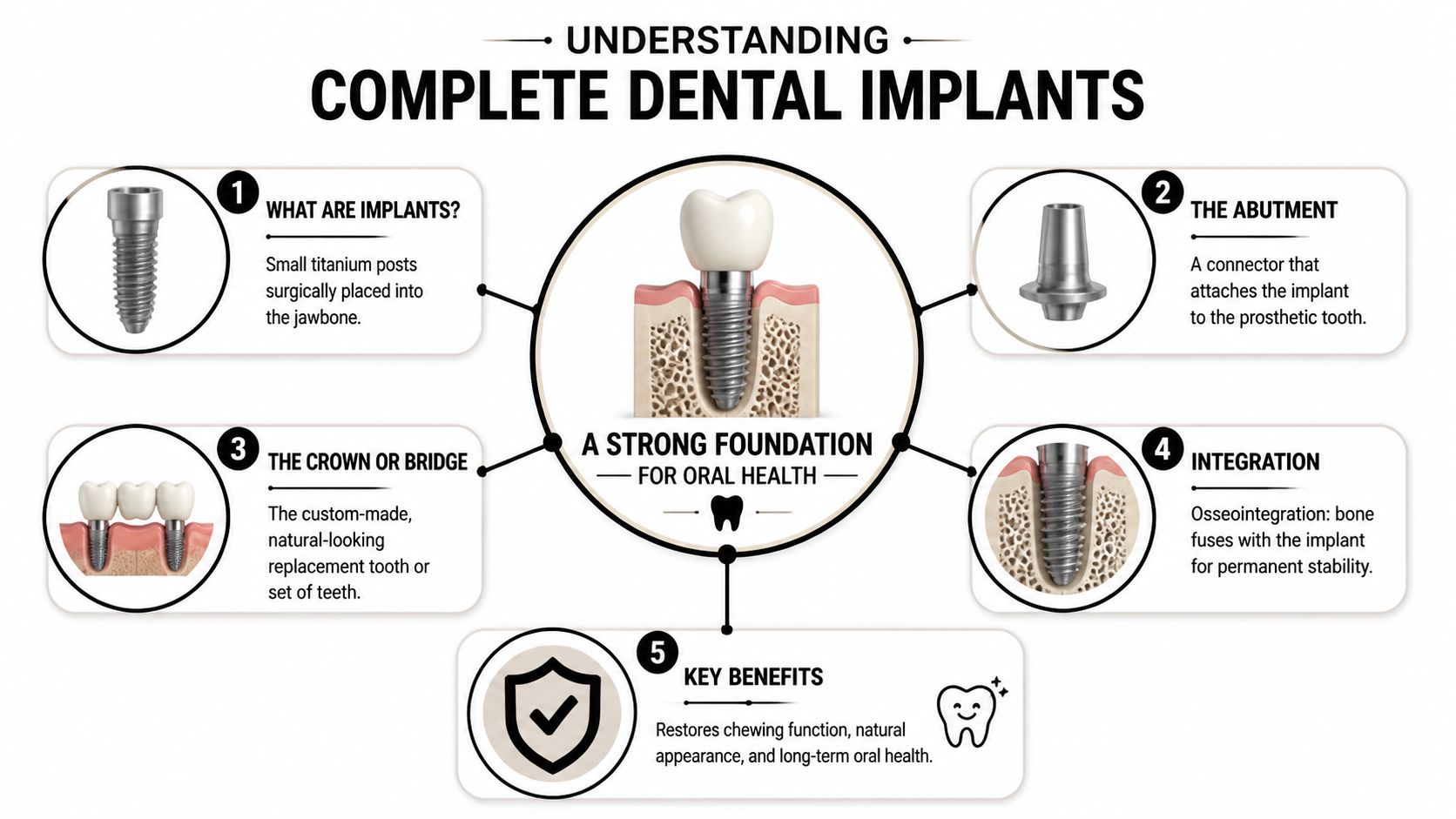
The three main parts
Most complete dental implant systems have three key components:
- The implant: a small titanium post placed into the jawbone
- The abutment: the connector piece that joins the implant to the new teeth
- The prosthesis: the full arch of replacement teeth that you see when you smile
The term osseointegration can sound technical, but the idea is simple. It means the bone heals around the implant and grips it firmly. That bond is what gives implants their stability.
Why a few implants can support many teeth
A common misunderstanding is that replacing a full arch means replacing every root individually. In reality, the dentist places implants in positions that spread the biting forces across the jaw. The bridge then attaches to those implants as one connected structure.
In full-arch treatment, All-on-4® uses four titanium implants to support a single-piece prosthesis replacing 10 to 14 teeth, while All-on-6® uses six implants for the same overall idea with additional support in some cases. This style of treatment can reduce the need for bone grafting in 70 to 80% of cases, and reported failure rates are under 5% at 5 years post-loading according to full-arch implant protocols and techniques.
That reduction in grafting matters, especially in regional settings where patients often want a more direct treatment path.
All-on-4 and All-on-6 in plain language
Here’s the simplest distinction:
| Option | What it means | |---|---| | All-on-4 | Four implants support the full arch | | All-on-6 | Six implants support the full arch, often when added support is helpful |
Neither option is automatically “better”. The right choice depends on the shape of your jaw, the amount of available bone, your bite, and the treatment goals.
> Practical rule: The number of implants isn’t chosen for marketing. It’s chosen to create a stable, cleanable, long-lasting result.
Why technology changes the conversation
Many patients were once told they didn’t have enough bone for implants. Modern planning has changed that for a lot of people. Digital workflows now make it easier to visualise bone shape, implant angle, and final tooth position before treatment begins.
Tools such as CBCT imaging, digital scanning, and in-house design have made full-arch planning much more precise. If you want to see how these systems work together in practice, a page on modern dental technology gives a useful overview of tools like CBCT, Trios scanners, and 3D printing.
Are You A Good Candidate For This Treatment
The short answer is that more people are suitable for complete dental implants than they expect.
Candidacy isn’t a yes-or-no judgement made from a quick look in the mouth. It’s a careful assessment of bone, gums, bite, medical history, and habits that may affect healing. Many concerns can be planned around rather than treated as an automatic barrier.
What dentists look at first
A dentist usually starts with a checklist like this:
- Current teeth and gums: are the remaining teeth restorable, and is there active gum disease to manage first?
- Jawbone shape: is there enough bone in the right areas to support a full-arch design?
- General health: are there medical conditions that affect healing and how should they be managed?
- Daily habits: does smoking, grinding, or inconsistent oral hygiene raise the long-term risk?
Bone level matters, but it’s not just about volume. Shape and position matter too. A jaw can have limited bone in one area and still be suitable with careful planning.
Why 3D planning opens more options
Two-dimensional X-rays only tell part of the story. CBCT imaging gives a 3D view of the bone, nearby anatomy, and angulation options. That can completely change the conversation.
For patients in regional NSW who smoke, where prevalence can be up to 20%, modern techniques matter. Tilted implants show a 95% 10-year survival rate in smokers versus 88% for straight implants, supported by precise planning with CBCT imaging and 3D printing according to this discussion of tilted implants in challenging cases.
That doesn’t mean smoking is harmless. It means treatment planning can be adapted intelligently.
> Smoking doesn’t always rule implants out, but it does make maintenance and review appointments more important.
Common worries patients raise
People often assume they’re not candidates because of one issue they were told about years ago. These are common examples:
- “I’ve worn dentures for years.”
- “I’ve been told I don’t have enough bone.”
- “I smoke.”
- “I’m older.”
The best way to think about suitability
Instead of asking, “Am I perfect for implants?” ask, “What would need to be managed well for implants to succeed?”
That’s a more realistic question. Dentistry works best when it’s honest about risk and practical about solutions.
Your Treatment Journey Step By Step
Most anxiety around complete dental implants comes from not knowing what happens. Once the process is clear, it usually feels far less mysterious.

The first appointment and digital planning
The first stage is diagnosis and planning. During this stage, the dentist works out whether the teeth can be saved, whether a full-arch solution is appropriate, and what design will suit your bone and bite.
Digital scans make this stage more comfortable than older mould-based methods for many patients. A Trios scanner can capture a digital map of the teeth and gums, while CBCT gives the 3D view of the jaw.
Precision matters here. Clinical benchmarks call for a minimum 7 mm of space for a standard implant, and positioning is planned at 1 mm below the gum line for aesthetics. This level of accuracy, supported by digital scanners and 3D printing, is linked to success rates in the AU region as high as 98% over 10 years in the benchmark summary from the Association of Dental Implantology planning guide.
The day of implant placement
On the procedure day, the focus is comfort, control, and getting the implants into the exact planned positions.
Some patients are surprised by how methodical the appointment feels. This isn’t guesswork done freehand. The planning has already happened. The appointment is about carrying out that plan safely.
A typical day may include:
- Anaesthesia and comfort support: local anaesthetic is used, and anxious patients may discuss sleep dentistry options with their dentist
- Removal of failing teeth if needed: this is done carefully to prepare the area for the implant-supported design
- Implant placement: the titanium implants are inserted into the jaw in the planned positions
- Immediate temporary teeth in some cases: many full-arch cases involve a temporary bridge so you don’t leave with major gaps
> The surgery is one day in a longer process. The planning and healing around it are what make the result durable.
Healing and living with the temporary teeth
After surgery, the bone needs time to integrate with the implants. This is the healing phase when osseointegration does its work in the background.
Temporary teeth are useful because they let you function and smile while the deeper healing happens. They’re not just cosmetic. They also help guide bite position, speech, and the shape of the final result.
During this stage, patients are usually adjusting to three things at once:
- How to clean around the new work
- How to eat while healing
- How the bite and speech feel with a fixed arch
Soft foods are often the safest starting point while everything settles. Even when the temporary teeth feel firm, the deeper bond between bone and implant still needs respect.
The final smile
Once healing is stable, the final prosthesis is designed and fitted. At this stage, function and appearance come together.
The final teeth should do more than look white and straight. They need to support speech, suit the lips, allow cleaning access, and spread bite forces properly. Good implant dentistry balances all of that.
A patient resource page on what to expect during dental care can also help if you like reading practical information before treatment, especially if you’re the kind of person who feels calmer once you know the sequence.
What often surprises people most
The biggest surprise is usually that the process is more organised than dramatic.
People often expect a single huge event. In reality, it’s a staged treatment with clear checkpoints. Diagnosis. Planning. Surgery. Healing. Refinement. Final fit.
That structure is what makes it feel manageable.
Comparing Implants With Traditional Dentures
This decision often comes down to one question. Do you want a removable replacement, or do you want something fixed?
Both options replace missing teeth. They don’t deliver the same day-to-day experience.
The practical difference at home
Traditional dentures sit on the gums. Complete dental implants anchor into the jaw and support a fixed bridge. That difference affects chewing, speech, cleaning, confidence, and long-term bone support.
If you’ve ever had a denture lift when biting into a sandwich, you already understand the issue. Stability changes everything.
Dental implants have a success rate exceeding 97% at 5 years, and 86% are still functional after 20 years. Traditional dentures have a 10-year survival rate of around 60%, and they don’t prevent the 40% jawbone resorption associated with untreated tooth loss, according to the statistics summarised in this piece on dental implant longevity and outcomes.
Complete Implants vs Traditional Full Dentures
| Feature | Complete Dental Implants | Traditional Dentures | |---|---|---| | How they stay in place | Fixed to implants anchored in the jaw | Rest on the gums and are removable | | Feel while eating | More secure and closer to natural chewing | More likely to move under pressure | | Speech confidence | Usually steadier once adjusted | Can click or shift for some wearers | | Bone support | Helps preserve jawbone through implant support | Doesn’t stop ongoing jawbone shrinkage | | Daily care | Requires thorough cleaning around the bridge and gums | Removed for cleaning and storage | | Long-term experience | Designed as a fixed long-term solution | May need ongoing relines, adjustments, or replacement |
Which type of patient tends to prefer each
Some people still prefer dentures because they want a non-surgical option or a lower upfront cost. That’s understandable.
Others reach a point where they’re tired of compromise. They don’t want adhesive. They don’t want movement. They want to chew more confidently and stop thinking about their teeth all day.
> A denture replaces teeth. A fixed implant solution can also restore a sense of certainty.
The less obvious difference
The biggest contrast isn’t visible in the mirror. It’s behavioural.
People with unstable dentures often adjust their lives around the appliance. They choose safer foods. They eat more slowly in public. They become careful with laughter and speech. A stable fixed solution can remove a lot of that background tension.
Costs Financing and Long-Term Value
This is the question commonly asked early, and rightly so. Complete dental implants are a major treatment. They should be discussed with honesty, not vague promises.

For regional patients, cost has extra layers. The treatment fee matters, but so do travel time, follow-up logistics, and whether planning and fabrication can happen closer to home.
What influences the fee
A full arch can cost around $25,000, but that figure is only a starting point from the available data. The final amount depends on factors such as the number of implants, the complexity of the case, the type of provisional and final prosthesis, and whether additional procedures are needed, based on the summary of implant rebates and regional cost considerations.
The fee isn’t just for the surgery. It reflects diagnosis, digital planning, implant components, prosthetic design, review visits, and the long-term thinking built into the case.
Where rebates and support may help
Patients in regional Australia often ask whether Medicare pays for implants. In general, most routine implant treatment isn’t covered like standard medical care, but some support pathways do exist for eligible people.
Here are the main ones noted in the verified data:
- DVA support for eligible veterans: DVA may cover up to $500 per implant
- Reduced grafting costs in some cases: tilted implant approaches can reduce the need for bone grafting by 80%
- Potential savings in low-bone cases: avoiding or reducing grafting can save $5,000 to $10,000
If you're a veteran or family member helping a veteran arrange care, it’s worth asking the clinic to explain the claim pathway clearly before treatment starts.
Why local technology matters financially
People often think technology only affects accuracy. It also affects efficiency.
When CBCT imaging, digital scanning, and in-house 3D printing are available locally, planning can be more efficient. That can mean fewer external steps, quicker adjustments, and less travel disruption than a fragmented process spread across different providers.
For regional families, that practical convenience has value. Less time on the road. Fewer handovers. Fewer unknowns.
> The cheapest treatment isn’t always the least expensive in the long run. Delays, remakes, travel, and avoidable extra procedures all carry a cost.
Thinking about value, not just price
A removable solution may cost less at the start. A fixed full-arch implant treatment may offer more in return if your priority is long-term stability, function, and quality of life.
That value shows up in ordinary ways:
- Meals feel easier
- Social confidence improves
- You spend less mental energy managing your teeth
- You’re investing in a solution built for long-term use
If the financial side feels overwhelming, it can help to look at broader budgeting approaches as well as dental payment options. Some patients find outside reading on medical debt relief options for 2026 useful when planning for larger health expenses, especially if several treatments are being managed at once.
The right question isn’t only “What does it cost?” It’s also “What am I paying to avoid, and what am I paying to regain?”
Your New Smile Aftercare and Lifespan
Once your complete dental implants are in place, the goal shifts from treatment to protection. The good news is that maintenance is usually straightforward. It just needs consistency.
A fixed bridge isn’t cared for in exactly the same way as natural teeth, but the daily habits are familiar. Clean thoroughly. Keep plaque away from the gumline. Attend reviews before a small issue becomes a bigger one.
The daily routine that matters
Most patients do well when they keep aftercare simple:
- Brush carefully every day: clean the teeth and the gumline where plaque collects
- Use the right cleaning aids: floss threaders, super floss, or interdental tools may be recommended depending on the bridge design
- Clean under the prosthesis as instructed: this area is easy to miss if no one has shown you the technique
- Watch for changes: bleeding, tenderness, bad taste, or difficulty cleaning shouldn’t be ignored
This is especially important for anyone with a history of gum problems. If you want a clear explanation of why inflamed gums can affect long-term stability, this page on gum disease and preventive care is a helpful primer.
Professional maintenance matters too
Implants don’t get decay, but the surrounding tissues can still become inflamed if plaque is left sitting around them.
That’s why professional review appointments matter. The dentist and hygienist check the gums, assess how cleanable the bridge is, look at the bite, and make sure the implants remain stable over time. For patients who smoke or have a history of gum disease, those visits become even more valuable.
> If something feels harder to clean than it did last month, book a review. Don’t wait for pain.
How long can complete dental implants last
Long-term success depends on two things working together. First, the treatment must be well planned and well placed. Second, the patient has to maintain it.
A fixed implant restoration is built for long-term service. With good home care, regular reviews, and early attention to any issues, it can support comfort, function, and confidence for many years.
The deeper truth is this. Complete dental implants aren’t a one-day miracle. They’re a long-term partnership between careful dentistry and consistent care at home.
If you’ve been putting off treatment because it seems too complex, too technical, or too city-focused, it may be worth having a proper conversation. The right plan often becomes much clearer once your mouth is assessed and your options are explained in plain language.
---
If you're considering complete dental implants and want clear, local advice, Oasis Smiles Dental offers advanced digital planning, restorative care, and patient-focused support for Tamworth and the New England region. A consultation can help you understand whether a full-arch solution suits your health, budget, and long-term goals.