

How Long Do Dental Implants Last? Expert Insights
Dental implants have a 95%+ success rate over 10 years, and the implant post itself can often last over 20 years or a lifetime with proper care. The part that usually wears first is the crown on top, which commonly needs replacing after 10 to 15 years.
That surprises a lot of people in the chair. Many patients assume the whole implant either “lasts forever” or “fails early”, but the situation is more practical than that. An implant is a long-term restoration made of different parts, and its lifespan depends on both good dentistry and the choices you make every day at home.
If you live in Tamworth or elsewhere in the New England region, that matters. The question isn’t only how long do dental implants last in a textbook. It’s how long they last in a real mouth, with real chewing, real brushing habits, and real life getting busy.
The Short and Long Answer to Implant Longevity
The short answer is reassuring. In high-quality long-term research, dental implants show strong durability over decades, with prospective studies reporting a 92% mean survival rate at 20 years according to long-term implant survival data.
The longer answer is that “how long” depends on which part you mean, and how well the surrounding bone and gums stay healthy. The titanium post in the jaw is designed to be the stable anchor. The visible tooth on top takes the everyday wear from biting, chewing, and grinding, so it usually needs more maintenance over time.
What most patients really want to know
Usually, people are asking one of three things:
- Will I get good value long term? In most cases, yes. Implants are built as a durable replacement rather than a short-term patch.
- Will I need more treatment later? Sometimes, yes. That often means maintenance or replacing the crown, not starting over from scratch.
- Can I influence the result? Absolutely. Daily cleaning, avoiding smoking, attending reviews, and managing clenching all matter.
> Practical rule: Think of an implant as a long-term foundation with a replaceable top, not a single piece that either survives or fails all at once.
Why the answer isn’t the same for everyone
Two patients can receive very similar implants and have very different outcomes. One keeps the area clean, comes in for check-ups, and wears a night guard if they grind. The other misses reviews, smokes, and only brushes the visible parts. The implant system may be similar, but the environment around it isn’t.
That’s why I usually describe implant longevity as a partnership. Your dentist places and restores the implant carefully. You protect that result with the habits that keep the bone and gums healthy year after year.
That’s the most useful way to think about longevity. Not as a promise of “forever”, but as a restoration with every chance to serve you for decades if it’s looked after well.
The Anatomy of a Lifetime Smile
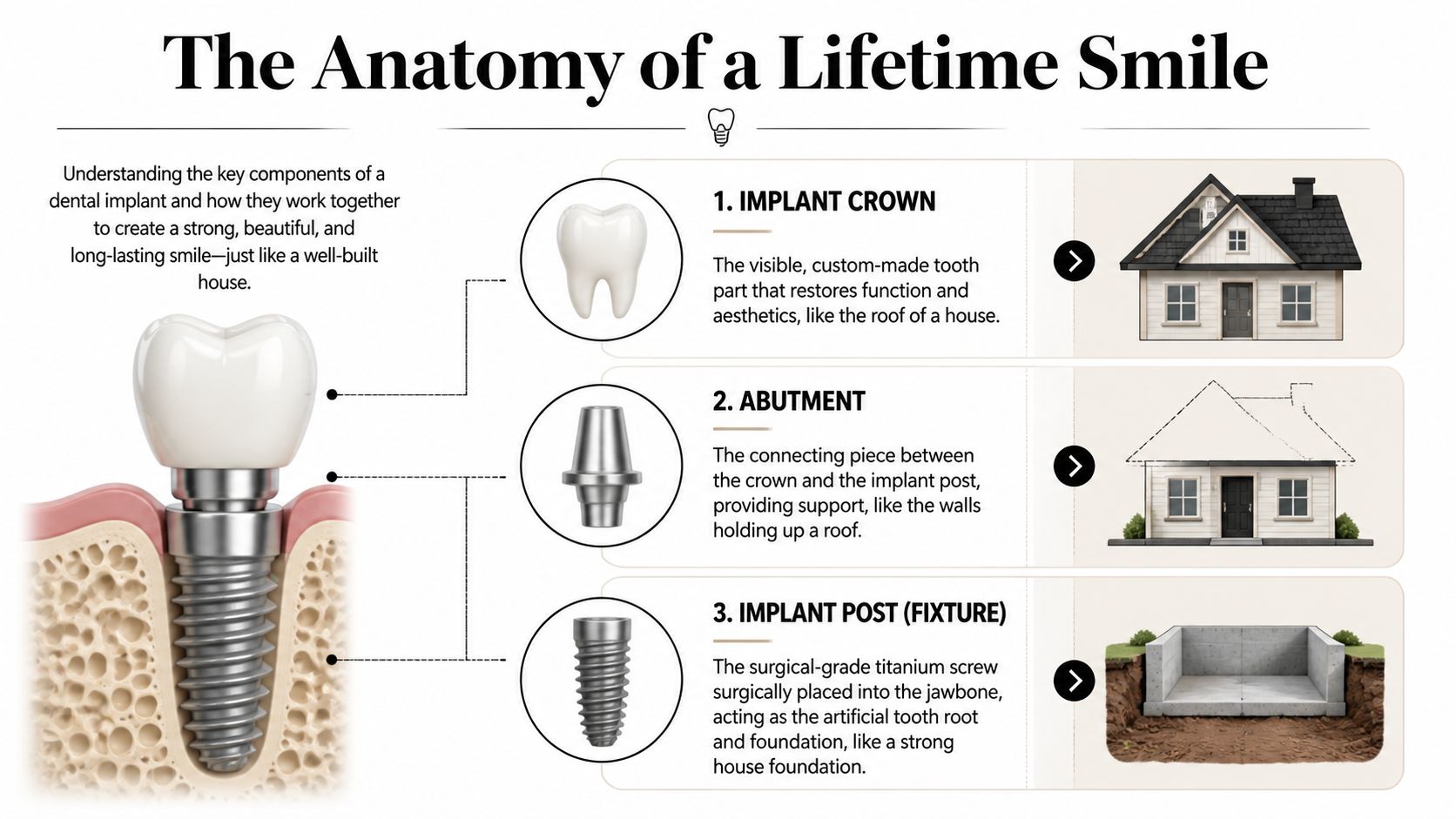
A long-lasting implant restoration has three parts, and each one ages differently. That is the part many patients miss.
The implant post sits in the jawbone. The abutment connects the post to the replacement tooth. The crown is the part you see in the mouth and use for biting and chewing.
Understanding those layers helps answer a common question in clinic. If someone hears that implants can last for decades, they often assume the whole restoration behaves as one single piece. It does not. The part under the gum and bone has a different job from the part exposed to daily wear, so the expected maintenance is different too.
The implant post
The implant post is usually made from titanium and placed into the jaw where the missing root used to be. Over time, the surrounding bone heals tightly against its surface. Dentists call that osseointegration.
A simple way to understand osseointegration is to picture a fence post set firmly into the ground. The strength does not come from the top you can see. It comes from how securely the post is held below the surface. With an implant, healthy bone does that holding.
That bond is the reason implant treatment can be such a stable long-term option. A large review published in *Clinical Oral Implants Research* reported high long-term survival for implant-supported fixed prostheses over 10 and 15 years, showing why we separate the lifespan of the implanted fixture from the parts attached to it (systematic review of long-term implant-supported restoration outcomes).
The abutment and crown
The abutment and crown live in a tougher day-to-day environment. They handle biting pressure, temperature changes, staining, and in some patients, clenching or grinding at night. In real life, this means the visible tooth may need repair or replacement before the implant post does.
That does not mean the treatment has failed. It usually means the top part has worn in the same way a well-used tyre wears before the car chassis does. The foundation can still be sound while the working surface needs attention.
For patients in Tamworth, this distinction matters because it changes expectations. If we ever need to replace a crown years down the track, that is often a maintenance issue rather than starting the whole process again. Our dental implant treatment options explain how these parts work together in a full restoration plan.
Why osseointegration matters so much
Osseointegration is what turns an implant from a metal post into a functioning tooth replacement. Without a healthy bond between bone and implant, the crown above cannot stay stable no matter how natural it looks.
This is why good implant care is not only about polishing the visible tooth. The primary priority is protecting the bone and gum seal around it. At Oasis Smiles, that is what we help patients focus on from the start. Clean the area well. Keep inflammation down. Come in for reviews so small changes can be spotted early.
Once that clicks, implant longevity starts to feel much more practical. You are not hoping for luck. You are protecting the supporting tissues that keep the whole restoration standing.
Key Factors That Influence Implant Longevity
Two people can have the same implant placed in the same year and get very different long-term results. The difference often comes down to a mix of healing, daily care, bite pressure, and how easy the restoration is to keep clean.
Your biology around the implant
An implant needs healthy support from bone and gums, much like a fence post needs firm ground around it. If the bone is limited, the gum seal is weak, or healing is slower than expected, the implant can still succeed, but the planning has to match those conditions.
This is why assessment matters before treatment starts. We look at the amount and shape of bone, the condition of the gum tissue, and the forces that will land on the implant once you start chewing. For many patients in Tamworth, this is the point where implant treatment becomes less mysterious. You are not being told to "hope it lasts." You are being shown which conditions support a longer-lasting result.
Inflammation is one of the biggest threats over time. Plaque sitting at the gumline can irritate the tissue around an implant in the same way it irritates tissue around natural teeth. If you have a history of bleeding gums or periodontal problems, our page on gum disease treatment explains why controlling inflammation helps protect the bone around an implant.
The habits you control every day
This is the part many patients find reassuring. A lot of what affects implant longevity is in your hands.
Smoking is one of the clearest examples. A systematic review and meta-analysis published in the *International Journal of Oral and Maxillofacial Surgery* found higher implant failure risk in smokers than non-smokers, as reported in this review of smoking and dental implant outcomes. In practical terms, smoking can slow healing, reduce blood supply, and make it harder for the tissues around the implant to stay healthy.
Cleaning technique matters too. The weak point is rarely the shiny biting surface of the crown. It is the edge where the restoration meets the gum, because that is where plaque tends to collect first. If that area is cleaned well every day, you give the surrounding tissues a much better chance of staying stable.
Night-time grinding can also shorten the life of an implant restoration. Some patients do not realise they clench until a partner mentions it, or until we see wear patterns and strain on the crown or screw. Extra force over months and years is a bit like repeatedly overloading the same shelf bracket. The problem may not show up on day one, but the stress keeps building.
Then there is follow-up care. Life gets busy. In regional areas, it is easy to put off an appointment because work, family, or travel gets in the way. A small issue such as plaque build-up, a slightly loose crown, or early gum irritation is usually much easier to correct when we catch it early.
The dentist’s role in precision
Good implant dentistry is not only about placing a titanium post in bone. Position, angle, bite design, and crown shape all affect how well that implant will cope with real chewing forces and how easy it will be for you to clean at home.
A well-planned implant should be stable under load and practical to maintain. If the crown is bulky, hard to floss around, or taking too much bite pressure, the implant may be working harder than it should from the start. At Oasis Smiles, we try to make longevity practical, not theoretical. That means planning for the way you eat, clean, and live.
Here is a simple summary:
| Factor | What helps longevity | What shortens it | |---|---|---| | Bone and gums | Healthy support and predictable healing | Ongoing inflammation and bone loss | | Home care | Daily cleaning at the gumline and between teeth | Plaque build-up around the implant | | Bite forces | Balanced chewing pressure and protection from grinding | Heavy clenching or uneven loading | | Follow-up care | Regular reviews and early repairs | Long delays after warning signs appear |
An implant rarely develops a serious problem without some earlier clue. Bleeding, food trapping, a change in bite, or a crown that feels different can all be early signs that something needs attention.
Your Proactive Maintenance Plan for Lasting Implants
The best implant care is ordinary, consistent, and a bit boring. That’s good news, because it means you don’t need anything extreme. You need a routine you’ll stick to.

What to do at home each day
Start with a soft-bristled toothbrush. Brush the crown, the gumline around it, and the rest of your mouth thoroughly. The most important area isn’t just the visible tooth. It’s the edge where plaque likes to sit.
Then clean between teeth and around the implant with the tool that suits your space best. For some people that’s floss. For others it’s an interdental brush or a water flosser. The right tool is the one that reaches the area well and that you’ll use properly every day.
A practical routine often looks like this:
- Brush gently but thoroughly around the implant crown and gumline.
- Clean between teeth with floss, a water flosser, or interdental brushes.
- Check for bleeding or tenderness instead of ignoring it.
- Wear a night guard if you’ve been told you clench or grind.
What not to ignore
Patients often assume pain is the only sign of a problem. It isn’t. Mild bleeding around an implant, food trapping, a change in bite, or a crown that starts feeling “different” can all matter.
Here are the habits that make the biggest difference over time:
- Keep recalls even when things feel fine: Implant problems are easier to treat when they’re found early.
- Don’t use the implant as a tool: Opening packets or biting very hard objects can damage the crown.
- Report changes quickly: A small chip or slight looseness is usually simpler to manage early.
- Protect the surrounding gums: Healthy implants sit in healthy mouths, not in isolated spots.
If you want a broader overview of the routine care that supports long-term oral health, our preventive dental care page covers the basics that matter for both natural teeth and restorations.
What happens at your dental review
Professional implant maintenance is different from a quick polish. Your dentist or oral health therapist checks the gum condition, how the crown is sitting, whether there’s plaque or calculus around the implant, and whether the bite is putting too much force on it.
> Chairside advice: If an implant feels normal, that’s exactly when you want to maintain it. Waiting for pain means you’ve often missed the easiest window to fix a small problem.
Those appointments also let us compare what we see over time. A tiny change in tissue health or a slightly loose component might not be obvious to you at home, but it can be picked up and managed before it becomes more serious.
Recognising the Early Signs of Implant Complications
Most implant complications begin subtly. They don’t usually start with dramatic pain. They start with small changes that are easy to dismiss.
That’s why I encourage patients to pay attention to what’s new, not just what hurts.
Signs in the gums and surrounding tissue
If the gum around an implant starts to look red, puffy, or bleeds during brushing, that suggests inflammation. It doesn’t mean the implant has failed. It means the tissues need attention.
Bad breath that lingers around one area, tenderness when cleaning, or a taste you can’t account for can also point to plaque buildup or infection around the implant. The earlier this is treated, the better the chance of protecting the bone support underneath.
Signs in the crown or bite
Not every problem is biological. Sometimes the implant post is stable, but the crown or screw components need review.
Watch for:
- A loose feeling when chewing: This can mean the crown or abutment needs tightening or assessment.
- A bite that feels “high” or different: Uneven contact can overload the restoration.
- Chipping or wear on the crown: Surface damage can change how force is distributed.
- Food trapping in a new way: That may signal a change in fit or contact point.
What’s normal and what isn’t
After implant treatment, some tenderness during early healing can be expected. What isn’t normal is increasing discomfort, persistent swelling, or a restoration that starts moving.
> If you notice bleeding, swelling, a loose crown, or a sudden change in how the implant feels, don’t monitor it for months. Book a review while the issue is still small.
Patients sometimes worry that raising a concern means they’re overreacting. Usually, it means they’re doing exactly the right thing. Early review can be the difference between a simple maintenance fix and a more involved repair.
How Implants Compare to Bridges and Dentures for Longevity
A replacement tooth is a bit like a car you plan to keep for years. The purchase price matters, but so do repairs, maintenance, and how often you may need to replace parts.
That is why longevity matters when you compare implants, bridges, and dentures. A treatment that lasts well can mean fewer replacements, fewer interruptions, and more predictable costs over time.
Researchers comparing single implants with tooth-supported fixed bridges found that implant-supported crowns tended to have better long-term survival, while bridges were more likely to need replacement or involve problems in the supporting teeth over time, according to a large review published in the *International Journal of Oral & Maxillofacial Implants* on implant-supported single crowns versus tooth-supported fixed dental prostheses.
Longevity comparison
| Feature | Dental Implants | Dental Bridge | Partial/Full Denture | |---|---|---|---| | Expected lifespan | Designed as a long-term tooth replacement, with the implant post often lasting longer than the crown attached to it | Can last well for years, but replacement is more commonly needed over time | Often needs relining, repair, or replacement as the mouth changes | | Effect on nearby teeth | Usually stands independently | Usually relies on neighbouring teeth for support and preparation | Does not depend on crowns on nearby teeth in the same way, but rests on gums and surrounding structures | | Bone support | Replaces the root as well as the visible tooth, which helps preserve function in the jaw | Replaces the visible gap only | Replaces missing teeth above the gum, not the root in bone | | Daily feel | Fixed in place and generally closest to a natural tooth feel | Fixed in place | Removable, unless attached to a different retention system | | Maintenance | Daily cleaning around the gumline and regular professional review | Daily cleaning under and around the bridge and regular review | Cleaning of the denture itself, plus care of the gums and any remaining teeth |
The practical difference is simple. An implant replaces the tooth from the root up. A bridge replaces the visible part of the tooth but depends on the teeth next door. A denture replaces teeth without replacing the root support, so fit can change as the gums and bone change over time.
That does not make implants the right answer for everyone.
A bridge can still be an excellent option if you want to avoid surgery, need a faster solution, or have nearby teeth that already need crowns. If you want to compare that route in more detail, our page on dental bridges as a tooth replacement option explains where bridges fit.
Dentures also have an important place, especially for patients replacing several teeth or managing treatment in stages. For some people in Tamworth, a denture is the most practical starting point because it suits their budget, health history, or treatment goals right now.
What this means for you is less about picking the option with the longest average lifespan on paper and more about choosing the option you can look after well. A well-planned implant that is cleaned properly and reviewed regularly often gives the most stable long-term result. A well-made bridge or denture can still serve you very well if that is the better fit for your mouth, your routine, and your budget.
The Oasis Smiles Advantage for a Lifetime Result
Long-lasting implants don’t come from one clever product. They come from accurate planning, careful placement, a restoration that fits properly, and maintenance that doesn’t get skipped.

Why precision matters
If an implant goes in at the right angle, in the right position, with proper assessment of the surrounding bone, everything that follows tends to work more smoothly. The crown can be designed to take force well. Cleaning around it is easier. The bite can be adjusted more precisely.
That’s where tools such as CBCT 3D imaging and Trios digital scanners matter in day-to-day care. They help the dentist plan position and fit more accurately than relying on simpler methods alone. A well-fitting restoration isn’t just about looks. It’s about hygiene access, comfort, and load distribution over time.
Why convenience affects longevity too
Patients don’t always think of convenience as a clinical factor, but it is. When review appointments are simpler and repairs are more efficient, people are less likely to delay care.
At Oasis Smiles Dental, technologies such as CEREC same-day crowns, in-house 3D printing, and digital scanning support restorative workflows that can make implant maintenance and crown replacement more practical when needed. That doesn’t guarantee a longer lifespan by itself. It helps reduce delays and supports accurate follow-up care.
What this means for local patients
For families in Tamworth and the wider New England region, the biggest advantage is often continuity. The same clinic can monitor how the implant is performing, compare changes over time, and act early if the crown, bite, or gum health needs attention.
> Good implant care is rarely about one dramatic intervention. It’s about precise treatment at the start, then steady follow-up that keeps small issues from turning into major ones.
That approach suits real life. People get busy. Crowns wear. Bites change. Health conditions shift. A long-term result is easier to protect when your care stays organised and consistent.
Frequently Asked Questions About Dental Implants
Do dental implants hurt?
Most patients describe implant treatment as easier than they expected. The area is numbed carefully during the procedure, and the first few days usually feel more like post-extraction soreness than severe pain.
A helpful way to think about it is this: the planning often worries people more than the healing. Once you know what will happen on the day, what normal tenderness feels like, and when to call us, the process tends to feel far more manageable.
For patients in Tamworth, that matters in a practical sense. If work, family, or travel time makes treatment feel like a big event, clear instructions and realistic expectations can make the whole experience feel much more straightforward.
Can any dentist place an implant?
Implant treatment is not just about placing a titanium post into bone. It also involves checking bone support, gum health, bite forces, implant position, and how the final crown will function and be cleaned.
An implant works a bit like a fence post. If the post is set in the wrong position, the top may still go on, but it will not handle pressure as well and it may be harder to keep clean.
What this means for you is simple. Ask who will plan the case, who will place the implant, how the bite will be checked, and what the review schedule looks like after treatment. At Oasis Smiles Dental, that conversation is part of helping patients understand the long-term picture, not just the procedure itself.
If the crown wears out, do I lose the whole implant?
Usually, no. In many cases, the implant post in the bone stays sound while the crown above it is the part that eventually needs repair or replacement.
That makes sense if you picture the implant as the foundation and the crown as the working surface. The top part does the daily chewing, takes the wear, and is more exposed to chips, cracks, and changes in bite over time.
What this means for you is reassuring. A worn crown does not automatically mean starting again from scratch. If the implant remains healthy, replacing the top can be a much simpler job.
I’m anxious about treatment. Does that affect longevity?
Anxiety can affect implant success indirectly because it makes some patients delay treatment, skip reviews, or avoid cleaning around a sore area. The implant does best when small concerns are checked early and home care stays consistent.
The Australian Dental Association notes that fear and anxiety are common reasons people avoid dental visits, which is one reason good communication matters so much in implant care: Australian Dental Association information on dental anxiety.
What this means for you is practical. If you feel nervous, say so early. We can slow the pace, explain each step clearly, and give you a care plan that feels realistic. A patient who feels calm enough to attend reviews and follow instructions is in a better position to keep an implant healthy for years.
How do I know if something is wrong with my implant?
Look for change. Bleeding when brushing, swelling around the implant, bad taste, tenderness, a crown that feels loose, or a bite that suddenly feels “off” all deserve a review.
Pain is not the only warning sign, and sometimes it is not the first one.
This is one of the biggest patient-controlled parts of implant longevity. If you notice something early and book in promptly, a small gum issue or a crown problem is often much easier to manage than a problem left for months.
Are implants worth it for the long term?
For many patients, yes, especially if you want a fixed tooth replacement that feels close to a natural tooth in daily life. Implants can last for many years, but they reward good habits. They are more like owning a car than buying a kitchen chair. Regular care keeps them performing well.
That means brushing carefully around the implant, cleaning between teeth, wearing a night guard if you grind, and coming in for reviews even when nothing feels wrong.
For many people around Tamworth, the question is not only “How long can an implant last?” It is “Can I look after it properly?” If the answer is yes, implants are often a sensible long-term option for comfort, chewing, and confidence.
---
If you’re weighing up whether implants are right for you, or you want an existing implant checked, Oasis Smiles Dental can assess your gum health, bite, bone support, and restoration options in a practical, patient-focused consultation.