

Dental Cleaning Whitening: Dental Cleaning Whitening:
You catch your smile in the bathroom mirror before work, or in the front camera while sending a message, and something feels off. Your teeth might look a little dull, a bit yellow, or are not as fresh as they used to. Then the questions start. Do you need a clean? Do you need whitening? Aren't they basically the same thing?
They’re not the same, and that’s where many people in Tamworth and across New England get stuck. One treatment is about health and build-up removal. The other is about changing tooth colour. Both can help your smile look better, but they do very different jobs.
That’s why it helps to have clear, local advice from a practice that sees these concerns every day. At Oasis Smiles Dental in Tamworth, patients often come in asking for “dental cleaning whitening” when what they really want is a brighter, healthier smile and some simple guidance on the best way to get there.
Your Brightest Smile Starts Here
A common story goes like this. Someone has a wedding coming up, a new job, school photos, or they’ve just had enough of hiding their teeth in pictures. They book in thinking a quick clean will make their teeth dramatically whiter. After all, if something looks stained, cleaning should fix it, right?
Sometimes it helps a little. Sometimes it doesn’t help much at all.
That’s because there are really two separate ideas hiding inside the phrase dental cleaning whitening. A professional clean removes plaque, tartar and some surface staining. Whitening uses a bleaching gel to lighten the tooth colour itself. Caring for a white shirt offers a good comparison: Washing it removes dirt, while whitening changes the brightness of the fabric.
For local families, that distinction matters. In regional areas, people don’t always have easy access to supervised cosmetic care, and online advice can be confusing or flat-out wrong. It’s much safer when your mouth is assessed properly first, especially if you’ve got sensitive teeth, old fillings, braces history, or gum problems.
> A brighter smile usually starts with knowing which problem you’re trying to solve. Surface build-up and natural tooth colour are not the same thing.
If you’ve been wondering whether you need a clean, whitening, or both, you’re asking the right question. The best approach is usually simpler than people expect, and once you understand the difference, the path forward feels much less confusing.
Professional Dental Cleaning The Foundation for Health
A professional dental clean is best thought of as a deep clean for your mouth. It’s not just about making teeth look nicer. It removes things that your toothbrush can’t shift once they’ve hardened onto the teeth.
If plaque sits too long, it can turn into tartar. Tartar sticks firmly to the tooth surface and often gathers around the gumline. You can’t brush it off at home. That’s where a dentist or hygienist steps in.
What happens during a professional clean
A clean usually starts with an examination. Your dental team checks the teeth, gums, and areas where plaque tends to collect. If needed, imaging may also be used to understand the bigger picture, especially if there are signs of gum problems or harder-to-see build-up.
Then comes the active cleaning phase, which may include:
- Scaling to remove tartar and plaque from the tooth surface and around the gums
- Polishing to smooth the teeth and lift away some superficial stains
- Fluoride application where appropriate, to support enamel after the clean
- Home care guidance so the result lasts longer and problem spots are easier to manage
This is why a clean is a health appointment first. Fresh breath and a smoother smile are welcome bonuses, but the main goal is reducing the conditions that can lead to decay and gum disease.
Why cleaning matters before anything cosmetic
People sometimes think cosmetic care starts with whitening gel. In reality, it starts with visibility. Your dentist needs to see the tooth's surface clearly and check whether the gums are healthy enough for whitening.
Australia’s whitening rules have been shaped by formal guidance for decades. The Australian whitening history summary notes that the Australian Dental Association adopted peroxide-based whitening guidelines in 1999, and that practices such as Oasis Smiles Dental have served Tamworth for over 20 years since around 2004, with 85% patient satisfaction reported in internal audits aligned with ADA benchmarks.
That history matters because it shows something patients often miss. Cleaning and whitening aren’t random beauty extras. They sit inside a regulated dental framework built around safety and proper sequencing.
> Local perspective: If you haven’t had a check-up in a while, a clean is often the most sensible first appointment because it tells us whether whitening is suitable at all.
For patients who want to understand what’s going on before making cosmetic decisions, a standard dental check-up and clean appointment is usually the right starting point.
Cosmetic Teeth Whitening Brightening Your Natural Colour
Cleaning lifts away what’s sitting on the teeth. Whitening works on colour that sits within the teeth.
That’s the key difference.
If cleaning is like washing a wall, whitening is more like brightening the wall itself. It doesn’t scrub off tartar or plaque. Instead, it uses peroxide-based gels to lighten discolouration inside the enamel and dentine.
How whitening actually works
In simple terms, the whitening gel breaks down stain compounds so teeth look lighter. You don’t need the chemistry details to understand the result. The gel is doing a different job from a polish cup or scaler.
That’s why someone can leave a cleaning appointment with smooth, healthy teeth but still feel disappointed if they expected a much whiter colour. The clean may remove tea, coffee, or smoking marks on the surface, but it won’t reliably change the underlying shade in the way whitening can.
What professional whitening can achieve
In Australia, whitening is one of the most requested cosmetic dental treatments. A 2022 ADA survey found that about 28% of Australian adults under 45 had undergone professional whitening, and in-office treatments using 35 to 40% hydrogen peroxide had 90% success rates in lightening teeth by up to 8 to 10 shades, according to the reported whitening data here.
That doesn’t mean every smile becomes paper-white, and that’s a good thing. The best result usually looks natural, healthy and in proportion to your features.
| Treatment | Main goal | What it changes | |---|---|---| | Professional cleaning | Oral health and surface stain removal | Build-up on the teeth | | Professional whitening | Cosmetic brightening | The natural tooth colour |
A useful way to think about it is this:
> Whitening doesn’t replace cleaning, and cleaning doesn’t replace whitening. They solve different problems.
When patients understand that early, they make better decisions and usually end up happier with the final result.
Cleaning First Then Whitening The Right Order for Best Results
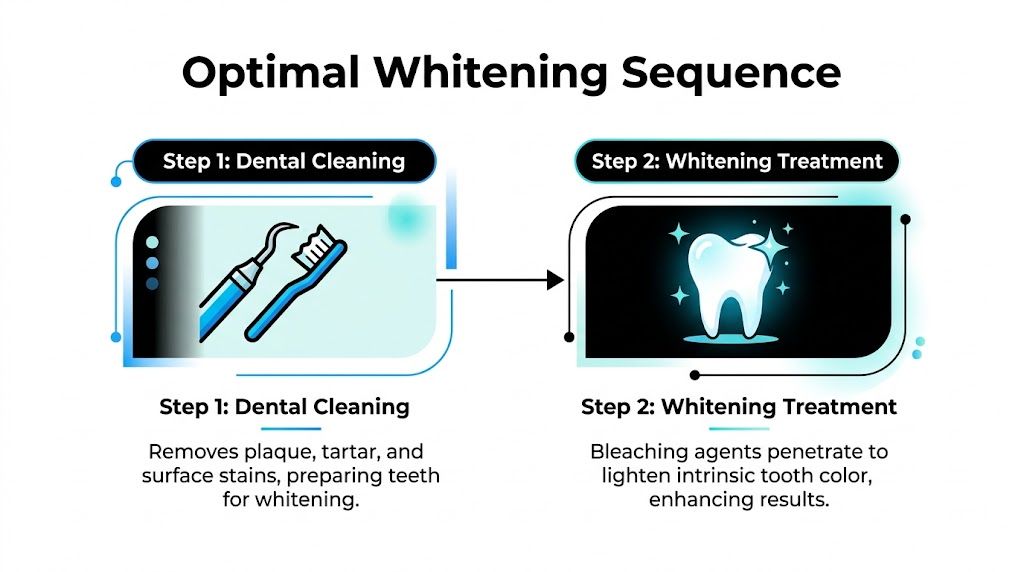
If you remember one rule from this article, make it this one. Clean first. Whiten second.
You wouldn’t paint a dirty wall and expect a smooth finish. Teeth work the same way. If plaque, tartar, or surface film is still sitting on the enamel, the whitening gel can’t contact the tooth evenly.
What gets in the way
When teeth aren’t properly cleaned first, whitening can be patchy. Some areas absorb the gel better than others. The gums may also be more irritated if build-up is left near the gumline.
The ADA guidance on whitening states that uncleaned plaque barriers can reduce peroxide penetration by up to 50%. The same source notes that after cleaning, hydrogen peroxide diffusion rates increase from 15 to 20% to over 70% through enamel.
Those figures explain why the order matters so much. The clean doesn’t just tidy up the teeth. It prepares the surface so whitening can work as intended.
Why the sequence is safer too
A clean before whitening also gives the dental team a chance to check for problems that might make whitening a bad idea on the day, such as inflamed gums, exposed roots, decay, or leaking fillings. If those issues are missed, whitening can feel more uncomfortable and the result may be less predictable.
For patients, the practical takeaway is simple:
- Book a proper assessment
- Have any recommended cleaning done first
- Only start whitening when the teeth and gums are ready
> Practical rule: If someone offers whitening without first checking the health and cleanliness of your teeth, that’s a reason to slow down and ask more questions.
This step is especially important for people who’ve delayed dental visits, wear aligners, drink lots of coffee, or have noticed bleeding when brushing.
Your Professional Whitening Options at Oasis Smiles
Once the teeth are clean and suitable, most patients are choosing between two professional paths. One happens in the chair. The other happens at home with dentist-supervised trays.
Both can work well. The right choice depends on your timeline, your routine, and how much support you want along the way.
In-clinic whitening
This option suits people who want a faster result and prefer everything to be done under direct supervision. The appointment usually follows a prior assessment and clean. Your gums are protected, the whitening gel is carefully applied, and the team monitors comfort throughout.
In-clinic whitening often appeals to people preparing for an event, returning to work in a public-facing role, or wanting a more immediate change.
It can be a good fit if you:
- Prefer speed and want visible brightening without managing trays yourself
- Value supervision because you’re prone to sensitivity or feel nervous about getting it right
- Want a more guided experience with less guesswork at home
Professional take-home whitening
Take-home whitening is different, but not lower quality. It’s slower, more flexible, and often easier to fit around family and work life. The biggest difference is precision. A professionally made tray fits your teeth closely, which helps the gel stay where it should.
For regional patients, that matters. Rural access to supervised care can be more limited, and that’s one reason professional planning is so important. The rural access and whitening overview notes that in regional and remote Australia, access to dental visits is lower than in major cities, that non-dental whitening services are illegal under NSW rules, and that 25% of rural users of unregulated online kits reported issues. The same source highlights that clinics like Oasis Smiles help bridge that gap with supervised cleaning-whitening care, Medicare and DVA acceptance, and Trios scanners for precise pre-treatment assessment.
A quick comparison
| Option | Best for | Main advantage | Main consideration | |---|---|---|---| | In-clinic whitening | People wanting speed | Treatment is supervised start to finish | Requires chair time | | Take-home professional kit | People wanting flexibility | Whiten gradually at home with custom trays | Results take more patience |
Trios digital scanners are especially helpful for take-home whitening because they allow precise tray design without messy traditional impressions. A well-fitting tray reduces overflow, helps comfort, and makes the process feel more manageable.
If you’d like to compare the available professional whitening options offered locally, it’s worth asking which approach best suits your timing, sensitivity history, and smile goals.
> Good whitening isn’t only about making teeth lighter. It’s about choosing a method you can use safely and consistently.
Suitability Safety and Keeping Your Smile Bright
Not every mouth is ready for whitening on the first visit. That doesn’t mean you can’t have it. It usually means something needs attention first.
Whitening works best when the teeth and gums are healthy, the staining is on natural tooth structure, and your expectations are realistic. It’s less predictable if the front teeth contain visible fillings, crowns, or other restorations, because those materials don’t whiten in the same way natural enamel does.
When whitening may need to wait
A dentist may suggest delaying whitening if you have active gum disease, untreated decay, or areas of strong sensitivity. These issues should be managed first so treatment is more comfortable and the result is more even.
If you’ve had braces or you’re using clear aligners, timing matters too. The shape and exposure of the tooth surfaces can affect when whitening makes the most sense.
For gum concerns, it’s sensible to deal with inflammation first through proper assessment and, if needed, gum disease care before moving into cosmetic treatment.
What about sensitivity
Sensitivity is the question nearly everyone asks, and fairly so. It can happen with whitening, but professional care gives your dental team options to reduce the risk and adjust the plan if needed.
The March 2025 whitening update summary states that cleaning before whitening is recommended for best results, notes that standard water fluoridation in New England is relevant to planning, and says emerging sensitivity linked with vaping needs custom gel formulation. The same source says post-cleaning whitening in this setting is considered safe for patients aged 12+ and for those with Invisalign, while over-the-counter strips had a 40% failure rate in fluoridated areas in the cited ADA study.
That doesn’t mean everyone with sensitivity or a teen smile should rush into whitening. It means personalised assessment matters more than ever.
Simple ways to help results last
After whitening, patients usually keep their smile brighter for longer by being a little more deliberate for a while:
- Watch dark drinks early on such as coffee, tea, red wine, and cola
- Rinse with water after strongly coloured foods and drinks
- Keep up regular cleans so new surface staining doesn’t build back quickly
- Tell your dentist about sensitivity instead of pushing through discomfort at home
> The best whitening result is one that still looks good months later because the teeth and gums were healthy from the start.
Your Dental Cleaning and Whitening Questions Answered
Will a dental clean make my teeth white enough on its own
Sometimes, but only if the main problem is surface staining. If the colour change is deeper or related to ageing, a clean alone usually won’t create the brighter result people have in mind.
Is whitening safe for teenagers
It can be appropriate in some cases, but it should be professionally assessed first. Age, enamel health, orthodontic history, and sensitivity all matter. That’s especially important for teens with aligners, braces history, or vaping-related sensitivity.
How long do results last
That depends on your diet, smoking or vaping habits, home care, and whether you keep up with professional cleans. Whitening isn’t permanent, so maintenance is part of the plan.
Can I whiten if I have fillings or crowns on the front teeth
Possibly, but the result needs careful planning. Natural teeth can whiten. Fillings, crowns, and veneers generally won’t change in the same way, so colour matching may need to be discussed first.
Are online kits the same as professional whitening
No. The biggest difference is assessment, fit, and supervision. A dentist checks whether whitening is suitable, whether your gums are healthy, and whether a custom tray or in-clinic treatment is the better option for your smile.
Is a clean before whitening really necessary
Yes. It helps the gel work more evenly and gives the dental team a clear view of the tooth surface and gums before any bleaching starts.
--- If you’re in Tamworth or the New England region and want clear advice on dental cleaning whitening, Oasis Smiles Dental can help you work out the right next step. Whether you need a thorough clean, a whitening assessment, or a plan that suits sensitive teeth and busy family life, the team offers modern care with a warm local approach.