

Do You Need to Have Wisdom Teeth Removed in 2026? Signs, Options, and Costs
The big question many people have is whether their wisdom teeth actually need to come out. The short answer is: not always. If they grow in straight, healthy, and don't cause any trouble, we might just leave them be.
But often, that’s not what happens. If they’re stuck (or *impacted*), causing you pain, or putting your other teeth at risk, we’ll almost always recommend having them removed.
What Are Wisdom Teeth and Why Do They Cause Problems?
Wisdom teeth are your third and final set of molars. They’re the last to arrive, usually making an appearance at the very back of your mouth somewhere between the ages of 17 and 25. The name comes from the idea that this is the age you’re meant to be getting wiser!
The main issue is a simple lack of real estate. Think of your jaw like a car park that’s already full. By the time your wisdom teeth try to show up, all the good spots have been taken by your other 28 teeth. Our modern jaws are just smaller than our ancestors'—they needed those extra-strong molars for a tougher, more abrasive diet. For most of us today, there’s simply no room at the inn.
The Problem of Impaction
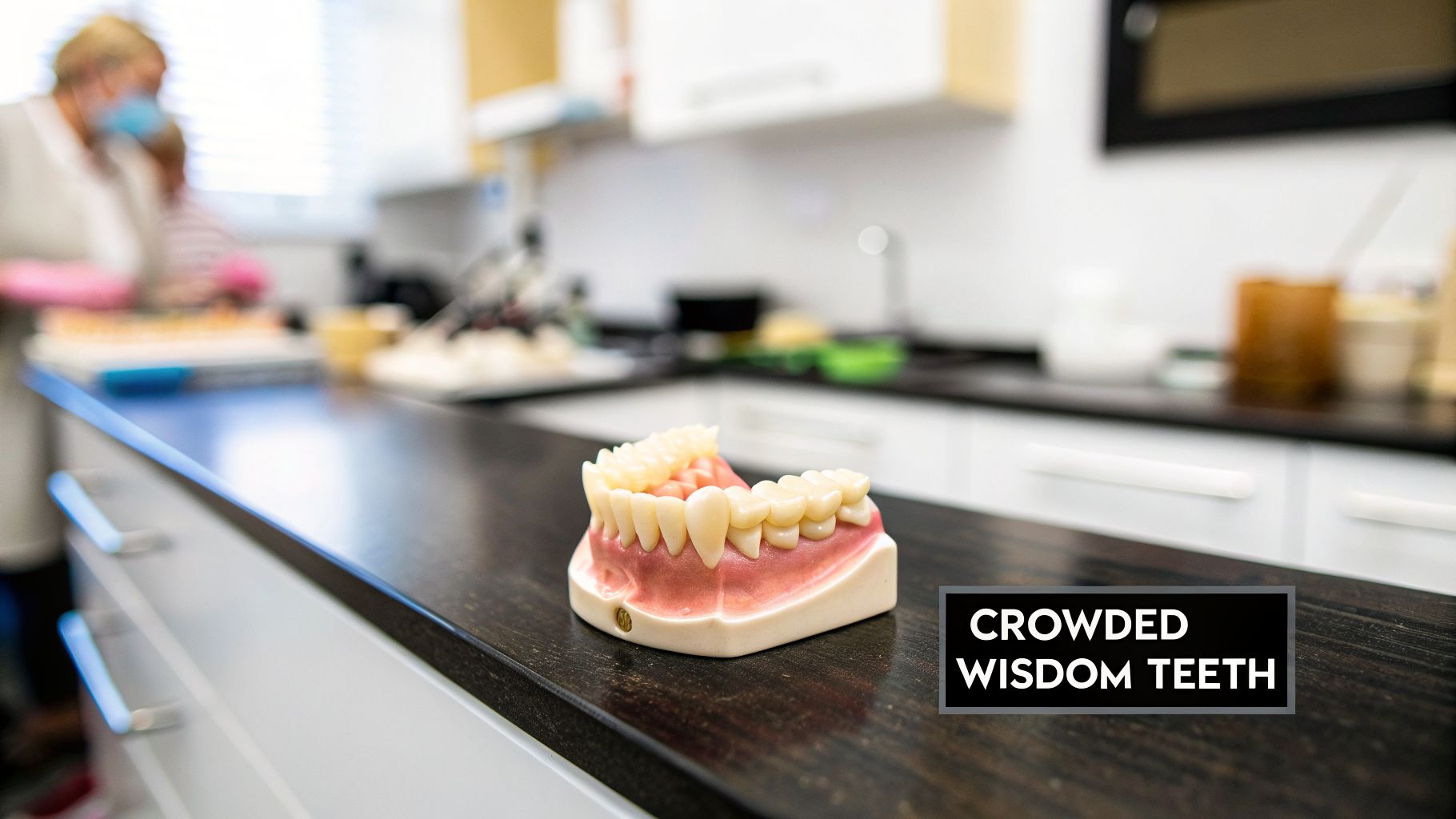
When a wisdom tooth doesn’t have enough space to break through the gum line properly, it gets stuck. We call this being impacted. An impacted tooth is trapped, either partially or completely, in the gum tissue or jawbone. It can’t do its job, and worse, it often becomes a ticking time bomb for future dental issues.
Not all impactions are the same, which explains why some people have more trouble than others. The way the tooth is stuck determines how much of a problem it's likely to be.
Here are the most common ways a wisdom tooth can get impacted:
- Mesial Impaction: This is what we see most often. The tooth grows at an angle, pushing forward into the molar right next to it. This can create a lot of pressure and crowding.
- Vertical Impaction: The tooth is growing in the right direction (straight up and down) but is stuck under the gum or bone because there isn't enough space for it to fully emerge.
- Distal Impaction: This one is less common. The tooth is angled backwards, into the rear of your jaw.
- Horizontal Impaction: This is often the most troublesome. The tooth is lying completely on its side under the gum, growing straight into the roots of the neighbouring molar. As you can imagine, this can be quite painful and damaging.
Why Stuck Teeth Spell Trouble
A partially erupted or impacted wisdom tooth is a magnet for problems. Because they’re tucked away at the very back of the mouth, often with a little flap of gum tissue over them, they are notoriously difficult to keep clean.
> This is where the real trouble starts. Food and bacteria get trapped under that gum flap, which can lead to a nasty, painful infection called pericoronitis. It’s one of the most common reasons we see patients for emergency dental appointments.
But it doesn't stop there. That hard-to-clean spot is the perfect breeding ground for decay—not just in the wisdom tooth itself, but more worryingly, in the crucial second molar right beside it. Over time, this can lead to persistent infections, abscesses, and even contribute to the development of gum disease.
So, while not every wisdom tooth is destined to cause grief, their tendency to become impacted and create these kinds of problems is why we, as dentists here in Tamworth, always recommend keeping a close eye on them with regular check-ups.
Key Signs You Might Need Your Wisdom Teeth Removed
So, how can you tell if your wisdom teeth are starting to cause trouble? While only a dentist can give you a definite diagnosis, your body is pretty good at sending out warning signals when something’s not right at the back of your jaw. Knowing what to look for can help you get ahead of the problem before a minor irritation turns into a major toothache.
It’s tempting to ignore these little nudges, hoping they’ll just go away. But more often than not, ignoring them just gives the underlying issue more time to get worse. Think of it as a smoke alarm—it’s a clear signal to investigate, not to take the batteries out.
Pain and Discomfort
Pain is the most common and obvious sign. It doesn’t always show up as a sharp, stabbing sensation, either. It often starts as a dull, constant ache deep in the back of your mouth or jaw. You might only notice it when you’re chewing, or it could be a low-grade throb that’s just always *there*.
This discomfort is usually caused by an impacted wisdom tooth physically pushing against the molar next to it. There’s literally a battle for space happening under your gums, and that pressure is what you feel as an ache. Sometimes, this pain can even radiate, leading to headaches or earaches that you might not immediately link back to your teeth.
You might also feel a new stiffness in your jaw, making it tough or uncomfortable to open your mouth wide. That’s a tell-tale sign that inflammation is starting to affect the muscles and tissues nearby.
Swelling and Gum Problems
Another huge red flag is visible swelling or changes to your gums. Take a look in the mirror—if the gum tissue around a back tooth looks red, puffy, or feels tender when you touch it, that’s a problem. This inflammation is a condition we call pericoronitis, and it’s one of the most frequent issues with partially emerged wisdom teeth.
It happens because a small flap of gum (called an operculum) can end up covering a part of the tooth that's trying to come through. This flap creates the perfect little pocket for food and bacteria to get trapped, which almost inevitably leads to infection.
Alongside the swelling, you might also experience:
- Bleeding gums in that specific area, especially when you brush.
- A strange or unpleasant taste in your mouth that won't go away.
- Persistent bad breath (halitosis), as the trapped bacteria release odours that mouthwash can’t fix.
If you suddenly experience severe pain or swelling, it may be a dental emergency. Our guide on what to do in emergency dental situations can help you navigate what to do next.
The Broader Impact on Your Oral Health
A problematic wisdom tooth rarely keeps to itself; it can create a domino effect that impacts the rest of your mouth. The constant pressure from an impacted tooth can gradually push your other teeth out of alignment, which can be incredibly frustrating if you’ve had braces.
On top of that, wisdom teeth are notoriously difficult to clean properly. Their position way at the back makes them a high-risk area for decay and gum disease. This isn’t just a risk for the wisdom tooth itself, but more importantly, for the healthy and essential second molar right next to it.
This is a common story for many Australians. National data reveals that of all adults who needed teeth extracted, 25.6% of those cases involved wisdom teeth—that’s around 440,000 people every year. And when one is a problem, others often are too; 60.9% of these procedures involved removing multiple wisdom teeth. You can read more in the full Australian dental health report.
> Key Takeaway: Symptoms like a dull ache, swollen gums, bad breath, or a stiff jaw are not things you should just put up with. They are your body’s way of saying your wisdom teeth might be impacted or infected, and it’s time to book a consultation.
How a Dentist Decides if Removal Is Necessary
So, you’re dealing with some pain or swelling and wondering if it’s your wisdom teeth causing the trouble. The next logical question is, "Do they need to come out?" There's no single 'yes' or 'no' answer that fits everyone; the right path forward comes from a careful, professional look at what’s really going on inside your mouth.
At Oasis Smiles Dental, we don't guess. We start with a conversation and a thorough check-up. We'll chat about the symptoms you're feeling, then have a gentle look at your teeth and gums for any obvious signs of a problem—like redness, swelling, or a tooth that’s clearly struggling to break through. This gives us the first piece of the puzzle.
Seeing the Full Picture With Dental Imaging
While that initial look tells us a lot, the real story is often hidden beneath the surface. To see what’s happening with the tooth's position and roots, we need to take a look with dental imaging.
For most people, a standard 2D X-ray (we call it an OPG) is the perfect starting point. It gives us a great bird's-eye view of your whole jaw, showing where your wisdom teeth are in relation to your other teeth. In many straightforward cases, this is all we need to make a confident recommendation.
Sometimes, though, the situation is a bit more complex. A tooth might be severely impacted or sitting very close to important nerves in your jaw.
> Think of it like this: a 2D X-ray is like a flat road map. It’s useful for getting the general lay of the land, but if you need to navigate tricky terrain, you really want a 3D model that shows you all the hills, valleys, and potential obstacles.
Precision Planning With CBCT 3D Scans
When we need that complete, three-dimensional view, we use our in-house Cone Beam Computed Tomography (CBCT) scanner. This amazing piece of technology creates a detailed 3D model of your jaw, bone, and teeth. It’s like having a digital globe of your mouth that we can turn and inspect from every possible angle.
This detailed view allows us to:
- Pinpoint the impaction: We can see the exact angle of the tooth and whether it’s damaging the roots of the molar in front of it.
- Map out any risks: The scan clearly shows us how close the wisdom tooth's roots are to the major nerve that runs through your lower jaw, which is vital for preventing injury.
- Plan the safest removal: Knowing the precise anatomy helps us plan the most efficient and least invasive way to remove the tooth.
This means that any recommendation we make is based on solid, detailed evidence specific to you. If you're experiencing symptoms, this simple flowchart can help guide your next steps.
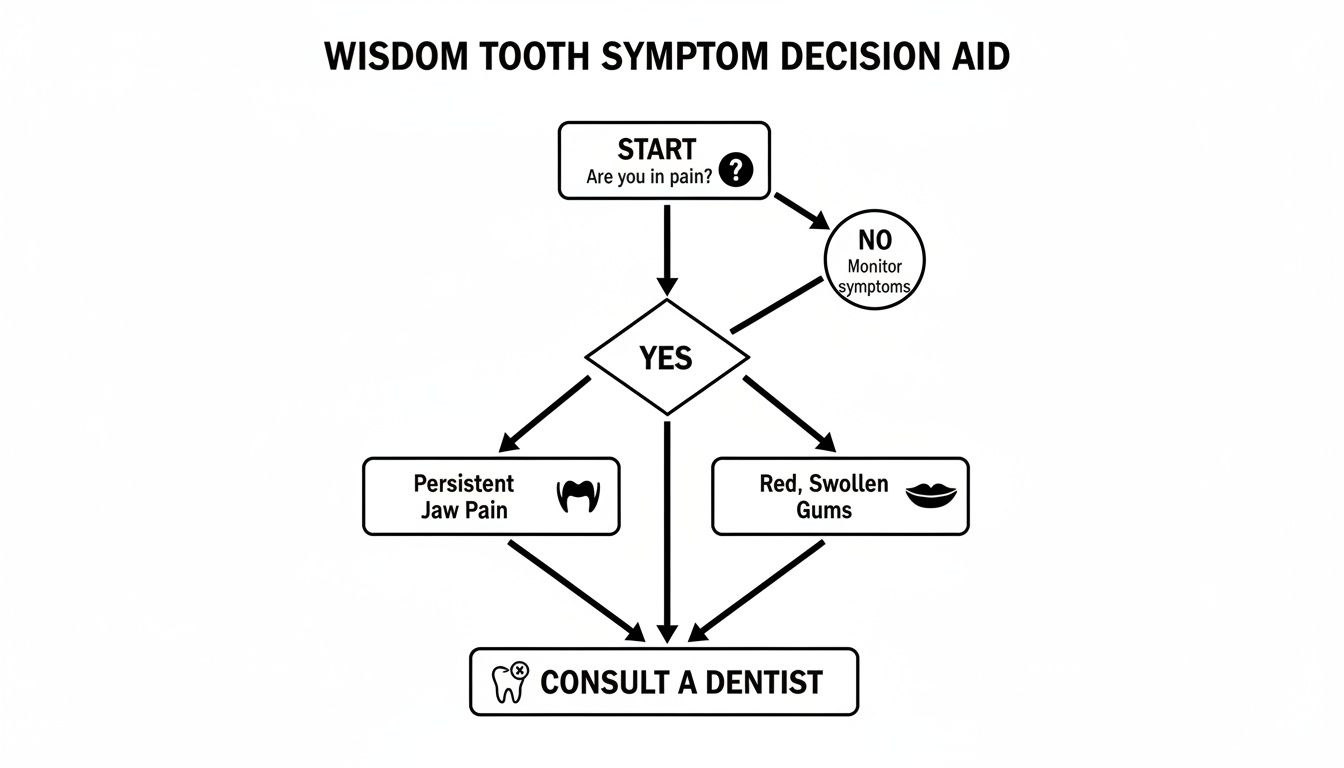
As the chart shows, things like persistent pain or swollen gums are your cue to come in for a professional assessment.
It’s worth knowing you’re not alone in this. Wisdom teeth removal is one of the most common hospital procedures for young Aussies. National data shows an age-adjusted rate of about 1300 people per 100,000 are hospitalised for impacted teeth removal, which adds up to nearly 62,000 patients every year. Statistics from Western Australia revealed that 80% of these procedures were for people in the 15-34 age group—right when these third molars tend to make their appearance. You can read more about these Australian oral surgery trends if you're curious.
By combining a hands-on exam with the right imaging, we can confidently advise whether your wisdom teeth need attention or are perfectly fine to be left alone.
What Happens During a Wisdom Tooth Removal?
Thinking about the actual procedure can feel a bit overwhelming, but the reality is usually much simpler and more comfortable than you might imagine. Let's walk through what really happens when we remove a wisdom tooth, so you know exactly what to expect.
The first thing we need to figure out is whether your tooth needs a simple or a surgical removal. It all comes down to the tooth’s position. Is it fully out and visible? Or is it stuck under the gum or bone? That's the key difference.
Simple vs. Surgical Extraction
A simple extraction is for wisdom teeth that have already made their way through the gum line. If we can see the whole tooth, the process is pretty straightforward and very similar to removing any other tooth. It's usually a quick appointment done right here in our dental chair.
A surgical extraction sounds more intense than it is. We need to do this when a tooth is impacted, meaning it's trapped beneath the gums. To get to it, we make a small, careful incision in the gum. If the tooth is in a tricky spot or is very large, we might break it into a few smaller pieces. This actually makes the removal gentler and easier on you.
> Think of it this way: a "surgical" extraction just means we need to open a little window to safely get to a tooth that hasn't come out on its own. It's an incredibly common and routine part of modern dentistry.
Your Comfort Is Our Top Priority
Knowing you need a tooth out is one thing, but feeling relaxed and comfortable during the process is just as important. At Oasis Smiles Dental, we take pain and anxiety management very seriously. You have options, and we'll work with you to choose the one that best fits your needs and the type of extraction you're having.
We use advanced tools to make sure every procedure is as precise and comfortable as it can be. You can learn more about the dental technology we use at our Tamworth clinic to give our patients a better experience.
Here are the main options we use to ensure a pain-free procedure:
- Local Anaesthesia: This is the go-to for most extractions, especially simple ones. We start with a numbing gel on the gum, then gently administer a local anaesthetic. You’ll be awake, but the area will be completely numb. You won’t feel any pain at all, just a little bit of pressure.
- IV Sedation (Sleep Dentistry): If you're feeling particularly anxious or you're having several teeth removed at once, IV sedation is a fantastic choice. The sedative is delivered through a vein, and you'll drift into a deeply relaxed, dream-like state. You'll still be conscious enough to respond if needed, but you'll feel completely calm and will likely have no memory of the procedure afterwards.
- General Anaesthesia: For very complex cases or for patients with severe dental phobia, we might suggest a general anaesthetic. This is done in a hospital with a specialist anaesthetist, and you will be completely asleep for the entire surgery.
We’ll sit down and discuss all of this during your consultation. Together, we’ll look at the complexity of your case, your medical history, and most importantly, your personal comfort level to decide on the best path forward for you.
Your Recovery Guide After Wisdom Teeth Removal
Getting your wisdom teeth out is one thing, but the recovery is where you play the biggest part. We’ll handle the procedure, but your care in the days that follow is what will get you back on your feet quickly and comfortably. Think of us as your partners in this process.
We’ve guided countless patients in Tamworth and the New England region through this, and we’ve learned that a little preparation makes all the difference.

Let's walk through what you can expect, day by day. Your main job is simple: rest, manage the swelling, and protect the healing site.
Your Recovery Timeline Day by Day
The first few days are really the most important. A blood clot will form in the empty tooth socket—this is nature’s own little bandage, and it’s absolutely vital for healing. Your number one goal is to keep it safe and sound.
The First 24 Hours: * Rest is non-negotiable. Clear your schedule. Lie down and prop your head up with some pillows to help reduce swelling. No gym, no heavy lifting, no running around. * Ice packs are your best friend. Apply an ice pack to your cheek for 20 minutes on, then 20 minutes off. This is the single best thing you can do to minimise swelling and bruising. * Expect some bleeding. A little oozing is perfectly normal. Bite down gently but firmly on the gauze pads we give you, and change them when they become saturated.
Days 2-3: This is typically when swelling will peak, so don't be alarmed if you look a bit like a chipmunk! Just continue with the ice packs and stick to the pain relief schedule we've given you. Discomfort can be most noticeable during this time, so staying ahead of it with your medication is key.
After day three, you should start to feel a little better each day.
Managing Pain and Preventing Infection
Pain is a part of any surgery, but it should be manageable. We'll send you home with a clear plan for pain relief, whether that’s a prescription or specific over-the-counter options. The trick is to take your medication on schedule, even if you’re feeling okay, to prevent pain from creeping back up.
Keeping the area clean is also crucial for preventing infection.
> Wait 24 hours after your procedure, then you can start gently rinsing your mouth with a warm salt water solution. Just mix 1/2 a teaspoon of salt into a glass of warm water and rinse after meals and before bed. This will help flush away any food debris.
When you brush your other teeth, just be extra careful around the extraction sites for the first few days. Don't spit or rinse forcefully.
What to Eat After Wisdom Teeth Removal
For a little while, your diet will be a bit different, but good nutrition is essential for healing. The golden rule is soft foods only. You need to avoid anything hard, crunchy, spicy, or too hot, as this could disturb the healing socket.
Here are some go-to ideas: * Yoghurt, custard, and ice cream * Smoothies (but no straws!) * Lukewarm soups and broths * Mashed potato, pumpkin, or avocado * Scrambled eggs * Applesauce and jelly
And this is a big one: absolutely do not use a straw for at least a week. The suction can easily dislodge that all-important blood clot and lead to a painful complication called a dry socket.
Recognising and Responding to Complications
While most people sail through recovery without a hitch, it’s good to know what to look out for. The most common issue we see is a dry socket. This happens when the blood clot is lost too soon, exposing the bone and nerves underneath. It’s quite painful but easily managed once you see us.
Give our Tamworth office a call straight away if you experience any of these: * Severe, throbbing pain that your medication isn't touching, especially if it starts 3-5 days after your surgery. * A foul taste or bad breath that seems to be coming from the socket. * A fever, or swelling that gets worse instead of better after the first three days.
Knowing what’s normal and what’s not is the key to a stress-free recovery. By taking these simple steps, you'll be on the fastest track to healing well and feeling like yourself again.
Understanding the Costs of Wisdom Teeth Removal in Tamworth
Let's talk about one of the first questions on just about everyone's mind: "So, what's this going to cost?" It's a perfectly reasonable question. The truth is, there’s no single price tag for wisdom teeth removal because every patient’s situation is unique.
The final cost really comes down to what your specific procedure involves. We'll look at how many teeth need to come out, how tricky the extraction might be (a deeply impacted tooth is more complex than one that has fully erupted), and which type of anaesthesia you’d prefer to ensure you're comfortable.
A Guide to Costs in Australia
It's worth remembering that not everyone needs their wisdom teeth out. If your teeth are healthy, properly positioned, and not causing any trouble, the best approach is often just to keep an eye on them. But when removal is necessary, it helps to have an idea of the investment.
In Australia, you can generally expect the cost for a single impacted wisdom tooth to be anywhere from $225 to $800. If the procedure needs to be done in a hospital under general anaesthetic, that figure can climb to between $1,000 and $3,000 per tooth. You can find a more detailed look at the factors influencing these figures in this guide to wisdom teeth removal costs.
While those numbers might seem high, they account for the skill, technology, and level of care required to perform the procedure safely. The fee for the extraction itself usually includes local anaesthetic, but if you opt for something like IV sedation (or 'sleep dentistry'), that will be an additional cost.
Making Your Care Accessible in Tamworth
Here at Oasis Smiles Dental, we believe that worries about cost should never stand in the way of essential dental treatment. We've worked hard to put together flexible and straightforward payment options for our community here in Tamworth and across the New England region. Our promise is to give you clear, upfront information so you can choose the best path forward without feeling financial pressure.
> Your health is the priority. We're committed to working with you to find a payment solution that fits your budget, ensuring you get the treatment you need, when you need it.
We offer several ways to help manage the cost of your wisdom teeth procedure:
- All Major Health Funds: We accept all major private health insurance. Our friendly front office team can check your cover on the spot using HICAPS, so you only need to settle the gap payment.
- Medicare Child Dental Benefits Schedule (CDBS): For eligible kids and teens, the CDBS provides up to $1,095 in benefits for basic dental services over two years, which can often include wisdom tooth extractions.
- Department of Veterans' Affairs (DVA): We are proud to support our local veterans and welcome DVA Health Card holders for treatment.
- Flexible Payment Plans: Through our partnerships with trusted finance providers, we can offer you interest-free payment plans. This lets you break the cost into smaller, more manageable payments over a period that suits you.
We always encourage you to have a chat with our team about these options. You can also find more details on our patient info page or simply give us a call.
Your Wisdom Teeth Questions Answered
It's completely normal to have questions running through your mind about the practical side of things. Let's walk through some of the most common ones we hear from our patients every day.
How Long Does The Removal Procedure Take?
One of the first things people worry about is how long they'll be in the chair. The good news is, it's often much faster than you might think. A straightforward extraction of a tooth that has fully come through can be done in as little as 20-30 minutes.
If your tooth is impacted and needs a more complex surgical removal, we'll book a longer appointment, usually around 45-60 minutes. Keep in mind, this is just the procedure time. You’ll also need time for final checks before and a little recovery time after, especially with sedation, so it's best to plan for a longer visit overall.
Will I Have Stitches?
We get this question a lot. Whether you'll need stitches really depends on the type of extraction. For a simple removal, they're often not needed at all. However, if we've had to make a small incision in the gum for a surgical extraction, we’ll usually place dissolvable stitches to help it heal cleanly.
> The great thing about these stitches is that they simply disappear on their own within about 7 to 10 days. It means one less thing for you to worry about and no need for another appointment just to have them taken out.
How Much Time Should I Take Off Work Or Uni?
Planning your recovery time is crucial. We always recommend taking at least 2 to 3 days off from your usual routine. This gives your body a chance to get past the initial swelling and discomfort without the added pressure of work or study.
If you have a physically demanding job, you should plan for a bit more time off—closer to a week. You need to avoid any heavy lifting or strenuous activity that could disturb the healing site. Honestly, proper rest in those first few days is the best thing you can do for a quick and smooth recovery.
Can All Four Wisdom Teeth Be Removed At Once?
Yes, absolutely. In fact, it’s quite common to have all four wisdom teeth taken out in a single session. This is an especially popular option for patients who are having IV sedation or a general anaesthetic.
Many people prefer this "one and done" approach because it means you only have to deal with the surgery and recovery period once. We'll look at your X-rays, assess the complexity of each tooth, and have a chat about whether this is the right plan for you.
---
Have more questions, or ready to find out if your wisdom teeth need attention? The team at Oasis Smiles Dental is here to help our community in Tamworth and the New England region. Book your consultation today to get clear answers and a personalised care plan.