

Your Guide to a Gentle Wisdom Teeth Check Up
A wisdom teeth check up is simply a dedicated look at how your third molars are developing. It’s a crucial appointment for young adults, designed to get ahead of any potential trouble before it starts, saving you from pain, infections, or damage to your other teeth down the track.
Why a Wisdom Teeth Check Up Is a Smart Move

Think of this appointment as a sneak peek into the future of your smile. For most people between 17 and 25, those late-blooming molars can cause a whole host of issues if they’re ignored. But problems aren't a given, which is exactly why getting a professional opinion is so important.
Getting an assessment doesn't automatically mean your wisdom teeth need to be removed. Not at all. It’s really just about getting a clear picture of what’s happening beneath the gums so you can make calm, informed decisions with your dentist. This simple, proactive step helps you sidestep bigger issues like severe pain, nasty infections, or crowding that can ruin your straight smile.
Staying Ahead of Potential Problems
The whole point of a wisdom teeth check up is to be proactive, not reactive. If you wait until you feel pain, the problem has already taken hold, and the treatment needed is often more urgent and complex.
Here’s what early monitoring helps you avoid: * Pain and Infection: We can spot impacted teeth before they trigger painful infections like pericoronitis (an infection in the gum flap over the tooth). * Damage to Other Teeth: We’ll make sure your wisdom teeth aren’t pushing your other molars out of alignment. * Future Complications: If removal does turn out to be the best option, tackling it when you’re younger often means a much simpler procedure and a quicker, smoother recovery.
Taking this preventative step is incredibly important. In Australia, a shocking 87,400 hospitalisations for dental conditions in 2022-23 could have been avoided with earlier care, and wisdom teeth issues are a major contributor to that number.
> At Oasis Smiles Dental, we truly believe that preventative care is the secret to a lifetime of good oral health. For our patients in the Tamworth region, a simple check up gives you peace of mind and keeps you in the driver’s seat.
Ultimately, checking on your wisdom teeth is just another part of your overall dental health journey, working hand-in-hand with our standard comprehensive checkups. It’s a painless way to make sure your smile stays healthy for years to come.
Listening to What Your Mouth Is Trying to Tell You

Your body has a funny way of letting you know when something’s not quite right, and your wisdom teeth are no exception. Think of these symptoms as a quiet alarm bell—it's always better to see what’s going on before it becomes a real emergency. While a sudden, sharp pain is an obvious sign, the first warnings are often much more subtle.
Ignoring these little nudges can let a small problem grow into something much more painful and complicated to fix. Learning to recognise the signs is your first step towards getting a timely wisdom teeth check up, which can help you catch issues well before they get serious.
Common Signs It’s Time for a Check-Up
When people think of wisdom teeth trouble, they usually imagine unbearable pain. But that’s not always how it starts. The first symptoms can be surprisingly mild and easy to brush off. Knowing what to look for can save you a world of hurt down the track.
Some of the most common early warnings we see include:
- A Dull, Lingering Ache: You might notice a constant, low-level ache or feeling of pressure deep in the back of your jaw. Sometimes, you can even feel it near your ear. This is a classic sign of an impacted tooth starting to push against the others.
- Swollen or Tender Gums: Take a look at the gum tissue right at the back of your mouth. If it looks puffy, feels sore when you touch it, or has a reddish colour, that inflammation could mean a tooth is trying to erupt or an infection is brewing.
- Trouble Chewing: If you find yourself avoiding one side of your mouth or feel a twinge of discomfort when you bite down, it might be due to pressure from a wisdom tooth that doesn't have enough room.
> Your mouth works like a finely-tuned machine. When a new part, like a wisdom tooth, tries to force its way into a space that’s already full, it can throw the whole system out of balance. That’s when these early warning signs start to appear.
Other Subtle Clues to Watch For
Beyond aches and swelling, a few other things can point to a wisdom tooth issue. At first glance, you might not even connect them to your teeth, but they’re often part of the same puzzle.
A wisdom teeth check up is a smart move if you're experiencing: * Jaw Stiffness or Soreness: Waking up with a tight jaw or finding it hard to open your mouth as wide as usual can be a symptom of inflammation spreading from an impacted tooth. * A Nasty Taste or Persistent Bad Breath: Sometimes a wisdom tooth only pokes part of the way through the gum, creating a little flap of tissue. Food and bacteria love to hide under there, leading to a small infection that causes a foul taste or bad breath that no amount of brushing seems to fix.
Paying attention to these signals and scheduling an assessment with us at Oasis Smiles Dental is a simple, proactive way to stay on top of your oral health.
What to Expect During Your Assessment
It’s completely normal to feel a little unsure before a dental appointment. But when it comes to a wisdom teeth check-up, you can rest easy. It’s a gentle and methodical process, and knowing what’s involved can help take away any anxiety. Let's walk through what your assessment at Oasis Smiles Dental will look like, so you know exactly what’s happening every step of the way.
It all starts with a simple conversation. We’ll sit down with you and have a chat about any symptoms you’ve been feeling—maybe a dull ache in your jaw, some stiffness, or pain at the back of your mouth. We'll also go over your general health history. This friendly chat helps us piece together your experiences with what we might find during the exam.
The Clinical Examination
From there, your dentist will have a gentle look inside your mouth. Think of this part as some good old-fashioned detective work. We’ll be carefully checking your back molars and the gums around them for any tell-tale signs of trouble.
During this visual check, we’re looking for a few key things: * Signs of Eruption: Can we see part of the tooth? Is there a noticeable bulge under the gum line where it’s trying to come through? * Inflammation or Infection: We’re on the lookout for red, swollen, or tender gums, which can be a sign of a common issue called pericoronitis. * Crowding or Damage: Is the new tooth pushing uncomfortably against its neighbours?
This part of the exam is completely painless. It gives us that first important layer of information before we dig a little deeper with our imaging tools.
Advanced Imaging: The Key to Clarity
A visual check only tells half the story. To really understand what's going on with your wisdom teeth, we need to see what’s happening beneath the surface. This is where modern dental technology is an absolute game-changer.
We use advanced tools like a wide-angle OPG X-ray to get a complete, two-dimensional picture of your entire jaw. This single scan shows us where every tooth is, including the wisdom teeth that might still be buried deep in the bone. For more complex situations, we might use a Cone Beam CT (CBCT) scan.
> A CBCT scan is like creating a 3D digital map of your jaw. It gives us an incredibly detailed view of the tooth’s roots, its exact angle, and its relationship to important structures like nearby nerves and sinuses.
This level of detail is crucial for planning any potential treatment safely and effectively. You can learn more about how we use this kind of advanced dental technology to put your safety and comfort first.
With these crystal-clear images, we can confidently diagnose any issues and map out the best next steps with you. This clarity is especially important, as private care managed 85% of wisdom teeth cases in 2021, often because people want to avoid the long waits and potential complications of the public system. At Oasis Smiles Dental, our in-house CBCT scanner means New England locals can get a thorough, fast assessment, helping to stop small problems from becoming big ones.
Deciding What's Next: Monitor or Remove?
Once your wisdom teeth check up is complete, we'll have a really clear picture of what’s going on at the back of your mouth. Now comes the important part: sitting down together to figure out the best plan for you. Ultimately, it comes down to two paths—keeping a close eye on your wisdom teeth or planning to have them removed.
There's a common myth that all wisdom teeth are troublemakers and need to come out. That’s just not true. The modern way of thinking is far more conservative and always puts your health first. If a wisdom tooth is healthy and not causing any problems, leaving it alone is often the best thing to do.
This isn't just a hunch; it's a shift backed by solid research. Years ago, routine removal was common in Australia, but dental experts now favour a "watchful waiting" approach for teeth that are behaving themselves. This evidence-based stance, supported by reviews from organisations like the Cochrane Oral Health Group, moves away from the old fear that every wisdom tooth will eventually cause crowding.
This flowchart maps out the journey from our initial chat and your scans to deciding on the right course of action for you.
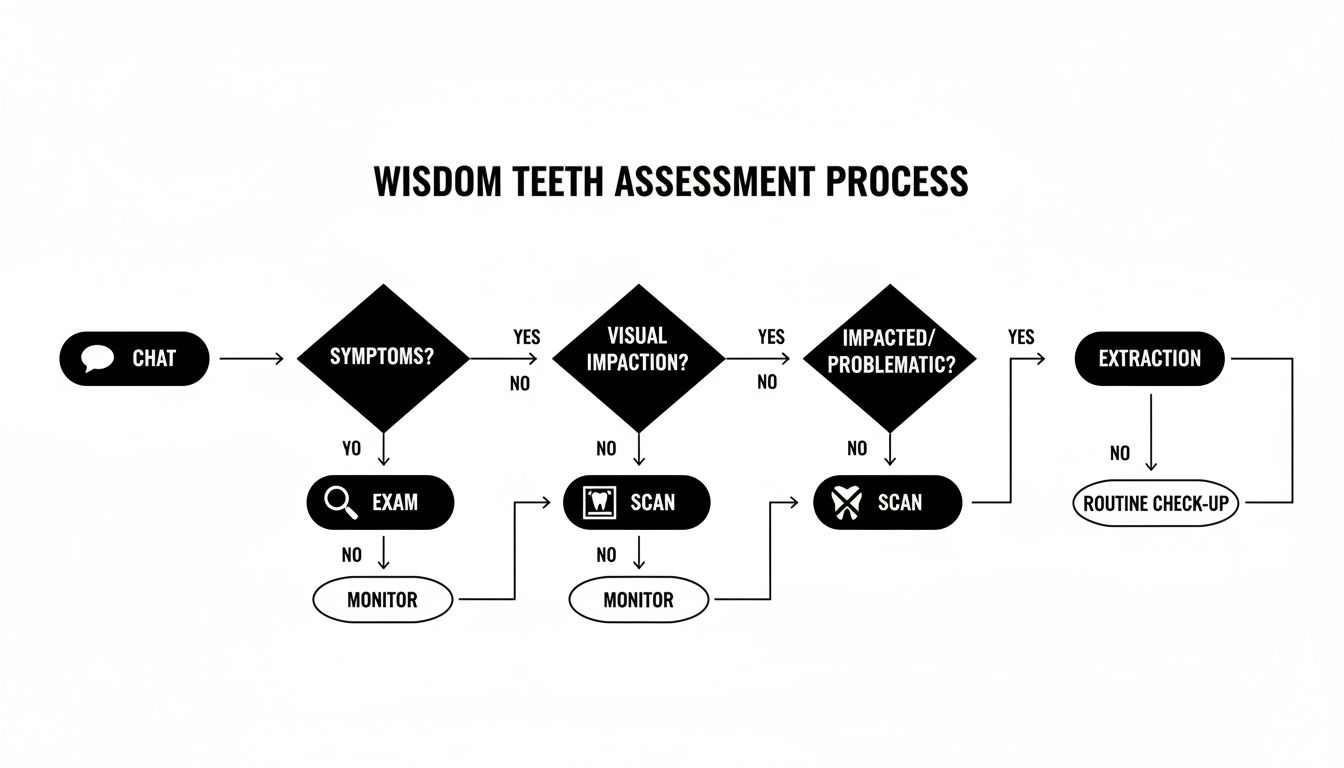
As you can see, the findings from your assessment directly lead us to a recommendation, whether that's simply routine monitoring or scheduling an extraction.
When Is Removal the Right Choice?
At Oasis Smiles Dental, we’ll only recommend removing a wisdom tooth if there’s a clear and definite reason. Your comfort and long-term oral health are what matter most. With the detailed 3D scans and X-rays from your assessment, we can pinpoint specific issues that make removal the safest and smartest choice.
We generally recommend removal when we see: * Impaction: The tooth is trapped in the jaw and can’t grow in properly. It might be pushing sideways into the next molar, which can cause damage, decay, or throw your other teeth out of alignment. * Recurrent Infections (Pericoronitis): If a tooth only partially breaks through the gum, it can create a little flap where food and bacteria get trapped. This often leads to painful, recurring infections. * Cyst Formation: Sometimes, a fluid-filled sac (a cyst) can develop around an impacted tooth. If left alone, this can seriously damage the jawbone and the roots of nearby teeth. * Significant Decay: Wisdom teeth are way back there and can be tricky to clean. If a large cavity develops and it’s too difficult to repair properly, taking the tooth out is often the better long-term solution.
> Think of it like this: if a tree root is growing under your house and starting to crack the foundation, you’d remove it to protect your home. It’s the same idea here. If a wisdom tooth is threatening the health of your other teeth and jaw, removing it protects your overall smile.
Why Monitoring Is Often the Best Option
On the flip side, if your wisdom teeth are healthy and aren't causing you any grief, leaving them be is a perfectly good option. We’ll suggest monitoring your wisdom teeth if they tick a few key boxes.
We’ll typically recommend a "watch and wait" approach when a wisdom tooth has: * Erupted Fully and Correctly: It’s all the way through the gum, sitting in a good, upright position, and working just like your other molars. * No Symptoms or Problems: You aren’t experiencing any pain, swelling, or decay, and it’s not causing any damage to its neighbours. * Good Accessibility for Cleaning: You can easily get your toothbrush and floss around it to keep it clean and healthy.
If we decide to monitor them, it just means we'll keep a friendly eye on them during your regular dental check-ups. This lets us make sure they stay healthy and allows us to step in quickly if any trouble starts down the track. And if removal ever does become necessary, you can learn more about how we handle dental extractions with the highest level of care.
Navigating Your Next Steps and Costs
Okay, so the check-up is done and we’ve had a good look at your X-rays. Now what? The next step is to sit down together and map out a clear plan. Whether we decide to simply monitor your wisdom teeth or plan for their removal, our goal is to make sure you know exactly what to expect and feel confident about the path ahead.
Sometimes, the best move is no move at all. If your wisdom teeth look healthy and aren’t causing any trouble, we might recommend a “watch and wait” approach. This just means we’ll keep a close eye on them during your regular six-monthly check-ups, allowing us to catch any potential issues early before they become bigger problems.
Planning for Wisdom Tooth Removal
If we decide that removal is the best option, don't worry—you have choices. The right approach really depends on how tricky the extraction might be, which is something we can tell from your scans and examination.
Here are the most common ways we handle it: * In-Chair Extraction: For straightforward cases where the tooth has come through the gum properly, we can often remove it right here in the dental chair using a local anaesthetic. It’s a routine procedure, very similar to other tooth extractions. * Referral for Complex Cases: If a tooth is stuck deep in the jawbone, lying on its side, or wrapped around a nerve, we’ll refer you to a trusted oral surgeon. They have the specialised skills and hospital setting needed to handle more complex situations safely. * Sleep Dentistry: We know that dental procedures can be daunting. For anyone feeling anxious, we offer sleep dentistry options. This lets you relax in a calm, twilight state, completely comfortable and unaware of the procedure itself.
> The most important thing is that you feel safe and in control. We’ll explain every option in detail, making sure you’re confident with the plan before moving forward.
Understanding the Costs Involved
We're big believers in transparent, upfront conversations about cost. The price of wisdom tooth removal can vary quite a bit, depending on whether it’s a simple extraction in the chair or a more complex surgical procedure in a hospital.
To give you a general idea, we’ve put together a table of typical costs you might see in Australia. Please remember these are just estimates, and we will always provide you with a precise, personalised quote after your consultation.
#### Estimated Wisdom Tooth Extraction Costs in Australia (2026)
| Type of Extraction | Typical Cost Range per Tooth | Notes | | :--- | :--- | :--- | | Simple (In-Chair) | $250 - $450 | For fully erupted teeth that are easy to access. | | Complex (In-Chair) | $450 - $650 | May involve cutting the gum or removing some bone. | | Surgical (Oral Surgeon) | $600 - $950+ | For deeply impacted teeth, usually done under sedation or general anaesthetic. Hospital fees may be extra. |
These figures are a guide, but there are several ways to help manage the expense.
- Private Health Funds: If your policy has ‘extras’ cover, it will likely provide a rebate for dental extractions. We work with all major health funds and can give you the specific item codes you need to check your level of cover.
- Government Schemes: As part of our commitment to the community, we proudly accept the Child Dental Benefits Schedule (CDBS) and Department of Veterans' Affairs (DVA) cards.
- Payment Options: We want to ensure Tamworth families can get the care they need without delay. We offer flexible payment plans to help spread the cost of treatment over time.
You can find more helpful details about our billing and payment policies by reviewing our general patient information.
Your Partner for Wisdom Teeth Care in Tamworth
When you're dealing with something like wisdom teeth, finding a dental team you genuinely trust is half the battle. You need to feel confident you're getting straight-up, honest advice and care that's as gentle as possible. For more than 20 years, that's what we've aimed to be for families all over Tamworth and the New England region.
We believe the best care comes from blending a personal touch with the right technology. It’s one thing for us to tell you what’s going on, but it’s another for you to see it for yourself. That’s why we use advanced tools like our CBCT and Trios digital scanners. They give us—and you—a crystal-clear picture, helping us make safe, precise decisions together.
Why Tamworth Families Trust Us
Our connection to the community is built on more than just dental work. We're focused on making sure everyone can get great care without the stress.
Here's how we help: * Worried About Your Visit? If the thought of a dental chair makes you anxious, we have sleep dentistry options to help you feel completely at ease. * Pain Can't Wait: We always leave time in our day for same-day emergency appointments, so we can get you out of pain fast. * Making It Affordable: We accept all major health funds, Medicare, and DVA, and also offer flexible payment plans to fit your budget.
> At the end of the day, our goal is your long-term health and peace of mind. We want you to walk out of our practice feeling informed, comfortable, and in complete control of your dental health decisions.
Don't wait until pain forces your hand. Book a consultation with our friendly team today and take a positive step towards looking after your smile.
Answering Your Wisdom Teeth Questions
It's completely normal to have a lot of questions about wisdom teeth. We get them all the time from our patients! To help clear things up, here are some straightforward answers to the most common things people ask us.
When Is the Best Age for a First Wisdom Teeth Check Up?
We really like to see our patients for an initial wisdom teeth assessment in their mid-to-late teens, usually somewhere between 16 and 19 years old. This isn't an arbitrary number; it's the key window where these teeth are starting to make their move.
Getting an early look, often with a simple OPG x-ray, gives us a sneak peek at what’s happening below the gums. It helps us see how your wisdom teeth are developing and if they're heading for trouble, allowing us to make a plan long before they ever cause you pain.
Does a Wisdom Teeth Check Up Hurt?
Not in the slightest. You can expect the check-up to feel just like any other routine dental visit. It’s completely painless. We’ll have a gentle look inside your mouth and then take some quick, comfortable digital X-rays or scans.
> At Oasis Smiles Dental, our entire team is focused on making sure you’re comfortable and relaxed. Your peace of mind is genuinely our top priority.
Will My Health Fund Help Cover the Costs?
Most Australian private health funds that include 'extras' cover will provide benefits for dental work, including check-ups, X-rays, and extractions. How much you get back really depends on your specific policy and your level of cover.
We accept all major health funds here at Oasis Smiles Dental. We can give you the right item codes to check with your insurer beforehand so there are no surprises. We also offer flexible payment options to help with any out-of-pocket expenses.
--- Ready to get some clarity on your wisdom teeth? Don’t wait for an ache to tell you something is wrong. Book a proactive wisdom teeth check up with Oasis Smiles Dental today for total peace of mind. You can schedule your appointment by visiting us online at https://www.oasissmilesdental.com.au.