

Tamworth Laser Dental Whitening: Brighten Your Smile
A lot of people start thinking about whitening just before something important. A wedding. Family photos. A job interview. A school reunion. You catch your smile in the mirror and notice the coffee, tea, red wine, or general dullness more than you used to.
If that sounds familiar, you are not alone. Many patients want a brighter smile, but they also want it done properly. They do not want to waste money on strips that do not significantly shift the colour, and they do not want to risk sore gums or patchy results by guessing their way through it.
Laser dental whitening is the professional option many people ask about when they want faster, more noticeable change under dental supervision. It is designed to lift stain more efficiently than most take-home products, while giving your dentist control over comfort, safety, and shade planning.
For patients in Tamworth and the wider New England region, there is another layer to the conversation. Not every stain is the same. Not every tooth responds the same way. Local issues such as fluorosis can affect how whitening should be planned. That is why a proper assessment matters.
Brighten Your Smile with Laser Dental Whitening
A patient from Tamworth often comes in with a simple question. “Can I brighten my teeth without doing anything drastic?” In many cases, the answer is yes. If your teeth are healthy and you are concerned about yellowing, tea or coffee stain, or a smile that looks flat in photos, laser dental whitening can improve colour without changing the shape of the teeth.
That is why it appeals to people who want a visible change but do not need veneers or crowns.
Professional whitening has become a well-known part of cosmetic dental care in Australia, and patient interest keeps growing because the goal is easy to understand. People want their smile to look cleaner, fresher, and more even, especially before weddings, work events, family photos, or long-overdue check-ups. At Oasis Smiles Dental, we pair that cosmetic goal with a proper clinical assessment, so treatment is chosen for your teeth rather than copied from a box on a pharmacy shelf.
Why patients look beyond shop products
The biggest difference is control.
Whitening strips and store-bought kits are designed for the general public. Each mouth is unique. One person has surface staining from coffee. Another has deeper colour change. Another has fluorosis, which is a concern we do see across Tamworth and the New England region. Those situations should not all be treated the same way.
Professional laser whitening gives your dentist room to adjust the plan. Your teeth and gums are checked first. Existing fillings, crowns, and uneven areas are identified early. If needed, we can also use our digital dental technology at Oasis Smiles Dental to record and assess your starting shade more clearly.
What makes laser whitening worth considering
Patients usually ask about three things. Speed, safety, and whether the result will look natural.
Laser whitening is popular because it can deliver a noticeable lift in a shorter appointment than many take-home options. It is also supervised from start to finish, which helps reduce avoidable gum irritation and allows the treatment to be adjusted if sensitivity is a concern. For nervous patients, that chairside support matters often as much as the cosmetic result.
There is also a practical point that many people do not realise at first. Whitening is not one-size-fits-all. A tooth with fluorosis marks may brighten differently from a tooth stained by tea, and a crowned front tooth will not whiten like natural enamel. That is why a proper consultation is so useful. It helps set realistic expectations before you spend money.
For many patients, a key benefit is simple. They stop hiding their smile in conversations and photos.
How Laser-Activated Whitening Works
Laser whitening sounds more dramatic than it is. The laser does not scrub or blast stains off your teeth. It acts more like an accelerator for the whitening gel.
The easiest way to picture it is this. Think of the gel as the cleaning agent and the laser as the tool that helps it work faster and more efficiently. The whitening happens because the gel breaks down stain molecules, not because the laser cuts into the tooth.
The simple version
Your dentist places a professional whitening gel on the front surfaces of the teeth. That gel contains peroxide. When activated, it releases reactive oxygen that helps break apart the dark compounds causing the tooth to look stained.
Those dark compounds are often called chromogens. You do not need to remember the term. What matters is this. They are the molecules making the tooth look darker than you want, and the whitening process helps break them down.
What the laser is doing
Different laser systems work in different ways, but the basic goal is the same. The light energy activates the gel so the whitening reaction happens more quickly than it would on its own.
One well-described example is the Er:YAG laser. Fotona explains that this wavelength is highly absorbed by the water in the bleaching gel, allowing gel temperatures of 50 to 60°C and speeding peroxide breakdown into active oxygen radicals. In that system, whitening can be 5 to 10 times faster than non-laser methods, with sessions completed in 20 to 30 minutes and results of up to 7 to 10 shade improvements (Er:YAG laser whitening details).
That does not mean every patient gets the maximum change. Teeth differ. Stains differ. But it explains why laser systems are often chosen when speed matters.
Why this matters in real life
A non-laser whitening product usually relies on the gel working by itself over a longer period. Laser activation helps the chemical reaction happen in a more concentrated clinical setting.
That can be useful for people who:
- Have limited time
- Want one appointment rather than repeated home use
- Prefer a dentist to monitor the process
- Need a treatment plan built around existing dental work
A modern clinic may combine this with digital records and imaging to track your starting shade and plan your target result. If you want to see the sort of tools used in advanced care, this overview of dental technology shows the kinds of systems that can support more precise planning.
A common point of confusion
Some patients think laser whitening means the tooth is being heated directly. In properly managed treatment, the system is chosen and used to activate the gel while protecting the tooth and surrounding tissues.
That is why whitening should start with an exam, not with a product. A dentist checks for decay, leaking fillings, exposed roots, gum inflammation, and other issues that can make whitening uncomfortable or unsuitable.
> Key takeaway: The gel does the whitening. The laser helps the gel work faster and more effectively.
The Patient Journey at Oasis Smiles Dental
If you have never had in-chair whitening before, the process usually feels more structured and calm than people expect. Most of the reassurance comes from knowing what will happen before anyone starts.
The first appointment
The visit begins with a conversation, not a laser. The dentist looks at your teeth, your gums, and any existing dental work such as fillings, crowns, veneers, or bonding. Whitening changes natural tooth structure, not artificial materials.
Shade planning is part of that first step too. A clinic may use tools such as a Trios digital scanner to record the current colour and help compare changes more precisely. That is especially helpful when a patient says, “I want them whiter, but still natural.”
You may also talk through practical details such as timing before an event, previous sensitivity, and whether you are also considering orthodontic or restorative treatment later. For general preparation advice and what to bring to a visit, patient resources like this patient information page can help you understand what to expect.
Before the whitening starts
The treatment room setup is about protection and control. The teeth are cleaned if needed so surface plaque does not interfere with the gel. Then the lips and gums are isolated.
This part is important. The whitening gel is powerful, so the dentist creates a barrier to keep soft tissues protected while the visible tooth surfaces are treated.
A typical sequence may include:
- Checking the starting shade: This gives a realistic reference point.
- Protecting the gums: A barrier is placed so the gel stays where it should.
- Applying the whitening gel: The gel is spread carefully across the teeth being treated.
- Activating in short intervals: The laser is used in controlled passes rather than one long exposure.
During the session
Most patients describe the procedure as manageable. You are usually lying back comfortably while the team monitors the gel and laser timing.
If you are an anxious patient, a calm environment makes a big difference. Some clinics also offer sleep dentistry options for people who feel tense in the chair or who have had difficult dental experiences in the past. That can be especially helpful if whitening is being coordinated with other treatment on the same day.
Rather than one continuous burst, the laser is often used in brief cycles. Between cycles, the dentist checks progress, reapplies gel if needed, and makes sure everything remains comfortable.
> Practical note: Patients often worry they will not be able to signal if something feels too strong. In a supervised whitening appointment, the team can pause and adjust as needed.
Right after treatment
At the end, the protective barriers are removed and the teeth are rinsed. You are shown the immediate result, although the final settled shade may look a little different once the teeth rehydrate.
The team then goes through aftercare. This is usually simple but important.
Common advice includes:
- Avoid strong staining foods and drinks at first. Coffee, tea, red wine, curry, and dark sauces can all work against a fresh whitening result.
- Use gentle oral care. A soft toothbrush and non-abrasive products help.
- Expect temporary sensitivity if it occurs. This is usually short-lived and easier to manage when anticipated.
- Keep up routine cleans and check-ups. Whitening looks better and lasts better on a healthy mouth.
What the experience feels like overall
For most patients, the biggest surprise is how uneventful the appointment feels. The fear often comes from the word “laser,” but in practice it is usually a carefully paced cosmetic treatment with a lot of attention to comfort.
The other surprise is that whitening is rarely just about “white teeth.” It often starts a broader conversation about smile balance. If one tooth is darker than the others, if old fillings stand out afterwards, or if crowding affects how the smile reads, those details become easier to see once the teeth are brighter.
That is why the best whitening appointments feel personalised rather than rushed. The goal is not to make teeth lighter. The goal is to make the smile look cleaner, healthier, and more even in a way that suits your face.
Who is a Good Candidate for Laser Whitening?
Laser whitening is not for every mouth, and that is a good thing. A careful dentist says yes when the treatment fits, and no when another approach would be safer or give a better cosmetic result.
Good candidates usually have this profile
In general, laser dental whitening suits people with healthy natural teeth and gums who want to reduce common staining from food, drinks, smoking, or age-related yellowing.
You may be a strong candidate if:
- Your teeth are mostly natural and free from major untreated decay
- Your gums are healthy or can be stabilised first
- You want quicker results than trays or strips usually offer
- You understand that whitening improves colour, not shape or alignment
- You are happy to have a dental assessment before treatment
People often do well when the stain is mostly external or generalised across the smile, rather than being limited to one damaged tooth.
When whitening may need more caution
There are situations where a dentist may postpone whitening, modify it, or steer you toward a different option.
That often includes:
- Active decay
- Gum disease or inflamed gums
- Very sensitive teeth
- Exposed root surfaces
- Visible crowns, veneers, or tooth-coloured fillings at the front
- Internal discolouration that may not respond evenly
For younger patients, pregnant patients, or people with special medical considerations, the dentist may advise waiting or choosing a different cosmetic plan.
A local New England issue to know about
For patients in Tamworth and the New England region, fluorosis can be part of the assessment. Verified background data notes that patients in this area may have a higher regional prevalence of fluorosis, and Australian studies indicate that while laser whitening can still be effective, it requires professional assessment so it does not worsen enamel microhardness concerns over time (fluorosis and enamel safety considerations).
That point matters because fluorosis is not just “stain.” It can involve changes in the enamel itself. Some fluorosis-marked teeth whiten well. Others need a more careful plan.
> Key takeaway: If your teeth have white flecks, brown patches, or an uneven enamel look, do not assume whitening will behave like it does in online before-and-after photos.
A quick self-check
Ask yourself these questions before booking:
| Question | Why it matters | |---|---| | Are my teeth natural in the visible smile area? | Crowns and veneers do not whiten like natural enamel. | | Do I get pain from cold drinks already? | Sensitivity should be discussed first. | | Have I been told I grind my teeth or have gum issues? | The mouth may need stabilising before cosmetic treatment. | | Do my teeth have patchy marks from childhood? | Fluorosis or other enamel conditions may change the approach. |
A proper consultation turns this from guesswork into a clear yes, no, or not yet.
Laser Whitening vs Other Whitening Methods
Not all whitening methods aim for the same result. Some are built for convenience. Some are built for speed. Some are built for stronger in-chair change under professional supervision.
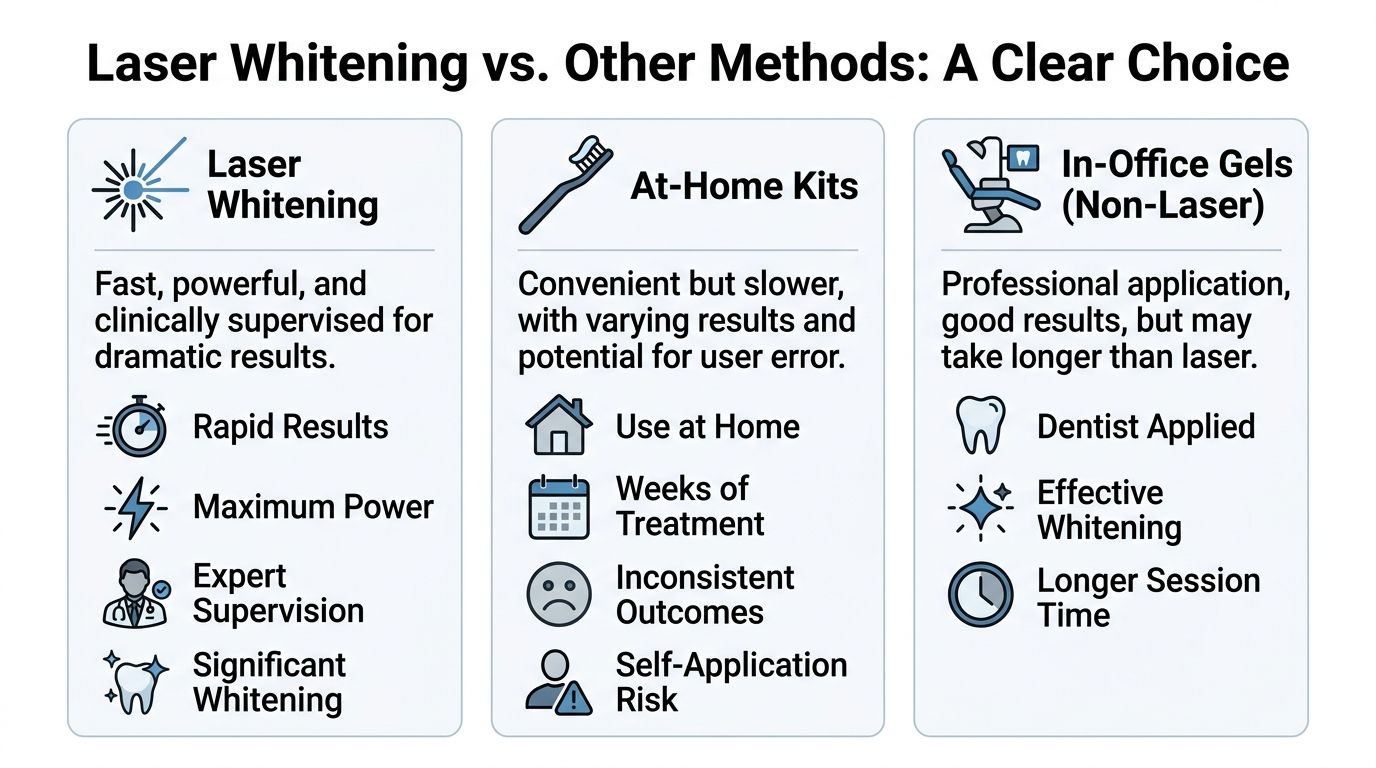
The quickest side-by-side view
| Method | Best for | Main trade-off | |---|---|---| | Laser whitening | Fast, professionally supervised whitening | Higher upfront cost | | In-office non-laser gel whitening | Professional care without laser activation | May take longer or produce a less dramatic immediate shift | | At-home kits | Lower cost and convenience | Slower, less controlled, more variable results |
Laser whitening
Laser systems are chosen when the goal is stronger in-chair performance. One verified source notes that KTP laser (532 nm) systems can deliver up to 10 shade improvements in a single session and show 2 to 3 times higher brightness change than many diode systems, while also working significantly faster than non-laser alternatives (KTP laser whitening evidence).
That sounds technical, but the patient-facing meaning is simple. Laser systems can create a stronger reaction in the whitening gel, which can mean a faster and more noticeable result in one visit.
Laser whitening is often the best fit when:
- You have an event coming up
- You prefer treatment under close supervision
- You want the strongest in-chair option available to you
- You are already discussing broader smile improvements
If you are comparing aesthetic treatments more broadly, this page on cosmetic dentistry services helps place whitening in the wider context of smile design.
In-office whitening without laser activation
Non-laser in-chair whitening still has advantages. You are in a controlled clinical setting, the gums are protected, and the treatment is performed by professionals.
For some patients, this is enough. It may suit someone who wants a professional option but is not chasing the fastest possible treatment style. It can also be a useful alternative if the dentist thinks another in-chair protocol is better matched to the enamel, the stain type, or sensitivity history.
The key point is that “professional whitening” is broader than one machine. The right choice depends on your teeth.
At-home trays and strips
At-home products appeal because they are easy to buy and cost less upfront. For mild surface stain, they can be reasonable.
But they come with clear limits:
- You wear the product over days or weeks
- Application can be uneven
- The active ingredients are usually less aggressive than in-chair systems
- There is no dentist watching how your teeth and gums respond in real time
For people with crowns, fluorosis, gum recession, patchy enamel, or unexplained discolouration, home whitening often becomes frustrating. It may lighten part of the smile while leaving another part unchanged.
What usually matters most to patients
Patients rarely ask for “the best whitening technology” in the abstract. They ask practical questions.
#### If speed matters
Laser whitening usually leads the pack because activation is faster and more powerful in the chair.
#### If budget matters first
At-home kits usually cost less upfront, but they also ask more of the patient in time, consistency, and tolerance for mixed results.
#### If your mouth is complicated
Professional care matters more than the method label. Existing restorations, fluorosis, sensitivity, and orthodontic history can all affect the choice.
> Decision tip: Choose the method that fits your teeth, not just the method with the loudest advertising.
Results, Risks and Cost Considerations
A good whitening result should look brighter, healthier, and believable for your face. In Tamworth, that often means aiming for a cleaner, fresher smile rather than chasing the brightest shade on a chart.
What results look like in real life
Laser whitening can lift colour noticeably in a single visit, but the final change is not identical from one person to the next. Teeth respond differently for the same reason different fabrics take up dye differently. Uniform enamel tends to whiten more evenly. Teeth with fluorosis, white spots, old fillings, crowns, bonding, or patchy wear can respond in a less predictable way.
That matters in the New England region, where enamel changes and fluorosis are common enough that a quick look in the mirror does not always tell the full story.
At Oasis Smiles Dental, this is why planning matters before the gel goes on. A close exam, photos, and where needed a digital record with Trios scanning help show whether laser whitening is likely to give an even result or whether another approach will be more sensible.
Teeth can also look extra bright immediately after treatment because they are slightly dehydrated. That early colour usually settles over the next few days. It is normal.
How long results usually last
Whitening is best understood as maintenance, not a once-only permanent change. The colour can hold well, then gradually soften over time with coffee, tea, red wine, smoking, ageing, and everyday wear.
Some patients keep a brighter result for quite a while. Others notice the shade drifting sooner. The main difference is usually your starting enamel, the type of staining, and how well the result is maintained at home.
That is why top-up planning matters. A dentist-supervised review can be more useful than repeating full treatment too soon.
The main risks to know
The common side effects are usually temporary and manageable:
- Tooth sensitivity for a short time after treatment
- Mild irritation if whitening gel touches the gums
- Uneven colour where crowns, fillings, veneers, or bonding do not change with whitening
- Patchiness showing up more clearly at first in teeth affected by fluorosis or enamel defects
Professional care reduces these problems because the teeth and gums are isolated carefully, the gel is placed precisely, and the treatment time can be adjusted if your teeth start to react.
For anxious patients, comfort matters as much as colour. If dental treatment makes you tense, Oasis Smiles can discuss supportive options, including sleep dentistry where appropriate, so the appointment feels manageable rather than stressful.
What the cost usually covers
Fees vary by clinic, technology, and how much preparation your teeth need first. A simple, healthy smile is quicker to assess and treat than one with stain patterns, restorations, sensitivity, or signs that the enamel needs closer review.
You are not only paying for whitening gel. You are paying for diagnosis, protection of the gums, controlled application, monitoring during treatment, and advice about how to keep the result looking good. That is the difference between buying a product and having a treatment planned around your mouth.
If you want a clearer idea of what laser whitening may involve for your teeth, the most useful next step is to book a whitening consultation with Oasis Smiles Dental in Tamworth.
A straightforward consultation can save a lot of guesswork. It can also tell you early whether laser whitening is likely to work well on its own, or whether your smile would benefit from a different plan.
Your Next Steps for a Brighter Smile in Tamworth
If you are thinking about laser dental whitening, the next step is not choosing the whitest shade on a chart. It is finding out whether your teeth are suitable and what kind of result makes sense for your smile.
That matters even more if you are also considering aligners, crowns, veneers, or other cosmetic work. Whitening changes the colour of natural teeth, so timing becomes important. Verified guidance for full smile makeovers notes that planning matters when whitening is done around orthodontic or restorative treatment, and that treatment should be sequenced carefully to keep results even and predictable (whitening and smile makeover sequencing).
What to do before you book
A simple checklist helps:
- Look at your smile in natural light: Are the teeth uniformly dark, or patchy?
- Note any existing dental work: Fillings, crowns, bonding, and veneers all matter.
- Think about your goal: Brighter for an event, or part of a larger smile plan?
- Mention sensitivity early: This changes how the treatment may be approached.
Why local planning matters
For Tamworth and New England patients, local knowledge is useful. Enamel changes, fluorosis concerns, and mixed restorative histories are not unusual. A dentist who sees these issues regularly can guide you away from wishful thinking and toward a result that suits your mouth.
If you are ready to take the practical next step, the simplest option is to arrange a consultation and ask direct questions about suitability, timing, comfort, and maintenance. You can do that through the clinic’s contact page.
A good consultation should leave you with a clear plan. Sometimes that plan is laser whitening. Sometimes it is cleaning first, replacing an old crown later, or scheduling whitening at a more strategic point in a smile makeover. Clear advice is part of the value.
Frequently Asked Questions about Laser Whitening
Does laser whitening hurt
Most patients do not describe it as painful. The more common issue is temporary sensitivity, either during treatment or shortly after. It often feels like brief zings from cold air or cold drinks rather than ongoing pain.
A proper assessment helps reduce the chance of this. If your teeth are already sensitive, tell the dentist before treatment so the plan can be adjusted.
How long do I need to avoid coffee and red wine afterwards
Dentists often recommend a “white diet” immediately after whitening. The exact timeframe can vary by patient and protocol, so it is best to follow the instructions you are given on the day.
In practical terms, avoid strongly coloured foods and drinks straight after treatment unless your dentist says otherwise. If you do have something staining, rinse with water soon after.
Can laser whitening work on crowns or fillings
No. Whitening changes natural tooth colour, not the colour of crowns, veneers, or fillings. That is why existing dental work must be checked before treatment.
If a front crown matches your current darker teeth, whitening the natural teeth may make that crown stand out more. In those cases, the dentist may plan whitening first and replacement of visible restorations later if needed.
Is laser dental whitening safe
When it is performed after a proper dental check and with professional supervision, it is designed to be a controlled cosmetic treatment. The key is not the machine alone. The key is selecting the right patient, protecting the gums, and using the right protocol.
Will my teeth stay white forever
No. Teeth keep living in the world. Coffee, tea, red wine, smoking, ageing, and diet all affect how long the result holds.
Good brushing, regular cleans, and sensible stain management can help the brighter shade last longer.
What if my teeth have patchy white or brown marks
That can happen with fluorosis, past enamel changes, or other developmental issues. It does not automatically rule out whitening, but it does mean you should not self-treat without advice.
Patchy enamel often needs a more careful cosmetic plan than standard staining.
---
If you are ready to talk through laser whitening with a local team, Oasis Smiles Dental can help. The practice has served Tamworth and the New England region for over 20 years and is located at Shop 15/1 Piper Street, near Northgate Shopping Centre. They offer advanced dental technology, sleep dentistry options for anxious patients, and full care that can coordinate whitening with Invisalign, crowns, and broader smile treatments. The clinic is open Monday to Friday. To arrange a consultation, visit the website or contact the practice directly.