

Medicare Dental Scheme: A Tamworth & New England Guide 2026
A lot of parents in Tamworth know this feeling. Your child mentions a sore tooth after dinner, or the school holidays arrive and you realise it has been a while since their last check-up. The next thought is usually cost.
For many families, the phrase medicare dental scheme sounds helpful but vague. Does Medicare cover children’s check-ups? Is there a form to fill in first? Can you use it at a local clinic, or only through a public waiting list?
Those are fair questions. Government dental support in Australia can feel harder than it should be, especially when you are already juggling school runs, work, sport, and the general busyness of family life in New England.
This guide is written for local families who want plain answers. It is not legal language, and it is not a generic national summary. It is a practical explanation of what these dental schemes usually mean, what to check, and how families can use them confidently in Tamworth. If you want a starting point for general clinic paperwork and appointment basics, the patient information page is a useful first stop.
Understanding Your Family's Dental Costs in Tamworth
A child’s dental visit can be simple. A check-up, a clean, maybe a fluoride treatment, and everyone goes home relieved.
It can also feel uncertain before you book. Parents often ask whether they should wait, whether a baby tooth problem matters, or whether the visit will lead to a bigger bill than expected.

The local reality for families
In Tamworth and the wider New England region, dental care is not just about treatment. It is also about timing, travel, school schedules, and finding a clinic that explains things clearly.
A family in town might have more flexibility than a family coming in from a surrounding area. If you need to organise a whole morning around one appointment, uncertainty about cost becomes a bigger issue.
That is why people often search for the term medicare dental scheme even when they are really asking a more practical question. They want to know whether there is any government help for their child’s visit.
Why this matters before a problem gets worse
Small dental issues are easier to manage when they are found early. A routine exam can pick up plaque build-up, early decay, or brushing problems before a child starts waking at night with pain.
Parents also tell us they avoid booking because they are worried about surprise fees. That hesitation is understandable. It is also one reason many eligible families miss support that is already available.
> Tip: If you are unsure whether your family qualifies for government-funded dental care, check first before putting off the appointment. A quick eligibility check can remove a lot of stress.
A simpler way to think about it
Instead of seeing Medicare dental support as a complicated policy, it helps to think of it as a possible funding pathway for certain people and certain treatments.
For families, the most important pathway is often the Child Dental Benefits Schedule, usually called the CDBS. That is the scheme most parents mean when they ask whether Medicare covers a child’s dentist visit.
Adults sometimes assume there is one broad Medicare dental system for everyone. There is not. That confusion causes missed opportunities, especially for children.
The good news is that once you know which scheme applies to your situation, the process becomes much easier to follow.
Demystifying Australia's Public Dental Schemes
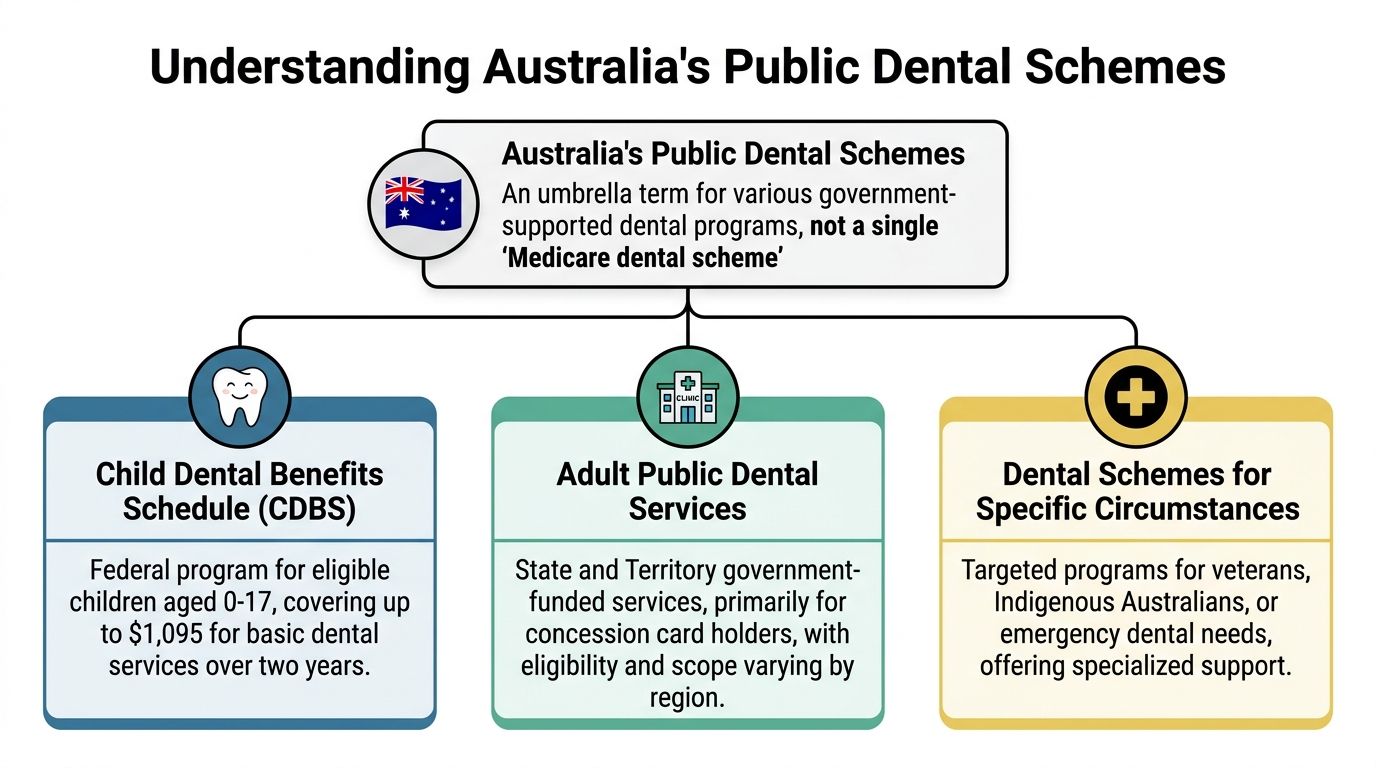
The phrase medicare dental scheme makes it sound like there is one card, one rulebook, and one set of benefits.
That is not how Australia’s public dental support works. A better comparison is a wallet with different cards inside. Each card helps with a different situation, and individuals typically qualify for some of them.
The three main buckets
When local families ask about government dental help, the answer usually falls into one of these categories.
- Child-focused federal support: This is the Child Dental Benefits Schedule, which sits under Medicare for eligible children.
- State-run public dental services: These are usually aimed at adults with concession eligibility, urgent care needs, or people who meet state service criteria.
- Special programs: These can include DVA dental arrangements, support linked to specific health needs, and other targeted pathways.
If you mix these together, the rules seem messy. If you separate them, the system starts to make sense.
Child dental support through Medicare
For many families, this is the most relevant part of the medicare dental scheme conversation.
The CDBS is for eligible children. It covers a range of basic dental services, not every possible treatment. Think of it as support for the essentials that help keep children’s mouths healthy and catch problems early.
Common examples can include:
- Routine examinations
- Professional cleaning
- X-rays when clinically needed
- Fillings
- Fissure sealing
- Extractions when appropriate
It is not designed as a blanket dental membership for every service a child might ever need.
Adult public dental services
Adults are often surprised to learn that Medicare usually does not provide general dental cover in the way it covers GP visits.
For adults, public dental help is more often delivered through state systems. Eligibility can depend on concession status and local service rules. Access can also vary by area.
That is why one adult may qualify for public treatment while another may need to rely on private care, DVA support, or payment plans.
Schemes for specific circumstances
Some dental support sits outside the standard family conversation.
A veteran may use DVA arrangements. A patient with sleep-related breathing issues may be looking into an oral appliance pathway. Someone with an urgent dental problem may enter the system through an emergency or priority process rather than a routine check-up.
> Key takeaway: When someone says “Does Medicare cover dental?”, a more precise question is, “Which dental program applies to my situation?”
Why the wording causes confusion
The term medicare dental scheme is common because people want a simple label. The system itself is not simple.
A parent might search that phrase while needing CDBS. An older patient might use the same phrase while asking about DVA. Another person might be looking for public adult emergency care.
That is why it helps to stop using the broad label for a moment and ask three smaller questions instead:
- Who needs treatment?
- What kind of treatment is it?
- Which program matches that situation?
For most local families with children, the next place to focus is the CDBS.
Is Your Child Eligible for the Child Dental Benefits Schedule
The Child Dental Benefits Schedule is the clearest example of a medicare dental scheme that directly helps families.
It is also one of the most misunderstood. Some parents think they are not eligible because they have never claimed before. Others assume their child’s dentist will tell them automatically. Many do not realise the scheme exists.
What the CDBS is
The CDBS is a Medicare-supported program for eligible children aged 0 to 17. It can provide up to $1,095 over two years for basic dental services, according to this summary of CDBS eligibility and regional uptake.
That figure matters because it gives families a practical budget to work with for preventive and routine care.
The same source notes that 1.2 million children were eligible nationally in 2024, yet New England uptake was just 32%, which suggests many regional families are missing support they may qualify for.
Who is usually eligible
Eligibility is generally tied to a child’s age and the family receiving a relevant government payment.
In plain language, parents usually need to check whether:
- Their child is within the eligible age range
- Their child is linked to Medicare
- The family receives a qualifying payment for the child
The easiest way to confirm is through official Medicare channels rather than guessing. Eligibility can change over time, so a child who was not eligible before may become eligible later, and the reverse can also happen.
What kinds of treatment are covered
The CDBS is focused on basic dental care. That usually includes the services parents need most often for school-age children.
A child might use the scheme for:
- Check-ups and oral exams
- Cleans
- X-rays
- Fluoride applications
- Fissure sealants
- Fillings
- Root canal treatment on suitable teeth
- Extractions
This is why the scheme is so valuable. It is not only for children with pain. It can help families stay ahead of problems through regular care and prevention. Many of the most common children’s visits sit under the same broad category as children’s dentistry and preventive care.
What is not covered
Confusion often starts here.
The CDBS does not cover every treatment a dentist provides. In general, parents should not expect it to cover:
- Orthodontics such as braces or aligners
- Cosmetic treatments
- Hospital costs
- Services outside the approved basic dental list
A useful way to think about it is this. If a treatment is mainly about prevention, routine care, or straightforward restoration, it is more likely to fall within the scheme. If it is specialised, cosmetic, or orthodontic, it usually will not.
Why local families miss out
The regional gap is not just about eligibility. It is also about awareness and access.
A parent may have a child who qualifies, but they may not know how to check the balance, whether the local clinic accepts the scheme, or whether the visit can be bulk billed. If you live outside town, a delayed booking can turn a simple clean into a bigger problem.
That is one reason the low New England uptake matters. It suggests the barrier is often not the existence of the scheme. The barrier is understanding how to use it.
> Practical tip: If your child is eligible, use the benefit for routine care before there is a problem. The scheme is far more helpful as a prevention tool than as a last-minute rescue.
A simple self-check
Parents can use this quick filter before making enquiries:
| Question | If the answer is yes | | :------- | :------------------- | | Is my child under 18? | Keep checking | | Is my child on Medicare? | Keep checking | | Do we receive a qualifying government payment for the child? | Eligibility may apply | | Do we want basic dental care rather than braces or cosmetic work? | The CDBS may be relevant |
This is only a guide, not a formal approval. Medicare will confirm the actual status and available balance.
The biggest misunderstanding
Many parents assume they need to use the whole amount at once, or that using part of it is somehow wasteful.
That is not how most families use the scheme. It is often used across ordinary visits over the two-year period. A check-up now, a clean later, a filling if needed, then another review.
That staged use is often the smartest approach because it supports regular care instead of waiting until treatment becomes more involved.
Your Step-by-Step Guide to Using the CDBS in Tamworth
Knowing that your child might qualify is one thing. Using the scheme is where many parents get stuck.
The process is usually much simpler once you break it into small steps.

Step one, confirm eligibility and balance
Start with Medicare, not the clinic.
You want to know two things:
- Is your child currently eligible?
- How much of the benefit is still available?
Parents often check this through their Medicare online services or by phone. If you are unsure how to access the account, have your Medicare card details ready before you begin.
This first check matters because it turns a vague hope into a clear answer.
Step two, book the right kind of appointment
Once eligibility is confirmed, book a routine check-up or the specific appointment your child needs. If your child has not been seen in a while, a standard examination is usually the right starting point.
If your child is nervous, mention that when booking. Reception staff can note it so the team is prepared to pace the visit gently.
For basic preventive care, families often begin with something like a dental check-up appointment, then discuss any next steps after the exam.
Step three, ask the practical questions before the day
Parents feel more relaxed when the admin side is clear.
Before the appointment, ask:
- Do you accept the CDBS for eligible children?
- Can you explain any likely gap before treatment starts, if one applies?
- What should I bring on the day?
Even if you have used Medicare for medical appointments before, dental claiming can feel different. Asking upfront avoids surprises.
Step four, bring the essentials
On the day, keep it simple.
Bring:
- Your child’s Medicare details
- Any concession or related information if relevant
- A list of medications or health conditions
- Notes about the problem, if your child has pain or sensitivity
If your child gets anxious, also bring whatever helps them feel secure. That might be headphones, a comfort item, or just a favourite distraction on your phone or tablet.
> Tip for nervous kids: Tell the receptionist and the dentist if your child has had a difficult dental visit before. That changes how the team approaches the appointment.
Step five, approve treatment with a clear understanding
A check-up and a course of treatment are not exactly the same thing.
After the exam, the dentist should explain what your child needs, what may be covered under the CDBS, and whether the available balance is likely to cover it. If more than one visit is required, that can usually be planned out clearly.
Parents do not need to pretend they understand every dental term. Ask for the plain-English version.
Step six, understand bulk billing and gaps
Many parents use the phrase “bulk billed” to mean “no out-of-pocket cost at the time.”
That can be true for eligible CDBS services up to the available benefit cap, but it is still worth confirming exactly how the clinic handles claiming and whether a gap applies for any proposed treatment. The important point is that the claim is linked to your child’s remaining CDBS balance, not an unlimited pool of cover.
A simple example
A Tamworth parent confirms their child is eligible, books a routine exam, brings the Medicare details, and the clinic processes the approved CDBS items against the remaining balance.
That is the basic flow. No special insider knowledge is required. The hardest part is usually taking the first step and checking eligibility.
Comparing Medicare Dental Schemes and Private Health Cover
Public dental support and private health insurance often get lumped together. They are not the same thing.
A medicare dental scheme is usually a targeted government support pathway. Private health extras is a policy you choose and pay for, with its own limits and rules.
The core difference
Government dental schemes are designed to help specific groups or situations.
Private health cover is broader in concept, but it is still limited by your policy details. One family might use the CDBS for a child’s check-up while also holding extras cover for other household dental needs.
That means the two options can sit side by side rather than compete.
CDBS vs. Private Health Insurance at a Glance
| Feature | Child Dental Benefits Schedule (CDBS) | Typical Private Health 'Extras' Cover | | :------ | :------------------------------------ | :----------------------------------- | | Who it is for | Eligible children | People who choose and pay for a policy | | How access works | Based on government eligibility | Based on membership and policy terms | | Main purpose | Basic dental care for eligible children | Broader support depending on cover level | | Common covered services | Preventive and basic restorative treatment | Varies by insurer and level of cover | | Orthodontics | Generally not included | Sometimes included on higher-level cover | | Waiting periods | Not usually thought of in the same way as private cover | Common on many policies | | Limits | Set by the scheme and remaining balance | Set by annual limits, sub-limits, and policy rules | | Cost to join | No separate insurance premium | Ongoing premium paid by the member |
When each option makes sense
The CDBS makes sense when your child is eligible and needs routine or basic treatment.
Private extras may make more sense when a family wants wider support over time, especially for services outside public schemes. This can include more complex restorative work, depending on the policy. Families exploring treatments in that category often compare options around services such as restorative dentistry.
Where people get mixed up
The most common misunderstanding is thinking private cover automatically beats public support.
That is not always true. If a child is CDBS-eligible, it can be a very practical first funding option for basic care. On the other hand, private extras may help in areas the CDBS does not touch.
> Key takeaway: Public schemes are about eligibility. Private cover is about the policy you buy. One is not a better version of the other.
A balanced way to decide
Ask these questions:
- Is my child eligible for government support right now?
- Do we need only basic care, or something outside that scope?
- Does our private policy include dental benefits we will use?
That approach is better than choosing based on assumptions or advertising language.
Frequently Asked Questions about Dental Schemes in New England
Families often understand the basics of the CDBS, then hit a second wave of questions. Those questions usually involve adults, veterans, bigger treatments, or specialised appliances.
Does Medicare cover dental for adults in the usual sense
Usually, no. Medicare does not generally work as broad routine dental cover for adults.
Adult support is more often tied to state public dental services, concession pathways, DVA arrangements, or very specific circumstances. That is why adults are often disappointed when they expect the same setup children can access through the CDBS.
Why are crowns, implants, and braces usually not covered by a medicare dental scheme
Because public dental schemes are usually designed around essential and targeted care, not every treatment available in private dentistry.
Braces are generally outside the CDBS because orthodontics is not its focus. Implants and many crown-related situations sit outside standard Medicare dental support for similar reasons.
This does not mean those treatments are unnecessary. It means families need to look at other funding pathways, including private health cover, payment options, or treatment staging.
What about DVA card holders
DVA dental support is separate from the CDBS.
Veterans and eligible dependants often have a different claiming pathway, and the rules can depend on card type and treatment category. The main practical point is that patients should tell the clinic early that they are using DVA, so staff can explain the likely claiming process and any approvals needed.
Is there Medicare help for dental sleep apnoea appliances
In some cases, yes. This is one of the more specialised areas people do not hear much about.
The 2024 to 2025 Medicare Dental Sleep Apnoea Appliance Scheme expansions reimburse up to 85% for oral appliances, according to this article discussing the scheme expansion and regional approval issues. The same source notes that the Tamworth region’s approval rate is 65% due to specialist shortages.
That explains why patients can feel stuck even when a scheme exists on paper. Access still depends on assessment, referral pathways, and available specialists.
Why does sleep apnoea appliance access feel so uneven locally
Because a funding pathway and a straightforward patient journey are not always the same thing.
A patient may still need diagnosis, documentation, and the right clinical support before an oral appliance can move forward. Regional shortages make the process slower and more confusing than many people expect.
This issue can be especially frustrating for people who want an alternative to CPAP or who are dealing with fatigue, snoring, and disrupted sleep.
Can veterans use both Medicare-related and DVA-related pathways
Sometimes people are eligible under more than one system, but that does not always mean every cost disappears.
The same source notes that low-income dual-eligible Medicare and DVA veterans can face out-of-pocket gaps. In real terms, that means a patient may assume they are fully covered when there are still parts of the process or appliance pathway that need clarification.
> Practical reminder: If you are a veteran, or helping a veteran family member, mention both Medicare-related eligibility and DVA status when making enquiries. It can affect how the administrative side is planned.
Does every clinic handle these schemes the same way
No. Clinics differ in the schemes they accept, the treatments they provide, and how they manage claiming.
That is especially true in more specialised areas such as oral appliance therapy for sleep apnoea. A general family check-up is one thing. A medically linked appliance pathway is another.
What should I ask before booking
These questions save time:
- Do you accept the scheme I plan to use?
- Is my treatment likely to need prior approval or extra documentation?
- Will I receive a clear explanation of any likely gap before treatment starts?
- If my case is more complex, do I need a referral first?
Those questions work for CDBS, DVA, and sleep-related appliance enquiries.
What is the safest way to avoid confusion
Do not rely on broad phrases like “Medicare covers dental” or “I have veteran cover, so it should be fine.”
Use specific wording instead. Say whether you are asking about CDBS, DVA dental, or a sleep apnoea oral appliance. The more precise you are, the easier it is for a clinic to give you a useful answer.
Taking the Next Step for Your Family's Dental Health
For local families, the biggest opportunity is often simple. Check whether your child can use the Child Dental Benefits Schedule, and do it before a minor issue turns into a stressful one.
Many parents in Tamworth and New England assume they will sort dental care out later. Later tends to arrive when a child is in pain, a school day is disrupted, or a parent is suddenly trying to understand claiming rules under pressure.
A medicare dental scheme can be helpful, but only when you know which scheme applies and how to use it. For children, that usually means the CDBS. For veterans or patients with specialised needs, it means asking the right questions early and confirming the pathway before treatment starts.
If you are unsure where your family stands, start with the practical basics:
- Check Medicare eligibility
- Confirm the available balance if your child qualifies
- Book a routine visit rather than waiting for pain
- Ask upfront how claiming works
That small amount of preparation can make the whole process feel much more manageable.
---
If you want friendly help working out your family’s next step, contact Oasis Smiles Dental. The team supports Tamworth and New England families with Medicare and DVA enquiries, routine children’s dental care, and clear guidance on what to bring and what to expect before you book.