

Medicare Dental Benefits: A Simple Guide for AU (2026)
If you're in Tamworth and searching for Medicare dental benefits, you're probably trying to answer a very practical question. Can Medicare help with this dental bill, or not?
The answer often feels frustratingly unclear. A parent wants to book a check-up for their child. An adult gets told they need a crown. Someone is preparing for hospital treatment and hears they might need a dental clearance first. The rules sound similar, but they aren't.
A lot of Australians miss out on help because they don't know the narrow situations where Medicare may contribute to dental care linked to medical treatment, as explained on the CMS dental coverage guidance. That confusion is common, and it matters.
This guide is written the way a practice manager would explain it at the front desk. Plain language. Real examples. No jargon where it can be avoided. If you live in Tamworth or the New England region, the aim is to help you understand what Medicare dental benefits mean for your family, when government help may apply, and what your next steps are when it doesn't.
Understanding Your Medicare Dental Benefits
A common starting point is the assumption that if Medicare helps with doctors, hospitals, and some scans, surely it must help with the dentist too.
In Australia, that's usually not how it works. Medicare dental benefits are limited and situation-specific, not a broad dental entitlement for everyone. That's the part that catches people out.
Why people get confused
The phrase "Medicare dental" sounds bigger than it is. Many readers are really asking one of these questions:
- For adults: Will Medicare help pay for my check-up, filling, crown, denture, or implant?
- For parents: Is my child eligible for government-funded dental care?
- Before hospital treatment: Does the dental work count because it's part of a medical procedure?
Those are three different pathways, and each has its own rules.
> Practical rule: Don't ask only, "Does Medicare cover dental?" Ask, "Is this routine dental care, a child benefit, or dental care linked to hospital treatment?"
The simplest way to think about it
For everyday dentistry, Medicare usually isn't your main payer. Instead, support tends to sit in a few narrow buckets:
- Children's cover through the Child Dental Benefits Schedule
- Dental treatment that is medically necessary and tied to a covered hospital or medical episode
- Separate programs such as public dental services or veteran entitlements
That distinction matters because the wrong question often gets the wrong answer. If a person asks, "Does Medicare cover my extraction?" the answer may be no in a routine setting, but the answer may change if that extraction is required before major medical treatment.
For Tamworth families, the goal isn't memorising policy language. It's knowing which question to ask before treatment starts, so you can check whether any help applies and avoid paying privately when a limited exception might exist.
What Medicare Typically Covers for Dental (And What It Does Not)
Here's the clearest version.
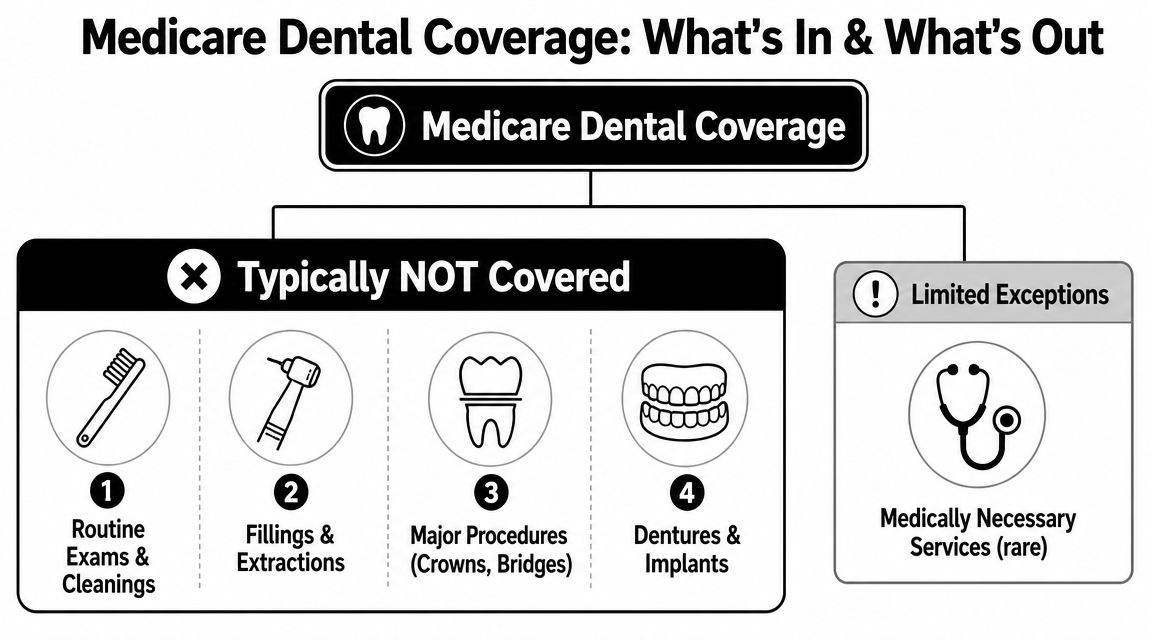
For most adults in Australia, Medicare does not cover routine dental care. It also doesn't generally cover most major dental work. A simple way to remember it is this: Medicare is usually set up around medical care, not ongoing dental maintenance.
What usually isn't covered
For a typical adult dental visit, Medicare usually won't pay for things like:
- Check-ups and cleans: regular examinations, scale and clean appointments, and preventive visits
- Fillings and standard extractions: treatment for decay or a painful broken tooth in a normal dental setting
- Crowns and bridges: restorative work after damage, wear, or root canal treatment
- Dentures and implants: replacement options for missing teeth
- Orthodontics and cosmetic treatment: braces, aligners, whitening, and appearance-focused work
If you want a broader consumer-friendly overview of where the line usually sits, Medicare and dental treatment options gives a useful plain-English summary.
Why this matters so much
This isn't just a technical funding issue. Cost changes behaviour. The Australian Government's National Oral Health Plan 2015 to 2024 identified cost as the most frequently reported barrier to care, and AIHW reporting has shown that around 16% of adults delayed or avoided seeing a dentist because of cost in recent reporting periods, according to the Urban Institute paper discussing Australian oral health access.
That helps explain why people often search "Medicare dental benefits" when what they're really looking for is any pathway that reduces out-of-pocket costs.
The narrow exception
There are limited cases where dental care may be covered because it is part of medical treatment rather than ordinary dental care. That's the part many patients never hear about until they're already under pressure before surgery or specialist care.
> Most confusion comes from treating all dental treatment as one category. Medicare usually separates routine dentistry from dental care that is directly linked to medical treatment.
If your treatment is an ordinary dental problem, assume Medicare probably won't pay. If the dental issue is tied to hospital care or a major medical plan, stop and ask more questions before you book or proceed.
Dental Care for Kids The Child Dental Benefits Schedule
If you're a parent, this is the part worth checking first. Australia's main federally funded dental program is the Child Dental Benefits Schedule, usually called the CDBS.
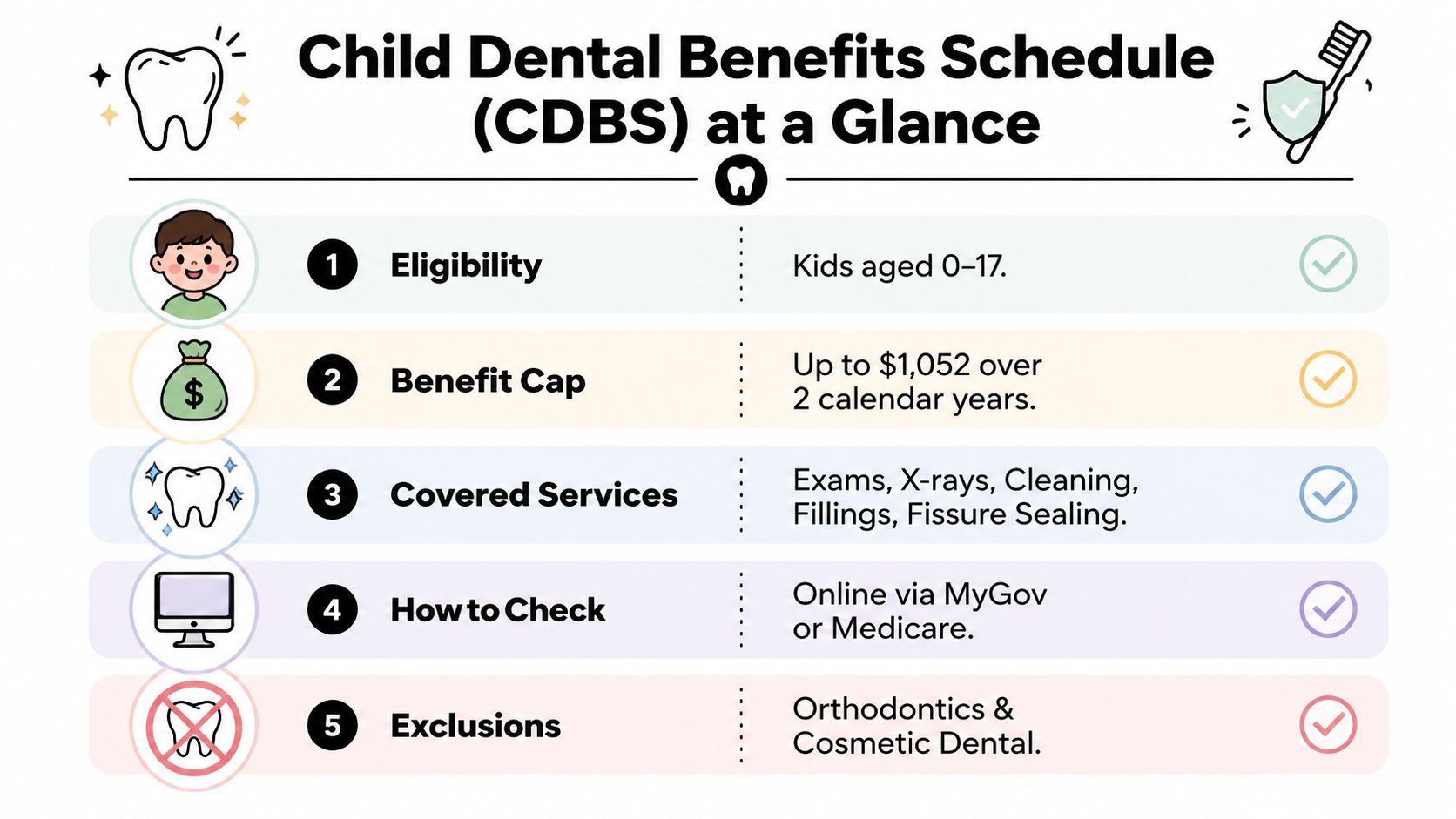
The scheme has been available since 1 January 2014 and provides up to $1,132 in benefits over a consecutive 2-year period for eligible children aged 0 to 17, according to Milliman's summary of Australian dental coverage. The same source notes that the Australian Institute of Health and Welfare has reported that roughly 3 million children are potentially eligible in a typical year.
Who can get it
Eligibility is means-tested. In simple terms, a child generally needs to meet all of these points:
- Age requirement: the child is aged 0 to 17
- Medicare requirement: the child is eligible for Medicare
- Family payment requirement: the family receives an approved government payment, such as Family Tax Benefit Part A
Parents often assume they would've been automatically told if they qualified. Sometimes they were, sometimes they weren't, and sometimes the letter was missed or forgotten. That's why it's worth checking directly rather than guessing.
What the CDBS is designed to help with
The CDBS is aimed at basic and preventive dental care for children. In practical terms, that often means the sort of treatment parents commonly need help with during school years.
It can generally be used for services such as:
- Dental examinations: routine check-ups to assess teeth and gums
- X-rays when needed: to help diagnose decay or monitor development
- Cleaning and preventive care: including preventive appointments and similar routine support
- Fillings and other basic treatment: when decay or damage needs attention
It isn't a catch-all dental fund for everything a child might ever need.
What parents often expect but the scheme doesn't cover
This is one of the biggest sources of disappointment. The CDBS is helpful, but it has boundaries.
Common exclusions include:
- Orthodontics: braces and aligners aren't part of the scheme
- Cosmetic treatment: appearance-focused procedures aren't included
- Complex treatment outside the scheme rules: if a service doesn't fit the eligible item list, it won't be claimable under the CDBS
> If your child may need braces later, treat the CDBS as help for everyday dental care, not as a full teenage orthodontic fund.
What this means for Tamworth families
For local parents, the practical move is simple. Check eligibility before the appointment, not after treatment has already been planned.
If you'd like a better sense of what children's preventive dental care involves, this page on children's dentistry gives a straightforward overview of the kinds of appointments families usually book.
A good front desk team can usually help you confirm whether your child is likely to be eligible, explain which services fit under the scheme, and let you know if any part of a treatment plan sits outside the CDBS so there are no surprises.
Hospital and Medically Necessary Dental Exceptions
This is the area adults misunderstand most. People hear that Medicare doesn't cover dental, then assume that's the end of the story.
Sometimes it isn't. In Australia, public coverage may apply for clinically necessary dental treatment when it is integral to a covered medical service, such as an oral examination or extraction before heart-valve replacement, transplant, or cancer therapy, based on the Medicare dental services coverage explanation.

What "medically necessary" really means
The key test isn't whether the tooth is in bad shape. The key test is whether the dental treatment is medically linked to a Medicare-funded hospital or medical episode.
That means the question changes from "Is this major dental work?" to "Is this dental work required because of my hospital treatment or specialist medical care?"
Here are the kinds of situations people often mean:
- Before heart surgery: a specialist may want dental infection cleared before treatment
- Before transplant care: problem teeth may need assessment or removal to reduce medical risk
- Before cancer therapy: dental treatment may be required as part of preparation for treatment
- During inpatient care: a limited dental service may be provided because it is part of the hospital episode
What to ask before treatment starts
Patients can protect themselves. If a surgeon, physician, oncologist, or hospital team tells you to see a dentist before medical treatment, don't assume it will be handled automatically.
Ask these questions:
- Is this dental treatment being requested as part of my medical treatment plan?
- Has the hospital or specialist documented that link clearly?
- Which part, if any, is expected to be covered?
- Do I need a referral, hospital paperwork, or written instruction before the dental appointment?
> The paperwork matters. If the dental treatment isn't clearly tied to the medical plan, the patient may still face the cost privately.
Emergency pain is different from a medical exception
This catches people too. Severe toothache can feel medically urgent, but that doesn't automatically make it a Medicare-funded dental service.
If you're dealing with sudden pain, swelling, or a broken tooth, you still need prompt dental assessment. A local option for that kind of problem is emergency dentistry, where the focus is getting you out of pain and deciding what treatment is needed quickly.
A separate note for DVA patients
Veterans' dental entitlements sit in a different category from Medicare. If you hold a DVA card, your access pathway is based on DVA rules rather than the general Medicare dental framework.
That distinction is important because people often merge the two systems in conversation. They aren't the same. If you're a veteran or helping a family member who is, bring the card details and ask the clinic to check the entitlement pathway directly rather than assuming Medicare rules apply.
Your Options Beyond Medicare Private Health and Payment Plans
For many adults in Tamworth, Medicare dental benefits won't be the main answer. That doesn't mean you're out of options. It just means you need to look at the funding path that fits your situation.
Private health extras cover
Private health insurance often helps with everyday dentistry through extras cover, not through Medicare. Under such policies, many people receive support for check-ups, cleans, fillings, and some larger items, depending on their policy.
The important part is not the brochure headline. It's the detail. Before relying on your extras cover, check:
- Waiting periods: some services aren't available straight away
- Annual limits: your cover may stop paying once you hit the policy cap
- Item restrictions: not every treatment is treated the same way
- Gap payments: you may still pay part of the fee yourself
If you're comparing how different systems talk about dental cover and exclusions, Family Caregiving Kit's dental insights are useful as a general reminder that dental "cover" often sounds broader than it really is.
Payment plans and staged treatment
When private cover doesn't stretch far enough, a payment arrangement can make needed treatment more manageable. This matters most for work that improves function and comfort but isn't funded by Medicare, such as crowns, dentures, or implants.
Some clinics offer structured ways to spread costs over time. If you're weighing that option, this page on payment options outlines the kinds of arrangements patients often ask about when planning treatment.
Public dental services
Public dental care can also be relevant, especially for people with concession access. The trade-off is that availability, eligibility, and wait times can affect how practical that option is for a non-urgent problem.
If your issue is stable and cost is the main concern, public services may be worth exploring. If you're in pain, have a broken tooth, or need timely restorative treatment, many patients choose private care because they want treatment sooner and more predictably.
Comparing your options
| Service | General Medicare | Child Dental Benefits Schedule (CDBS) | Private Health Insurance (Extras) | Oasis Smiles Payment Plan | |---|---|---|---|---| | Routine adult check-up | Usually not covered | Not relevant for adults | May help, depending on policy | Can help spread private costs | | Child preventive care | Usually not the main pathway | May cover eligible services for eligible children | May help if included in policy | Can assist if treatment sits outside available benefits | | Crowns and major restorative work | Usually not covered | Generally not the scheme's focus | May contribute depending on extras level | Can help manage out-of-pocket costs | | Orthodontics | Usually not covered | Not covered under CDBS | Only if policy includes it | May assist with private payment planning | | Dental linked to hospital treatment | May apply in limited medically linked cases | Not the relevant pathway | May still be separate from health fund extras | May help with any non-covered portion |
A good rule is to think in layers. First check if a government pathway applies. If not, check your health fund. If the gap is still too large, ask about staged care or payment arrangements.
Your Dental Care Journey at Oasis Smiles in Tamworth
Once you know the rules, the next challenge is turning them into a simple next step. That's what people usually want when they ring a clinic. Not a policy lecture. Just clarity.
If you're in Tamworth, the easiest approach is to gather the right information before the appointment. For a child, that means checking whether they're likely to be eligible for the CDBS. For a veteran, that means having DVA details ready. For an adult planning larger treatment, that means knowing whether you're using private health, self-funding, or asking about staged payments.
What to bring and what to ask
A short checklist can save a lot of back-and-forth:
- For children: bring Medicare details and ask whether CDBS eligibility can be checked
- For hospital-related dental care: bring referral letters, specialist instructions, or hospital paperwork
- For DVA patients: bring your card and ask the team to confirm the entitlement pathway
- For planned restorative work: ask for a written treatment plan so you can understand the likely costs and timing
One useful starting point for new or returning patients is the clinic's first visit information, which helps explain what to expect and what to bring along.
What local patients usually need most
In practice, many individuals don't need more information. They need someone to help sort the information they already have.
That might mean confirming whether a child's care fits under the CDBS, helping a patient understand why a crown sits outside Medicare, or checking whether hospital paperwork is detailed enough before treatment starts. For Tamworth families, that kind of admin help often makes the biggest difference because it turns a confusing funding question into a clear plan.
Taking Control of Your Dental Health
The biggest takeaway is simple. Medicare dental benefits in Australia are real, but narrow. They usually don't function as broad cover for routine adult dentistry.
Where support does exist, it's important. The Child Dental Benefits Schedule can make a real difference for eligible children. Medically linked dental treatment can matter before major hospital care. Separate pathways can also apply for some veterans and public patients.
For everything outside those categories, the practical answer is planning rather than hoping. That might mean using private health extras, asking for a staged treatment plan, or discussing payment options before work begins. Once you know which bucket your treatment falls into, the decision becomes much easier.
> Good dental planning isn't only about teeth. It's about timing, paperwork, and knowing which funding path applies before treatment starts.
If you're in Tamworth or anywhere in the New England region, don't leave it until the day of treatment to ask about cover. A quick conversation beforehand can help you understand what's claimable, what's private, and what your realistic options are.
---
If you'd like help sorting out your own situation, Oasis Smiles Dental can be a practical first call. Whether you're checking a child's eligibility, trying to understand a hospital-related dental request, or working out how to manage treatment costs, a no-pressure chat can help you work out the next step.