

Surgery for Tooth Extraction: A Patient Guide
Facing the thought of dental surgery can be a little unnerving, but we want to walk you through what it really means in simple, straightforward terms. A surgery for tooth extraction is a very common procedure we perform for things like troublesome wisdom teeth or teeth that are too damaged to be saved. Our aim is to help you feel confident and informed, not anxious, by showing you just how safe and comfortable modern dentistry has made this process.
Your Guide to Surgical Tooth Extraction
Hearing the words "surgical tooth extraction" might sound full-on, but it's actually one of the most routine procedures we do. It’s best to see it as a positive step—one that solves a current problem, protects your other teeth, and sets you up for better oral health down the track.
We only recommend surgery after a very careful look at your unique situation. This guide is here to give you a clear picture of what to expect, from the first chat we have right through to your recovery, so you feel completely in the loop.
Why Surgery Is a Positive Step
Instead of thinking of it as a last resort, a surgical extraction is often the best way to get ahead of bigger problems. It provides a clean slate and a permanent fix for issues that a filling or crown simply can't handle.
Here are a few common reasons why this procedure is so important:
- Prevents a Domino Effect: Taking out an impacted wisdom tooth can stop it from causing damage or crowding to the molar next door.
- Stops Pain and Infection: A badly broken or infected tooth can cause constant grief. Removing it gets rid of the source of the problem for good.
- Makes Way for a Better Smile: Sometimes, a tooth needs to be removed to create space for braces to work properly or to prepare the jaw for a future dental implant.
> A surgical extraction isn’t guesswork; it's a planned and precise procedure. With today’s technology, like 3D imaging and modern sedation, we can map out every detail to ensure everything goes smoothly and you remain comfortable.
Your Path to a Healthier Smile
Knowing what's involved is the best way to feel prepared. Our entire team is here to make sure you feel looked after and listened to from the moment you walk in. We believe in clear, honest communication and making sure you feel secure in our care.
This overview gives you a roadmap of what’s to come, focusing on your comfort and achieving a great outcome. For more detailed information on what to expect as a patient with us, you can find a wealth of information in our patient information resources.
Simple vs Surgical Tooth Extractions: What’s the Difference?
When your dentist brings up a tooth extraction, it’s not a one-size-fits-all situation. The truth is, how we remove a tooth depends entirely on its condition, its location, and what’s happening below the gumline. We generally group extractions into two types: simple and surgical.
Think of a simple extraction as plucking a ripe, healthy piece of fruit from a branch. The tooth has fully emerged from the gum, it’s visible, and we can gently ease it out with specialised tools. It's a straightforward process done right here in the chair with local anaesthetic.
A surgical extraction, on the other hand, is a bit more involved. Imagine trying to remove a stubborn shrub with deep, tangled roots, or one that hasn't fully broken through the soil. We need to be more methodical. This is the approach for teeth that are broken off at the gumline, haven't fully erupted (like an impacted wisdom tooth), or have complex root shapes.
How We Decide on the Right Approach
Making this call is a critical part of our job, and it’s always based on a careful, thorough assessment of your mouth. We’re not just looking at what we can see; we need the full picture, which is why we rely on detailed dental X-rays or even our in-house 3D CBCT scans.
We’re looking closely at a few key things:
- Is the tooth fully out? Can we see the entire crown, or is it trapped under gum tissue or bone?
- What’s the tooth's condition? Is it a whole, solid tooth, or has it been badly damaged by decay or a fracture?
- What do the roots look like? Are they straight and simple, or are they long, hooked, or wrapped around a nerve?
A classic example is an impacted wisdom tooth. Because it’s stuck beneath the surface, there's no way to grab it for a simple extraction. The same goes for a tooth that’s snapped off, leaving nothing to grip. These situations call for a surgical solution.
> No matter the method, our goal is always the same: to remove the tooth safely and with the least amount of disruption to your surrounding gums and jawbone. It's simply about choosing the right technique for that specific tooth.
Simple Extraction vs Surgical Extraction at a Glance
To help you get a clearer picture, it’s useful to see the two procedures side-by-side. While the end result is the same—a problematic tooth is gone—the process and recovery can look a little different.
This table breaks down the main distinctions.
| Feature | Simple Extraction | Surgical Extraction | | :--- | :--- | :--- | | Procedure | The tooth is gently removed using forceps. No incisions or stitches are needed. | We make a small incision in the gum to access the tooth. Sometimes, a tiny bit of bone is removed, and stitches are often used to help it heal. | | Anaesthesia | Local anaesthetic is all that's needed to completely numb the area. | Local anaesthetic is always used, but we often pair it with sedation options (like sleep dentistry) for total comfort. | | Common Reasons | Severe tooth decay, advanced gum disease, or making space in a crowded mouth. | Impacted teeth (especially wisdom teeth), teeth broken below the gumline, or teeth with very complex roots. | | Recovery Time | Usually quite quick. You might feel some minor discomfort for a day or two. | Recovery takes a little longer. Expect a few days of manageable swelling and to stick to a soft-food diet. |
Ultimately, whether you need a simple or surgical procedure, you can rest assured that modern dentistry makes the process comfortable. With effective anaesthesia and sedation options, you won't feel any pain during the appointment.
To learn more about what to expect with either procedure, you can read our complete guide to tooth extractions at Oasis Smiles Dental.
When Is a Surgical Extraction Actually Necessary?
Hearing your dentist recommend a surgical extraction might sound a bit daunting, but it’s not a cause for alarm. It simply means your tooth needs a more specialised approach to be removed safely and cleanly, ensuring the best possible outcome for your long-term health.
Think of it less as a major operation and more as a carefully planned procedure. It's often the most straightforward way to solve a complex problem and prevent future pain, infection, or damage to your other teeth.
The Classic Culprit: Impacted Wisdom Teeth
One of the most common reasons we perform a surgical extraction is for an impacted wisdom tooth. Impacted simply means the tooth is stuck and hasn’t been able to grow into its proper place. It might be completely trapped under the gum and bone, or just peeking through at an awkward angle.
Because they’re trapped, these wisdom teeth can cause a whole host of issues:
- Pain and Swelling: They often push against neighbouring teeth or become inflamed, causing that familiar, nagging ache and swelling at the back of your jaw.
- Infection: A partially erupted tooth can create a small gum flap that’s almost impossible to keep clean. This area can quickly become a breeding ground for bacteria, leading to painful infections.
- Damage to Other Teeth: If a wisdom tooth is growing sideways, it can ram into the roots of the molar next to it. This can cause serious damage, sometimes to a perfectly healthy tooth.
- Cysts: In some situations, a fluid-filled sac (a cyst) can form around the trapped tooth. If left alone, this can damage the jawbone and surrounding tooth roots.
Removing impacted wisdom teeth is often a proactive step to prevent these problems from ever starting. You can learn more about how we handle wisdom teeth at Oasis Smiles Dental on our dedicated page.
When There’s Not Enough Tooth to Grab
Another common scenario is a tooth that’s so badly damaged there’s nothing left to hold onto. Picture a tooth that has broken right off at the gumline, either from extensive decay or an accident. A standard extraction is off the table because there's no visible crown for the dentist's tools to grip.
> Think of it like trying to pull a nail that's been hammered flat against a piece of wood. You can't just grab it with pliers; you have to carefully work around it to lift it out. A surgical extraction lets us do exactly that by making a small, precise incision in the gum to access and remove what’s left of the tooth.
This is often the case for teeth that are:
- Severely decayed and have crumbled.
- Fractured below the gumline.
- Worn down to a tiny stump.
Getting these remnants out is essential for stopping infection and properly preparing the site for a future restoration, like a dental implant or bridge.
Other Important Reasons for a Surgical Approach
While impacted wisdom teeth and broken-down teeth are the main reasons, a few other situations also call for the precision of a surgical extraction.
- Tricky Root Shapes: Some teeth are just built differently, with long, curved, or hooked roots. Trying to pull these with a simple extraction risks breaking off a root tip and leaving it behind. A surgical approach allows the dentist to see the root and remove the whole tooth cleanly in one go.
- Making Room for Braces: In cases of severe crowding, an orthodontist might recommend removing a tooth to create the space needed to align everything properly. If that tooth is wedged in or blocked by others, a surgical extraction is the most predictable way to get it out.
- Preparing for Dental Implants: To preserve as much healthy bone as possible for a future implant, we can perform an atraumatic extraction. This is a very gentle surgical technique specifically designed to protect the surrounding bone and give the implant the best possible foundation.
These procedures are far more common than you might think. Data from Australian dental research shows that surgical extractions account for about 25% of all dental procedures in regional Australia. Here in New South Wales, over 250,000 extractions are performed each year, with a large number being for impacted wisdom teeth—a problem that affects up to 35% of young adults.
A Step-by-Step Look at Your Surgical Extraction
Knowing what to expect can make a world of difference when you’re facing a dental procedure. So, let's walk through what a surgical tooth extraction actually looks like from our side. It’s not as scary as it might sound—it’s a carefully planned and controlled process, and our entire focus is on your comfort and safety.
Step 1: The Consultation and a Precise Game Plan
A smooth, successful extraction all comes down to the planning we do beforehand. We don't just glance at the tooth; we need a complete picture of what’s happening beneath the surface—with the roots, the jawbone, and any nearby nerves. This is where our modern imaging tools really shine.
Here at Oasis Smiles Dental, we rely on our in-house Cone Beam CT (CBCT) 3D scanner. It’s a huge leap forward from old-school, flat 2D X-rays. The scanner builds a complete 3D model of your jaw, letting us see the exact curve and position of the tooth’s roots, how close they are to important nerves, and the quality of the bone around them.
> Think of it like this: a normal X-ray is a paper map, showing you the general roads. A CBCT scan is like a GPS with a live, 3D satellite view. It lets us see every hill, valley, and potential roadblock, so we can plan the absolute safest and most efficient path to remove the tooth.
This deep level of detail is crucial. For example, a 2026 AIHW national dental survey noted that 8.5% of extractions in regional areas like ours in Tamworth are done on an emergency basis. Often, this is due to severe decay, which affects around 22% of adults in rural communities. Having served Tamworth for over 20 years, our team at Oasis Smiles Dental uses this advanced CBCT imaging to get things right the first time, especially for tricky cases. To see just how far the field has come, you can read about the history of oral and maxillofacial procedures.
Step 2: Making Sure You're Comfortable with Anaesthesia
Once we have our detailed plan, the next step on the day of your surgery is all about making sure you’re completely comfortable and won't feel any pain. We’ll talk through the options to find what’s right for you.
- Local Anaesthetic: This is the foundation of every surgical extraction. We start with a numbing gel on your gum, then gently administer a local anaesthetic. This completely numbs the tooth and the area around it. You’ll be awake, but all you'll feel is a bit of pressure—no pain.
- IV Sedation (Sleep Dentistry): If you’re feeling particularly anxious or your procedure is a bit more involved, we can offer IV sedation. It puts you in a deeply relaxed, "twilight" state. You’re not fully asleep, but you’ll feel drowsy and calm, and you likely won’t remember much of the procedure afterwards.
We never start until you are fully numb and comfortable. Your peace of mind is our priority.
This simple flowchart shows how we move from planning to the final procedure, making sure everything is handled safely and calmly.
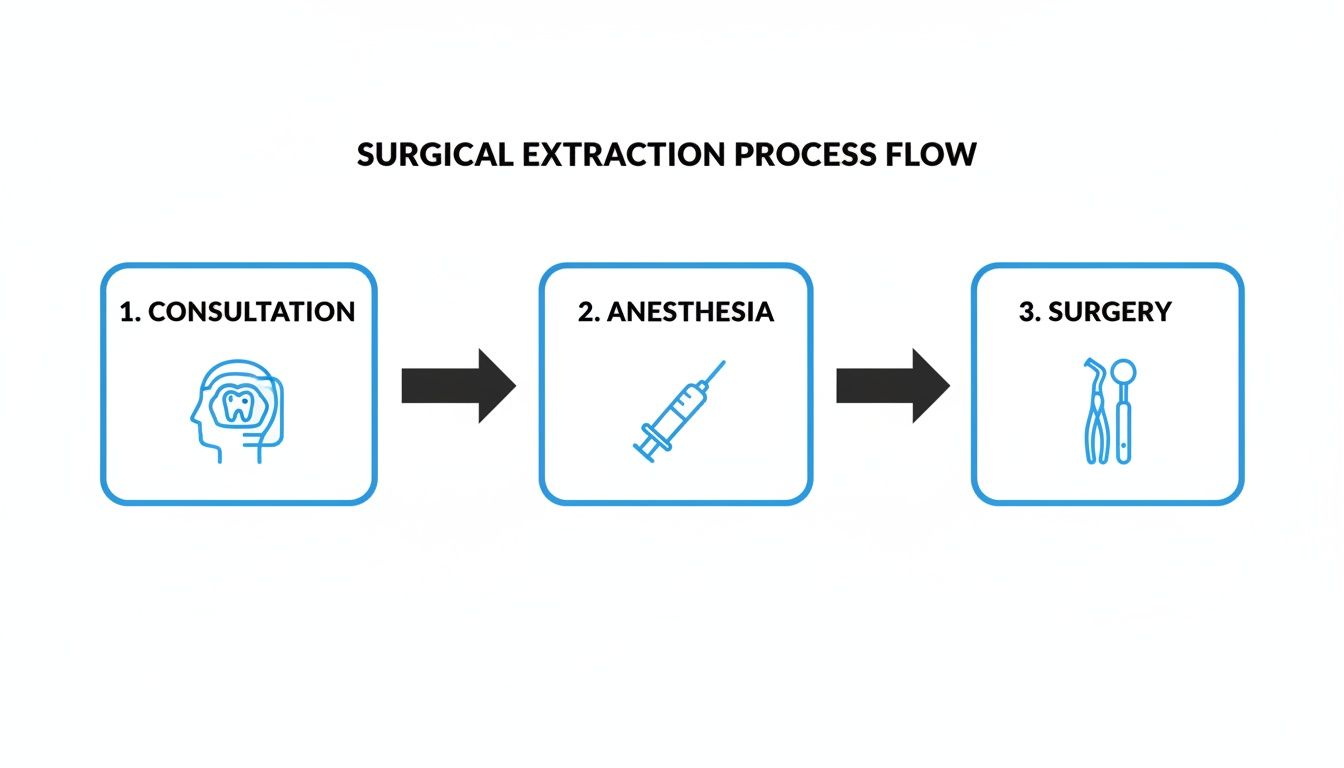
As you can see, every step, from the high-tech scan to your anaesthesia, is designed to create a completely controlled and stress-free environment.
Step 3: The Surgical Procedure Itself
With the area numb and you feeling at ease, we can begin the actual procedure. The whole process is very methodical and precise, aimed at removing the tooth while disturbing the surrounding tissue as little as possible.
- Gaining Access to the Tooth: First, your dentist will make a small, neat incision in the gum tissue. This creates a tiny flap that we can gently lift back, giving us a clear view of the tooth and the bone holding it in place.
- Clearing the Way: Sometimes, a bit of bone might be covering the tooth. If so, your dentist will carefully remove just enough of it to create a path for the tooth to come out.
- Sectioning the Tooth (If Needed): If a tooth has tricky, curved roots or is wedged in tightly, the safest approach is often to divide it into smaller, more manageable pieces. This allows for a much gentler removal and helps protect the surrounding bone.
- Stitching Everything Up: Once the tooth is out and the area has been cleaned, we gently place the gum flap back into position. A few small, dissolvable stitches are used to hold it securely while it heals.
From start to finish, the procedure is carried out in a calm, sterile environment. Your safety and well-being are what guide every single step we take.
Your Guide to a Smooth Recovery

The success of your surgical tooth extraction doesn't end when you leave our clinic; in many ways, it's just beginning. How you look after yourself in the days following the procedure is every bit as important as the surgery itself.
Following our aftercare advice carefully will not only help you feel more comfortable but also speed up your healing and prevent any frustrating setbacks.
The First 24 Hours: Your Top Priorities
That first day is absolutely crucial for a good recovery. The main goals are simple: manage any bleeding, keep swelling to a minimum, and protect the blood clot that forms in the empty tooth socket. Think of this clot as a natural bandage—it’s essential for protecting the underlying bone and nerves while they heal.
To handle any initial bleeding, bite down firmly on the gauze pack we gave you. Keep gentle, steady pressure on it for about 30–60 minutes. If you find it’s still oozing a bit after that, you can swap it for a fresh gauze pad.
To reduce swelling, an ice pack applied to your cheek is your best friend. A good routine is 20 minutes on, then 20 minutes off. This simple step helps constrict the blood vessels, which really helps with both swelling and discomfort.
Normal Healing vs. A Complication
It’s completely normal to have some mild discomfort, a bit of swelling, and minor oozing for the first day or two. But it’s also important to know what isn’t normal, especially a condition called dry socket.
> A dry socket happens if the protective blood clot gets dislodged or dissolves too soon, usually 2 to 3 days after your surgery. This leaves the bone and nerves exposed, causing a sharp increase in pain that can throb and radiate towards your ear. You might also notice an unpleasant taste or odour.
While it sounds nasty, a dry socket is very treatable. If you find yourself in severe, throbbing pain that your pain relief medication isn't touching a few days after your procedure, please call us straight away. We can see you promptly and place a medicated dressing to soothe the area and get the healing process back on track.
Your Recovery Timeline: Week by Week
Healing happens in stages, not all at once. Here’s a rough guide to what you can expect.
First 24-48 Hours: * Focus: Rest, rest, and more rest. Manage pain proactively. * Diet: Stick to cool, soft foods. Think yoghurt, smoothies (no straws!), mashed potato, and lukewarm soup. Avoid anything hot, spicy, or crunchy that could irritate the site. * Activity: Take it easy. No hitting the gym or doing any heavy lifting, as raising your blood pressure can trigger more bleeding.
Days 3-7: * Focus: Gently reintroducing routine and more foods. * Diet: You can slowly start eating semi-soft foods like scrambled eggs, oats, and pasta. Just be sure to chew on the opposite side of your mouth. * Oral Hygiene: Now’s a good time to start gently rinsing with warm salt water after you eat. This helps keep the area clean without disturbing it.
We've come a long way with oral surgery. In Australia's early colonial days, tooth extractions were often performed by barbers or general surgeons without the sophisticated anaesthesia we rely on today. This journey from a feared, often painful ordeal to a comfortable, patient-focused procedure has revolutionised oral health outcomes. To learn more, you can read about the interesting facts in oral surgery's history.
The Do's and Don'ts of Recovery
To keep it simple, here’s a quick checklist for a smooth recovery. Sticking to these tips is the best way to heal quickly and avoid complications.
DO: * Rest with your head propped up on a few pillows to help minimise swelling. * Take your prescribed pain medication on schedule, before the pain has a chance to build up. * Drink plenty of cool water to stay hydrated. * Stick to a soft food diet for the first few days.
DON'T: * Smoke or vape. The sucking action is a major risk for dislodging the blood clot, and the chemicals slow down your body's ability to heal. * Drink from a straw. The suction created is a leading cause of dry socket. * Spit forcefully. When you rinse, just let the water fall out of your mouth into the sink. * Poke or prod the extraction site with your tongue or fingers. Just leave it be.
Your Questions About Surgical Extraction Answered
It's completely understandable to have questions when you’re facing a surgical tooth extraction. Making sure you feel informed and comfortable is our first priority. We find that having a straightforward chat about what to expect is the best way to ease any worries.
Here are the honest answers to the questions we hear most often from our patients here in Tamworth.
How Much Pain Will I Feel During and After Surgery?
This is usually the number one concern, and we take it very seriously. Let's be clear: you will feel no pain during the surgery itself. We use a powerful local anaesthetic to completely numb the area, so while you might feel some pressure, you won't feel any pain.
If the thought of the procedure still makes you anxious, we can help with that too. We offer IV sedation, often called "sleep dentistry." It's not a general anaesthetic; instead, it puts you into a deeply relaxed, dream-like state. Most people have little to no memory of the surgery afterwards, making it a completely stress-free experience.
> Once the anaesthetic wears off, you can expect some discomfort—that's a normal part of healing. We'll send you home with a clear pain management plan, usually involving simple over-the-counter pain relief like ibuprofen or paracetamol. For most people, this is more than enough to stay comfortable, with the soreness easing up significantly after the first two or three days.
What Are the Risks and How Are They Minimised?
Modern dental surgery is incredibly safe, and complications are rare. But like any surgical treatment, there are some risks involved, and our job is to minimise them through careful planning.
The most talked-about risk is a "dry socket." Think of the blood clot that forms in the socket as a natural bandage. A dry socket happens if that clot gets dislodged or dissolves too soon, exposing the bone and nerves underneath. It's quite painful but only affects a small number of patients. The best way to avoid it is by carefully following all of your aftercare instructions.
Other potential risks include: * Infection: We work in a sterile environment with sterile tools. We might also prescribe antibiotics if your case has a higher risk of infection. * Nerve Numbness: The roots of lower wisdom teeth can sometimes sit very close to a major nerve. There’s a small chance of temporary numbness or tingling in your lip, chin, or tongue. * Sinus Issues: With upper back teeth, there’s a slight possibility of creating a tiny opening into your sinus cavity, which almost always heals quickly on its own.
This is where our technology makes a huge difference. We use an in-house 3D CBCT scanner to create a detailed map of your jaw before we do anything. This gives us a "blueprint" showing the exact location of your tooth's roots, nerves, and sinuses, allowing us to plan the safest, most predictable path for the extraction.
What Are My Options if I Do Not Want an Extraction?
At Oasis Smiles Dental, our goal is always to save your natural tooth if we can. Extraction is a last resort, recommended only when it’s the best path forward for your overall health.
We will always explore the alternatives with you first. Depending on the problem, these could include:
- Root Canal Therapy: If the tooth's inner nerve is infected, a root canal treatment can clean out the infection and seal the tooth, saving it from extraction.
- Coronectomy: In the rare situation where a wisdom tooth's roots are wrapped around a major nerve, we might remove just the crown (the top part) of the tooth. This leaves the harmless roots in place, eliminating the risk of nerve damage.
Sometimes, though, an extraction is the only sensible choice. This is often the case for teeth that are badly broken below the gumline, have decay that’s too advanced to treat, or are impacted and damaging their healthy neighbours. Removing the problem tooth is the key to protecting the rest of your mouth.
Of course, we won't just leave an empty space. We have fantastic options for filling the gap and restoring your bite. To see how we can rebuild your smile, you can learn more about dental implants, one of the best long-term solutions available.
How Much Does a Surgical Tooth Extraction Cost?
The cost of a surgery for tooth extraction really depends on the complexity of your specific case. For example, removing a deeply impacted wisdom tooth that's stuck in the jawbone is more involved than a simpler surgical removal. The type of sedation you opt for, like IV sedation, will also be a factor in the final cost.
We believe in being completely upfront about pricing. During your consultation, we’ll give you a detailed treatment plan with a clear, itemised breakdown of all costs. You’ll know exactly what to expect—no surprises.
To make payment simple, we accept all major health funds and can process claims on the spot with HICAPS. We also support the Child Dental Benefits Schedule (CDBS) and DVA cardholders. If you need it, we can work with you to set up a flexible payment plan to ensure you can get the care you need without financial stress.
--- At Oasis Smiles Dental, your health and peace of mind are what matter most. If you have more questions or you’re ready to book a consultation, our friendly Tamworth team is here to help. Visit us at https://www.oasissmilesdental.com.au to make an appointment.