

Your Guide to a Tooth Extraction Dentist in Tamworth
Let's be honest, hearing you might need a tooth extraction can be unnerving. But having the right tooth extraction dentist on your side can completely change the experience. Here at Oasis Smiles Dental in Tamworth, our entire focus is on making you feel comfortable and reassured, turning a potentially stressful situation into a straightforward, gentle one.
Our job is simple: to get you out of pain and on the road to recovery with compassionate, modern care.
Finding a Gentle Tooth Extraction Dentist in Tamworth
The idea of losing a tooth often brings up a lot of worry and questions. While it’s a very common procedure, we know it’s a big deal for you. That’s why we’ve created this guide for our neighbours in Tamworth and the surrounding New England region—to give you clear, reassuring information about what’s involved.

Think of us as your partners in dental health. Our mission is to take you from a place of discomfort or worry to one of relief and wellness. With the right approach and a gentle touch, having a tooth removed can be a surprisingly calm and positive step toward a healthier smile.
What to Expect From This Guide
We’ve put this guide together to walk you through everything, step-by-step. We want to replace any uncertainty you might feel with confidence by showing you just how much modern dentistry has simplified the process.
Here’s a quick look at what we'll cover:
- When an extraction is the best option: We’ll explain the reasons, from deep decay to making space for orthodontic work.
- Simple vs. surgical extractions: A clear breakdown of the different types of procedures.
- Keeping you comfortable: A look at the anaesthetic and sedation options we use to ensure a pain-free visit.
- Your recovery at home: Practical, easy-to-follow advice for a smooth and speedy healing process.
- Costs and payment information: We believe in transparency, so we’ll demystify the financial side of things.
To give you a quick overview, here's a summary of what to expect when you come to us for a tooth extraction.
Quick Guide to Tooth Extractions at Oasis Smiles
| Aspect | What You Need to Know | | :--- | :--- | | Consultation | We'll assess the tooth, take x-rays, and discuss why the extraction is needed. | | Comfort | Local anaesthetic is standard. We also offer sedation for anxious patients. | | The Procedure | Most extractions are quick, often taking less than 30-45 minutes from start to finish. | | Aftercare | You'll receive clear, simple instructions for managing the site at home to ensure proper healing. | | Follow-Up | We are always here to answer questions and will schedule a follow-up if needed. |
This table is just a snapshot, and we'll go into more detail on each of these points throughout the guide.
> A necessary tooth extraction isn't about losing something. It's about protecting your overall health by removing a source of pain or infection to keep your other teeth and gums healthy for years to come.
By the time you finish reading, you'll have a much clearer picture of what the process looks like. We want you to feel fully informed and in control of your health decisions. Our team at Oasis Smiles Dental is here to provide exceptional care, and we're ready to help you feel better.
If you’re in pain or have questions you’d like answered now, please don't hesitate to contact our Tamworth clinic and chat with our friendly team.
Understanding Why a Tooth Might Need to Come Out
Let's be honest—hearing you might need a tooth extracted is never welcome news. It’s completely normal to think, "Does it *really* have to go?" As dentists, our number one priority is always to save your natural teeth. So when we do recommend an extraction, it’s because we’ve determined it's the only way to protect your long-term health and prevent a small problem from becoming a much bigger one.
Think of it this way: if a structural pillar in a house is rotted through and can't be repaired, leaving it in place would put the whole building at risk. A severely damaged tooth can pose a similar threat to your jawbone, gums, and the teeth right next to it.
Severe Decay or Infection
One of the most common culprits is a tooth so badly decayed or infected that it’s simply beyond repair. This usually happens when a cavity is left to its own devices, allowing bacteria to work their way deep into the tooth’s pulp—the soft tissue centre that houses nerves and blood vessels.
Once that happens, you can end up with a very painful abscess, which is a pocket of pus forming at the root of the tooth. While a root canal is our first choice to clear out the infection and save the tooth, sometimes the damage is just too severe. If a root canal isn't an option or has already failed, taking the tooth out is the only way to get rid of the infection for good and stop it from spreading.
Advanced Gum Disease
Another major reason is advanced gum disease, or periodontitis. This is a serious infection of the very tissues that anchor your teeth in your jaw. In its later stages, it starts to eat away at the bone and ligaments that provide support.
This causes teeth to become loose, and eventually, they may simply not have enough support to stay in place. It's like a fence post set in crumbling concrete; as the foundation erodes, the post becomes wobbly and unstable. When there's been too much bone loss, an extraction is often needed to manage the infection and prevent even more damage to your jaw.
> A tooth extraction isn't just about removing a problem. It’s about creating a fresh start for your oral health. By getting rid of the source of pain or infection, we pave the way for a healthier, more comfortable smile.
This is a more widespread issue than many realise. The need for dental extractions in Australia has steadily climbed over the years, going from 6.0% of the population in 1987-88 to 9.0% in 2017-18. Worryingly, for adults aged 25-34, that figure was 11.7% in 2017-18, showing it’s a problem that affects people of all ages.
Other Situations That Call for an Extraction
Decay and gum disease aren't the only reasons a tooth might need to be removed. A few other scenarios also point toward extraction as the best path forward for your long-term health.
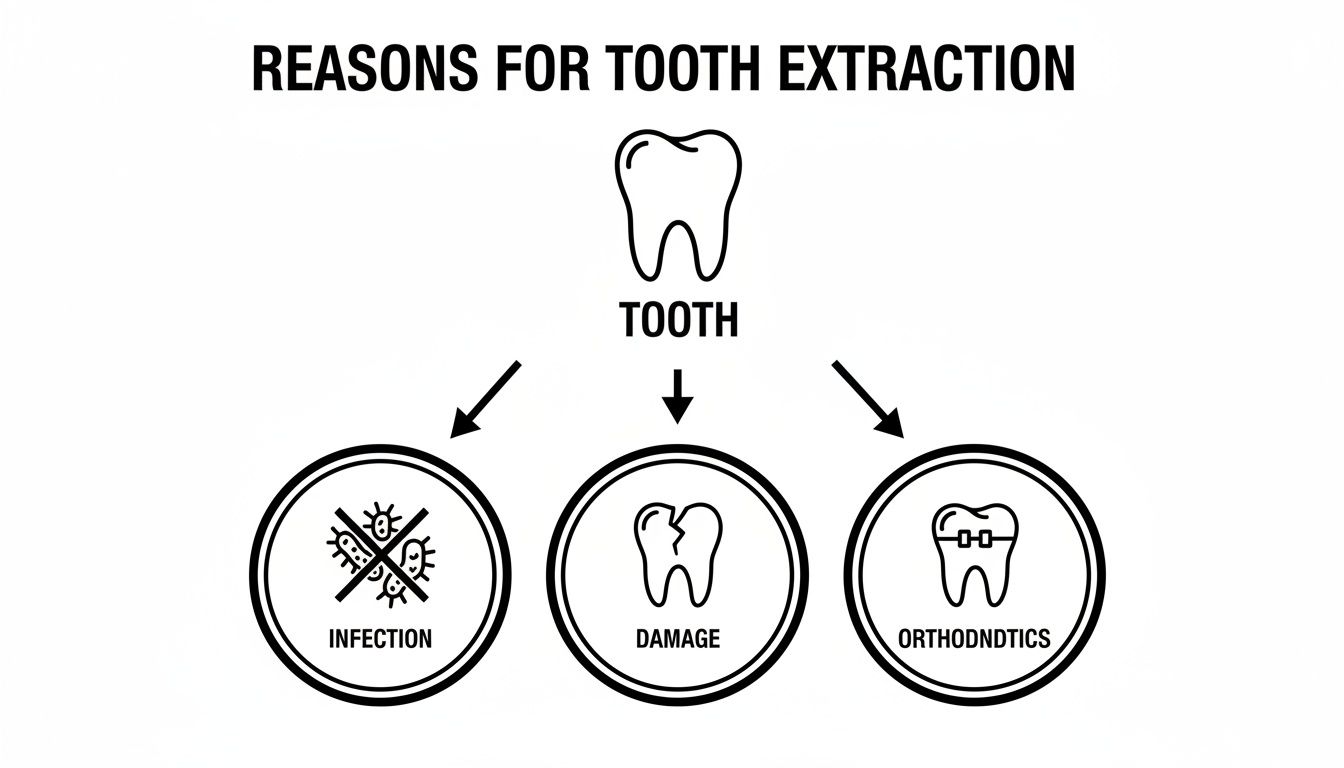
- Major Trauma or Injury: A nasty fall or accident can crack a tooth down to the root or break it off below the gum line. If the damage is too severe for a crown or filling to fix, removing the tooth is often the only realistic option.
- Creating Space for Orthodontics: Sometimes, there just isn't enough room in the jaw for all the teeth to fit properly. An orthodontist might recommend removing a tooth or two to create the space needed for braces or Invisalign to effectively straighten your smile.
- Problematic Wisdom Teeth: Wisdom teeth are notorious troublemakers. They often don’t have enough space to grow in correctly, causing them to become "impacted" or stuck in the jaw. This can lead to pain, recurring infections, cysts, and even damage to the neighbouring molars. Removing them is a preventative measure to avoid these future headaches.
Getting to the bottom of *why* an extraction is needed is the first step in feeling confident about your treatment. In every case, the goal is the same: to protect your overall health and set you up for a much better outcome down the road.
The Difference Between Simple and Surgical Tooth Extractions
When you’re told you need a tooth removed, your dentist will usually talk about one of two approaches: a simple extraction or a surgical extraction. It can sound a bit intimidating, but understanding the difference is the first step to feeling more comfortable and in control.
Think of it this way: a simple extraction is like plucking a ripe strawberry from its stem. It’s visible, easy to grasp, and comes out cleanly. A surgical extraction is more like digging out a stubborn potato that’s buried deep in the ground—it takes a bit more work to access it and get it out in one piece.
So, What's a Simple Extraction?
A simple extraction is exactly what it sounds like—the most straightforward way to remove a tooth. This is the go-to method when the tooth is fully visible above the gum line and isn't broken or trapped.
After we make sure the area is completely numb, the process is usually quite fast. Your dentist uses special tools to gently rock the tooth back and forth, which loosens it from the ligaments holding it in place. Once it's loose enough, it can be carefully lifted out. We often use this technique for teeth with severe decay or to make space for orthodontic treatment.
And What Makes an Extraction Surgical?
A surgical extraction is needed for trickier situations. This is the method we use when a tooth can't be easily removed, perhaps because:
- It's broken off at or below the gum line.
- It hasn't fully come through the gums (we call this an impacted tooth).
- The roots are unusually long, curved, or tangled.
During a surgical extraction, the dentist needs to make a small incision in your gum to get to the tooth. Sometimes, a tiny bit of bone might need to be removed, or the tooth might be cut into smaller, more manageable sections. This actually makes the removal process gentler on your jaw and surrounding tissues.
The image below shows a few of the common reasons a tooth might need to be removed in the first place, which often determines if the procedure will be simple or surgical.
It’s interesting to note that in Australia, surgical extractions are actually the norm. Of the roughly 180,000 tooth extractions performed each year, a surprising 80% are surgical. That comes out to about 144,000 surgical procedures annually, from complex wisdom teeth to emergency cases, compared to 36,000 simple extractions.
Comparing Simple and Surgical Tooth Extractions
To make things even clearer, let's break down the key differences side-by-side. While both are done with local anaesthetic to ensure a pain-free experience, the process and recovery look a little different.
| Feature | Simple Extraction | Surgical Extraction | | --------------------- | ----------------------------------------------------------- | -------------------------------------------------------------------------------- | | Tooth Position | Visible and fully erupted above the gum line. | Broken, below the gum line, or impacted (not fully erupted). | | Procedure Steps | The tooth is loosened and lifted out directly. | Involves a small incision in the gum and sometimes sectioning of the tooth. | | Procedure Time | Very quick, often just a few minutes. | Takes longer due to the more detailed steps required. | | Stitches Needed? | No. | Yes, usually a few dissolvable stitches are placed to help the gum heal. | | Typical Recovery | Quicker, with minimal swelling or discomfort. | A bit longer, may involve some swelling and bruising. | | Common Examples | A decayed but intact molar; removing teeth for braces. | Impacted wisdom teeth; removing the root of a tooth that has broken off. |
Wisdom teeth are a classic example where a surgical approach is often needed. Because they’re the last to arrive, they frequently get stuck or grow in at odd angles. If you’re worried about your wisdom teeth, you can learn more about how we manage impacted wisdom teeth in our detailed guide.
No matter which type of extraction you need, our team at Oasis Smiles Dental is here to make sure you’re comfortable and know exactly what to expect. We'll walk you through every step so you can feel completely at ease.
How We Ensure Your Comfort During the Procedure
Let's be honest—the thought of having a tooth pulled can be daunting. If you’re feeling nervous, please know you’re not alone. For most people, the anticipation is far worse than the actual procedure, and our number one job at Oasis Smiles Dental is to make sure your experience is calm, comfortable, and pain-free.
We firmly believe that fear shouldn't prevent anyone from getting the dental care they need. We have plenty of ways to manage anxiety and ensure that even the most nervous patient can have a relaxed and positive visit.
The Foundation of a Pain-Free Extraction
A comfortable extraction starts with excellent local anaesthesia. The first thing we do is apply a strong numbing gel to your gums, so you won’t even feel the tiny pinch from the injection that delivers the anaesthetic.
The anaesthetic gets to work right away, completely blocking any pain signals from the nerves around your tooth. While you’ll be awake and aware of what’s happening, the area will be profoundly numb. You might feel a bit of pressure as your dentist works, but you won't feel any pain. This method is incredibly safe and is all that’s needed for the vast majority of extractions.
> A common worry we hear is, "Will it actually hurt?" With modern local anaesthetics, the answer is a confident no. You'll feel movement and pressure, which is normal, but the sensation of pain is completely gone. We never start until we’re both certain the area is totally numb.
For many patients, this is all the reassurance they need. But if you’re still feeling anxious, we have other options to help you feel truly at ease.
Sleep Dentistry for Deeper Relaxation
For anyone with significant dental anxiety, we offer sedation dentistry, which you might have heard called 'sleep dentistry'. This doesn't involve being put to sleep like in a hospital for major surgery. Instead, it guides you into a deeply relaxed, dream-like state where you're still conscious but completely untroubled by the procedure.
Here’s what you can expect from our sedation options:
- What it feels like: Most people describe feeling incredibly calm, sleepy, and pleasantly detached from what’s going on. Time tends to fly by, and it’s common to have little or no memory of the extraction afterwards.
- Who it’s best for: It’s a fantastic option if you struggle with dental fear, have a strong gag reflex, or are having a longer or more complex surgical extraction. It transforms a potentially stressful appointment into a peaceful one.
- Our commitment to safety: We take your safety very seriously. Our dentists and clinical team are expertly trained in administering and monitoring sedation, following strict, careful protocols from start to finish to keep you safe and comfortable.
We combine these comfort techniques with modern equipment to make even complex procedures feel straightforward. To see some of the tools we use to create better patient experiences, you can read about our dental technology. Our goal is to find the right approach for you, so you can get the care you need without any of the stress.
Your Guide to a Smooth Recovery After Extraction
Alright, the procedure is done. Now, the focus shifts to you and your healing. A comfortable recovery really comes down to a few simple but crucial steps, especially over the next couple of days. Think of this as your personal game plan, guiding you from the moment you leave our clinic to feeling right as rain.

We’ll walk you through what to expect and what to do, covering everything from managing discomfort to what you can eat. Your body is fantastic at healing itself; these tips just give it the best possible support.
The First 24 Hours: Your Top Priorities
This first day is the most important for getting your recovery off to a great start. Your main job is to rest and protect the little empty socket where your tooth was. A blood clot needs to form in that space—it's the foundation for all the new tissue that will grow there. Protecting it is everything.
For the first 24 hours, just focus on these key things:
- Rest Up: Seriously. Plan on taking it easy for the rest of the day. No gym, no heavy lifting, no strenuous activity. Anything that gets your heart rate up can increase bleeding.
- Stay Ahead of the Pain: Take any pain relief medication we’ve prescribed or recommended, ideally *before* the local anaesthetic completely wears off. It’s much easier to manage discomfort this way.
- Control Swelling: Gently apply an ice pack to your cheek over the area for 15-20 minutes at a time, then take a 20-minute break. This really helps minimise swelling and bruising, and it’s most effective in the first 12-24 hours.
- Protect That Clot: This is the big one. No spitting, no rinsing your mouth out, and absolutely no drinking through a straw. Any of these actions can create suction and dislodge the protective blood clot.
> Think of the blood clot like a natural bandage that your body puts over the wound. If it gets disturbed or falls out, the healing process gets set back, and you can end up with a painful complication called a dry socket.
Getting Through Days 2 and 3
Once you’ve passed the 24-hour mark, you can start to ease back into your routine a little. It’s normal for swelling to peak around the second or third day, so don’t be alarmed. You can now switch from ice packs to applying a warm, moist cloth to your cheek to help with any stiffness or lingering swelling.
Starting 24 hours after your extraction, you can also begin to gently rinse your mouth. Just mix half a teaspoon of salt in a glass of warm water. Tip your head back and let the solution gently wash over the extraction site, then let it fall out of your mouth into the sink. Do this 2-3 times a day, especially after eating, to keep everything clean.
What to Eat After Your Extraction
Good nutrition helps you heal faster, but for the first few days, you'll need to stick to soft foods. This prevents you from accidentally disturbing the socket. It's also a good idea to get into the habit of chewing on the opposite side of your mouth for a while.
Great Soft Food Choices:
- Yoghurt, smoothies (remember, no straws!), and milkshakes
- Scrambled eggs
- Mashed potatoes or mashed sweet potatoes
- Soups and broths (just make sure they've cooled down to lukewarm)
- Pudding, jelly, and ice cream (a perfect excuse for a treat!)
As you feel more comfortable, you can slowly work your way back to more solid foods. The key is to listen to your body and not rush things. Stay away from anything hard, crunchy, or spicy for at least a week, as these can easily irritate the healing tissue.
How to Avoid a Dry Socket
A "dry socket" is the most common hiccup after an extraction, happening in about 2-5% of cases. It occurs when that all-important blood clot is lost too soon, leaving the bone and nerves underneath exposed. The result is a significant, throbbing pain that can even radiate up towards your ear.
To dramatically lower your risk, strictly avoid these three things:
- Smoking or Vaping: The suction from inhaling and the chemicals involved are a major cause of dry socket. They severely interfere with healing.
- Using Straws: That simple sucking motion creates negative pressure that can easily pop the clot right out of the socket.
- Spitting Forcefully: This also creates suction. Instead, just let saliva or rinse water gently fall from your mouth into the sink.
Following these simple rules is the best way to ensure your recovery is smooth sailing. If you do start to feel severe pain a few days after your procedure, please don't hesitate to call our Tamworth clinic straight away.
Navigating Extraction Costs and Payment Options
We know that when you’re facing a tooth extraction, the cost is often a big worry. The last thing anyone wants is a surprise bill, so at Oasis Smiles Dental, we make a point of being completely upfront about all the costs involved.
The price for an extraction really comes down to the complexity of the job. A simple, straightforward extraction is a quicker procedure and will cost less than a surgical one. During your consultation, your tooth extraction dentist will give you a detailed treatment plan that breaks down all the fees, so you know exactly what to expect before we begin.
Using Your Private Health Insurance
If you have private health cover, it can make a real difference to your out-of-pocket costs. We accept all major Australian health funds here, and our team is great at helping you navigate your policy.
Most extras cover will contribute towards tooth extractions. The exact amount will depend on your fund and your level of cover. We have a HICAPS terminal right here at the clinic, which means we can process your claim on the spot. You’ll only need to pay the remaining gap.
> It’s always a good idea to give your health fund a quick call before your appointment. You can ask them what you’re covered for using the dental item numbers on your treatment plan. That way, you’re fully in the loop.
Government Schemes and Other Support
Private insurance isn't the only way to get help with dental costs. We're proud to support several government programs that make essential dental care more accessible for families in our community.
Financial Assistance Options:
- Child Dental Benefits Schedule (CDBS): This fantastic Medicare scheme gives eligible kids up to $1,095 for basic dental services over two years, which often includes extractions. We can check your child's eligibility for you right here.
- Department of Veterans' Affairs (DVA): We warmly welcome DVA cardholders. For most approved treatments, we can bill the department directly, making the entire process smooth and simple for you.
Flexible Payment Plans for Our Community
Unexpected dental work can put a strain on any budget, and we firmly believe that financial stress shouldn’t stop you from getting the care you need.
To help out, we offer flexible, interest-free payment plans. This allows you to break up the cost of your treatment into smaller, more manageable payments over time. Just have a quiet chat with our friendly reception team—they’ll be happy to walk you through the options.
Your Tooth Extraction Questions, Answered
It's completely normal to have a few questions running through your head before a tooth extraction. We've put together this quick Q&A to cover the practical things our patients ask about most, so you can walk in for your appointment feeling calm and well-informed.
How Soon Can I Go Back to Work?
This really comes down to the type of extraction you’ve had. After a simple extraction, most people feel fine to head back to work the next day. The only catch is if you have a physically demanding job – it's best to avoid any heavy lifting or strenuous activity for a day or two, as it can increase bleeding.
If you’ve had a more involved surgical extraction for something like an impacted wisdom tooth, we usually recommend taking 2-3 days off. This gives your body a proper head start on healing and lets that initial swelling and discomfort settle down. We'll always give you a personal recommendation based on your procedure.
> The most important thing is to listen to your body. Pushing yourself too soon, especially with a physical job, can set your recovery back. It's always wise to plan for a little extra downtime, just in case.
Do I Have to Replace the Tooth We Took Out?
That’s a great question, and it all depends on which tooth it was. If we removed a wisdom tooth, then no, there's no need to replace it. They aren't really involved in chewing, and taking them out often solves or prevents a lot of other problems.
For any other tooth, however, we almost always recommend filling the gap. When a space is left empty, the teeth on either side can start to tilt and drift into it. Over time, this can mess with your bite, create tricky spots for food to get stuck, and even lead to jaw joint pain. Once the area has healed up nicely, we can chat about great long-term options like dental implants, bridges, or partial dentures.
Will the Actual Extraction Hurt?
Making sure you're comfortable is our top priority. We use a strong local anaesthetic that completely numbs the tooth and surrounding gum tissue. You'll feel some pressure during the procedure—that's just us working—but you won't feel any pain. We always double-check that the area is totally numb before we even think about starting.
If you're feeling particularly worried, we can talk about sedation or sleep dentistry. It’s a wonderful option that helps you feel deeply relaxed and at ease, ensuring you get the care you need without the stress. Afterwards, any discomfort is typically mild and easily handled with the pain relief medication we recommend in your aftercare instructions.
What if I Have a Dental Emergency?
Dental emergencies are awful, and we’re here to help you through them. If you are in severe pain, have bleeding you can't control, facial swelling, or you've injured a tooth, please call us straight away.
Here at Oasis Smiles Dental, we keep specific appointment times open every day for urgent situations. If you ring our Tamworth clinic before 1 pm, we will do everything in our power to see you that same day. Getting you out of pain is our first priority.
---
At Oasis Smiles Dental, our whole team is focused on providing gentle, top-quality dental care you can feel good about. If you have any more questions or you’re ready to book a consultation, our friendly team is here to help.