

Emergency Dental Bendigo: Urgent Care 24/7
It is 10 pm. Your tooth is throbbing, your cheek feels bigger than it should, and every minute makes you more anxious. Or your child has come off the field holding a tooth in their hand. In that moment, you do not need vague advice. You need a clear plan.
Dental emergencies are common enough in Bendigo that about 20 people a year present to the Bendigo Health Accident & Emergency department with dental complaints, and some cases are severe enough to require ICU admission, according to Bendigo Health’s dentistry and GP paper. That tells you two things. First, dental problems can become serious quickly. Second, waiting and hoping is often the wrong move.
If you are searching for emergency dental Bendigo, focus on three decisions straight away. Is this dangerous right now? Can you protect the tooth or reduce damage in the next few minutes? And who should you call first, a private dentist, the public dental clinic, or the hospital?
When Dental Pain Just Can't Wait
A real dental emergency rarely feels subtle. It usually announces itself with swelling, sharp pain, bleeding, trauma, or a tooth that has moved, cracked or fallen out.

One common Bendigo scenario is the late-night toothache that suddenly becomes a swelling. Another is the weekend sports injury. A third is the broken filling that seemed manageable until biting becomes impossible. These are not all equal. Some can wait until the next available dental appointment. Some should be treated as urgent.
Signs it is a true emergency
You should treat the problem as urgent if you have:
- Severe pain that is constant or worsening
- Swelling in the gum, jaw or face
- A knocked-out adult tooth
- A cracked or broken tooth with pain or sharp edges
- Bleeding after trauma
- Pus, bad taste, or swelling suggesting infection
- Difficulty opening your mouth, swallowing, or breathing
What can usually wait until the next routine slot
These issues still need care, but they are less likely to be dangerous right away:
- A small chip with no pain
- A lost filling or crown without significant pain
- Mild sensitivity that settles
- A denture problem that is annoying but not painful
> Rule of thumb: If the problem involves swelling, infection, trauma, heavy bleeding, or pain that stops you eating or sleeping, treat it as urgent.
Do not talk yourself out of seeking help because it is “only a tooth”. Dental infections can spread. Trauma can make a salvageable tooth unsalvageable if you wait too long. The right response in the first half hour matters.
Your First 30 Minutes Immediate Self-Care Steps
Panic wastes time. A simple first-aid routine does not.
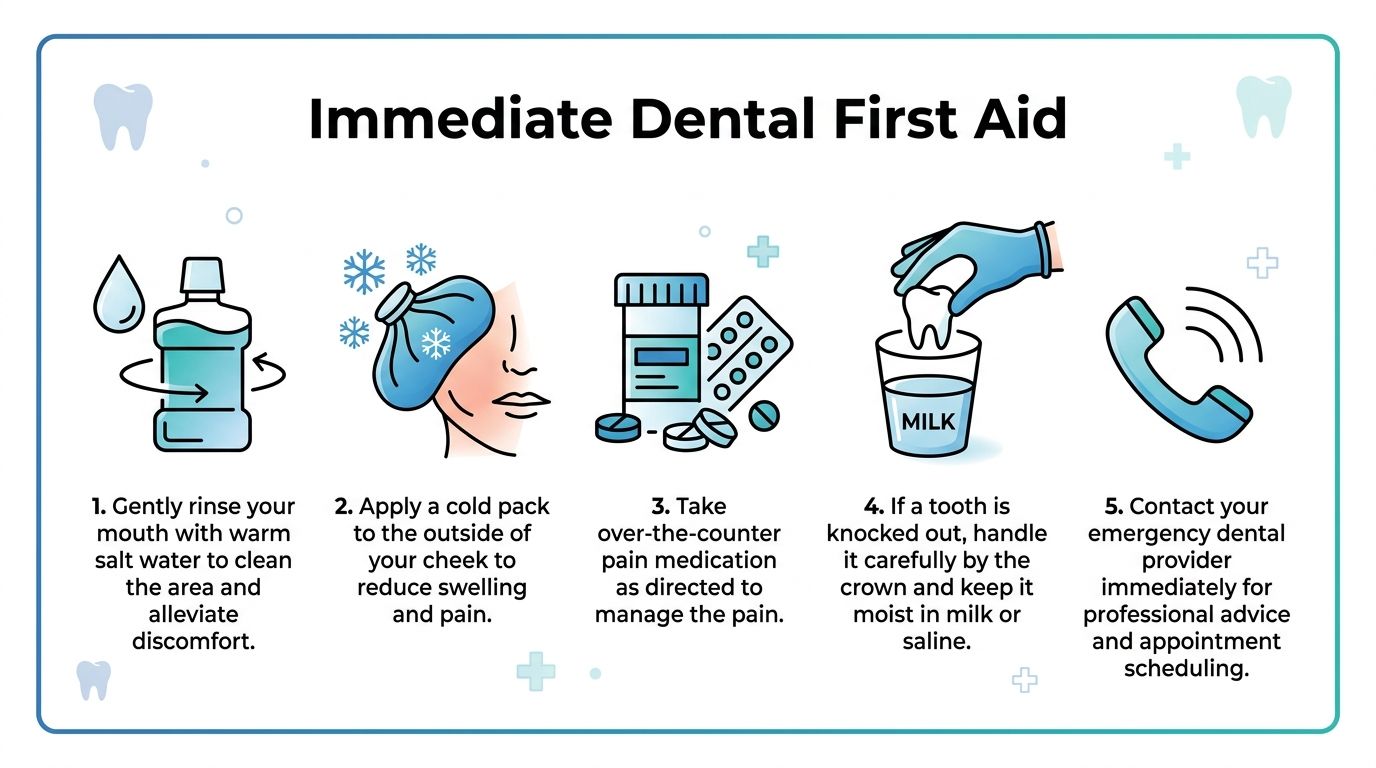
Start with these five steps
- Rinse gently
Use warm salt water if you can. This helps clear debris and makes the area easier to inspect.
- Use a cold pack
Hold it against the outside of the cheek. Cold helps with swelling and can dull pain.
- Take standard pain relief as directed
Use over-the-counter medication according to the label or advice from a pharmacist or doctor. Do not exceed the recommended dose.
- Protect the area
Avoid chewing on that side. Keep fingers and tongue away from the damaged tooth or swelling.
- Call a dentist immediately
Do this early, not after trying to “sleep on it”.
If a tooth has been knocked out
Handle it like something delicate and irreplaceable.
- Pick it up by the crown, not the root
- If dirty, rinse it briefly with clean liquid, but do not scrub it
- If possible, place it back in the socket gently
- If you cannot do that, keep it moist in milk or saline
- Get urgent dental help
The goal is simple. Keep the root surface as undisturbed and moist as possible until a dentist sees you.
If a tooth is chipped or broken
Small chips are one thing. A large fracture is another.
- Rinse your mouth
- Save any fragments if you can
- Cover sharp edges with clean gauze or dental wax if available
- Avoid biting with that tooth
- Arrange an urgent appointment if there is pain, sensitivity, or visible crack depth
If you have swelling or a suspected abscess
This is the one I want you to take seriously.
A hot, throbbing tooth with gum swelling, a bad taste, or facial swelling can indicate infection. Use a cold compress outside the face, rinse gently, and call for urgent care. Do not place heat on the swelling. Do not try to drain it yourself.
> If swelling is spreading or you have trouble swallowing, speaking, or breathing, go straight to hospital.
If it is a severe toothache
Toothache is not a diagnosis. It is a warning.
Try this:
- Clean between the teeth gently with floss in case food is trapped
- Rinse with warm salt water
- Take pain relief as directed
- Avoid very hot, very cold, or sugary foods
Do not place aspirin directly on the gum or tooth. That can irritate or burn the tissue.
If a filling or crown falls out
This often feels less dramatic, but it can become painful fast.
Keep the tooth clean, avoid chewing on it, and book an appointment promptly. If the crown has come off intact, take it with you. Do not glue it back yourself with household products.
Who to Call Private Emergency Dentists in Bendigo
Private care is usually the fastest path if you need prompt assessment and treatment. That is the practical reality.
Private emergency dental clinics in Bendigo often reserve daily same-day appointment slots and use tools such as CBCT 3D imaging to assess urgent problems accurately, with treatment for cases such as avulsions or fractures aimed to start within 24 hours, as described by National Dental Care McCrae Street’s emergency dental information.
What private clinics are generally best for
Private emergency dentists are often the right first call for:
- Knocked-out or displaced teeth
- Broken teeth
- Lost crowns, fillings, or veneers
- Sudden severe toothache
- Dental swelling
- Sporting injuries
- Cracked teeth that hurt on biting
The main advantage is speed. These clinics are set up to diagnose and act, not just tell you to wait.
What to say when you call
Do not say, “I need an emergency appointment.” Give the receptionist enough detail to triage you properly.
Tell them:
- What happened. Trauma, swelling, lost filling, pain, bleeding
- When it started
- Whether your face is swelling
- Whether the tooth is knocked out, loose, or broken
- Whether you can swallow and breathe normally
- What pain relief you have taken
- Whether you are an existing patient or new patient
This helps the clinic decide how urgently you need to be seen and what equipment or clinician may be needed.
What to expect at the appointment
Most private emergency visits follow a simple pattern.
| Stage | What usually happens | |---|---| | Assessment | History, examination, and often an X-ray or scan | | Pain control | Numbing the area or stabilising the source of pain | | Immediate treatment | Temporary filling, dressing, re-cementing, drainage, root canal start, or extraction depending on the case | | Next-step plan | You leave knowing whether you need follow-up treatment |
Not every emergency visit ends with the final solution on the spot. Sometimes the goal is to stop pain, control infection, and stabilise the tooth. That is still good care.
Ask direct questions
Many patients hold back. Do not.
Ask:
- Can you see me today?
- Is this likely to be an exam-only visit or treatment on the day?
- Do you offer after-hours advice?
- What payment options are available?
- What should I do before I arrive?
If you need to contact a clinic quickly, keep a direct practice contact page handy, such as the one at Oasis Smiles Dental contact.
> Best move: Call early, describe the symptoms clearly, and ask whether treatment can start on the same day. Waiting to “see if it settles” often turns a manageable problem into a bigger one.
Navigating Public and Hospital Emergency Dental Services
Public dental care and hospital care are not the same thing. Patients mix them up all the time, and that causes delays.
At Bendigo Health, public emergency dental care for adults requires a current Healthcare or Pension card, and patients are triaged into urgency categories, with the highest priority cases such as severe pain or swelling seen within 24 hours, according to Bendigo Health dental services.
When the public dental clinic makes sense
The public pathway is appropriate if:
- You are eligible, including holding the required card as an adult
- You have urgent dental pain or swelling
- You need assessment through the public system
- Your issue is significant but not immediately life-threatening
The triage system matters. It is designed to prioritise people with the greatest need first.
When the hospital Emergency Department is the right choice
Go to hospital, not a standard dental clinic, if you have:
- Facial swelling affecting breathing
- Difficulty swallowing
- Uncontrolled bleeding after trauma
- Severe infection with spreading swelling
- Major facial injury involving the jaw
- A child or adult who is becoming medically unwell
Hospital emergency departments are for threats to airway, bleeding, serious infection, or major trauma. They are not the best place for every toothache. But when they are needed, they are absolutely the right place.
Private, public, or hospital
This is the clearest way to choose.
| Situation | Best first option | |---|---| | Knocked-out adult tooth during clinic hours | Private emergency dentist | | Severe toothache and eligible for public care | Public dental clinic | | Facial swelling with trouble swallowing or breathing | Hospital ED | | Broken filling without severe pain | Next available dental appointment | | Dental trauma with bleeding and suspected jaw injury | Hospital ED |
A practical Bendigo decision rule
If you can speak comfortably, breathe normally, and the issue is painful but localised to the tooth or gum, start with a dentist. If the swelling is spreading or your general condition is worsening, bypass the dental waiting game and seek urgent medical care.
For patients comparing service pathways and urgent treatment options, this overview of emergency dentistry services gives a useful benchmark for what a dedicated urgent dental pathway should look like.
What to Expect Costs and Payments for Emergency Treatment
Cost worries stop people from calling. That is a mistake.
There is a real information gap in Bendigo around after-hours pricing. Public services have limited hours and involve co-payments, while private urgent care costs are not always clearly communicated upfront, as noted by Martin Vale Dentistry’s emergency dental page.
The right way to handle cost stress
Do not wait until you are in the chair to ask about fees. Ask on the phone.
You may not get an exact total immediately, because the final cost depends on the diagnosis. That is reasonable. But you should still expect clear answers about the consultation fee, likely treatment categories, and payment process.
Questions to ask before you book
Use this short checklist.
- What is the emergency consultation fee?
- Is there an extra after-hours charge?
- If treatment is needed today, how are fees explained before you start?
- Do you accept my health fund?
- Do you offer payment plans or staged treatment?
- If I am going through the public pathway, what co-payment applies?
A clinic that avoids these questions is making a stressful situation harder than it needs to be.
Why transparency matters
When people cannot get straight cost information, they delay care. Then the problem often gets worse, more painful, and more expensive to fix. That pattern is common, and it is avoidable.
> My advice: ask about fees early, ask again if the treatment plan changes, and ask for the next step in writing if needed.
If you want to understand practical patient matters such as payments, health funds, and visit preparation, a page like Oasis Smiles Dental patient information shows the kind of clarity patients should look for.
Managing Pain Until Your Appointment
Your job while waiting is simple. Keep the problem calm. Do not make it worse.
What helps
- Cold compress on the cheek for swelling
- Over-the-counter pain relief taken exactly as directed
- Soft food or no chewing on the sore side
- Warm salt water rinses if the area is irritated
- Head slightly elevated if throbbing is worse when lying flat
What to avoid
- Do not place aspirin on the gum or tooth
- Do not use heat on a swollen face
- Do not poke the area with sharp objects
- Do not keep testing the tooth by biting on it
- Do not take leftover antibiotics that were prescribed for something else
When pain changes the plan
Pain that escalates fast, keeps waking you, or comes with swelling, fever, or a foul taste should push the appointment higher on your priority list. Call back and tell the clinic the symptoms have changed.
You are not being difficult. You are giving updated clinical information.
How to Avoid Your Next Dental Emergency
Emergency treatment is important. Preventing the next crisis is better.
Across Victoria, about 40 percent of all public dental courses of care are for emergency or episodic treatment for acute problems, according to the Victorian Auditor-General report on access to public dental services. That is a strong sign that too many people enter the system when something already hurts.
Prevention beats rescue
The best way to stay out of urgent care is not glamorous.
- Book regular check-ups so cracks, decay, and failing fillings are caught early
- Use a custom mouthguard for sport, especially for children and teens
- Do not chew ice or hard objects
- Brush and clean between teeth properly
- Do not ignore a tooth that “only hurts sometimes”
Mouthguards matter
Sport and rough play cause a steady stream of avoidable dental injuries. A properly fitted mouthguard is one of the simplest protective steps you can take. If sport is part of your family routine, look at options such as custom mouthguards.
Prevention is less dramatic than emergency care. It is also cheaper, calmer, and far kinder to your teeth.
Your Emergency Dental Questions Answered
Should I go to the hospital for a toothache?
Not for an ordinary toothache alone. Go to hospital if you have serious swelling, trouble breathing, trouble swallowing, uncontrolled bleeding, or major facial trauma.
Is a child’s dental emergency different?
Yes. Children can deteriorate quickly, and trauma to baby teeth or adult teeth needs prompt assessment. If a child has swelling, bleeding, a loose tooth after trauma, or cannot settle because of pain, call for advice straight away.
Can a dentist diagnose me over the phone?
A phone call can help with triage and first-aid advice. It cannot replace an examination and imaging when needed. Use the call to decide urgency and get the right appointment.
What if it happens on a public holiday or late at night?
Call a private clinic and listen carefully to the recorded instructions or emergency contact process. If symptoms suggest spreading infection, airway risk, or major trauma, go to hospital.
Should I wait until morning if the pain eases?
No, not automatically. Pain that settles can still signal infection, fracture, or nerve damage. If the event was significant, keep the appointment.
---
If you need calm, practical help from an experienced family dental team, Oasis Smiles Dental offers modern emergency assessment, same-day support where possible, and clear treatment planning for patients across Tamworth and the New England region. If you are in pain, call early and get proper advice before the problem gets bigger.