
Mandibular Advancement Device Sleep Apnea Relief
You might be reading this after another rough night. Your partner says you snored, you woke up with a dry mouth or headache, and by mid-morning you already felt like you needed a nap. A lot of people in Tamworth and across regional Australia sit with those symptoms for far too long because they assume it’s “just snoring”.
Often, it isn’t.
A mandibular advancement device for sleep apnea is one treatment option that can make a real difference for the right person. It’s small, quiet, and custom-made to help keep your airway open while you sleep. If you’ve heard about CPAP but can’t imagine sleeping with a mask, or you’ve already tried one and struggled, this guide will help you understand what a mandibular advancement device does, who it may suit, and what the process looks like in an Australian dental setting.
Tired of Being Tired Understanding Obstructive Sleep Apnoea
Obstructive sleep apnoea, or OSA, happens when the airway partly or fully closes during sleep. The simplest way to picture it is like a soft straw that gets pinched shut. Air tries to move through, but the passage narrows or collapses, so your breathing pauses or becomes restricted.
That’s why OSA is more than noisy snoring. Snoring can be one clue, but the bigger issue is that your body keeps getting pulled out of deeper, restorative sleep so you can breathe again. Some people notice choking, gasping, broken sleep, morning headaches, or poor concentration. Others mostly notice the daytime effects: irritability, heavy fatigue, brain fog, and struggling to stay alert.
Why treatment matters
When breathing is disrupted night after night, the whole body feels it. Sleep becomes fragmented. Oxygen levels can drop. The stress response keeps firing when it should be quiet. Over time, this can affect blood pressure, heart health, mood, and daily function.
For many patients, the moment it clicks is this: treating sleep apnoea isn’t only about stopping snoring. It’s about protecting your health and helping you feel like yourself again.
> Sleep apnoea treatment should improve more than the bedroom noise. It should improve how you function during the day.
Why so many Australians are looking for alternatives
This is especially relevant here. In Australia, OSA affects an estimated 1 in 4 adult males, and Australian searches for “oral appliances for sleep apnea” surged over 200% from 2016 to 2024, while local studies report CPAP dropout rates as high as 50%, according to this Australian review of mandibular advancement devices and sleep apnoea trends.
That helps explain why more patients ask about oral appliances. They want treatment that works, but they also want something they can realistically keep using.
A diagnosis usually starts with a sleep study and a conversation about symptoms, risk factors, and treatment options. From there, the best choice depends on the severity of your OSA, your medical history, your teeth and jaw, and whether you’re likely to use the treatment consistently. If you’re exploring local care, our sleep apnoea treatment information outlines how dental appliance therapy fits into that pathway.
Common signs people brush off
A lot of patients don’t realise how many everyday problems can link back to poor breathing during sleep.
- Loud snoring often gets attention first, especially from a partner.
- Waking unrefreshed can happen even after what looked like a full night in bed.
- Daytime sleepiness may show up as poor focus at work, while driving, or while caring for children.
- Dry mouth or headaches in the morning can be another clue that sleep isn’t going well.
If that sounds familiar, it’s worth getting assessed rather than guessing. The right treatment starts with understanding what’s happening in your airway.
How a Mandibular Advancement Device Reopens Your Airway
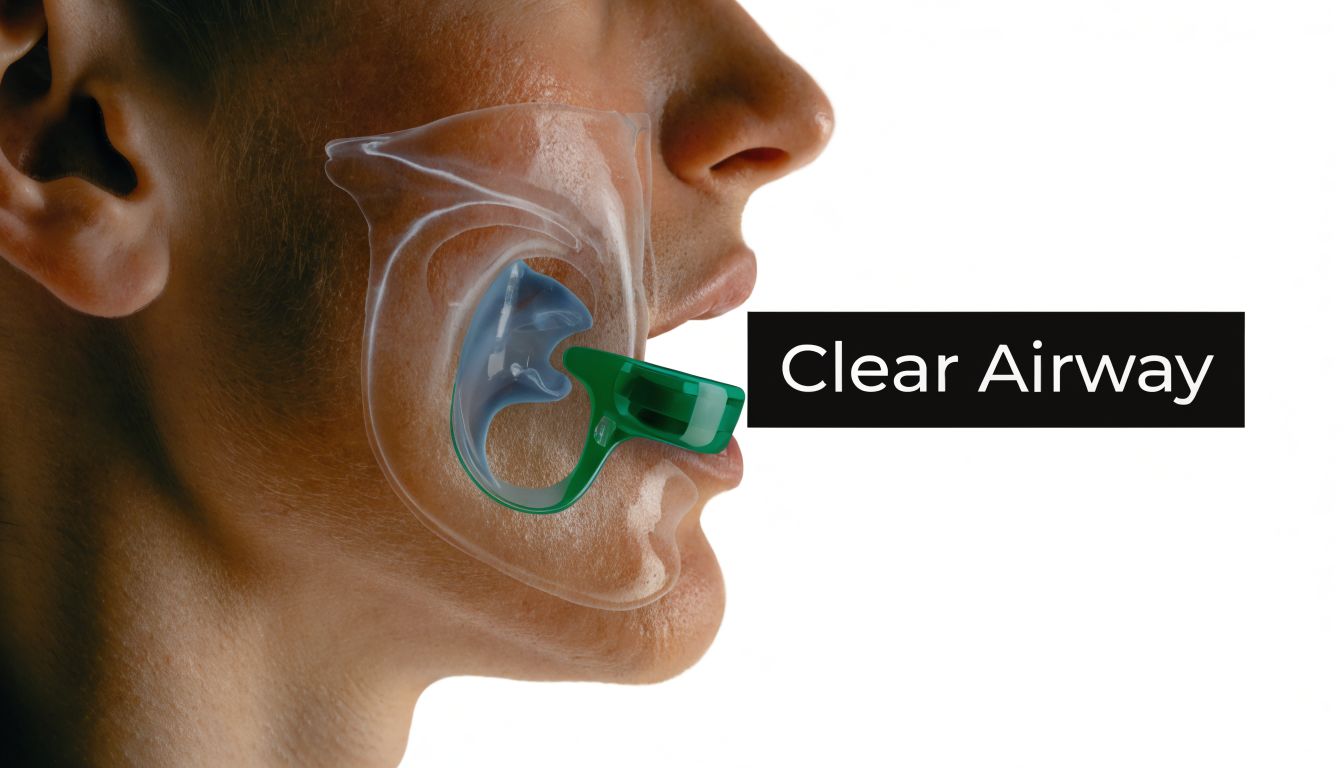
A mandibular advancement device, often shortened to MAD, is a custom oral appliance worn during sleep. It sits over your teeth a bit like a dental splint, but it’s not just a mouthguard. Its job is very specific: it gently holds your lower jaw forward to help stop the airway from collapsing.
Think of it as holding a soft hallway open. When the jaw sits slightly further forward, the tongue and surrounding soft tissues are less likely to fall back and block airflow. That extra space can make breathing steadier through the night.
It’s not guesswork
This treatment works best when it’s calibrated properly. Research shows MAD therapy is dose-dependent, meaning the position matters. Advancing the mandible to about 75% of its maximum protrusion is required for a satisfactory clinical effect, and that degree of advancement can reduce the Apnoea-Hypopnoea Index by an average of 16.8 events per hour, according to this review of oral appliance therapy mechanisms and outcomes.
That’s why a proper custom device is different from something bought off the shelf. The goal isn’t to force the jaw as far forward as possible. The goal is to find the right position. Enough to improve airflow, but not so much that you create unnecessary jaw strain or bite discomfort.
What a custom device is actually doing
A well-made mandibular advancement device sleep apnea appliance usually works in a few ways at once:
- Moves the lower jaw forward so the airway has more room.
- Helps the tongue sit further forward instead of drifting back.
- Supports a more stable airway shape during sleep.
- Allows gradual adjustment so the fit and position can be refined over time.
The appliance itself is usually made in two parts, one for the upper teeth and one for the lower teeth, linked in a way that controls jaw position. Some designs allow very fine titration, which means tiny adjustments rather than big jumps.
If you want to see how a custom oral appliance for sleep apnoea is used in practice, it helps to think of it less like a generic mouthguard and more like a carefully prescribed dental treatment.
Why custom fitting matters
A common point of confusion is this: if the idea sounds simple, why do I need a dentist for it?
Because your bite, jaw joints, tooth positions, existing dental work, and range of jaw movement all affect how safely and effectively the device can be made. Two people with the same sleep study result might need very different appliance settings.
> Practical rule: A mandibular advancement device should feel deliberate and controlled, not bulky, loose, or randomly positioned.
That precision is the whole point. The device is small, but the planning behind it is detailed.
CPAP vs Mandibular Advancement Device A Clear Comparison
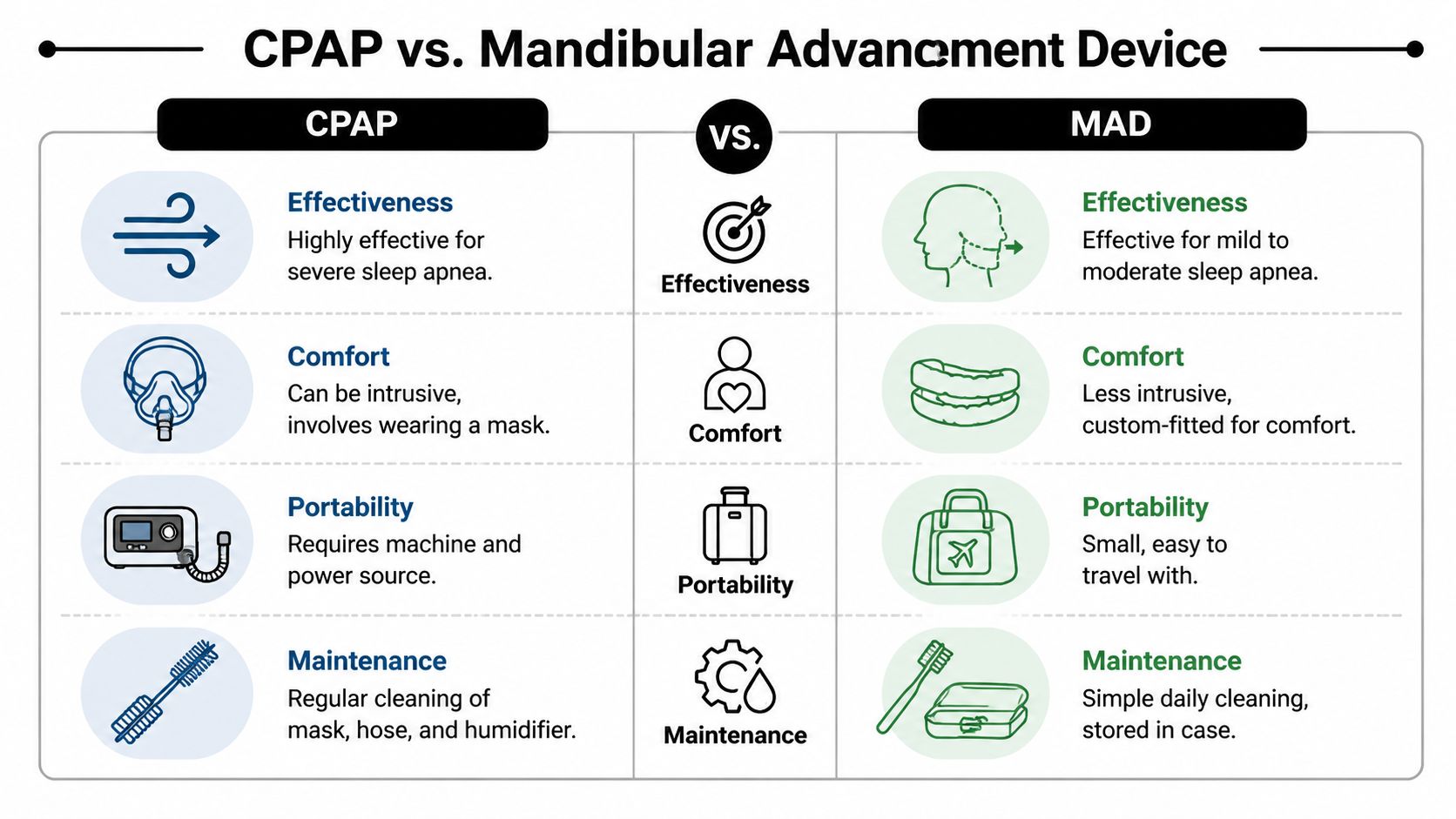
Individuals often first learn about CPAP when they’re diagnosed with sleep apnoea. CPAP uses pressurised air delivered through a mask to keep the airway open. It’s a well-known and important treatment. But it’s not the only one.
A mandibular advancement device approaches the same problem differently. Instead of using airflow from a machine, it changes jaw position to support the airway from within. For the right patient, that difference can be huge in daily life.
The clinical comparison that matters most
Some patients worry that choosing an oral appliance means settling for a weaker option. That’s not the right way to think about it. A network meta-analysis found that MAD and CPAP produce equivalent reductions in blood pressure for patients with OSA, with no statistically significant difference between them, as summarised by the Sleep Apnea Association’s review of oral appliance treatment.
That matters because sleep apnoea treatment isn’t only about snoring volume. It’s also about meaningful health outcomes.
Day-to-day differences
Here’s the practical side-by-side view most patients want.
| Treatment area | CPAP | Mandibular advancement device | |---|---|---| | How it works | Uses pressurised air through a mask | Repositions the lower jaw forward | | What you wear | Mask, tubing, machine | Small custom oral appliance | | Noise | Machine noise may bother some users | Quiet | | Travel | Bulkier, needs equipment and power planning | Compact and easy to pack | | Cleaning | More parts to clean and maintain | Simpler daily cleaning routine | | Comfort | Some people adjust well, others struggle with mask fit or airflow | Often easier for patients who dislike masks |
Which one feels easier to live with
This comes down to your habits and tolerances.
Some people do very well with CPAP from the first week. They like the structure, don’t mind the mask, and feel noticeably better once they settle into it. For them, it may be an excellent long-term choice.
Others keep running into the same barriers:
- Mask discomfort makes it hard to fall asleep.
- Claustrophobic feelings cause anxiety or restless nights.
- Machine setup feels like too much when travelling or sleeping away from home.
- Bed partner issues arise because of noise, tubing, or bedroom disruption.
For that group, a custom MAD can feel more natural. It’s inserted like a dental appliance, not strapped to the face. There’s no hose, no bedside machine, and no power source to think about.
> If a treatment works well on paper but sits in the cupboard at home, it isn’t helping you.
The right question to ask
Rather than asking, “Which treatment is better for everyone?”, ask, “Which treatment am I most likely to use properly and consistently?”
That question often leads to a more honest conversation. The best treatment plan is based on your sleep study, your symptoms, your airway, and your ability to live with the treatment night after night. In many cases, the answer is CPAP. In others, it’s a mandibular advancement device. Sometimes patients use one after struggling with the other.
The aim isn’t to win an argument between two devices. The aim is to keep your airway open and help you stay on treatment.
Are You a Good Candidate for a Sleep Apnoea Mouth Guard
A lot of people assume a sleep apnoea mouth guard is only for mild snoring. That’s too narrow. The better question is whether your breathing problem, anatomy, and lifestyle make a mandibular advancement device a sensible option.
Traditionally, these appliances are commonly considered for mild to moderate OSA, especially when a patient wants a smaller, quieter treatment. They’re also frequently discussed when someone has already tried CPAP and can’t tolerate it.
People who often ask about a MAD
You may want to discuss a custom device if any of these sound familiar:
- You couldn’t adapt to CPAP even though you gave it a real try.
- You travel often and want something simpler to carry and use.
- You’re a light sleeper and dislike the feeling of a mask or airflow.
- Your partner notices snoring and you want a quieter treatment option.
- You want a custom-fitted solution rather than a generic appliance.
That still needs proper assessment. A mouth guard that helps one person may be the wrong choice for another, especially if there are dental or jaw joint concerns.
Severe sleep apnoea isn’t an automatic no
Many patients are surprised to learn that even in very severe OSA patients with a median AHI of 60 who could not tolerate CPAP, a 2024 study found that a mandibular advancement device achieved a mean 72.5% reduction in AHI, and over 95% of patients achieved at least a 50% drop in AHI, according to this PubMed study on MAD treatment in very severe OSA.
That doesn’t mean every severe case should skip straight to a dental appliance. It does mean that “severe” and “hopeless if CPAP fails” are not the same thing.
> Some patients come in thinking they’ve run out of options. They often haven’t. They just need a treatment pathway tailored to their situation.
What your dentist also needs to assess
Suitability isn’t only about the sleep study. Your mouth matters too.
A dentist will look at factors such as:
- Teeth and gum health because the appliance needs stable support.
- Jaw comfort and movement to make sure forward positioning is realistic.
- Existing bite issues that may influence design and titration.
- TMJ symptoms including clicking, pain, locking, or muscle tenderness.
If you already have jaw concerns, it’s sensible to raise them early. Patients with TMJ symptoms or jaw joint concerns may still be candidates, but the design and monitoring plan need extra care.
The key point is simple. Candidacy is individual. A proper exam turns a vague “maybe” into a useful answer.
Your Custom-Fitting Journey at Oasis Smiles Dental
Patients often feel less anxious once they know what the process looks like. A custom mandibular advancement device isn’t made in one quick step. It’s built through assessment, measurement, fitting, and refinement.
That matters because broad online advice can only go so far. Much Australian-specific information on compliance, cost patterns, and suitability for regional demographics isn’t widely available, which is why a professional assessment is so important, as noted in this review discussing gaps in Australian-specific oral appliance information.
Step one is understanding you, not just the device
The first appointment is usually a conversation as much as an examination. Your dentist will want to know what symptoms you’re having, whether you’ve had a sleep study, what happened if you tried CPAP, and what your goals are. Some patients mainly want to stop snoring. Others are exhausted, worried about health risks, or desperate for a treatment they can tolerate.
Then comes the dental side. Teeth, gums, bite, jaw movement, and any signs of grinding or TMJ strain are assessed. Existing crowns, bridges, implants, or wear patterns may affect appliance choice and fit.
The records need to be precise
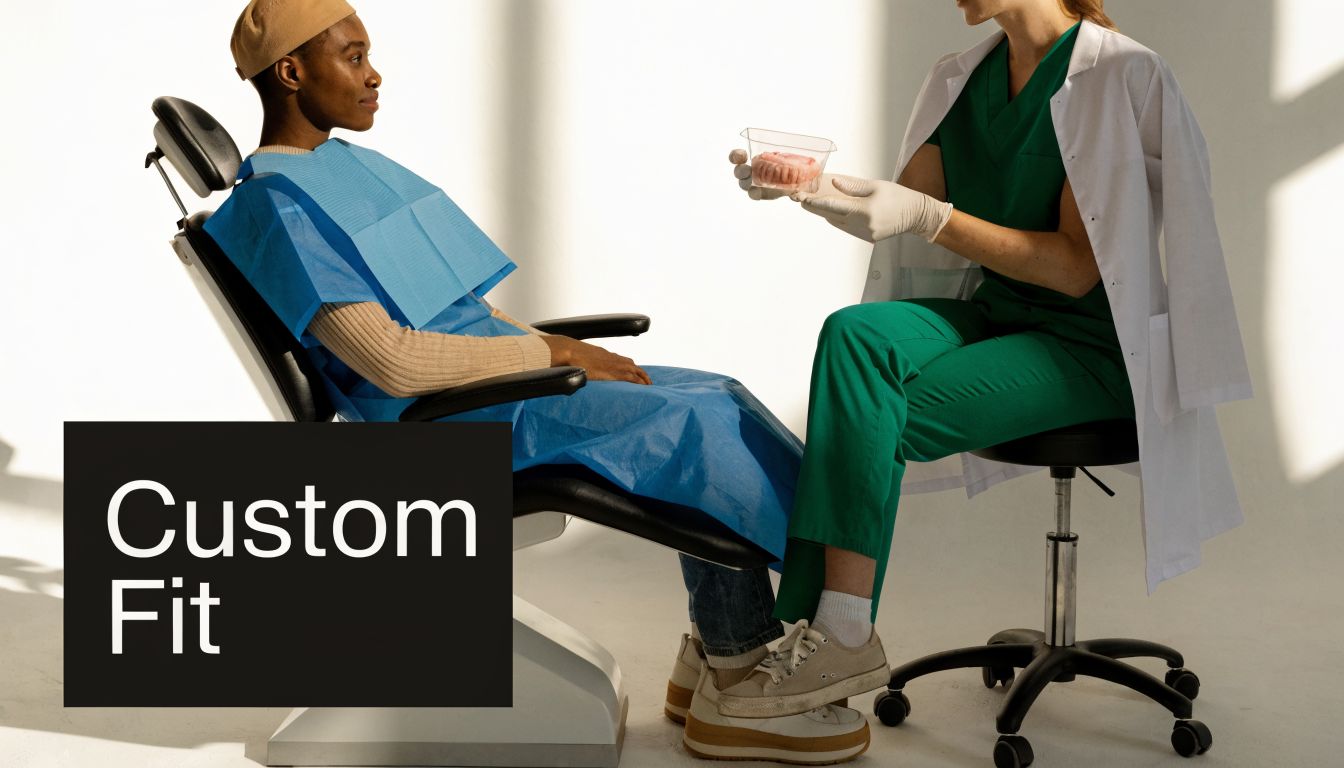
A custom appliance starts with accurate records of your mouth and jaw position. In a modern clinic, that may involve digital scans rather than old-style impression trays, though the exact method depends on the case.
Advanced imaging can also help. At Oasis Smiles Dental, technology such as CBCT 3D imaging and Trios digital scanning supports detailed planning for many dental treatments, and you can see the practice’s dental technology including CBCT and digital scanning on its website. For sleep appliance patients, that level of detail helps guide fit, comfort, and safe adjustment.
What happens after the device is made
Once the appliance is fabricated, the fitting visit is about more than handing it over. The dentist checks retention, comfort, insertion and removal, and the starting jaw position. You’ll also be shown how to wear it, clean it, and store it.
Most patients don’t start at the final position on night one. The device is usually set at a controlled starting point and then adjusted gradually. This process is called titration. It helps balance effectiveness with comfort.
Here’s what that journey usually involves:
- Initial consultation
- Digital records and measurements
- Custom fabrication
- Fitting appointment
- Review and adjustment
> A good fitting process doesn’t rush to the furthest jaw position. It builds toward the most effective and tolerable position for that patient.
Why follow-up matters so much
A mandibular advancement device is not a “set and forget” item. Your symptoms, jaw comfort, tooth pressure, and sleep response need review. If the device is helping but not enough, the next adjustment may improve things. If it feels too tight or causes soreness, the fit or settings may need modification.
That ongoing review is where custom treatment becomes personalised treatment. It gives you a better chance of ending up with a device you’ll use.
Life with Your Device Aftercare and Troubleshooting
The first few nights with a mandibular advancement device can feel unfamiliar. That’s normal. Your mouth and jaw are adapting to sleeping in a new position, and most patients need a settling-in period before the appliance feels routine.
The aim isn’t perfection on night one. The aim is steady adaptation with good support if anything feels off.
What you might notice at first
A few early reactions are common with oral appliances:
- Jaw muscle awareness when you wake up, especially in the first days or after an adjustment
- More saliva than usual, or sometimes a dry mouth feeling
- Tooth tenderness or pressure when inserting or removing the device
- Mild bite stiffness first thing in the morning
These issues don’t automatically mean the device is wrong. They often mean your mouth is adjusting. What matters is whether symptoms are mild and settling, or persistent and worsening.
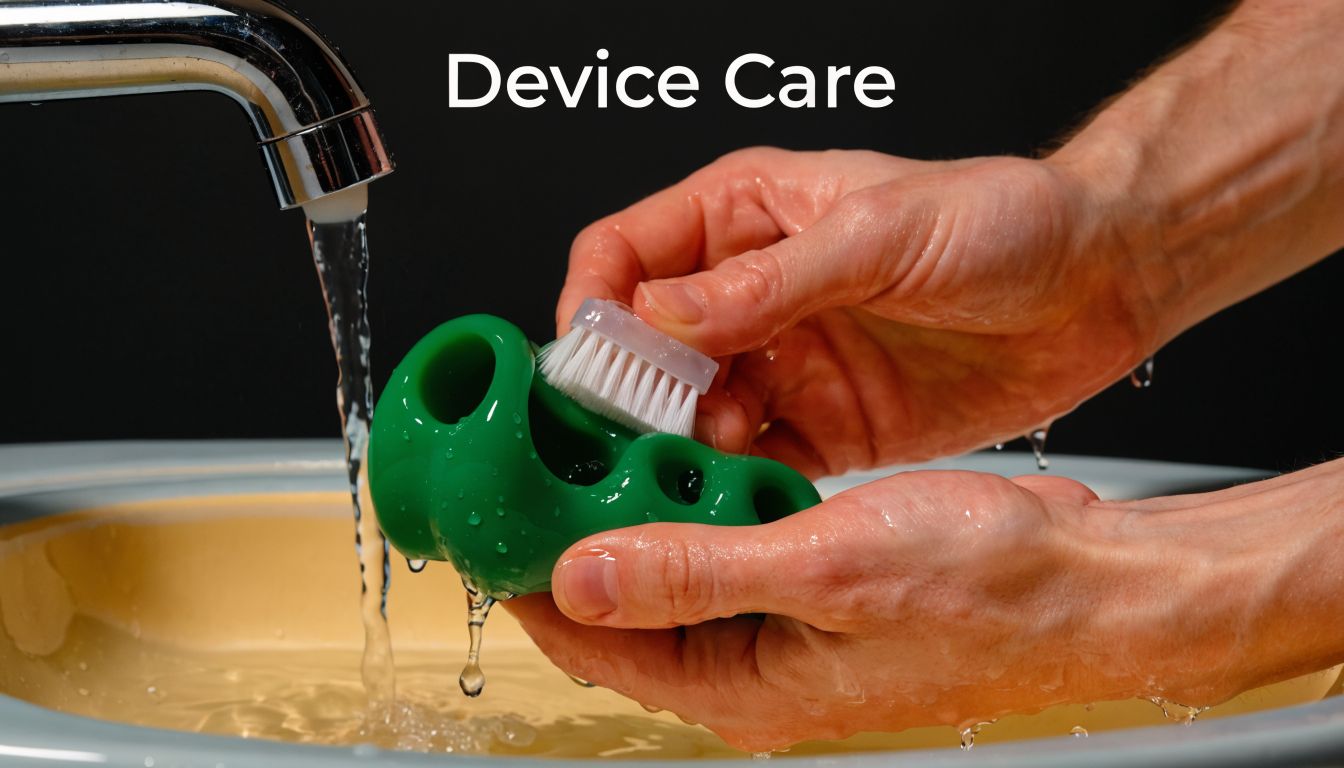
Everyday care that keeps the device in good shape
The routine is simple, but consistency matters.
- Clean it every morning using the method your dentist recommends.
- Store it dry and safely in its case when it’s not being worn.
- Keep it away from heat so the material doesn’t distort.
- Bring it to reviews so your dentist can check wear, fit, and function.
It also helps to keep a brief note of how you’re sleeping in the early weeks. Are you snoring less? Waking less? Feeling more alert? Those details can guide adjustments.
When to call for a review
Don’t wait if something doesn’t feel right.
Contact your dental team if you notice:
- Ongoing jaw pain rather than mild temporary soreness
- A fit that becomes loose or difficult
- New bite changes that don’t settle after waking
- Breakage, cracking, or warping
- No improvement in symptoms after the expected adjustment period
> If the device is uncomfortable enough that you’re avoiding it, that’s a review issue, not a willpower issue.
The best long-term results usually come from small corrections made early. Most problems are easier to fix when they’re addressed promptly.
Common Questions About Mandibular Advancement Devices
How much does a custom mandibular advancement device cost in Australia
The honest answer is that costs vary, and broad Australian-specific cost data isn’t well covered in mainstream information. Fees can depend on the appliance type, the complexity of your bite, whether imaging or extra reviews are needed, and how your provider structures treatment.
Health fund, Medicare, and DVA arrangements can also differ by patient and circumstance. Because that information isn’t consistent enough to summarise as a single national answer, it’s best to ask for an itemised treatment plan after a proper assessment.
Is a custom device different from a chemist mouthguard
Yes. A custom sleep apnoea appliance is prescribed and adjusted for airway treatment. A basic over-the-counter mouthguard is usually made for general mouth protection or grinding support, not calibrated sleep apnoea therapy.
A custom mandibular advancement device is designed around your teeth, your bite, your jaw movement, and your treatment position. That precision is what makes it a medical treatment rather than a generic plastic tray.
Will it cure my sleep apnoea
It’s better to think in terms of management than cure. The appliance works while you wear it, helping keep the airway more open during sleep. For many patients that means less snoring, fewer breathing interruptions, better sleep quality, and better daytime function.
Whether it becomes your long-term treatment depends on how well it works for your case and how comfortably you can use it over time.
Can I use one if I have crowns, bridges, or implants
Often, yes. But it depends on where that dental work is, how stable it is, and how the appliance would sit over it. A dentist needs to assess whether your teeth and restorations can safely support the device.
This is one reason self-diagnosing from online articles can be misleading. Two people with similar symptoms may need very different appliance designs because their mouths are different.
What if I grind my teeth
That’s something to mention at the first appointment. Grinding doesn’t automatically rule out a sleep apnoea appliance, but it can affect material choice, design, and how closely the appliance needs monitoring.
The same goes for jaw clicking, facial muscle fatigue, or previous TMJ discomfort. These details matter.
How long does the fitting process take
The process usually involves multiple appointments rather than one single visit. There’s the consultation, the records, the fitting, and follow-up adjustments. The exact timing depends on how the appliance is made and how much titration is needed.
Most patients find the staged approach reassuring because it allows the fit to be refined rather than rushed.
Will I be able to sleep with it straight away
Many people can sleep with it from the first night, but “comfortable straight away” and “completely familiar straight away” are different things. You may need a short adjustment period. That doesn’t mean the device is failing.
If it feels awkward at first but manageable, that’s common. If it feels painful or impossible to tolerate, the appliance should be reviewed.
Is it only for people who snore
No. Snoring is one reason people seek help, but its primary purpose as a mandibular advancement device sleep apnea appliance is to treat obstructive sleep apnoea by improving airway stability during sleep.
A person can have severe snoring without meaningful OSA, and another person can have significant OSA that isn’t recognised until a sleep study. That’s why diagnosis matters.
What should I bring to a consultation
If you have them, bring:
- Your sleep study results
- A list of symptoms you or your partner have noticed
- Details of previous CPAP use, if applicable
- Your medical history and medications
- Questions about comfort, travel, cost, and follow-up
That gives the dentist a clearer picture and makes the conversation more useful from the start.
---
If you’re looking for a practical next step, Oasis Smiles Dental offers assessment and custom oral appliance care for patients in Tamworth and the New England region. A consultation can help determine whether a mandibular advancement device suits your sleep apnoea, your jaw, and your day-to-day life.