

A Patient's Guide to Radiology in Dentistry
At its most basic, radiology in dentistry is about using imaging, like X-rays, to get a clear look inside your teeth and jaw. Think of it as our way of seeing what the naked eye can’t, making sure *nothing important is missed* during your check-up.
What Modern Dental Radiology Means for You
Have you ever wondered why we take those pictures of your teeth? It’s a vital part of modern dentistry. Just like a mechanic needs to look inside an engine to see what’s really going on, we use imaging to get a truly accurate picture of your oral health. This process, known as dental radiology, goes far beyond just looking for cavities.
These images are the foundation of any good treatment plan. They let us spot potential issues long before they become painful or complicated problems. For our patients here in Tamworth and across the New England region, it’s often the first and most important step towards achieving a healthy, confident smile.
A Deeper Look Without the Guesswork
Radiology helps us visualise all the complex structures hidden away under your gums. Without these images, we’d only have part of the story, and that’s just not good enough when it comes to your health. These detailed pictures give us the critical insights we need to guide every decision we make.
With this technology, we can: * Find decay hiding between teeth or underneath old fillings. * Check the health of the bone that supports your teeth. * Examine the delicate roots and nerves inside your teeth. * Carefully plan for more complex treatments like orthodontics or implants.
What this really means is that your care is based on solid evidence, not guesswork. It’s our guarantee that the treatment you receive is precisely what you need—no more, no less.
> At its heart, dental radiology is all about being proactive. By catching problems when they’re small, we can often recommend simpler, less invasive, and more affordable treatments that help you keep your natural teeth for life.
For example, a tiny spot of decay we see on a routine X-ray can be fixed with a simple filling. If we didn't see it, that same spot could grow until it needs a more serious procedure, like a root canal. This focus on early detection is a principle we’ve stood by for the 20+ years we've cared for local families. The advanced imaging at our Piper Street clinic is just one way we deliver on our commitment to your long-term health. To see how this technology fits into our overall approach, you can learn more about the technology at Oasis Smiles Dental. Our goal is simple: to make every diagnosis accurate and every treatment a success, so you can feel comfortable and confident in your care.
A Visual Tour of Different Dental X-rays
When we need to see what’s happening beneath the surface of your smile, we rely on dental x-rays. But just like a photographer has different lenses for portraits and landscapes, we have different types of x-rays for different jobs. Each one gives us a unique view, helping us build a complete picture of your oral health.
At Oasis Smiles Dental, we don’t believe in a one-size-fits-all approach. We carefully select the right imaging tool for the task at hand, whether it's a tiny, detailed snapshot or a broad, sweeping view of your entire jaw. Let’s walk through the common types we use and what they help us see.
Small Pictures with Big Details
The x-rays you’re probably most familiar with are the small ones we take inside your mouth. These are called intraoral x-rays, and you can think of them as close-up portraits of your teeth. They’re absolutely essential for routine check-ups, giving us incredible detail to diagnose specific problems.
We regularly use two main types:
- Bitewing X-rays: These are the ones we typically take during your regular check-up. You simply bite down on a little tab, and in one shot, we get a clear view of the crowns of your upper and lower teeth. Their most important job is finding decay hiding between your teeth—a spot where cavities love to start but are impossible to see with just a mirror.
- Periapical X-rays: When we need to see a whole tooth, from the very top (the crown) all the way down to the tip of the root, we use a periapical x-ray. This view is crucial for checking the health of the bone that supports the tooth. It helps us spot issues like abscesses, hidden fractures, or problems connected to root canal therapy.
These small, focused images are the true workhorses of diagnostic dentistry. They give us the specific information we need to catch issues early, long before they turn into bigger, more complex problems.
The concept map below shows how all our diagnostic tools, including these x-rays, fit into our commitment to accurate diagnosis, careful planning, and your safety.
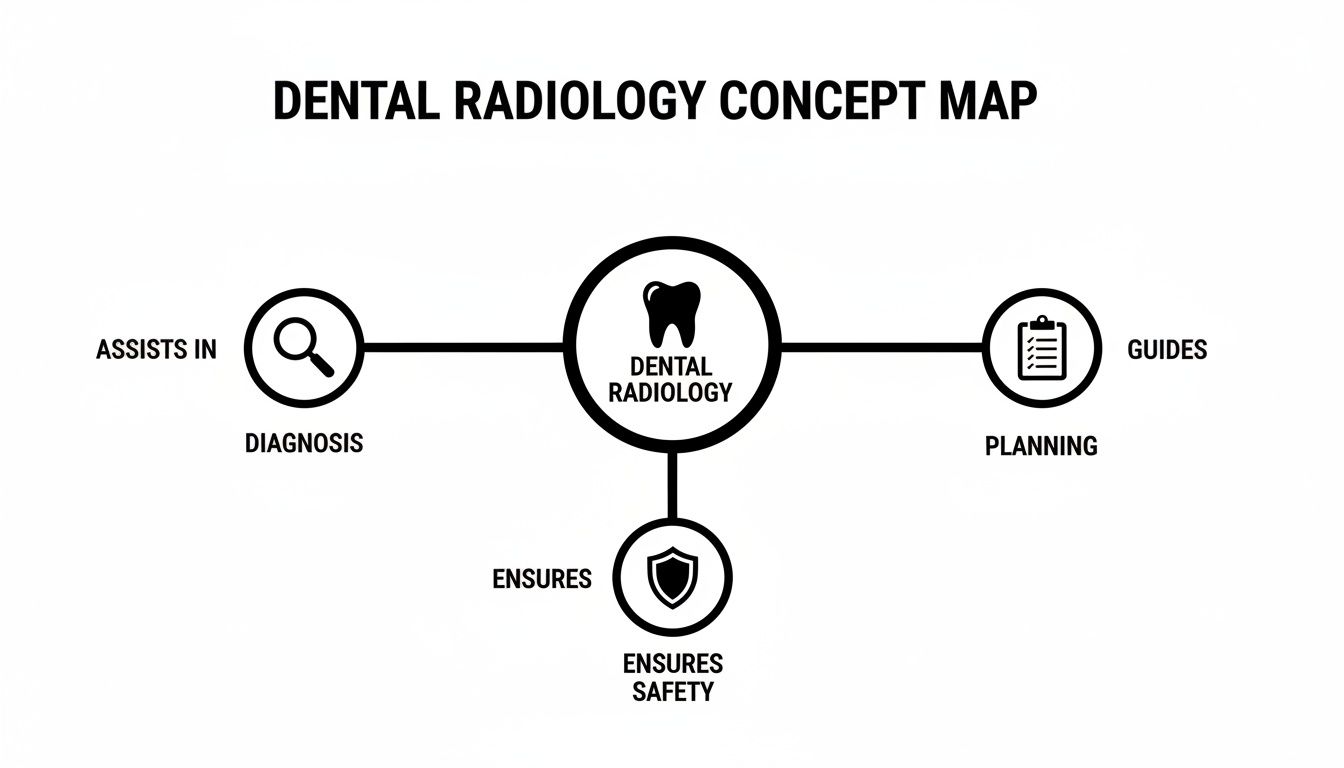
As you can see, every image we take is guided by these principles. It ensures that our use of technology is always purposeful and focused squarely on you.
Seeing the Whole Smile at Once
Sometimes, we need to step back and look at the bigger picture. That’s where a panoramic x-ray, also known as an OPG, comes in. Instead of a close-up, an OPG gives us a single, wide image of your entire mouth. It captures all your teeth, both your upper and lower jaws, and even your jaw joints (TMJ) in one go.
> A panoramic x-ray is like a sweeping landscape photo of your mouth. It provides a fantastic overview for assessing jaw development, bone levels, and the position of teeth that haven't even come through yet.
For a panoramic scan, you simply stand still for a few seconds while the machine slowly and quietly rotates around your head. Because the sensor stays outside your mouth, the whole process is quick, open, and comfortable.
We find OPGs incredibly helpful for:
- Wisdom Teeth Assessment: They give us a perfect view of the position, development, and angle of your wisdom teeth. This helps us see if they’re impacted or likely to cause trouble down the track.
- Orthodontic Planning: Before starting treatments like braces or Invisalign, an OPG helps us evaluate the overall jaw structure and tooth development.
- Implant Planning: It gives us an excellent initial look at the jawbone, allowing us to see if there’s enough bone height to place dental implants.
- General Oral Health Overview: An OPG can help us spot things that smaller x-rays would miss, like cysts, tumours, or other abnormalities in the jaw.
A Quick Look at Common Dental Scans
To make it even clearer, here’s a simple table outlining the different scans we use at Oasis Smiles Dental and what they’re best for.
| Imaging Type | What It Is Used For | Best For Diagnosing | | :--- | :--- | :--- | | Bitewing X-ray | Captures a close-up of several teeth in one area. | Cavities between teeth, changes in bone density due to gum disease. | | Periapical X-ray | Shows a single tooth from crown to root tip. | Root problems, abscesses, issues with the surrounding bone. | | Panoramic X-ray | Provides a wide view of the entire mouth. | Impacted wisdom teeth, orthodontic planning, jaw joint issues. |
By combining these different views, we can piece together all the clues needed to understand your oral health completely. Whether it’s a tiny bitewing or a full panoramic scan, each image is a valuable part of the puzzle that helps us keep your smile healthy for life.
Why 3D CBCT Scans Are Such a Big Deal in Dentistry
While our standard 2D x-rays give us a fantastic amount of detail for most dental work, sometimes we need to see the bigger picture. That’s when we turn to a seriously impressive piece of technology: the Cone Beam Computed Tomography, or CBCT scanner. Here at Oasis Smiles Dental, having our own on-site CBCT scanner is central to how we plan and deliver precise, safe care.
Think of it this way. A normal 2D x-ray is like looking at a flat street map. It’s great for seeing the main roads and getting a general idea of the layout. A CBCT scan, on the other hand, is like having a fully interactive 3D model of that same city. You can spin it around, zoom in on a single building, and see exactly where every laneway and underground pipe is located.
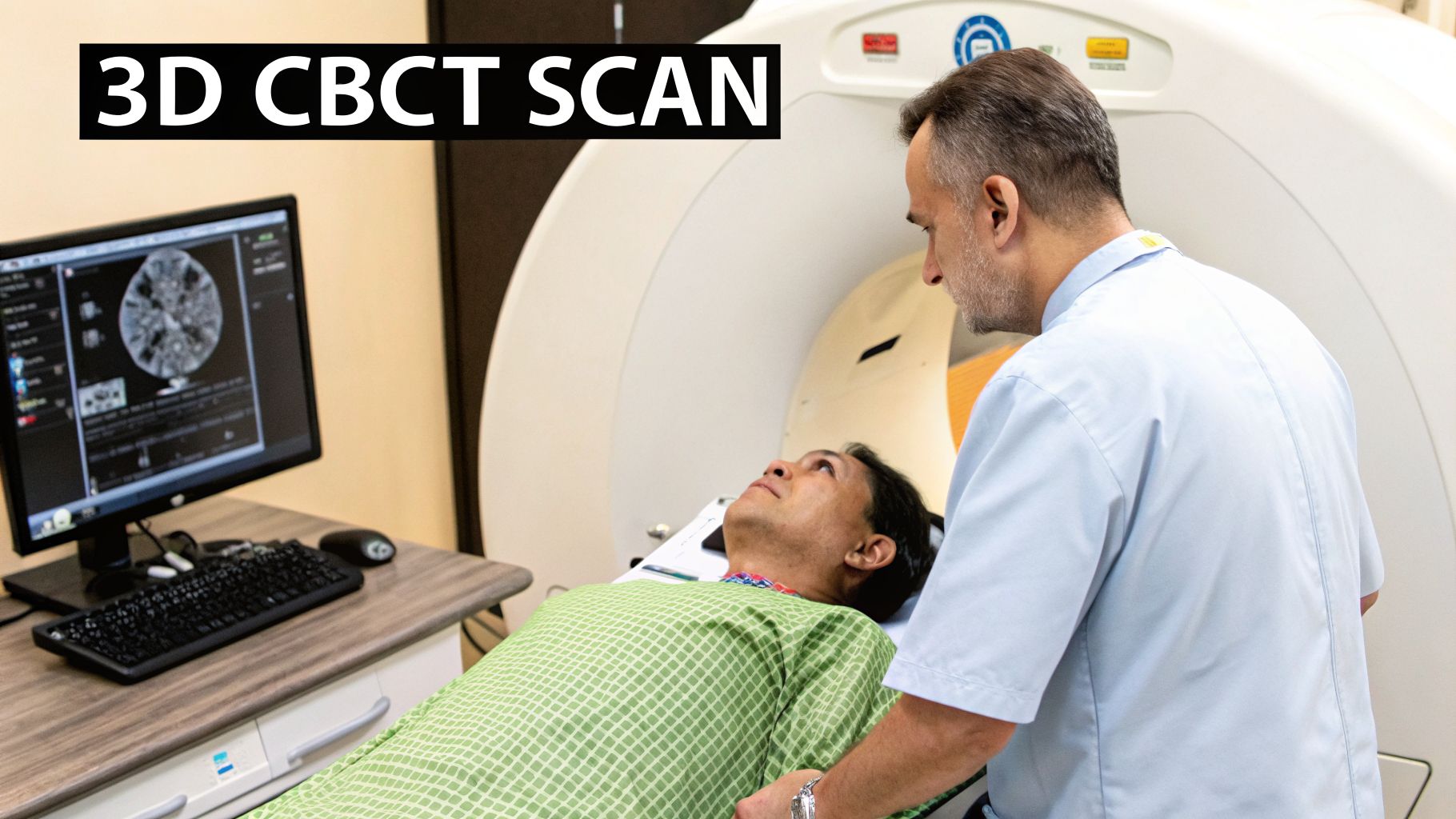
It’s that incredible depth that makes all the difference. Instead of one flat picture, the CBCT scanner uses a cone-shaped beam that rotates around your head in just a few seconds. It captures hundreds of individual images, which a powerful computer then pieces together to create a perfect 3D digital model of your teeth, jaw, and facial anatomy.
More and more dentists are seeing just how valuable this technology is. In fact, adoption of 3D CBCT imaging in Australian dental clinics has already reached 35%, a clear sign of how it’s improving diagnostics and treatment. We're proud to be one of the practices bringing this level of care to our community in Tamworth. You can read more about dental industry trends in Australia if you're curious.
Precision Planning for Complex Procedures
The real magic of CBCT happens before we even start a procedure. This detailed 3D view gives us a crystal-clear map of your bone, soft tissue, nerve pathways, and tooth roots. It takes the guesswork completely out of the equation, which is critical for complex treatments that demand absolute accuracy.
This isn’t just a ‘nice-to-have’ feature. For some of the most important procedures we do, having this level of detail is essential for a safe, predictable, and successful outcome.
> CBCT imaging turns our treatment planning from a well-educated estimate into a precise digital blueprint. It gives us the confidence to work around complex anatomy safely and carry out our plan with incredible accuracy, which has a direct impact on your final result.
This is especially true for treatments where even a millimetre can make a huge difference. Seeing the exact shape and density of your jawbone, for example, lets us plan with a level of detail we simply couldn't achieve before.
Real-World Applications at Oasis Smiles Dental
So, when would we actually recommend a CBCT scan? We reserve it for those cases where a standard x-ray just doesn’t give us the full story. Here are a few practical examples of how we use it to deliver better care for our Tamworth patients.
- Dental Implant Placement: This is where CBCT is an absolute superstar. We can measure the exact height and width of your jawbone to ensure there’s enough solid bone to support an implant. Most importantly, it allows us to map the precise location of major nerves and sinuses so we can place the implant safely, steering clear of any potential problems. This meticulous planning is the key to long-term success, and you can find out more about our dental implant process on our website.
- Difficult Root Canals: Some teeth have really tricky root systems with tiny extra canals or sharp curves that a 2D x-ray might miss. A CBCT scan reveals the entire root structure in 3D, making sure we can find, clean, and seal every last canal for a much more successful treatment.
- Full Mouth Rehabilitation: When a patient needs a lot of restorative work, a CBCT scan gives us a complete overview of their entire oral system. This helps us design a comprehensive treatment plan that addresses all the underlying issues for a result that is both functional and beautiful.
Enhancing Cosmetic and Orthodontic Outcomes
Predictability is just as vital when it comes to cosmetic and orthodontic treatments. For anyone in the New England region considering a smile makeover or Invisalign, a CBCT scan can be an invaluable part of the process, helping us get a perfect fit and a brilliant final outcome.
Here’s how it helps: 1. Invisalign and Braces: In orthodontics, a CBCT gives us a clear picture of how the tooth roots are positioned within the jawbone. This allows us to plan tooth movements more safely and effectively. 2. Smile Design: When we’re planning for veneers or other cosmetic work, a 3D view helps us understand the bone and tooth structure underneath, leading to a more stable and aesthetically pleasing result. 3. Wisdom Teeth Extractions: A CBCT scan lets us see the exact position of a wisdom tooth in relation to the major nerve in the lower jaw. This is critical information for planning a safe and straightforward extraction.
Having this technology right here in our Piper Street clinic means faster, more integrated care for you. You don’t have to drive to a separate imaging centre, which saves you a lot of time and hassle. We can take the scan, go over the images with you on the screen, and create a precise treatment plan—all in one visit. It’s just one more way we’re working to make exceptional dentistry convenient for our community.
How Better Imaging Leads to Better Results
It’s one thing to know about the different types of dental scans, but what does it all really mean for you? The truth is, advanced radiology isn’t just about taking fancy pictures. It’s about how we use those detailed images to deliver healthier smiles, more predictable treatments, and genuine peace of mind.
Here at Oasis Smiles Dental, we never take an x-ray just for the sake of it. Every image has a purpose. It’s the essential tool that lets us see exactly what’s going on, so we can create a treatment plan that is not only effective but carefully designed for success.
Spotting Problems Before They Hurt
One of the biggest advantages of modern dental imaging is our ability to find problems long before you feel any pain. Many serious issues, from deep cavities and infections to bone loss around your teeth, often start silently, with no symptoms at all.
Think of a routine bitewing x-ray as your mouth’s smoke detector. It can pick up a tiny spot of decay hiding between your teeth when it’s still small and can be fixed with a simple filling. If we don't spot it, that little cavity can quietly grow until it hits the nerve, causing a nasty toothache and likely needing a more involved and expensive treatment. You can discover more about how we handle advanced tooth decay to see why catching things early is so important.
This proactive approach is at the heart of the preventive care we provide for families across Tamworth. It's about saving you from future pain, more complex procedures, and unnecessary costs down the track.
Planning Treatments with Pinpoint Accuracy
When treatment is needed, accuracy is everything. Advanced imaging, especially our 3D CBCT scanner, gives us a perfect blueprint of your teeth and jaws. It takes all the guesswork out of the equation, allowing us to plan procedures with incredible precision and achieve much higher success rates.
> A detailed scan is like a GPS for your dentist. It maps out all the important structures—nerves, sinuses, and bone—so we can navigate with total confidence, ensuring your treatment is as safe and effective as possible.
This level of detail is a real game-changer for many of the services we offer at Oasis Smiles Dental:
- Dental Implants: A CBCT scan lets us measure the exact thickness and quality of your jawbone and see precisely where nerves are located. This ensures we can place the implant in the perfect spot for long-term stability and safety.
- Same-Day CEREC Crowns: By taking a highly accurate digital impression, we can make sure your new custom-milled crown fits perfectly against the tooth and its neighbours, creating a seamless and durable result.
- Cosmetic Smile Makeovers: For treatments like veneers or bridges, these detailed scans help us design restorations that not only look fantastic but also work in complete harmony with your bite.
This careful planning is what leads to better, more reliable results for our patients.
Putting Patient Safety and Comfort First
While achieving excellent results is what we strive for, your safety and comfort always come first. Modern radiology in dentistry has been designed with exactly this in mind. Digital x-rays and CBCT scanners use exceptionally low radiation doses, making them perfectly safe for routine check-ups and treatment planning.
We strictly follow the principle of only taking images when they are truly necessary for a diagnosis. This ensures you only receive the minimum exposure needed to get the clear picture we need for a successful plan.
The growing focus on dental hygiene in Australia is driving the expansion of the dental X-ray market, which is expected to see significant growth through 2026. For practices like Oasis Smiles Dental, this trend highlights the importance of using advanced tools like CBCT 3D imaging to deliver the precise diagnostics our patients deserve. You can read more about the growing Australian dental X-ray market.
Ultimately, better imaging means we can be more confident in our diagnoses and more precise in our work. For you, that translates to better long-term health, fewer complications, and a far more comfortable experience in the chair. It's a cornerstone of how we deliver quality care you can trust.
Of course. Here is the rewritten section, designed to sound completely human-written and natural.
***
Your Questions About Radiation Safety Answered
Let's talk about something we get asked all the time: are dental x-rays safe? It’s a great question, and we’re always happy to answer it. The word “radiation” can sound pretty full-on, but when it comes to modern dental imaging, we have some fantastic news for you.
To give you some real-world perspective, the amount of radiation from a standard set of digital dental x-rays is actually less than what you’d naturally absorb on a short plane trip from Sydney to Melbourne. It’s an incredibly small, targeted amount that’s widely considered to be very safe.
Our Commitment to Minimising Exposure
At Oasis Smiles Dental, we've always put our patients' safety first. That’s why we’ve invested in fully digital x-ray systems and moved on completely from the old-school film x-rays you might remember. This isn't just a small upgrade; it’s a huge leap forward for your safety.
Because new digital sensors are so much more sensitive than traditional film, they need far less radiation to get a crystal-clear picture. How much less? We’re talking about a reduction of up to 90%. This makes a massive difference, ensuring that imaging is safer than ever for every member of your family.
> This move to digital isn't just something we do; it's the gold standard of care across the country. It lets us get the detailed images we need for accurate diagnosis, while always keeping your exposure As Low As Reasonably Achievable (we call this the ALARA principle).
This commitment to safety is shared by dentists all over Australia. In fact, digital x-ray technology is now used in 88% of Australian dental practices, a shift that has dramatically improved both safety and our ability to spot problems early. As a practice that has cared for families in Tamworth and the New England region for over 20 years, adopting the safest technology is simply non-negotiable for us. You can learn more about these advancements in the Australian dental market if you'd like to dig deeper.
A Secure Environment for All Patients
We take every step possible to create a safe and comfortable atmosphere for anyone who walks through our doors. From using protective lead aprons to carefully calibrating our equipment, we ensure every imaging procedure is as safe as it can be. This is especially important for our younger patients, as children’s growing bodies are more sensitive.
Knowing that we prioritise your safety with the best technology can also be a huge relief if you feel a bit anxious about visiting the dentist. It’s just one of the ways we build trust and help you feel at ease, which is particularly helpful for our patients who are considering our gentle sleep dentistry options.
By pairing advanced technology with strict safety protocols, we make sure that radiology in dentistry is purely a tool for good—helping us protect your oral health without any of the worry.
What to Expect During Your Imaging Appointment
We get it—hearing “we need to take some x-rays” can make some people feel a bit uneasy. But we want you to know that the whole process here at our Tamworth clinic is quick, completely painless, and nothing to worry about. We’re right there with you every step of the way, making sure you feel comfortable and know exactly what’s happening.
Whether it’s for a routine check-up or for planning something more involved, our team will talk you through it all. No surprises, just clear explanations.
The Imaging Process Step by Step
The exact steps change a little depending on the type of image your dentist needs, but the experience is always straightforward. Here’s a quick rundown of what to expect for the most common types of radiology in dentistry.
- For Small Intraoral X-rays: Our dental assistant will have you gently bite down on a small, smooth digital sensor placed inside your mouth. You only need to hold for a few seconds while the image is taken. It’s over in a flash.
- For Panoramic or CBCT Scans: For this, you’ll simply stand still as the machine quietly rotates around your head. The whole scan is open and comfortable, taking only about 15-20 seconds from start to finish.
> The best part about our digital equipment is the speed. Your x-rays pop up on our screens instantly, so your dentist can sit down and review them with you right away.
Partnering in Your Dental Health Journey
This immediate result is a huge part of how we care for our patients. It turns you from a spectator into an active partner in your own dental health.
Your dentist can pull up the image on the screen and show you precisely what they’re seeing, pointing out any areas of concern and explaining their findings in plain English. This transparency helps you understand what’s going on and feel confident in the decisions you make about your treatment.
It’s an approach built on trust and clear communication, and it’s fundamental to everything we do. You can find out more about our commitment to patient-first care in our comprehensive patient information.
Your Questions About Dental X-Rays, Answered
It's completely normal to have questions about dental x-rays—we encourage them! We believe that the more you understand about your care, the more comfortable you’ll feel.
Here are a few of the most common queries we get from our patients at the practice, along with our straightforward answers.
Are Dental X-Rays Safe if I'm Pregnant?
Yes, they are. The technology we use for digital x-rays is incredibly advanced, and the radiation dose is extremely low. At Oasis Smiles Dental, we also take the extra step of using a protective lead apron to shield both you and your baby.
That said, your health is our top priority. We only take x-rays during pregnancy when it’s absolutely necessary for your immediate dental wellbeing. It's really important to let us know if you are pregnant or think you might be.
How Often Do I Really Need Dental X-Rays?
This is a great question, and the honest answer is: it depends entirely on you. Your oral health history, your age, and your individual risk for things like cavities or gum disease all play a part.
For new patients, we usually suggest a full set of images. This gives us a complete picture of your dental health and a vital baseline to refer back to. For your regular check-ups, we typically take bitewing x-rays every 12-24 months to catch any new problems. We'll always work with you to create a schedule that makes sense for your health, ensuring we're proactive without any unnecessary imaging.
> Probably the most common thing we hear is, "Why do I need an X-ray if nothing hurts?" The answer is that many dental problems—like small cavities between teeth, cysts, or even early-stage bone loss—don't show any symptoms at all. X-rays let us find them early, which almost always means simpler, less invasive, and more affordable treatment for you down the track.
Does My Health Fund Cover Dental X-Rays?
For most people, the answer is yes. Dental x-rays are a fundamental diagnostic procedure, so they are typically covered under the "general dental" portion of most private health insurance plans in Australia.
Here at Oasis Smiles Dental, we accept all major health funds. Our front-desk team is fantastic and can provide you with the specific item codes you'll need to check your exact coverage with your provider. We also support Medicare and DVA where they apply and have flexible payment plans to help make your care accessible.
--- Understanding your dental care is the first step toward a healthier, more confident smile. If you have any other questions or you'd like to experience our patient-first approach for yourself, the team at Oasis Smiles Dental is always here to help. Visit our website to book your next appointment today.