
Digital Smile Design: See Your New Smile Before Treatment
You've probably had this thought before. You like the idea of improving your smile, but you don't love the idea of committing to veneers, crowns, Invisalign, or a full makeover without feeling sure about the result.
That uncertainty stops a lot of people. They're not always worried about the treatment itself. They're worried about getting to the end and thinking, “That's not quite what I pictured.”
Digital smile design changes that experience. Instead of relying on a rough verbal description, a mirror conversation, or a dentist sketching an idea, it gives you a way to preview and test a planned smile before irreversible treatment begins. For many patients, that's the difference between hesitation and confidence.
In a regional area like Tamworth, that matters even more. People want quality care, but they also want to know a treatment is worth the time, cost, and travel. A modern planning process that improves communication and reduces guesswork can make cosmetic and restorative dentistry feel far more practical.
Imagine Designing Your Perfect Smile
A patient comes in wanting “a nicer smile,” but that can mean very different things.
One person wants teeth that look less worn. Another wants to close small gaps. Someone else wants front teeth that don't look uneven in photos. They all have the same concern though. They don't want to make a permanent change and then wish they'd chosen differently.
That's where digital smile design feels so different from older cosmetic planning. Instead of asking you to trust a vague description, it turns the process into a shared design conversation. Your dentist studies your smile, your face, the way your lips move, and the way your teeth show when you talk and laugh. Then you get to review a planned direction before treatment starts.
Why that changes the emotional side of treatment
Most cosmetic dentistry nerves come from the unknown. Patients often ask questions like:
- Will the teeth look too big
- Will they still suit my face
- What if I only want a subtle change
- Can I change my mind before anything permanent happens
Digital smile design is helpful because it slows the process down at the planning stage. That's a good thing. It gives you a chance to react, refine, and approve.
> A smile makeover shouldn't feel like a leap of faith. It should feel like a plan you understand.
For people who like seeing real-world outcomes before making a decision, browsing a smile gallery of completed transformations can also help you put possibilities into context. You start to notice something important. The best cosmetic work doesn't look “done.” It looks balanced, natural, and right for the person.
A better way to feel in control
That's the key appeal of digital smile design. It puts you in the driver's seat without making you do the technical work yourself.
You're not expected to understand scans, software, or measurements. You get a clearer view of where treatment is heading. For many patients, that turns the whole experience from stressful into exciting.
What Is Digital Smile Design Really
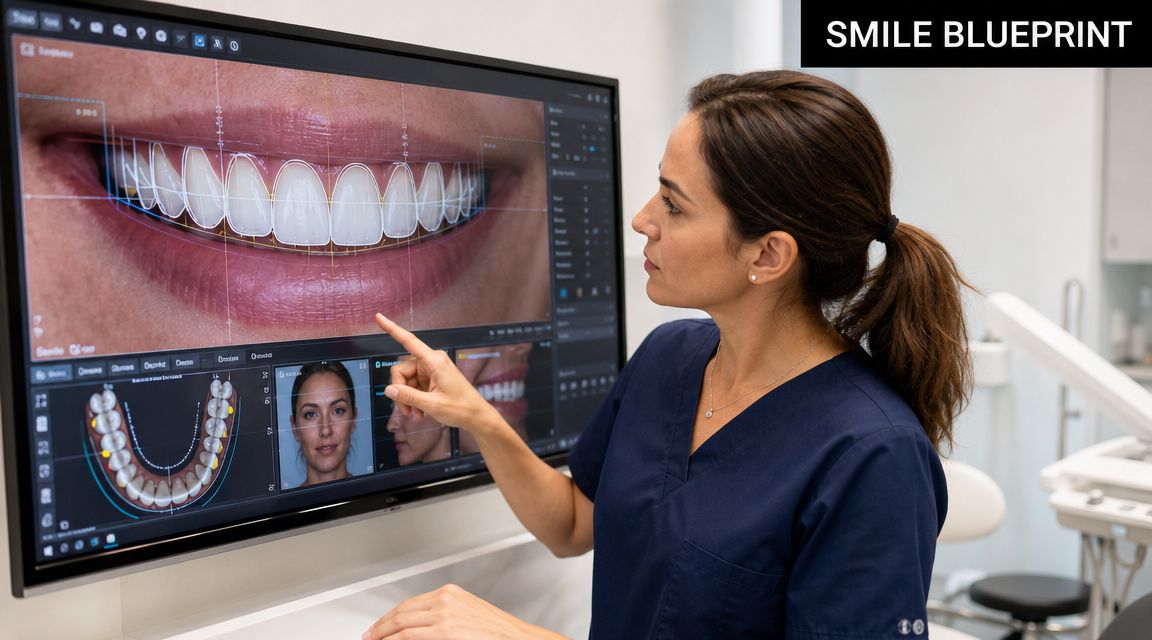
If traditional cosmetic dentistry is like renovating without a full plan, digital smile design is more like working from an architect's blueprint.
A good architect doesn't just draw a pretty front door. They look at the whole house, how each part fits, and how people will use the space. Digital smile design works the same way. It doesn't look at teeth in isolation. It considers your facial features, lip line, smile shape, proportions, and expression so the final result feels harmonious rather than artificial.
More than a pretty picture
Digital smile design was invented by Brazilian dentist Christian Coachman in 2007, and the clinical literature describes it as a software-enabled workflow that analyses smile aesthetics using photographs and digital scans. Modern versions can also include 4D jaw-motion capture, which means planning can account for smiles in motion, not just a still image, as described in this clinical review of digital smile design.
That last part is where many patients get confused. They assume digital smile design is just a computer mock-up. It isn't.
It's a planning method. The photos and scans are inputs. The software helps organise and analyse them. The goal is to create a treatment plan that can be tested and then translated into real dentistry.
What your dentist is actually assessing
When a dentist uses digital smile design well, they're not asking, “How can we make the teeth whiter or straighter?” They're also assessing things like:
- Smile balance so the teeth suit the face rather than dominate it
- Tooth display or how much tooth shows when you speak and smile
- Symmetry because small differences can look surprisingly noticeable
- Personality and preference since some patients want a bold Hollywood look, while others want a soft, natural change
This kind of visual planning also helps people understand a design concept in everyday terms. That's one reason visual communication matters well beyond dentistry. In other fields, strong Marketing design solutions help people grasp an idea faster because they can see it, not just hear about it.
> The best smile plans don't start with “What can we do to the teeth?” They start with “What will look right on this person?”
Why it feels more personalised
A standard photo edit can make almost anything look good on screen. Digital smile design is meant to be more disciplined than that. It connects aesthetics to clinical planning, so the proposed changes can be built and tested in the mouth.
That's why patients often find it reassuring. It doesn't promise fantasy. It creates a realistic, structured path to a smile that fits your face.
Your Smile Design Journey Step-By-Step
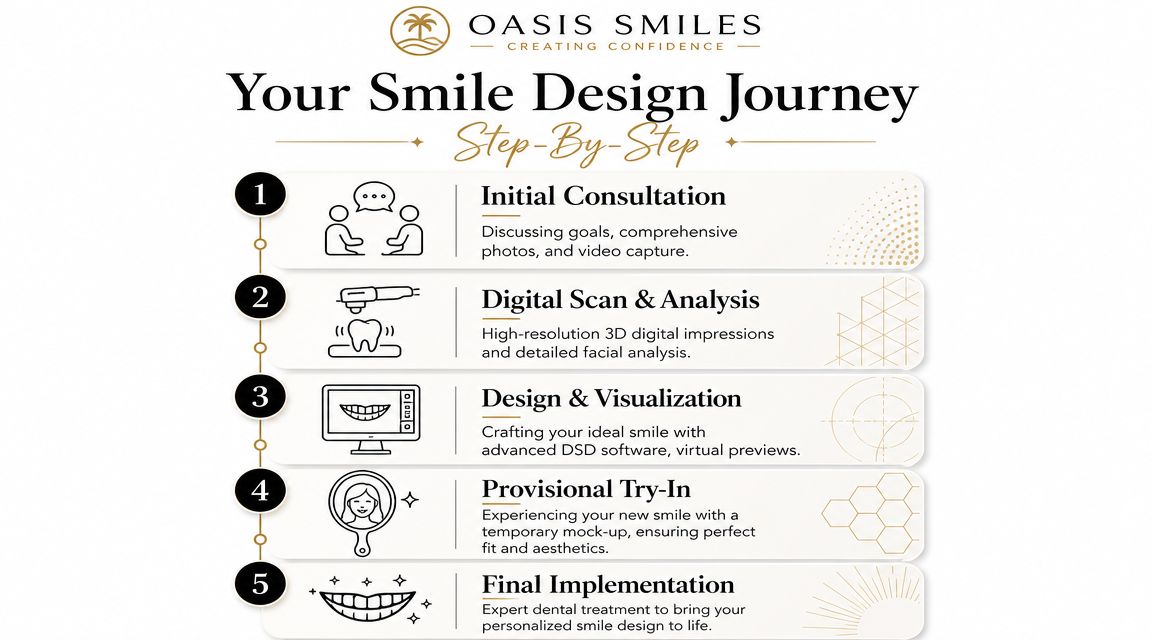
The process sounds high-tech, but from the patient side it's usually straightforward. You talk. We gather records. A design is built. You review it. Then, if it suits you, treatment goes ahead.
That sequence matters because it removes pressure. You're not being rushed from “I'm thinking about it” to “let's prepare the teeth.”
Step 1 starts with your goals
The first appointment is usually a conversation before it's anything else. You explain what bothers you. Maybe it's chipped edges, worn teeth, crowding, old dental work, or a smile that feels uneven in photos.
Your dentist also needs to know what you don't want. Some patients want a brighter, more polished look. Others say, “Please keep it subtle.” Those preferences shape the design from the beginning.
At this stage, records are taken. That often includes facial photos, close-up photos of your teeth, and sometimes video. Video can be especially useful because a smile isn't static. The way your lips move while talking or laughing can change what looks balanced.
Step 2 turns records into a usable plan
This is the technical heart of the process. In peer-reviewed DSD literature, clinicians draw reference lines on facial and intraoral photographs, then calibrate a digital ruler using a known tooth width so they can make reproducible changes to tooth size, position, and symmetry before any irreversible treatment begins, as explained in this published overview of the DSD calibration workflow.
If that sounds complex, the patient takeaway is simple. The design isn't just eyeballed. It's measured and matched to your actual mouth.
Step 3 is where you see the direction
Once the records have been analysed, a proposed smile design is created. At this stage, patients often feel the first real shift from uncertainty to excitement.
You can review shape, length, proportions, and overall character. Sometimes the feedback is immediate. “That looks great.” Sometimes it's more specific. “I love the symmetry, but can we soften the front edges?” That kind of feedback is useful. It helps refine the plan.
> Practical rule: The planning phase is the safest time to be picky. Small design changes are much easier before treatment than after it.
Step 4 gives you a smile test drive
One of the most helpful parts of digital smile design is the mock-up or provisional try-in. Instead of only seeing the design on a screen, you may be able to test a version in the mouth and see how it feels and looks in real life.
At this stage, patients often notice details they wouldn't have picked up in a digital preview. A tooth may feel slightly too square. A smile may need a softer contour. That's normal. The whole point is to learn before committing.
For people considering a broader smile makeover treatment plan, this try-in stage can be one of the most reassuring parts of the journey.
Step 5 is the treatment itself
Only after the design has been reviewed and approved does treatment move forward. What happens next depends on the case. It might involve whitening, Invisalign, composite bonding, veneers, crowns, implants, or a combination.
The important thing is that treatment now follows a plan you've already seen and discussed. That makes the final stages feel far more predictable.
The Technology Behind Your New Smile
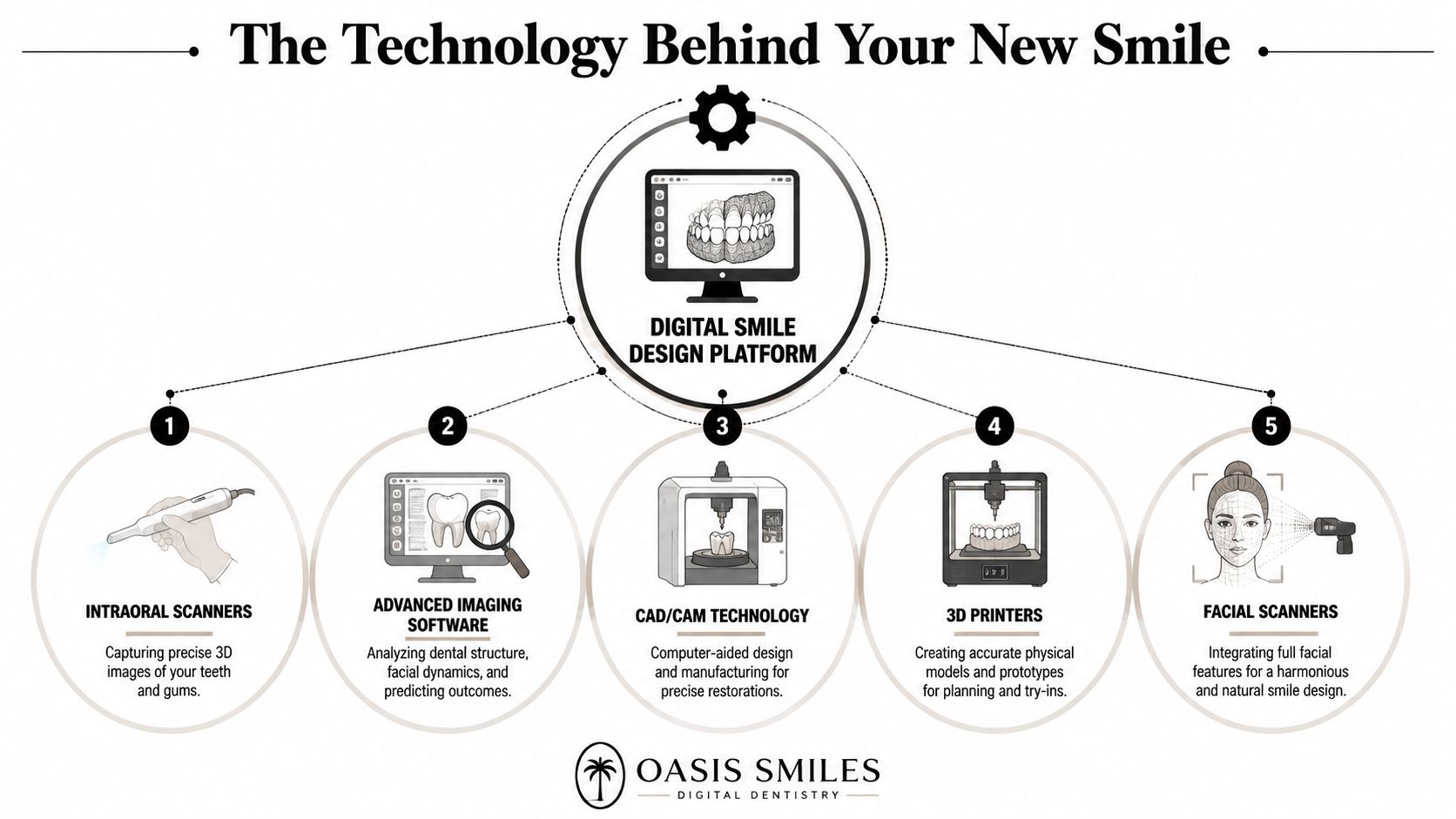
Digital smile design works best when it isn't used on its own. It becomes much more useful when it's connected to the rest of a modern digital dentistry workflow.
That's why patients often hear several tools mentioned together. The design software is one part. The scan, the imaging, the mock-up production, and the restoration process are all part of the same chain.
The tools patients notice most
Some technologies make an obvious difference to comfort and convenience.
- Intraoral scanners replace traditional moulds in many cases. Instead of a tray of impression material, a small scanning wand captures a digital model of your teeth.
- Facial photography and video help the dentist assess how your teeth relate to your whole face.
- 3D printing can turn a digital plan into a physical mock-up or guide that can be tested chairside.
- CAD/CAM systems such as CEREC can help fabricate restorations from a digital design workflow.
Patients usually notice the practical benefit first. Things feel cleaner, faster, and easier to visualise.
The tools patients may not notice, but still benefit from
Other technology sits more in the background but still matters a lot.
CBCT imaging can provide a detailed 3D view of teeth, roots, and supporting structures when a case calls for that level of planning. That's especially helpful in implant and more complex restorative cases, where the dentist has to think beyond the visible tooth surface.
Specialised software then brings those inputs together. Sources describing the standard DSD workflow note that facial photos, intraoral scans, and sometimes video are merged in software to plan tooth form and shade, then used to create a 3D-printed mock-up for chairside testing. This is particularly effective for Australian practices already using CAD/CAM and 3D printing for veneers, crowns, and implants, as outlined in this digital workflow overview for smile planning.
Why the digital stack matters in real life
A lot of patients assume “technology” means gadgets for the sake of gadgets. In a good clinic, that isn't the point.
Each tool has a job:
| Tool | What it helps with | |---|---| | Intraoral scanner | Captures a precise digital impression | | Facial photos and video | Shows how the smile works with the face | | CBCT | Adds deeper structural information when needed | | DSD software | Organises planning and visual design | | 3D printer and CAD/CAM | Converts planning into mock-ups and restorations |
If you're curious about how tools like Trios scanning, CBCT, CEREC, and in-house printing fit into treatment, a dedicated dental technology overview can make the workflow much easier to understand.
Key Benefits Over Traditional Methods
Traditional cosmetic planning often depends heavily on discussion, clinical judgement, lab communication, and a patient trying to imagine the result. That approach can still work well. But it leaves more room for crossed wires.
Digital smile design improves that conversation because the plan becomes visible and testable much earlier.
A quick side-by-side comparison
| Feature | Digital Smile Design (DSD) | Traditional Method | |---|---|---| | Visual preview | Patient reviews a planned smile before treatment | Patient often relies more on verbal explanation and examples | | Planning inputs | Photos, digital scans, and sometimes video are combined | Planning may rely more on impressions, photos, and manual interpretation | | Patient involvement | Strong collaboration during design review | Feedback may come later in the process | | Mock-up use | Digital plan can be turned into a physical try-in | Mock-ups may be more limited or less integrated | | Communication with lab | Digital files can support clearer alignment | More interpretation may occur between clinic and lab | | Predictability | Designed to reduce mismatch between plan and outcome | More dependent on visual imagination and manual transfer |
Precision that helps the final fit
One of the clearest clinical advantages is precision. A source describing modern DSD workflows reports that surface detail can be captured down to 20 microns, and final restorations can align with the approved design within 0.1 to 0.3 mm, which helps support predictable outcomes and better communication throughout treatment in this overview of DSD accuracy and workflow.
Patients don't need to think in microns to appreciate why that matters. Better translation from plan to final restoration can mean fewer surprises, fewer compromises, and a result that feels closer to what was approved.
> Good cosmetic dentistry isn't just about making teeth look nicer. It's about making the final result match the agreed plan as closely as possible.
Better communication changes everything
A big part of the benefit is human, not just technical.
When a patient can see a design, ask for refinements, and test a mock-up, the conversation improves. The dentist understands the patient's preferences more clearly. The lab understands the intended result more clearly. The patient understands what's realistic.
That same principle appears in other industries too. In retail, for example, tools that reduce returns using virtual try-on work because people make better decisions when they can preview the result before committing.
For some patients, digital smile design also pairs naturally with tooth movement planning. If alignment is part of the goal, options such as Invisalign clear aligners may fit into the broader plan.
Candidacy Cost and Timeline in Tamworth
The most practical question isn't “Is digital smile design impressive?” It's “Is it worth it for my situation?”
For regional Australian patients, that's a fair question. People want value, not bells and whistles. If digital smile design only makes a case look more polished on a screen, many patients would rather skip it. If it meaningfully improves planning and predictability, that's different.
Who tends to benefit most
Digital smile design is often most useful when the case has enough complexity that planning really matters.
It may be a strong option for people considering:
- Veneers where shape, size, and smile balance matter
- Crowns on front teeth where matching the surrounding teeth is critical
- Implant restorations where aesthetics and structure need to work together
- Orthodontic and restorative combinations where multiple stages must line up
- Full-mouth rehabilitation where small planning errors can multiply across the case
For a very minor cosmetic tweak, a conventional digital workflow may sometimes be enough. For broader smile changes, DSD often adds more value because it helps connect the overall vision to the final treatment.
What about the timeline
There isn't one fixed timeline because the design phase is only part of the journey. Whitening takes a different path from Invisalign. Veneers are different from crowns. Implant cases are different again.
Still, the sequence is usually easy to follow:
- Consultation and records including photos, scans, and possibly video
- Design phase where the planned smile is created and reviewed
- Mock-up or try-in if appropriate for the case
- Treatment delivery based on the agreed plan
- Review and refinement once the final work is in place
Some patients move through that path quickly. Others take more time because they want to think carefully before approving the design. That's perfectly reasonable.
Is it worth the extra investment
A review focused on this question in the Australian context notes that for regional patients, the value of DSD lies in the measurable benefit and predictability it can add for complex treatments such as veneers, crowns, and full-mouth rehabilitation, particularly by helping prevent mismatches between the plan and the outcome in this discussion of DSD value for regional Australian patients.
That idea is the heart of the cost discussion.
You're not just paying for nicer images. You're paying for clearer planning, better communication, and a lower chance of ending up with a result that doesn't match the intention. In more involved cosmetic or restorative work, that can be a sensible investment.
> If a case is simple, keep it simple. If a case is complex, better planning is often worth it.
It also helps to ask practical questions at your consultation. What parts of the workflow are included. Is a mock-up part of the process. Will your treatment involve veneers, crowns, aligners, or same-day restorations. Clear answers matter more than broad promises.
Common Questions About Digital Smile Design
Is the design process painful
No. The planning stage is usually very comfortable. It commonly involves photos, video, discussion, and digital scans. If treatment later includes veneers, crowns, aligners, or implants, comfort depends on that procedure, not on the design phase itself.
Can digital smile design be used for just one or two teeth
Yes, it can. It isn't only for full smile makeovers. It can be useful when even a single front tooth needs careful planning, especially if symmetry and matching are important.
Is the mock-up removable
Often, yes. Many provisional try-ins are designed so you can preview the appearance without committing to the final treatment. The exact form depends on the case and the materials being used, but the purpose is to let you assess the look before permanent dentistry begins.
Will the final smile look exactly like the preview
The preview is a planning guide, not a magic guarantee. The goal is to create a result that closely follows the approved design. Good planning, accurate records, and mock-up testing all help narrow the gap between the preview and the finished treatment.
Does everyone need digital smile design
No. Some cases are straightforward and don't need this level of planning. It tends to be most valuable when aesthetics are important, the treatment is more complex, or the patient wants a clearer preview before making a decision.
---
If you're thinking about improving your smile and want more certainty before you begin, Oasis Smiles Dental offers advanced digital dentistry in Tamworth, including CEREC, CBCT, Trios scanning, and in-house 3D printing. If you'd like to explore whether digital smile design suits your case, booking a consultation is the best place to start.