

Unlock Tamworth's Best Family Dental Plans
School shoes, sport fees, groceries, fuel, then a dental bill lands on top. That’s the point where most families in Tamworth start asking the same question. Is there a smarter way to pay for dental care than just hoping nothing expensive happens this year?
For some families, the trigger is a child who suddenly needs a filling. For others, it’s a teenager asking about braces or Invisalign. Sometimes it’s Mum or Dad needing a crown after putting off a cracked tooth for too long. The problem isn’t just the treatment. It’s the surprise.
Family dental plans matter because they turn surprise costs into planned costs. That’s the difference between staying on top of check-ups and avoiding the dentist until something hurts.
The Challenge of Managing Family Dental Costs in Tamworth
A lot of local families follow the same pattern. The kids are due for check-ups. One child is fine, the other needs treatment. Then a teenage consult raises the possibility of orthodontics. At the same time, one parent has an old filling failing. Suddenly the year’s dental budget is gone before winter.

That stress hits harder in regional areas because access isn’t as simple as it should be. In rural areas like Tamworth and New England NSW, the Child Dental Benefits Schedule provides substantial financial support over two years for eligible children, but it doesn’t cover advanced needs such as orthodontics or implants. The same source notes that 35% of rural NSW children have untreated dental issues, with dentist shortages of 42 dentists per 100,000 in rural areas compared with 65 in urban centres (research on rural dental access in NSW).
Why regional families feel the pressure first
When appointments are harder to get and travel is part of the equation, people delay care. Delay makes the problem more expensive, not less.
That’s why the best family dental plans aren’t the flashiest ones. They’re the ones that help you do three practical things:
- Book preventive care early: regular exams and cleans catch smaller problems before they turn into bigger bills.
- Spread costs over time: predictable payments are easier to manage than a sudden lump sum.
- Know your limits before treatment: families get caught when they assume a plan covers more than it does.
> Practical rule: If you don’t know exactly what your family can claim before an appointment, you don’t have a plan. You have a guess.
The local reality
Tamworth families don’t need more jargon. They need clarity. You need to know whether your child qualifies for a government benefit, whether your health fund extras are worth the premium, and whether a practice membership will save you money on the care your family uses.
If you’re trying to get organised, start with your family’s treatment history and current needs, then keep your documents in one place so appointments and claims are easier to manage. A good starting point is a simple patient information page for dental visits so you know what to bring and what to ask before costs build up.
Understanding the Basics of a Family Dental Plan
A family dental plan is just a way to make dental spending more predictable. That’s it. Don’t overcomplicate it.
Consider it a budget system for your family’s teeth. You either pay a regular amount to a health fund, qualify for a government dental scheme, or join a clinic membership that gives you included services and reduced fees. Different structure, same goal. Lower the shock when someone in the family needs treatment.
What a family dental plan really does
Most families don’t need “maximum coverage”. They need help with the care they’re most likely to use.
That usually falls into two buckets:
- Routine care like check-ups, cleans, x-rays and preventive treatment.
- Unexpected care like fillings, crowns, emergency visits or orthodontic work.
A dental plan works when it supports both. If it only helps with routine visits but leaves you badly exposed on larger treatment, it’s only half useful.
Dental plans are not the same as general medical cover
People get tripped up when they assume dental plans are the same as general medical cover. A dental plan is usually tied to dental services, not broader hospital or GP care.
Private extras cover sits inside health insurance, but it has its own rules. Government schemes have strict eligibility rules. In-practice memberships are separate again and apply only at the participating clinic.
That’s why you shouldn’t ask, “Do we have cover?” Ask this instead:
- Which family members are included?
- Which dental services are included?
- Are there waiting periods?
- Are there annual, item, or lifetime caps?
- Can we use this plan where we want treatment?
A simple test for whether a plan makes sense
If a plan helps your family stay consistent with preventive care, lowers the sting of common treatment, and gives you a clear path for bigger work, it’s doing its job.
If it’s full of exclusions, long waits, and tiny rebates on the treatments your family needs, it’s not good value, no matter how polished the brochure looks.
For families who want to understand the basics of ongoing care first, it helps to look at what falls under preventive dentistry. That’s where the best value usually starts.
Comparing Your Three Main Options in the New England Region
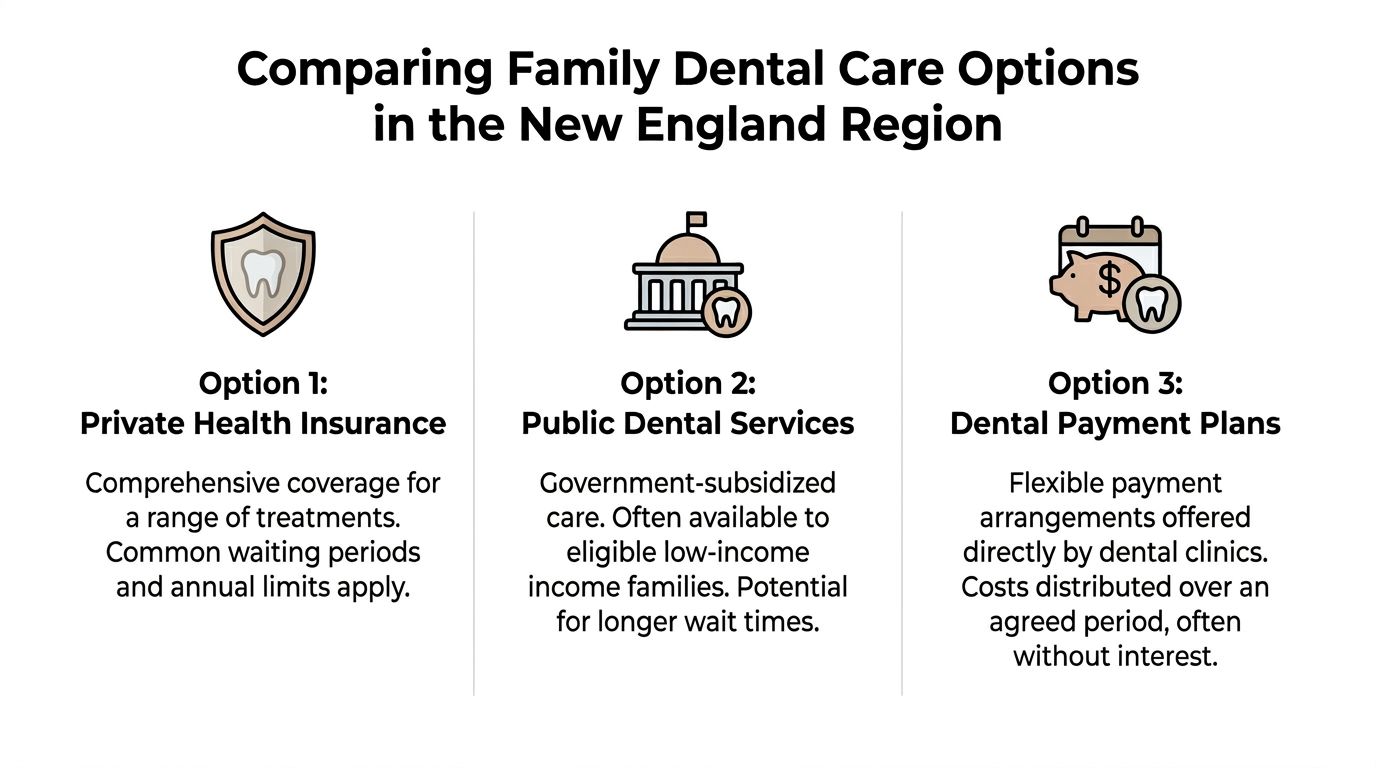
Families in the New England region have three main ways to manage dental costs. Private health insurance extras. Government dental schemes. In-practice memberships or payment arrangements.
They’re not interchangeable. Each one suits a different type of household.
Private health insurance extras
This is often the first option considered. You pay ongoing premiums to a health fund and claim part of the cost back on eligible dental services.
The upside is flexibility. Extras can help with routine care and sometimes contribute to larger treatment categories. The downside is the fine print. You’re dealing with waiting periods, annual limits, item limits, and sometimes weak value if your family only uses basic dental care.
Private extras suit families who:
- Use dental care consistently: if everyone attends regularly, you’re more likely to make use of the cover.
- Want access to a broader treatment mix: this can include preventive, general and some major dental categories.
- Need a buffer for future treatment: especially if you expect fillings, crowns or orthodontic consults.
It suits organised families. It frustrates casual users who pay premiums all year and claim little.
Government schemes
Government support is useful, but it’s narrower than many families expect. These schemes are best seen as targeted help, not complete family dental cover.
For eligible children, government benefits can make a real difference to basic dental care. DVA support can also help eligible veterans and dependants. But these pathways are based on eligibility rules, approved services, and administrative requirements. They don’t function like broad, open-ended family dental plans.
Here’s the practical issue. Government schemes are strongest for essential dental treatment, not for the more expensive things families worry about most.
> If your child is eligible for a government benefit, use it. But don’t assume that means your whole family’s dental planning is sorted.
Government support usually works best for families who:
- Meet the eligibility rules: without eligibility, there’s nothing to claim.
- Need help with routine and basic treatment first: that’s where these schemes are often most useful.
- Can separate essential care from optional or advanced treatment: that distinction matters.
In-practice memberships and payment plans
This option is overlooked, but for many local families it’s the easiest one to understand. You join a clinic plan or arrange direct payment support through the practice.
The big strength is simplicity. There’s less bureaucracy, fewer outside rules, and a clearer idea of what you’re getting. These plans often focus on preventive care and preferred pricing for additional treatment. They can also help when there’s a gap left after private cover or when you have no insurance at all.
The weakness is also obvious. A clinic membership isn’t broad insurance. It usually applies to one practice or network, and coverage depends on that clinic’s structure.
Side by side comparison
| Option | How you pay | Best for | Main drawback | |---|---|---|---| | Private extras | Ongoing premium to a health fund | Families wanting wider treatment access | Waiting periods and limits | | Government schemes | Eligibility-based support | Eligible children or qualifying patients | Narrow scope and rule-based access | | Practice membership or payment support | Direct arrangement with a clinic | Families wanting simple, predictable local use | Usually tied to one practice |
My recommendation for New England families
I wouldn’t tell every family to buy extras cover. That’s lazy advice.
I’d break it down this way:
- Choose private extras if your household uses dental care every year and you want access to a wider range of services.
- Use government support first if your child qualifies. Don’t leave available benefits untouched.
- Consider a practice membership or direct payment option if you want straightforward value without the complexity of a health fund.
Families also need to think locally, not just financially. Convenience matters. If a plan looks good on paper but becomes hard to use in real life, it loses value fast. That’s why it helps to look at a clinic’s approach, technology, and day-to-day support before deciding. A local family dental practice profile gives you a practical sense of what that experience can look like.
Decoding Your Coverage What Is and Is Not Included
The biggest mistake families make is assuming “dental cover” means all dental treatment. It doesn’t.
Every plan has categories. If you don’t know those categories, you’ll get caught by gaps, sub-limits, and waiting periods. That’s where frustration starts.
Preventive and basic care
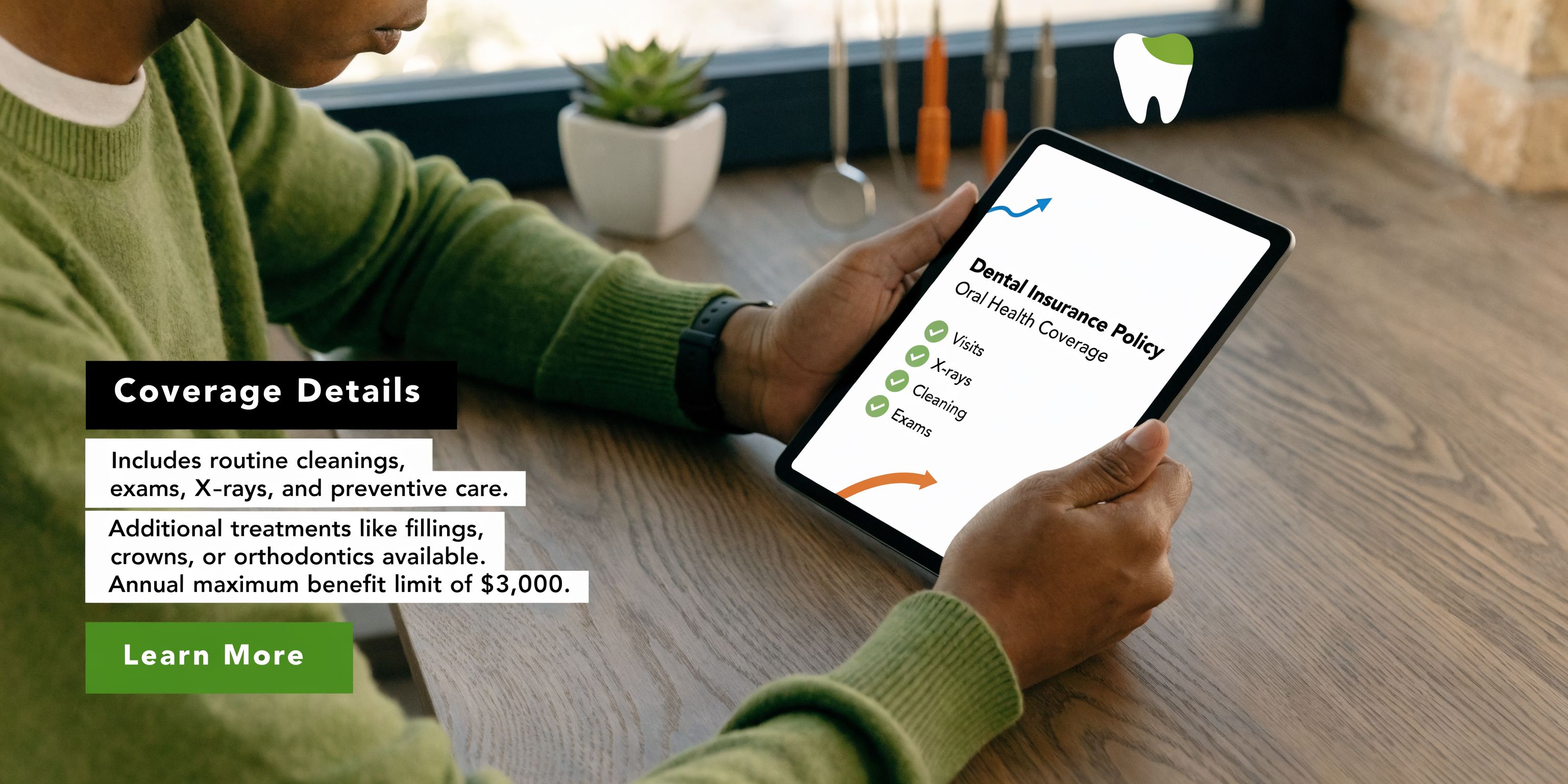
Here, many family dental plans deliver their best value. Preventive care usually includes check-ups, cleans, x-rays, and similar routine services. Basic restorative care may include fillings and simple general treatment.
These are the services families use most often. If your plan makes routine care affordable and easy to claim, that’s useful. If it makes routine care awkward, your family may skip visits, and that defeats the whole point.
A practical first step is to check what a standard dental check-up usually involves and compare that with your plan’s included items.
Major restorative work
Many plans become less generous regarding major restorative work. Crowns, bridges, implants, and other major treatment often sit in a higher-cost category with tighter limits.
That doesn’t mean private cover is useless. It means you need to stop looking at the premium and start looking at the rebate structure.
If one family member is likely to need a crown, don’t ask whether crowns are “covered”. Ask:
- Is there a separate major dental limit?
- Is there a lower sub-limit on crowns?
- Is there a waiting period before claiming?
- Will there still be a sizeable gap after the claim?
Those questions matter more than the marketing.
Orthodontics is where the fine print bites
Orthodontics is the category families misunderstand most. They hear “ortho included” and assume that means most of the cost will be handled. Usually, it won’t.
For orthodontic treatments such as braces or Invisalign, Australian health funds typically reimburse 50% of the cost up to a lifetime maximum of $750 to $3,000 per child, and new members often face waiting periods of 6 to 12 months. In regional areas like Tamworth, full Invisalign courses average $4,000 to $6,000, so families can still face major out-of-pocket costs even with cover (orthodontic insurance overview from Invisalign).
> Don’t buy a family plan for orthodontics unless you’ve checked the child limit, the lifetime cap, and the waiting period. “Included” can still mean a big bill.
Cosmetic treatment usually sits outside useful cover
Teeth whitening and some appearance-focused treatment may not be claimable in the same way as general dental care. Families should assume cosmetic work is less likely to be supported unless the policy says otherwise in plain language.
That’s why the smartest way to compare family dental plans is by matching them to likely treatment needs. A family with young kids and no history of major work should value preventive support. A family with teens may need to examine orthodontic rules very closely. A household with adults carrying old dental work should study major treatment limits before signing anything.
Calculating the True Cost of a Family Dental Plan
The premium is only one part of the cost. The true cost is what your family pays over a year after claims, exclusions, waiting periods, and gap payments are factored in.
That’s the number people should judge. Not the monthly sales pitch.
A simple family example
Take a fictional Tamworth household. Two adults, two children. They do the right thing and book routine visits. One child needs a filling. Later in the year, one parent is told a damaged tooth needs a crown.
On paper, they have a dental plan. In reality, they may still pay in three separate ways:
- Regular plan cost: their premiums, membership fee, or scheduled payments.
- Immediate gap costs: the amount not covered at the appointment.
- Delayed costs: treatment they postpone because a waiting period or annual cap gets in the way.
That third cost is the one families forget. Delayed treatment often becomes more complicated treatment.
What “the gap” means
The gap is your out-of-pocket cost after any benefit is applied. That could be small on a check-up and much larger on major work.
A lot of families are fine with paying something. What they hate is paying a lot more than they expected because they misunderstood the cover.
Here’s where plans usually catch people:
- Annual limits cap what you can claim in a year.
- Sub-limits carve out lower caps for specific services.
- Lifetime limits are common in orthodontics and don’t reset.
- Waiting periods block access even when you’ve started paying already.
How to assess cost without guesswork
Use this quick test before you commit to any family dental plan.
- List likely care for the next year: routine visits, fillings, consults, or any known pending work.
- Check who needs what: children, teens, and adults don’t use plans the same way.
- Ask for the item-level rebate, not the brochure summary: broad labels hide weak benefits.
- Estimate the gap on the treatment you’re most worried about: not just the services you hope to use.
- Decide whether convenience matters: some families value simplicity over chasing every possible rebate.
> The cheapest plan on paper can be the most expensive one in practice if it pushes treatment into next year or leaves you with a large gap on common work.
My blunt view on value
If your family mostly needs check-ups and cleans, a heavy premium can be poor value. If your family has a history of fillings, crowns, or orthodontic needs, having no plan at all can be more painful.
Good value sits in the middle. You want a structure that makes regular care easy, offers some help on larger treatment, and doesn’t lock you into confusing rules that defeat the savings.
The best family dental plans aren’t the ones with the most impressive wording. They’re the ones that fit your household’s pattern of care.
How Oasis Smiles Dental Helps You Maximise Your Plan
A good dental plan only works if the clinic can help you use it properly. That’s where many families lose money. Not because the treatment was wrong, but because the process was messy, the claim wasn’t checked early, or the patient didn’t understand the likely gap before starting.

Administrative support matters more than people think
Families need practical help, not a shrug at the front desk.
A well-run local clinic should be able to support patients with:
- On-the-spot private health claims: so you know the gap as early as possible.
- CDBS processing for eligible children: this makes government support easier to use.
- DVA support for eligible patients: clear handling matters here.
- Treatment planning before major work begins: families need the likely costs explained upfront.
- Flexible ways to manage remaining balances: especially for larger treatment.
That support can be the difference between a plan that feels useful and one that feels pointless.
Technology can also affect value
This is ignored. Better diagnostics and better records can make treatment planning clearer and claims smoother.
For example, the verified data provided for this topic notes that CBCT 3D imaging can support medical-necessity documentation under specific orthodontic claiming contexts, and that using integrated claiming systems helps practices verify fund-specific arrangements quickly. The practical takeaway isn’t that every scan creates a benefit. It’s that documentation and claim handling matter.
If a clinic can verify benefits promptly, explain treatment options clearly, and map out likely out-of-pocket costs before you commit, your plan becomes easier to use well.
What families should expect from a clinic
You shouldn’t have to chase basic answers. Ask these questions before treatment starts:
- Can you check my health fund claim on the spot?
- Can you confirm whether my child can use CDBS?
- What part is likely covered and what part isn’t?
- If there’s a gap, what are the payment options?
- If we stage treatment, how does that affect claiming?
> A dental clinic doesn’t replace your insurer or Medicare. But a capable clinic makes both much easier to deal with.
That’s why families should choose a provider with strong systems, not just a convenient address. The administrative side of dentistry affects affordability more than people realise.
A Checklist for Choosing the Right Plan for Your Family
Choosing between family dental plans gets easier when you stop asking which plan is “best” and start asking which one fits your household.
Ask these questions first
- How old are your children? A family with younger kids has different priorities from a family with teenagers who may soon need orthodontic advice.
- Do any family members already have treatment pending? If someone already needs a filling, crown consult, or alignment assessment, waiting periods matter a lot.
- Do you mainly want preventive care support, or protection against bigger bills? Those are not the same thing.
- Will you use the plan consistently? If your family misses routine appointments, a premium-heavy setup may not pay off.
- Do you qualify for government support? If yes, use it before paying for overlapping cover.
- Can you handle likely gap payments? A plan that reduces cost is still not the same as a no-cost plan.
- Do you want broad choice or simple local convenience? Some families prefer flexibility. Others prefer straightforward use at one trusted clinic.
A sensible decision path
If your children are eligible for government help, start there. If your family uses dental care regularly and may need more than check-ups, compare private extras closely. If you want a simpler system with fewer moving parts, look at a clinic membership or direct payment option.
The wrong plan is obvious in hindsight. It’s the one that looked affordable until someone needed treatment.
Frequently Asked Questions About Family Dental Plans
Can we use government dental support and private cover at the same time
Sometimes, but it depends on the scheme, the patient, and the treatment type. The safe approach is to ask the clinic to confirm what can be claimed under each pathway before the appointment.
What happens if we use up our benefits early
You keep paying privately for any further treatment unless you have another arrangement in place. That’s why annual caps and lifetime limits matter so much.
Are family dental plans worth it if we only want check-ups
Sometimes yes, sometimes no. If the plan is simple and strongly supports preventive care, it can be worthwhile. If you’re paying a high premium for benefits you rarely use, it may not be.
Does orthodontic cover mean braces or Invisalign will be mostly paid for
No. Orthodontic cover can still leave a meaningful gap. Families need to check the waiting period, the child lifetime cap, and the likely out-of-pocket cost before relying on it.
Do practice memberships replace health insurance
Usually not. They’re a different model. They can be excellent for routine care and reduced fees within one clinic, but they’re not the same as broad private extras cover.
What should we bring when asking a clinic to help us compare options
Bring your health fund details, any government eligibility information, and a list of the treatment your family has had or expects to need. That makes the advice far more useful.
---
If you want clear advice on family dental plans, likely gap costs, and the most practical way to combine private cover, government benefits, and payment options, book a visit with Oasis Smiles Dental. A local team that understands Tamworth families can help you sort out what’s worth paying for and what isn’t.