

Root Canal or Extraction: A Clear Guide for Tamworth Families
When you're told you have a deeply infected or damaged tooth, the choice between a root canal and an extraction can feel overwhelming. It's a tough spot to be in. The core of the decision is simple: a root canal saves your natural tooth, while an extraction removes it for good.
As a dentist, I almost always lean towards saving a tooth if we can. A root canal is designed to do just that.
The Critical Choice Between Saving and Removing Your Tooth

When a tooth is in trouble, you’re basically at a crossroads. The main question we have to answer together is, "Is this tooth structurally sound enough to be saved?" This guide is here to help our patients in Tamworth and across the New England region understand the two paths forward.
Here at Oasis Smiles Dental, our first priority is always to preserve what nature gave you. Keeping your own tooth is about more than just filling a gap; it maintains the natural alignment of your smile, prevents other teeth from drifting out of place, and supports the health of your jawbone.
Pulling a tooth might seem like the easier or cheaper option at first glance, but it can often set the stage for more complex and expensive problems down the road.
Root Canal vs Extraction Quick Answer
Getting your head around the immediate goal and the long-term effects of each treatment is key. A root canal is all about healing the tooth from the inside out, whereas an extraction is a final, irreversible step.
Here’s a quick way to frame the decision:
| Factor | Root Canal (Recommended) | Extraction (Situational) | | :--- | :--- | :--- | | Goal | Saves the natural tooth. | Removes the problem tooth completely. | | Long-Term Health | Preserves jawbone and tooth alignment. | Can cause bone loss and shifting teeth. | | Total Cost | Higher upfront cost, but often cheaper long-term. | Lower upfront cost, but can be costlier long-term. |
> The best choice really comes down to the condition of your tooth, your long-term health goals, and your budget. We can only make a solid recommendation after a thorough dental exam to see if there's enough healthy tooth structure left to work with.
In the following sections, we’ll walk through exactly what to expect with each procedure, from the treatment itself to recovery times and the real costs involved. We want you to feel confident and fully informed when making this important decision at our Tamworth clinic.
Understanding Root Canal Therapy: The Tooth-Saving Procedure

When people hear the words "root canal," they often tense up, thinking of old dental horror stories. The truth is, modern root canal therapy is a refined, comfortable procedure with a single, crucial mission: to relieve the very pain that brought you to us and save your natural tooth.
The problem originates deep inside the tooth, within a soft tissue called the pulp. When decay, a crack, or trauma allows bacteria to get in, the pulp becomes infected and inflamed. This is what causes that throbbing, unrelenting pain. A root canal simply lets us get inside the tooth to clean out the infection at its source.
How a Root Canal Works, Step by Step
The idea of working inside a tooth can seem daunting, but it’s a very methodical process designed entirely for your comfort. The first and most important step is getting the tooth and the surrounding gum tissue completely numb. You won't feel any pain during the treatment—that’s our promise.
Once you’re comfortable, here’s what we do:
- Accessing the Infection: We create a tiny opening in the top of your tooth. This gives us a direct path to the infected pulp chamber and root canals.
- Cleaning and Shaping: We carefully remove the inflamed pulp tissue. The inside of the tooth is then thoroughly cleaned, disinfected, and gently shaped to prepare it for sealing.
- Sealing the Canals: The cleaned canals are filled with a biocompatible, rubber-like material called gutta-percha. This seals the tooth from the inside out, preventing any bacteria from re-entering.
- Final Restoration: We finish by placing a temporary filling. Because a tooth is more brittle after a root canal, it needs protection. A permanent dental crown is nearly always recommended to restore its strength and function for the long haul.
Here at Oasis Smiles, we use advanced tools like Cone Beam CT (CBCT) 3D imaging and Trios digital scanners. This technology gives us a crystal-clear, millimetre-perfect map of your tooth’s unique anatomy, which makes the entire procedure incredibly predictable, efficient, and successful.
The Real Goal: Relieving Pain and Saving Your Tooth
It’s the biggest myth in dentistry. A root canal doesn't cause pain; it *relieves* it. The severe toothache you're feeling comes from the infection building pressure inside the tooth. By removing that infected tissue, we eliminate the source of the pain, bringing you immediate and lasting relief.
> The most important benefit, though, is that we get to keep your natural tooth. Preserving it maintains your normal bite, stops neighbouring teeth from shifting out of alignment, and protects the underlying jawbone. It's almost always the best long-term choice for your overall oral health.
Saving a tooth is a popular decision in Australia for a reason. Around 1.2 million people have a root canal each year, which speaks volumes about its reliability. With a success rate between 85% and 97%, the vast majority of patients enjoy a pain-free, functional tooth for many, many years.
You might hear that a root-treated tooth is "dead," but that’s not quite right. While the nerve tissue is gone, the tooth remains anchored by living tissues and ligaments that continue to nourish it. With a well-made crown, it can function just like any other tooth. You can learn more about our approach to root canal treatment at Oasis Smiles.
Ultimately, the choice between a root canal or extraction often boils down to a simple question: can this tooth be saved? If the answer is yes, root canal therapy is almost always the superior path forward.
When Tooth Extraction Becomes The Necessary Choice
Here at Oasis Smiles Dental, our first goal is always to save your natural teeth. But sometimes, a tooth is just too damaged or infected, and trying to save it would be a losing battle. In these cases, removing the tooth isn't a failure—it's the healthiest and most practical step forward for your overall wellbeing.
Deciding between a root canal or extraction can feel like a major crossroads. We only recommend an extraction when a tooth is genuinely non-restorable, meaning no treatment can reliably bring it back to a state where it can function properly for the long haul. It's a conclusion we reach together, after we've exhausted all other viable options.
Scenarios That Point To Extraction
So, when do we have to make that tough call? Several clear clinical situations can push a tooth past the point of no return. We use a combination of a thorough hands-on examination and advanced digital imaging to get a crystal-clear picture before recommending removal.
Common reasons an extraction becomes the best option include:
- A Severe Fracture: If a tooth has cracked vertically or the fracture extends deep below the gumline, it’s almost impossible to get a reliable seal. This creates a highway for bacteria, leading to persistent infection and pain.
- Extensive Decay: There are times when decay is so widespread that there simply isn't enough healthy tooth structure left to hold a filling or a crown. Think of it like trying to build a house on a crumbling foundation—it just won’t last.
- Advanced Gum Disease: Severe periodontitis can destroy the bone and ligaments that anchor a tooth. If the tooth becomes very loose because of this bone loss, removing it is often the only way to clear the infection and protect the neighbouring teeth.
- Orthodontic Needs: To get a beautifully aligned smile with braces or Invisalign, sometimes you just need more room. In cases of significant crowding, a strategic extraction can create the space needed for everything to shift into place perfectly.
- Problematic Wisdom Teeth: We’ve all heard the stories. Impacted wisdom teeth that are stuck, growing sideways, or causing infections are a common reason for removal to prevent pain and damage to the molars in front of them.
It's interesting to see how access to care can influence these outcomes. For example, national dental surveys show a stark difference between regional and urban areas. In inner regional Australia, like here in Tamworth, 12.3% of children end up needing extractions, which is significantly higher than the 6.1% seen in major cities.
What To Expect During An Extraction
Knowing what the process involves can make a world of difference in easing any anxiety. The first thing to know is that we always use effective local anaesthetic to make sure the area is completely numb. Your comfort is our top priority.
> The most important thing to know is that you should not feel any pain during the extraction, only a sense of pressure. We prioritise your comfort at every stage, offering sedation and sleep dentistry for those who are particularly anxious.
Extractions generally fall into two categories:
- Simple Extraction: This is for a tooth that’s fully visible in your mouth. We’ll gently loosen the tooth before lifting it out with specialised dental forceps.
- Surgical Extraction: This is needed when a tooth has broken off at the gumline or hasn't fully emerged, like an impacted wisdom tooth. We make a small, precise incision in the gum to access the tooth and remove it safely.
Before we ever recommend taking a tooth out, our team at Oasis Smiles performs a complete evaluation to be absolutely certain it can't be saved. We want you to feel confident that this decision of last resort is the right one for your health. To get a better sense of our approach, you can learn more about our tooth extraction services in Tamworth.
A Practical Comparison: Root Canal vs Tooth Extraction
When you're told you need either a root canal or an extraction, the decision can feel overwhelming. To help clear things up, let's move past a simple list of pros and cons. Instead, we'll look at how each procedure stacks up on the things that really matter: your immediate comfort, your long-term oral health, and the total time and cost involved.
Think of this as a practical guide. By seeing the real-world trade-offs, you'll be able to have a much clearer conversation with your dentist and feel confident in the path you choose together.
To give you a quick overview, here’s a side-by-side look at the two procedures.
Root Canal vs Tooth Extraction At a Glance
| Aspect | Root Canal Therapy | Tooth Extraction | | :--- | :--- | :--- | | Primary Goal | Preservation: To save your natural tooth from the inside out. | Removal: To completely take out a tooth that is beyond saving. | | Procedure | A detailed internal cleaning of the tooth's root canals. | The physical removal of the entire tooth from its socket. | | Long-Term Impact | Maintains jawbone health and keeps neighbouring teeth in place. | Can lead to bone loss and shifting of adjacent teeth if the gap isn't filled. | | Recovery | Quick, with minor tenderness for a day or two. | Longer, requiring 1-2 weeks for the socket to heal. | | Follow-Up | A dental crown is almost always needed to protect the tooth. | A replacement like a dental implant, bridge, or denture is highly recommended. | | End Result | You keep your own tooth, fully restored and functional. | You have a gap that requires a separate restorative solution. |
While this table gives a great summary, the nuances are what really help in making a decision. Let's dive deeper into what these points mean for you.
Goal: To Save or To Remove?
At its core, the difference is simple. A root canal is a procedure focused on preservation. We're essentially trying to heal the tooth from within to keep it right where it belongs in your smile. It’s an act of restoration.
An extraction, on the other hand, is an act of removal. It’s the final step when a tooth is too damaged or infected to be reliably saved. While this solves the immediate problem, it also creates a new one: a permanent gap in your smile that needs to be addressed.
> A root canal works to maintain your original smile, while an extraction fundamentally changes it. The choice reflects whether the priority is to restore the existing tooth or to remove it and plan for a replacement.
The Long-Term Domino Effect on Your Oral Health
This decision has major ripple effects that go far beyond just one tooth. When we save a tooth with a root canal, we’re also protecting the entire ecosystem around it.
Keeping your natural tooth in its socket is incredibly important. Every time you chew, it stimulates the jawbone underneath, keeping it strong and healthy. It also acts like a perfect bookend on a shelf, preventing the neighbouring teeth from drifting out of line.
Pulling a tooth sets off a completely different chain of events. The moment it’s gone, the jawbone that held it in place starts to shrink away from lack of use. Over time, this bone loss can affect your facial structure. Worse, the adjacent teeth often begin to tilt or shift into the empty space, which can mess up your bite and cause a host of new problems.
What to Expect During the Procedure
While we use effective local anaesthetic for both procedures to ensure you don’t feel any pain, the experience in the chair is quite different.
A root canal is detailed, delicate work. It involves using fine instruments to meticulously clean and seal the tiny, hollow canals deep inside your tooth's root. It requires a lot of precision and can sometimes take a bit longer, but the focus is entirely on internal repair.
An extraction is more direct. We use special tools to gently loosen the tooth from the ligaments holding it in the socket before lifting it out. You’ll feel pressure, but no pain. The physical sensation is one of removal, not repair, as we’re focused on getting the entire tooth out safely.
This flowchart shows the common reasons—like deep cracks or advanced decay—where an extraction becomes the only sensible option.
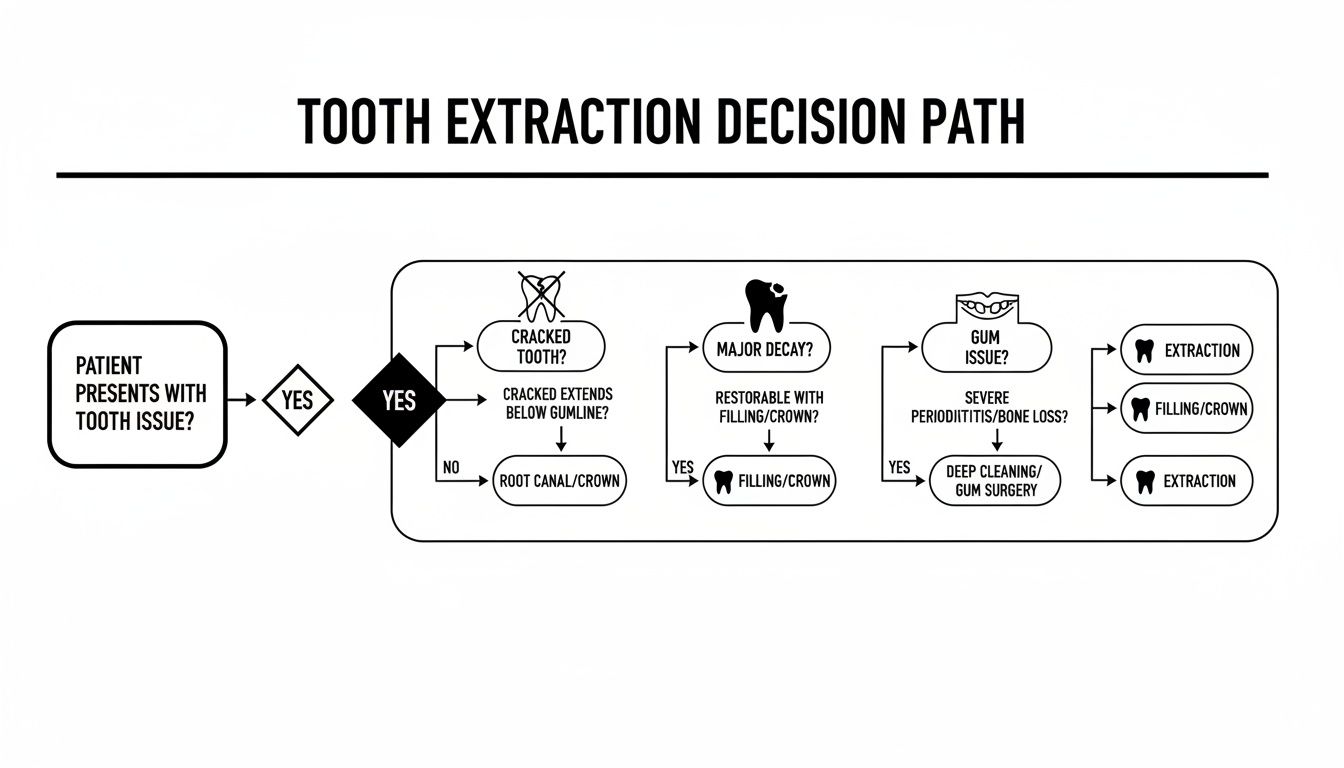
Essentially, we only recommend an extraction when we know the tooth's structure is too compromised to support a reliable, long-lasting restoration.
Recovery and Aftercare: Two Different Journeys
Your recovery path will also look quite different. Healing from a root canal is usually very quick and straightforward.
Most people only have some minor tenderness for a day or so, easily handled with over-the-counter pain medication. You can pretty much get back to your normal life the next day.
An extraction involves a bit more downtime. It leaves an open socket in your gum that needs time to heal properly, which usually takes about one to two weeks. You’ll have to follow specific aftercare instructions—like eating soft foods and keeping the area clean—to prevent complications and ensure everything heals smoothly.
The All-Important Follow-Up Treatment
Neither procedure is really "done" on the day it's performed. Both require a critical next step to ensure a good long-term outcome.
- After a Root Canal: The treated tooth is now hollowed out and more brittle. To protect it from cracking and restore its strength for chewing, a dental crown is nearly always placed over it. This is the final, non-negotiable step in truly saving the tooth.
- After an Extraction: You're left with a gap that really needs to be filled. Replacing the missing tooth is vital to prevent the bone loss and tooth shifting we talked about earlier. This means you'll need to plan for a second procedure, like a dental implant, bridge, or partial denture.
When it comes to replacing a tooth, a dental implant is widely considered the best solution because it mimics a natural tooth root. You can learn more about how dental implants restore smiles in our detailed guide. This just goes to show that an extraction isn't a single event, but the first step in a longer restorative process.
Analysing the True Costs in 2026
When you’re deciding between a root canal or an extraction, understanding the financial side of things is absolutely essential. It’s easy to focus on the upfront cost, but the reality is that the long-term financial picture can tell a very different story. This isn't just about a single dental bill; it's about the lifetime cost of keeping your smile healthy and complete.
For our Tamworth patients, we believe in being completely upfront. An extraction almost always has a lower initial fee, which can make it seem like the most budget-friendly choice at first. However, that initial saving is often just the first step in a much longer, and potentially more expensive, journey.
The Upfront Costs: Root Canal vs Extraction
Let's break down the immediate investment. A root canal is a detailed, specialist procedure, and its cost reflects that. The price will depend on which tooth needs saving—a molar with several canals is naturally more complex to treat than a front tooth with just one. After the root canal is complete, we almost always need to place a dental crown to protect the tooth, which is a separate but vital part of the total cost.
On the other hand, the upfront cost of a simple tooth extraction is typically lower. It's a more straightforward procedure that removes the problem tooth, giving you immediate relief. But this is where the financial comparison starts to get a little tricky.
> The initial price tag doesn't show the hidden costs of leaving a gap in your smile. An extraction isn't just a one-time fee; it’s often the down payment on future, more expensive dental work.
Uncovering the Hidden Long-Term Expenses
That "cheaper" extraction can easily become the more costly path over a person's lifetime. When a tooth is removed and not replaced, the jawbone in that area starts to shrink. This can cause the neighbouring teeth to drift and tilt into the empty space, throwing your bite out of alignment and leading to a cascade of other problems down the track.
To prevent these issues, you have to fill that gap. This means paying for a replacement, and your options typically include:
- A Dental Implant: This is the gold standard for replacing a single tooth, but it's also the most significant investment.
- A Dental Bridge: A more affordable option than an implant, but it involves placing crowns on the healthy teeth on either side of the gap to support the new tooth.
- A Partial Denture: This is the most budget-friendly replacement, but it's removable and often needs adjustments or even replacement over the years.
When you look at the total cost over time, saving the tooth with a root canal often makes the most financial sense. Based on 2026 figures for regional practices, a root canal typically ranges from $1,000–$3,000, depending on the tooth's complexity. This one-time investment saves your natural tooth and helps you avoid the high price of future replacements like implants or bridges.
Making Quality Care Accessible in Tamworth
At Oasis Smiles Dental, we never want finances to stand in the way of you choosing the best treatment for your long-term health. We’re committed to making top-quality care accessible for all our local families.
We proudly accept all major health funds and support patients covered by Medicare and the Department of Veterans' Affairs (DVA). To help you manage any out-of-pocket expenses, we also offer flexible payment plans. This allows you to get the care you need now and spread the cost over time.
You can find all the details about our financial policies and payment options in our comprehensive patient information.
How We Help You Make The Right Decision In Tamworth
Facing a decision between a root canal and an extraction can be overwhelming. Here at Oasis Smiles Dental, we see ourselves as more than just your dentist; we’re your guide through this process, dedicated to giving you the clarity you need to choose confidently.
Our entire approach is built around you. We don’t follow a one-size-fits-all playbook because your situation is unique. It all starts with getting a crystal-clear picture of what’s going on with your tooth.
A Clear Diagnosis with Advanced Imaging
Before we can even begin to talk about options, we need to know exactly what we're dealing with. While standard X-rays are a good start, for a big decision like this, we often turn to our in-house Cone Beam CT (CBCT) scanner.
This isn't your typical X-ray. It gives us a detailed, 3D view of your tooth, its roots, the nearby nerves, and the surrounding jawbone. This level of detail helps us answer the tough questions:
- Is there a hidden crack running down the root, below the gumline?
- Just how far has the infection spread?
- Is there enough healthy bone left to even support the tooth long-term?
A CBCT scan takes the guesswork out of the equation. It might show us that a tooth is a perfect candidate for a root canal, or it might reveal that an extraction is really the only predictable way forward. It ensures our recommendation is based on solid evidence, not a hunch.
> Your comfort is just as important as the clinical outcome. We understand that dental anxiety is real, and we've built our practice around creating a calm and reassuring environment for every patient.
Your Comfort Is Our Priority
We get it—the thought of either a root canal or an extraction can be stressful. That’s why we offer sleep dentistry options right here in our Tamworth clinic, so you can feel completely relaxed during your treatment. Whether you'd prefer a lighter sedation or to be completely asleep, we can manage it all in-house while we take care of your dental work.
We also know that tooth pain doesn’t work on a 9-to-5 schedule. If you’re in pain, our promise is to offer same-day emergency appointments for any calls we receive before 1 PM. Our first priority is always to get you comfortable again.
This focus on a smooth experience continues right through to the final restoration. Using our CEREC same-day crown technology, we can design, craft, and fit your permanent new crown in a single appointment after your root canal. No uncomfortable temporary crowns, no multiple visits—just a streamlined process from start to finish.
Ultimately, we’re here to give you all the information, support, and care you need. We’ll walk you through the scans, explain your options in plain English, and answer every single question until you feel completely confident in your decision.
Common Questions About Root Canals And Extractions
It's completely normal to have a few last-minute questions when you're facing a big decision about your dental health. To give you some peace of mind, let’s walk through the most common things our Tamworth patients ask when weighing up a root canal versus an extraction.
Which Procedure Is More Painful: A Root Canal Or An Extraction?
This is probably the number one question we hear, and the answer often surprises people. Neither procedure should be painful while it's happening. We use very effective local anaesthetic to make sure the area is completely numb before we start any work. The whole point of a root canal, in fact, is to get you *out* of the severe pain an infected tooth causes.
The difference really comes down to the recovery. After a root canal, most people feel only mild discomfort that's easily handled with standard pain relief from the chemist. An extraction is a different story. The site can be quite sore for a week or more as your gum and jawbone begin to heal.
How Long Does A Root Canal Last?
When a root canal is done properly and the tooth is sealed with a good-quality crown, it can absolutely last a lifetime. The success rates are incredibly high—studies consistently show that between 85% and 97% of treated teeth remain healthy and functional for the long haul.
> It’s important to remember that a root-treated tooth will function just like any of your other natural teeth. In sharp contrast, an extraction is permanent—the tooth is gone for good.
Do I Have To Replace An Extracted Tooth?
It can be tempting to just leave the gap, especially if it’s a back tooth that no one can see. However, as dentists, we strongly advise against this. Leaving a space can trigger a domino effect of problems throughout your mouth.
- Tooth Shifting: The neighbouring teeth often start to tilt or drift into the empty space, which can throw your whole bite out of alignment.
- Opposing Tooth Over-Eruption: The tooth directly above or below the gap can start to grow into the space, creating even more bite and jaw issues.
- Jawbone Deterioration: Without a tooth root to provide stimulation, the jawbone in that area will slowly start to shrink away.
Here at Oasis Smiles, we can head off these problems with fantastic replacement options like dental implants, bridges, or dentures.
What Is The Recovery Time For Each Procedure?
The recovery path for each option is quite different. Healing after a root canal is usually very quick. Most of our patients are back to their normal routine the next day, with maybe some minor sensitivity that disappears in a day or two.
On the other hand, recovering from an extraction takes a bit more time and care. You can expect about one to two weeks for the initial healing of the socket. It's crucial that you follow the aftercare instructions we give you to avoid complications like a painful dry socket and ensure everything heals smoothly.
---
Making the right call for your long-term dental health is a decision we make together. At Oasis Smiles Dental, our team is here to give you clear, expert guidance and comfortable, modern care every step of the way. If you have any more questions or you’re ready to book a consultation, please get in touch through our website at https://www.oasissmilesdental.com.au.