

Your Guide to Dental Gap Filler Options in Tamworth
You notice it in a photo first. Not a dramatic problem. Just a small space that seems more obvious than it used to. Maybe it’s between the front teeth. Maybe it’s where a tooth was removed years ago and the rest have started to drift. You might only care about how it looks at first, but tooth gaps rarely stay a purely cosmetic issue for long.
A dental gap filler can mean very different things depending on the tooth, your bite, your age, and your health. For one person, it’s a quick composite bonding appointment. For another, it’s orthodontics to move teeth properly before anything is added. For someone who has lost a back tooth, it may be a bridge, crown, or implant-based plan.
The good news is that there usually is a practical solution. The important part is choosing the right one, not the fastest-looking one.
That Small Gap in Your Smile and What It Means
A small gap can bother you every time you speak, smile, or sit for a family photo. I hear that often from patients across Tamworth. They’ll say, “It’s only a little gap, but it’s all I see now.” That reaction is normal.

Sometimes the concern starts with appearance and ends with function. Food catches in the space. Speech feels slightly different. One tooth starts to take more force than it should. If the gap is from a missing tooth, neighbouring teeth can tip or move. If it’s between front teeth, a key question is whether the gap is stable or part of a bite issue that’s still changing.
Why small gaps matter more than people think
Not every gap needs urgent treatment, but every gap needs proper assessment. A tiny front-tooth diastema is different from spacing caused by gum problems, tooth wear, missing teeth, or crowding elsewhere in the mouth.
For children, spacing can be part of normal development. It can also be an early sign that preventive care or orthodontic guidance is needed. Over 60% of Australian children aged 5 to 12 in regional NSW, including Tamworth, experience at least one gap or space requiring preventive filling or orthodontic intervention, and decay in primary teeth affects 41.6% of children in non-metropolitan areas like New England, according to the AIHW oral health overview.
A dental gap filler isn’t one treatment
When people search for a dental gap filler, they’re usually looking for one simple answer. Dentistry doesn’t really work that way. The right treatment depends on a few practical questions:
- Where is the gap: Front teeth and back teeth need different planning.
- Why did it happen: Genetics, decay, wear, trauma, gum disease, and missing teeth all change the answer.
- What matters most to you: Speed, appearance, longevity, budget, or avoiding drilling.
- What condition are the surrounding teeth in: Healthy teeth can sometimes be preserved with a lighter-touch option.
> Some gaps should be closed by adding material. Others should be closed by moving teeth. Choosing the wrong method can create a smile that looks better briefly but functions worse.
That’s why a careful exam matters more than the label.
An Overview of Dental Gap Filler Options
A dental gap filler can be fixed, removable, cosmetic, restorative, or orthodontic. The names sound technical, but the basic ideas are straightforward once you strip the jargon away.
Fixed restorations
If a tooth is missing or badly broken, fixed restorations often come into the conversation.
A bridge fills a gap by joining an artificial tooth to neighbouring teeth that act as anchors. Think of it as spanning the space. It stays in the mouth and doesn’t come out at night. If you want a closer look at restorative pathways for damaged or missing teeth, the broader restorative dentistry options give a useful overview.
A crown doesn’t close an empty space by itself, but it often plays a role when a tooth beside a gap needs rebuilding or when a bridge is being supported. A crown is a full cover over a damaged tooth, restoring shape and strength.
A dental implant replaces a missing tooth root and then supports a replacement tooth above it. It’s the most like rebuilding from the ground up. For the right patient, it can be an excellent long-term option.
Cosmetic additions
For small spaces, especially between front teeth, cosmetic options can work very well.
Composite bonding is often what people mean when they ask for a tooth gap filler. Tooth-coloured resin is shaped directly onto the tooth and polished to blend in. It can often be done in one visit and usually needs little or no drilling when the case is suitable.
Veneers are thin covers placed over the front surface of teeth. They can close gaps and reshape the smile at the same time. They’re usually chosen when the issue isn’t just spacing but also tooth shape, colour, or symmetry.
Orthodontic solutions
If the gap exists because teeth are in the wrong position, the most conservative answer may be to move them rather than build around them.
Braces and clear aligners such as Invisalign close spaces by guiding teeth into better alignment over time. This matters when there are bite problems, crowding, tooth size imbalances, or drifting after tooth loss. Orthodontics can also create the right amount of space before a bridge or implant is placed.
Removable options
A partial denture replaces one or more missing teeth and can be removed for cleaning. It can be a practical choice for some patients, especially when multiple teeth are missing or when a fixed plan isn’t suitable yet.
The simple way to think about it
- Bonding adds to the tooth
- Veneers cover the front of the tooth
- Orthodontics moves the tooth
- Bridges span the gap
- Implants replace the missing tooth root
- Partial dentures replace missing teeth with a removable appliance
Each one solves a different problem. The best results come when the treatment matches the reason the gap is there.
Comparing Your Dental Gap Filler Choices Side by Side
The most useful way to compare options isn’t by brand names or trends. It’s by the questions patients ask in the chair. How long will this take. How much work is done to my teeth. Will it last. What maintenance comes with it.
Here’s a quick side-by-side view before we break it down.
| Option | Best For | Avg. Time | Est. Cost | Lifespan | |---|---|---|---|---| | Composite bonding | Small front-tooth gaps and minor reshaping | Single visit in suitable cases | Lower relative cost | Often several years, with maintenance | | Veneers | Front teeth needing gap closure plus shape or colour change | Multiple visits | Higher relative cost | Long-lasting with good care | | Orthodontics | Gaps caused by tooth position or bite issues | Months to longer treatment | Moderate to higher relative cost | Stable if retainers and follow-up are maintained | | Bridge | A missing tooth with support from neighbouring teeth | Usually more than one step | Higher relative cost | Long-lasting with proper hygiene | | Implant-based replacement | A single missing tooth where bone and health allow | Multi-stage treatment | Higher relative cost | Long-term option with maintenance | | Partial denture | Multiple missing teeth or interim replacement | Fewer steps to start | Varies | Depends on fit, wear, and ongoing review |
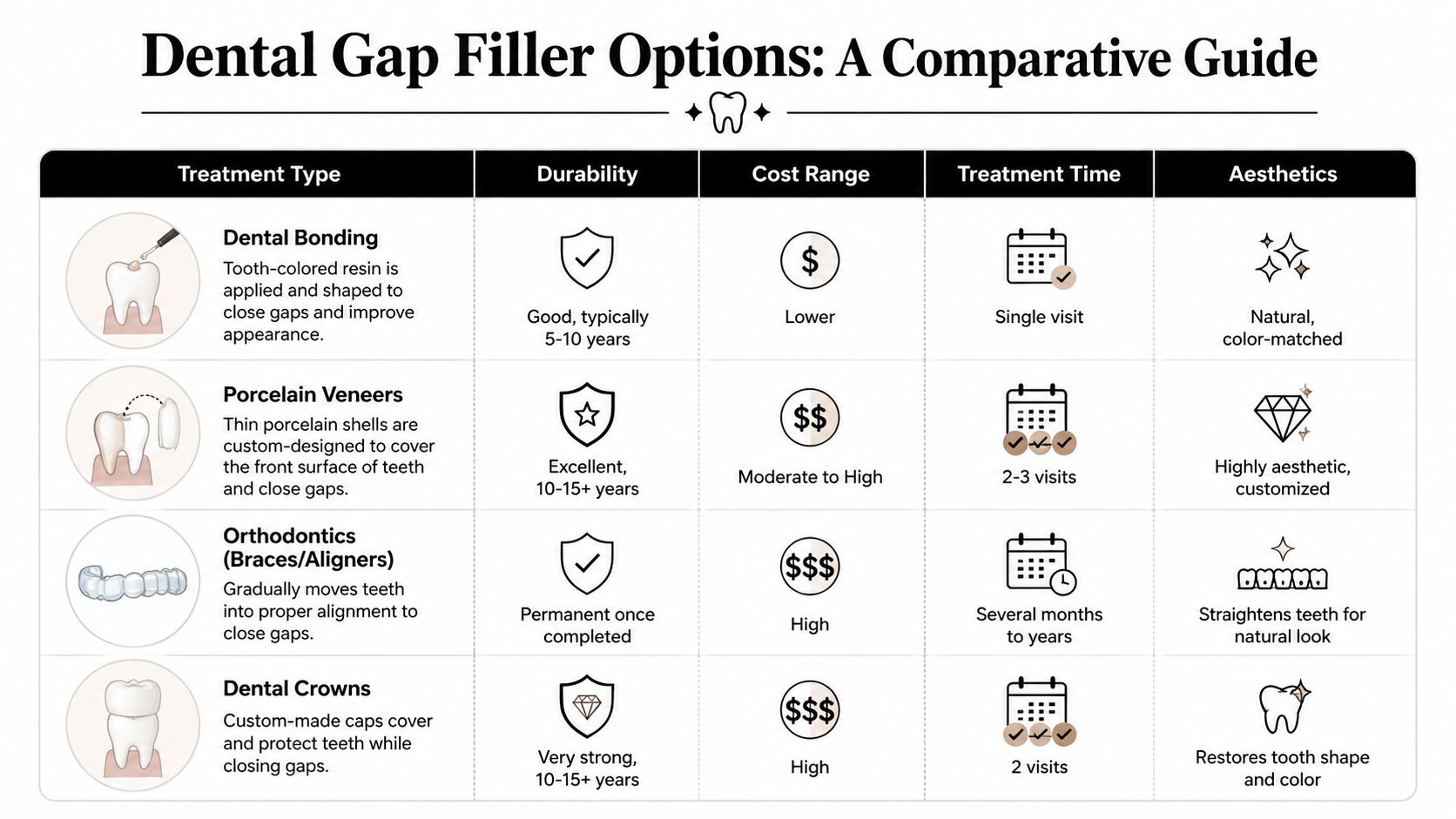
If speed matters most
For a small cosmetic gap, bonding is usually the fastest fixed option. In Australian dental practices, composite resin bonding for small gaps is applied in a single visit and has 95 to 98% colour stability after 2 years, with a 10-year survival rate of 80 to 90% under normal chewing forces, according to this review of teeth filler for gaps.
That single-visit appeal matters in regional areas. If you work shifts, travel in from outside Tamworth, or need to fit treatment around school pickups, fewer visits can make the difference between getting treatment done and putting it off.
Veneers usually take longer because they require planning, preparation, and lab-style stages. Orthodontics takes much longer, but that isn’t a downside if movement is what the case needs. A rushed shortcut on a movement problem often creates a nicer photo and a worse bite.
> Practical rule: If the teeth are in the wrong place, moving them is usually better than making them look wider.
If preserving natural tooth structure matters most
Bonding is attractive because it’s often conservative. In the right case, the dentist can add resin rather than remove healthy tooth structure. That makes it a sensible option for younger adults and patients who want an improvement without committing to a more aggressive cosmetic plan.
Veneers can also look excellent, but they’re a bigger commitment. They’re best when the goal is broader smile redesign, not just plugging a small space.
A bridge solves a different problem. It can be a strong and predictable way to replace a missing tooth, but it may involve preparing neighbouring teeth. If those teeth already need crowns, that can make good sense. If the neighbouring teeth are untouched and healthy, many patients pause at that trade-off.
For patients exploring bite correction along with spacing, non-surgical approaches can be worth understanding. This guide on how to fix overbite without surgery effectively is useful background reading because gap closure and bite correction often overlap.
If the gap is from a missing tooth
At this juncture, people often compare a bridge with an implant.
A bridge spans the space and relies on adjacent teeth. It can be an excellent choice when those teeth already need restoration, when timing matters, or when implant treatment isn’t ideal for health, anatomy, or personal preference. A more specific look at dental bridges for replacing missing teeth helps explain where that option fits.
An implant replaces the missing tooth root and then supports a crown. It doesn’t depend on the teeth next door in the same way. For the right patient, that can be a major advantage.
> A dental implant is the option that most closely replaces a missing tooth from the root upward.
That said, “best” still depends on the person. Healing time, bone volume, smoking, gum health, medical history, and budget all matter.
If you want the most aesthetic front-tooth result
For very small front gaps, bonding can give a polished and natural result quickly. It’s especially useful where tooth shape needs subtle refinement. Shade matching and contouring matter far more than marketing terms here. Good bonding looks invisible because the proportions are right, not because the material is magical.
Veneers can produce a beautiful result when the gap is only one part of a bigger cosmetic issue. If the teeth are worn, discoloured, uneven, or heavily restored, veneers may create a more balanced final result.
Orthodontics often gives the most natural appearance when spacing comes from alignment. That’s because the treatment closes the gap by putting teeth where they belong instead of making each tooth wider.
If maintenance and repairs worry you
Every option needs maintenance. The difference is what kind.
- Bonding: Can chip, stain, or wear, but repairs are often straightforward.
- Veneers: Hold aesthetics well, but replacement is more involved if damage occurs.
- Orthodontics: Needs commitment during treatment and retainer use afterward.
- Bridges: Need excellent cleaning around the supporting teeth and under the pontic area.
- Implants: Need ongoing hygiene and gum monitoring, just like natural teeth do.
- Partial dentures: Need removal, cleaning, and periodic fit review.
Bonding deserves an honest note here. It is not “set and forget”. It’s a good option when the case is selected well and the patient understands that touch-ups can be part of the long-term picture.
What often works best in real life
The right answer is often a combined one. A patient may need orthodontics first, then bonding for fine detail. Someone else may need a bridge now and a more definitive plan later. Another may need gum treatment before any cosmetic closure should even be considered.
That’s why the best dental gap filler isn’t the one with the most dramatic before-and-after photo. It’s the one that fits your teeth, your bite, and the life you live.
Which Dental Gap Filler Suits Your Situation
The same gap can need a completely different solution depending on who’s sitting in the chair. Age matters. Habits matter. Medical history matters. So does whether you’re trying to solve a single cosmetic concern or rebuild a mouth that’s been under strain for years.
The teen with a visible front gap
A teenager with spacing at the front often needs a careful diagnosis before anything cosmetic is added. If the gap is part of active growth or a broader alignment issue, orthodontics usually makes more sense than bonding straight away. In some cases, bonding is still useful later for final reshaping once the teeth are in the right positions.
For families considering clear aligners, the Invisalign treatment pathway can be helpful when appearance, sports, and day-to-day convenience all matter.
The adult with a small cosmetic gap
This is the classic bonding case. The patient is happy with the bite, the space is modest, and the goal is a fast, natural improvement without major drilling.
But regional reality matters. In areas like New England, composite resin bonding has shown 28% re-treatment within 3 years compared with 12% in cities because delayed repairs and local wear factors can affect longevity, according to this review on filling a gap tooth smile. That doesn’t mean bonding is a poor choice. It means maintenance access should be part of the decision from the start.
> If you live further out and getting back for small repairs is difficult, durability and follow-up convenience need to be part of the plan, not an afterthought.
The parent who lost a back tooth years ago
A missing molar often doesn’t feel urgent because it’s out of sight. Then chewing shifts to one side. Food packs into the gap. The opposing tooth can over-erupt. In that situation, the decision is less about cosmetics and more about restoring function.
A bridge may suit someone who wants a fixed replacement without a longer surgical pathway. An implant-based plan may suit someone who wants to replace the missing tooth more independently, assuming bone, health, and healing factors line up. If multiple teeth have shifted into the space, orthodontic movement may need to come first.
The patient with several missing teeth and a long dental history
This is rarely solved by asking, “What’s the cheapest gap filler?” The primary issue is stability. Which teeth are strong enough to keep. Which ones are overloaded. Whether the bite has collapsed. Whether gum support is healthy enough for cosmetic work to last.
In these cases, removable options, staged bridgework, implant planning, or a broader rehabilitation sequence may all be considered. A quick front-tooth fix can look appealing, but if back teeth aren’t functioning properly, the cosmetic work often ends up carrying forces it wasn’t designed to handle.
The budget-conscious patient who wants something simple
There’s nothing wrong with wanting a straightforward option. Bonding can be sensible when the gap is small, the bite is stable, and expectations are realistic. It can improve appearance quickly and preserve future options.
What doesn’t work is treating every gap like a cosmetic surface issue. If the space comes from clenching, drifting, gum disease, or a missing tooth elsewhere, a fast fix may need repeating unless the cause is addressed too.
A good plan fits the stage of life you’re in. It should solve the problem you have now without creating a larger one later.
The Oasis Smiles Dental Advantage in Tamworth
Access changes treatment decisions in regional practice. That’s just reality. Some patients can drop in easily for multiple appointments. Others travel in from outside town, take time off work, organise childcare, and need things done efficiently.

That matters in NSW, where 42.1% of adults avoided visiting a dentist due to cost in the previous 12 months, and dental attendance in non-metropolitan areas was 8.5 percentage points lower than in major cities, according to the National Study of Adult Oral Health summary. Efficient care isn’t just a convenience issue here. It’s part of making treatment more realistic.
Why technology changes the experience
CEREC same-day crowns can reduce a process that once stretched over weeks into a much shorter treatment pathway for suitable crown cases. That’s a major benefit when a gap-filling plan involves restoring a damaged tooth or completing part of a bridge-related treatment.
Trios digital scanners improve planning and comfort. Instead of messy traditional impressions, the clinician can capture a digital model of the teeth and bite. For cosmetic gap closure, that helps with shape planning, shade communication, and showing patients what’s happening more clearly.
CBCT 3D imaging is especially valuable when implant placement is being considered. It allows the dentist to assess bone, position, and nearby anatomy in three dimensions, which supports safer and more precise planning.
In-house 3D printing can also make small adjustments and staging more efficient in suitable cases.
The patient-centred part matters just as much
Technology only helps if the team uses it in a way that suits the person in the chair.
- For anxious patients: Sleep dentistry options can make care more manageable.
- For busy families: Fewer visits and better planning reduce disruption.
- For regional patients: Consolidating steps where possible can remove travel friction.
- For patients watching costs: Flexible payment options can make necessary treatment less daunting.
A strong clinic also explains trade-offs transparently. Not every gap should be bonded. Not every missing tooth should be replaced the same way. The useful question is, “What gives this patient the best mix of function, longevity, comfort, and practicality?”
Why local trust matters
When people look for health providers online, they often want clear information before they book. For practice owners or managers interested in how clinics build that kind of trust online, this piece on how dental practices can attract high-intent dental patients is a solid marketing resource.
For patients, trust usually comes from something simpler. You want a team that explains your choices plainly, has the right tools on site, and has a track record in the area. Learning more about the Oasis Smiles Dental team and practice approach helps put that local context around the treatment options discussed here.
Frequently Asked Questions About Filling Tooth Gaps
Will filling my tooth gap hurt
Usually, discomfort is manageable and often minimal, especially for bonding. Composite bonding for a small gap often needs little or no drilling in suitable cases, so many patients find it easier than they expected.
Orthodontic treatment doesn’t usually hurt during placement, but teeth can feel tender as they move. Crowns, bridges, and implant-related procedures involve more steps, so comfort planning matters more. If you’re anxious, ask about numbing options and sleep dentistry support before treatment starts.
> Most patients cope well when they know exactly what will happen and the treatment matches the problem properly.
Can I use private health insurance or Medicare
Private health fund cover depends on your extras policy and the type of treatment. It’s worth checking item eligibility before you commit, especially for major restorative or orthodontic work.
For children, the Child Dental Benefits Schedule may help with eligible services. The background information provided for this article notes that the scheme expanded in 2013 and reimburses up to $1,000 per child biennially, with regional uptake differences also noted in NSW utilisation data. Medicare generally doesn’t cover routine adult dental care in the way many people assume, though some specific programs and eligibility pathways may apply. DVA support may also be available for eligible patients.
How do I care for a dental gap filler
The answer depends on the treatment, but the basics stay the same. Brush thoroughly, clean between the teeth every day, and don’t ignore rough edges, food trapping, or changes in the bite.
A few practical habits matter:
- Protect bonding and veneers: Avoid using your teeth to open packets or bite hard objects.
- Keep review appointments: Small repairs are easier than major replacements.
- Use retainers as instructed: Orthodontic results can shift without them.
- Clean around bridges carefully: Special flossing tools or brushes may be recommended.
- Watch for clenching: Night grinding can shorten the life of cosmetic and restorative work.
What happens if I leave the gap untreated
Sometimes very little happens for a while. Sometimes quite a lot changes without much notice.
A cosmetic front gap may stay stable, or it may widen if there’s an underlying bite, gum, or tongue habit issue. A missing tooth at the back is more likely to affect chewing, tooth movement, and load distribution over time. Gaps also tend to trap plaque and food more easily, which can make surrounding teeth and gums harder to keep healthy.
The earlier the true cause is identified, the more conservative the treatment often is.
---
If you’d like clear advice on the best dental gap filler for your smile, Oasis Smiles Dental can help. The team serves Tamworth and the New England region with practical, patient-focused care, from cosmetic bonding and veneers to bridges, implants, orthodontics, and same-day CEREC restorations. If you’re unsure whether your gap needs a quick cosmetic fix or a more complete restorative plan, booking a consultation is the simplest place to start.